
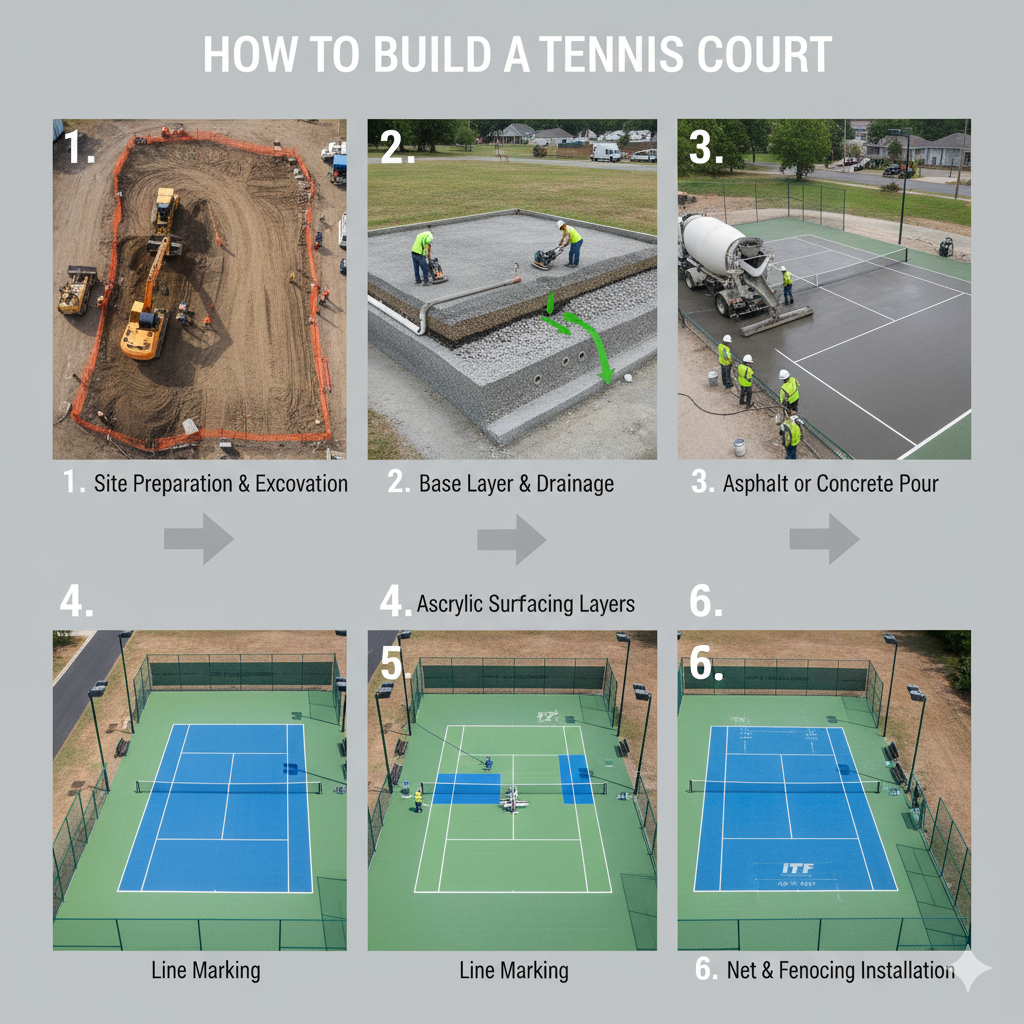
Step 1: Planning & Site Selection
Proper planning is crucial for a successful tennis court:
-
Ground & Soil Assessment:
Check soil stability, drainage, and slope. A slight slope of 1% helps water drainage. -
Accessibility & Surroundings:
Ensure the court is easily accessible and away from trees or structures that could interfere with play.
Step 2: Base Construction
The foundation determines the longevity and performance of the court:
-
Clearing & Excavation:
Remove topsoil, rocks, and vegetation. Excavate to the required depth for the base layers (typically 12–18 inches). -
Sub-Base Layer:
Lay a compacted layer of crushed stone or gravel to provide stability and proper drainage. -
Drainage System:
Install a drainage network around the court to prevent waterlogging. Proper drainage extends the lifespan of the court.
Step 3: Surface Preparation
Choose a surface type based on usage, climate, and budget. Common tennis court surfaces include:
-
Acrylic/Hard Courts: Smooth and durable; low maintenance; ideal for high-speed play.
-
Clay Courts: Soft, natural surface; slower ball bounce; requires regular maintenance.
-
Grass Courts: Traditional; visually appealing; high maintenance
Step 4: Surface Installation
-
Acrylic/Hard Courts: Apply multiple layers of acrylic coating with proper curing time between layers.
-
Clay Courts: Spread crushed brick or shale and compact it evenly.
-
Grass Courts: Lay turf and ensure even leveling
Step 5: Line Marking & Net Installation
-
Line Marking: Use durable, non-slip paint to mark boundaries, service boxes, and center lines.
-
Net Posts & Net: Install regulation-height posts and tension the net correctly (3 feet at center).
-
Fencing: Install fencing around the court to prevent balls from leaving the area (minimum 10–12 feet high).
-
Lighting: For evening play, use LED sports lighting with uniform illumination.
Proper maintenance ensures long-term performance:
-
Regular cleaning and sweeping
-
Repainting faded lines
-
Checking drainage and surface wear
-
Repairing cracks or turf issues promptly
Tips for a High-Quality Tennis Court
-
Hire professional contractors for base construction and surface installation.
-
Choose surfaces based on local climate and usage frequency.
-
Invest in quality materials for base, drainage, and surfacing for durability.
-
Ensure proper slope and drainage to prevent water damage.
Conclusion
Building a tennis court requires careful planning, quality materials, and precise execution.