
Badminton is a sport that demands agility, speed, and precision — and the right court flooring plays a vital role in supporting all three. Whether you’re setting up a badminton court for a professional sports facility, a school, or a residential complex, the type of flooring you choose will directly impact player performance, comfort, and safety. A well-chosen floor not only enhances gameplay but also ensures the longevity of your investment.
In this complete guide, we’ll help you understand the different types of badminton court flooring, their advantages, and how to choose the perfect one based on your space, budget, and usage.
Why Flooring Matters in Badminton
Badminton involves constant movement — quick direction changes, lunges, and jumps. The flooring must be resilient enough to absorb impact while offering excellent grip and smoothness for fast footwork.
Here’s why choosing the right badminton flooring is essential:
-
Shock Absorption: Prevents joint and muscle injuries.
-
Anti-Slip Surface: Reduces the risk of falls.
-
Consistent Bounce: Ensures predictable shuttle movement and stability.
-
Durability: Withstands heavy foot traffic and equipment use.
-
Comfort: Minimizes fatigue during long training sessions or matches.
A poorly designed court can cause injuries and affect performance, making flooring one of the most important elements of badminton court construction.
Types of Badminton Court Flooring
Different materials are used to construct badminton courts depending on whether the court is indoor or outdoor, as well as on the level of play — from casual recreation to professional tournaments.
Let’s explore the most popular types of badminton flooring used today.
1. Wooden Flooring (Maple or Teak)
Best For: Indoor professional courts
Overview:
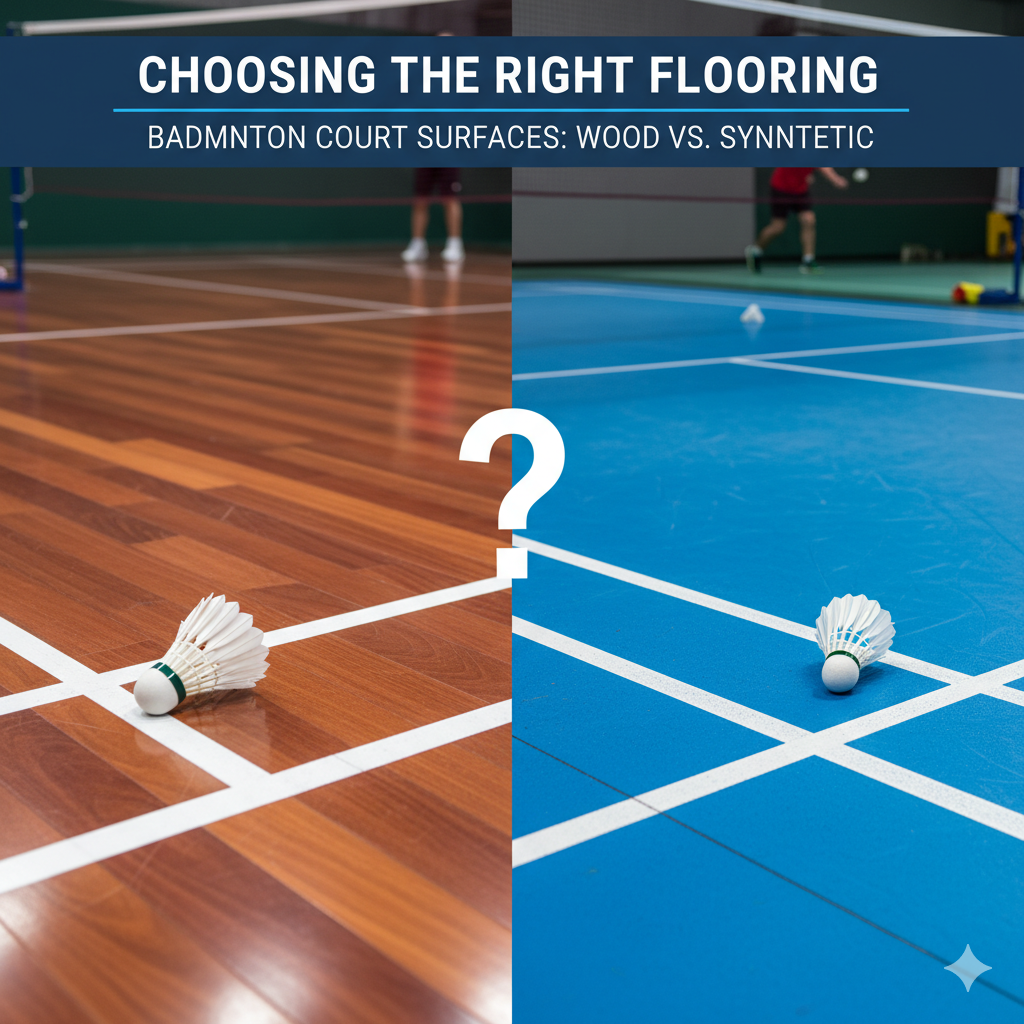
Wooden flooring is the officially recommended surface by the Badminton World Federation (BWF) for professional play. Typically made from high-quality maple or teak wood, these floors are laid over a shock-absorbing subfloor system.
Advantages:
-
Excellent Shock Absorption: Minimizes impact on joints.
-
Superior Grip: Offers ideal traction for fast movements.
-
Durability: Can last for decades with proper maintenance.
-
Professional Look: Enhances the aesthetics of indoor arenas.
-
Refinishing Option: Can be sanded and polished multiple times.
Disadvantages:
-
Higher Cost: Expensive to install and maintain.
-
Sensitive to Moisture: Needs humidity control to avoid warping.
Ideal For:
Indoor badminton courts in professional stadiums, academies, and sports complexes.
2. Synthetic (PVC/Vinyl) Flooring
Best For: Indoor and semi-professional courts
Overview:
Synthetic badminton flooring made of PVC or vinyl has become a popular alternative to wood. It’s a multi-layered flooring system that provides comfort, flexibility, and excellent shock absorption.
Advantages:
-
Affordable: Lower installation and maintenance costs.
-
Anti-Slip Surface: Reduces the risk of injury.
-
Shock Absorbing: Ensures comfort for players.
-
Easy Maintenance: Simple cleaning and long-lasting color.
-
BWF Approved Options: Many synthetic floors meet global badminton standards.
Disadvantages:
-
Less Natural Feel: Slightly different bounce than wood.
-
Not Ideal for Outdoor Use: Can be damaged by sunlight or moisture.
Ideal For:
Indoor facilities, schools, colleges, and multi-sport halls.
3. PU (Polyurethane) Flooring
Best For: Indoor multipurpose courts
Overview:
PU flooring is a seamless, cushioned sports flooring ideal for multi-purpose indoor arenas. It’s applied as a liquid coating that forms an elastic, joint-free surface.
Advantages:
-
Seamless Surface: Prevents dust accumulation and provides uniformity.
-
Excellent Shock Absorption: Protects players during intense play.
-
Durable & Easy to Maintain: Long-lasting surface with minimal upkeep.
-
Multi-Sport Use: Suitable for badminton, basketball, and volleyball.
-
Customizable: Available in various colors and thickness levels.
Disadvantages:
-
Softer Feel: May not provide the same foot response as wooden floors.
Ideal For:
Indoor community sports halls, schools, and multi-sport facilities.
4. Acrylic Flooring
Best For: Outdoor badminton courts
Overview:
Acrylic flooring is a hard, weather-resistant synthetic surface applied on a concrete base. It’s commonly used for outdoor badminton courts in residential complexes and schools.
Advantages:
-
All-Weather Resistant: Performs well under sun and rain.
-
Durable & Long-Lasting: Can withstand outdoor wear and tear.
-
Anti-Slip Coating: Ensures safety in all conditions.
-
Low Maintenance: Easy to clean and repaint when needed.
-
Custom Colors: Available in various shades for visual appeal.
Disadvantages:
-
Hard Surface: Limited cushioning compared to indoor floors.
Ideal For:
Outdoor courts in parks, clubs, and residential areas.
5. Modular Interlocking Tiles (PP Tiles)
Best For: Outdoor and temporary courts
Overview:
Made from polypropylene (PP), these modular interlocking tiles are an innovative flooring solution for outdoor and portable badminton courts.
Advantages:
-
Quick Installation: No adhesives required.
-
Weatherproof: UV and moisture resistant.
-
Shock Absorbing: Offers good comfort and traction.
-
Portable: Easy to dismantle, move, and reinstall.
-
Customizable Design: Available in multiple colors and styles.
Disadvantages:
-
Slightly Different Feel: Doesn’t replicate the natural feel of wood.
Ideal For:
Outdoor or temporary badminton setups, event venues, or community centers.
Comparison Table: Types of Badminton Court Flooring
| Flooring Type | Usage | Shock Absorption | Durability | Maintenance | Cost | Ideal For |
|---|---|---|---|---|---|---|
| Wooden Flooring | Indoor | Excellent | Very High | Medium | High | Professional courts |
| Synthetic PVC/Vinyl | Indoor | High | High | Low | Medium | Schools, academies |
| PU Flooring | Indoor | High | High | Low | Medium | Multipurpose halls |
| Acrylic Flooring | Outdoor | Moderate | High | Low | Low | Outdoor courts |
| Modular PP Tiles | Outdoor | Good | Very High | Very Low | Medium | Residential/playgrounds |
Factors to Consider Before Choosing Badminton Court Flooring
1. Type of Facility
-
Professional or Tournament Level: Go for BWF-approved wooden or high-quality PVC flooring.
-
School or Recreational Level: PU or vinyl flooring provides great balance between performance and cost.
-
Outdoor Setup: Choose acrylic or modular tile systems.
2. Budget
-
Premium Range: Wooden flooring.
-
Mid-Range: PU or synthetic PVC flooring.
-
Economical: Acrylic or modular tiles.
3. Maintenance Requirements
-
Wooden floors need polishing and climate control.
-
Synthetic, PU, and acrylic floors are low-maintenance and long-lasting.
4. Player Safety
Ensure that the flooring provides sufficient grip, cushioning, and impact resistance to reduce fatigue and prevent injuries.
Maintenance Tips for Badminton Court Flooring
-
Keep It Clean: Regularly sweep and mop the surface to remove dust.
-
Avoid Moisture Exposure: Especially for wooden floors.
-
Use Proper Footwear: Only non-marking badminton shoes should be used.
-
Inspect Regularly: Repair cracks, peeling, or loose edges early.
-
Resurface When Needed: Extend the court’s lifespan with timely maintenance.
Conclusion
Choosing the right badminton court flooring is about balancing performance, comfort, safety, and durability.
-
For indoor professional play, maple or teak wooden flooring offers the best performance and official approval.
-
For multipurpose or budget-friendly indoor setups, PVC/vinyl or PU flooring are excellent choices.
-
For outdoor courts, acrylic coating or modular tiles provide durability, weather resistance, and low maintenance.
Each flooring type has unique strengths—select one based on your location, level of play, and long-term goals. With the right surface, your badminton court can provide an exceptional playing experience for years to come.