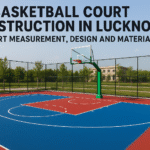


A full basketball court is designed with precise measurements to ensure fair play, player safety, and consistency across all levels of the sport. Whether you are constructing a professional arena, school court, or multisport indoor hall, understanding the official court size in meters is essential. This guide explains the complete layout, dimensions, and component measurements of a full basketball court based on international standards.
Standard Full Basketball Court Size in Meters
Most commercial and professional courts follow regulations set by FIBA (International Basketball Federation), which is widely used across Asia, Europe, Africa, and international competitions.
FIBA Full Court Size
-
Length: 28 meters
-
Width: 15 meters
These measurements are used in:
-
International tournaments
-
Professional leagues outside the USA
-
Schools, colleges, and sports academies
-
Sports complexes and multipurpose indoor arenas
NBA Court Size (for comparison)
-
Length: 28.65 meters (94 feet)
-
Width: 15.24 meters (50 feet)
Although slightly larger, NBA measurements are used mainly in North America.
Key Sections of a Full Basketball Court
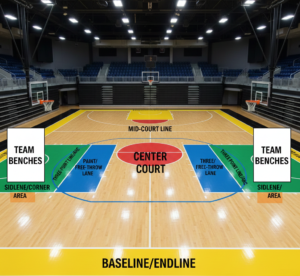
A basketball court contains several marked areas that guide gameplay. Below are their dimensions in meters based on FIBA standards.
1. Playing Court Boundary Lines
-
Sidelines: 28 meters long
-
Baselines/Endlines: 15 meters long
-
Line thickness: 5 cm
These lines define the playing area and must be clearly visible with contrasting color.
2. Center Circle
-
Diameter: 3.6 meters
-
Radius: 1.8 meters
Used for jump balls at the start of the game.
3. Three-Point Line
The three-point arc defines long-range scoring.
-
Distance from basket to arc: 6.75 meters
-
Distance in corner areas: 6.6 meters
This arc forms one of the most strategic zones in modern basketball.
4. Free-Throw Lane / Paint Area
Also known as the key or the lane, this area is essential for free throws, defense, and post play.
-
Width of the paint area: 4.9 meters
-
Free-throw line distance from baseline: 5.8 meters
-
Free-throw circle radius: 1.8 meters
5. No-Charge Semi-Circle
Located under the basket to prevent charge fouls in close-contact play.
-
Radius: 1.25 meters
-
Measured from point directly under the basket center.
6. Backboard and Basket Specifications
-
Basket height: 3.05 meters above the playing surface
-
Backboard dimensions:
-
Width: 1.8 meters
-
Height: 1.05 meters
-
-
Distance from baseline to backboard: 1.2 meters
-
Ring (hoop) diameter: 45 cm
Correct installation ensures consistent scoring conditions and safety.
7. Restricted Area / Free-Throw Lane Markings
-
Blocks and hash marks help position players during free throws
-
All markings must follow precise spacing defined by FIBA guidelines
8. Team Bench and Technical Area
Although outside the main court:
-
Benches are placed along one sideline
-
Scorer’s table occupies the center of the same sideline
-
Space must remain clear for referees and players
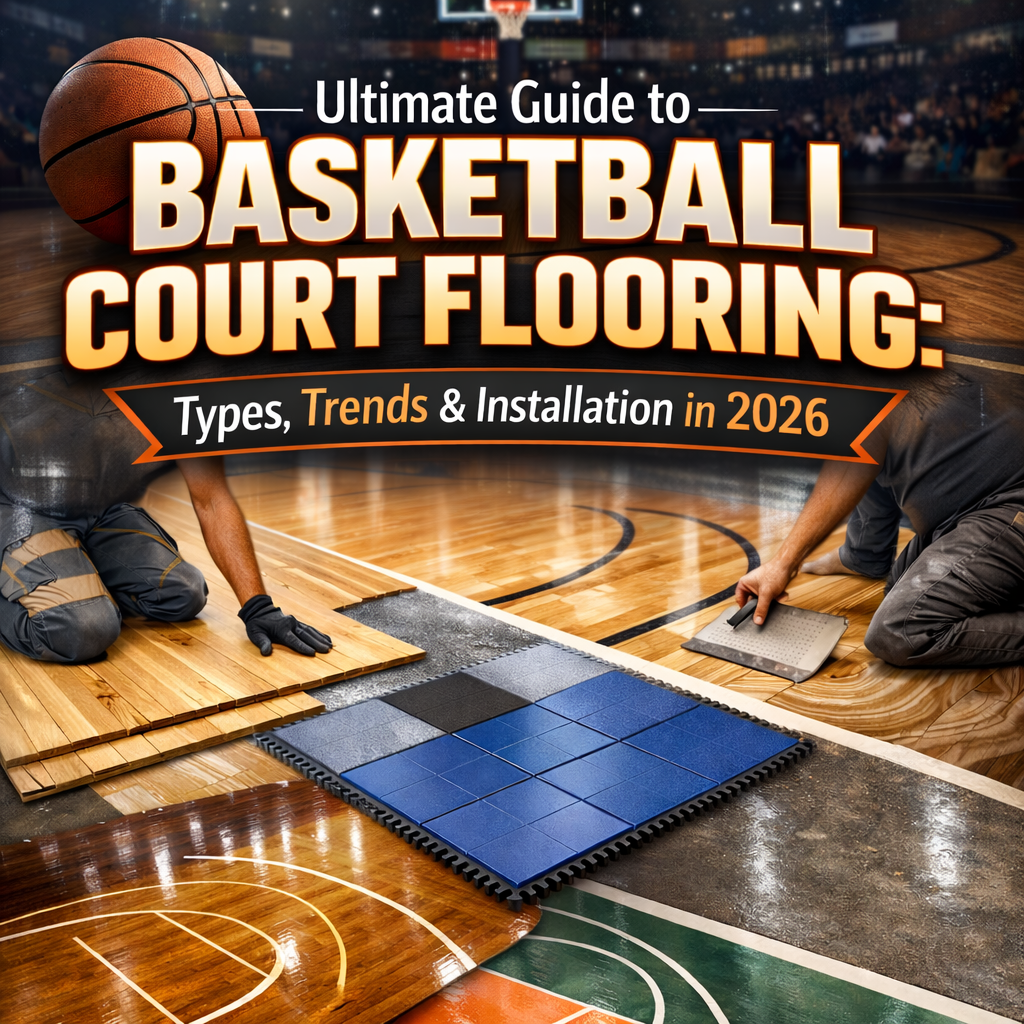
Surface & Flooring Recommendations
A regulation court requires a safe, durable, and performance-oriented playing surface.
Common flooring options:
-
Hardwood (Maple) — preferred for high-level indoor courts
-
Synthetic PU / PVC flooring — durable and cost-effective
-
Acrylic outdoor flooring — weather-resistant for outdoor full courts
-
Epoxy sports flooring — seamless, anti-slip, impact-resistant
Key safety features:
-
Shock absorption
-
Anti-skid finish
-
Seamless leveling
-
High load-bearing strength
Why Standard Dimensions Matter
Adhering to official measurements ensures:
-
Fair and professional gameplay
-
Accurate player spacing and movement
-
Compatibility with official equipment
-
Consistent training experience for athletes
-
Eligibility for hosting certified tournaments
Whether the court is used for training, competitions, or recreational events, maintaining proper size guarantees optimal performance and safety.
Conclusion
A full basketball court built to correct FIBA-approved dimensions—28 meters by 15 meters—provides the ideal space for skill development, competitive play, and long-term durability. Understanding every section of the court, from the three-point arc to the paint area, ensures a proper and professional construction layout.