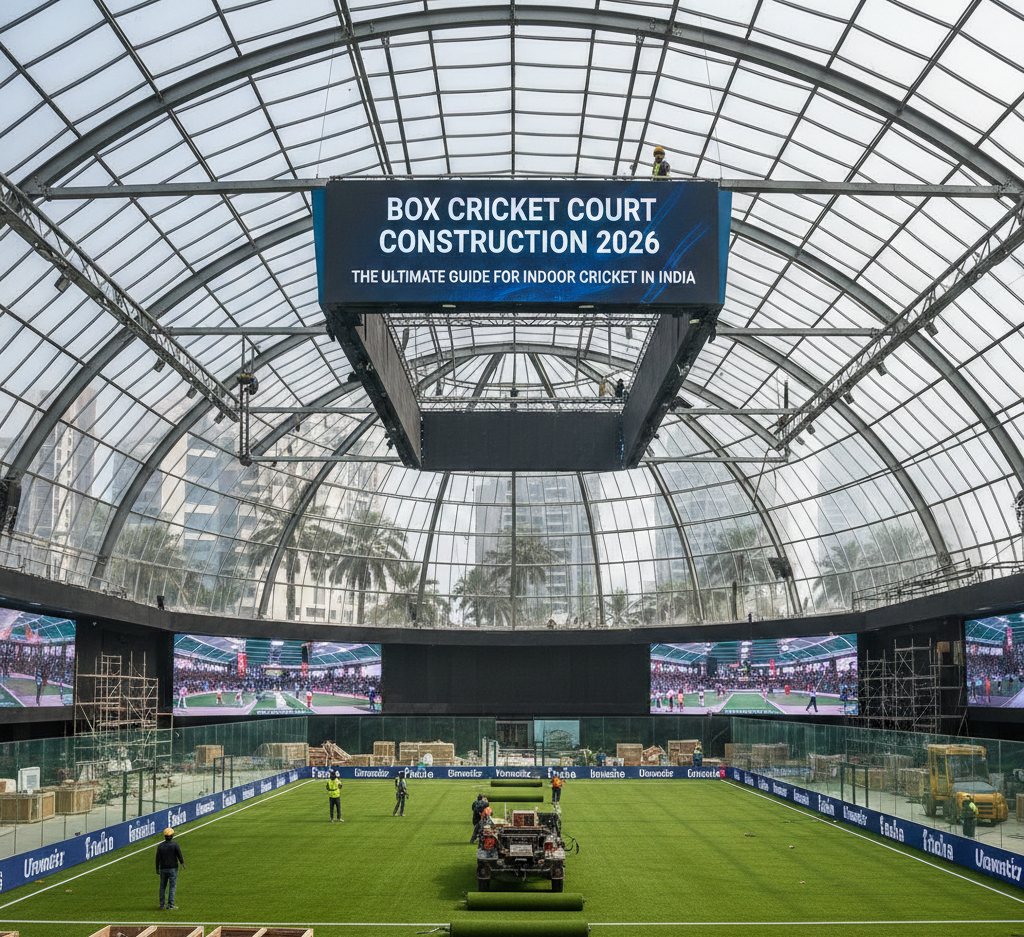

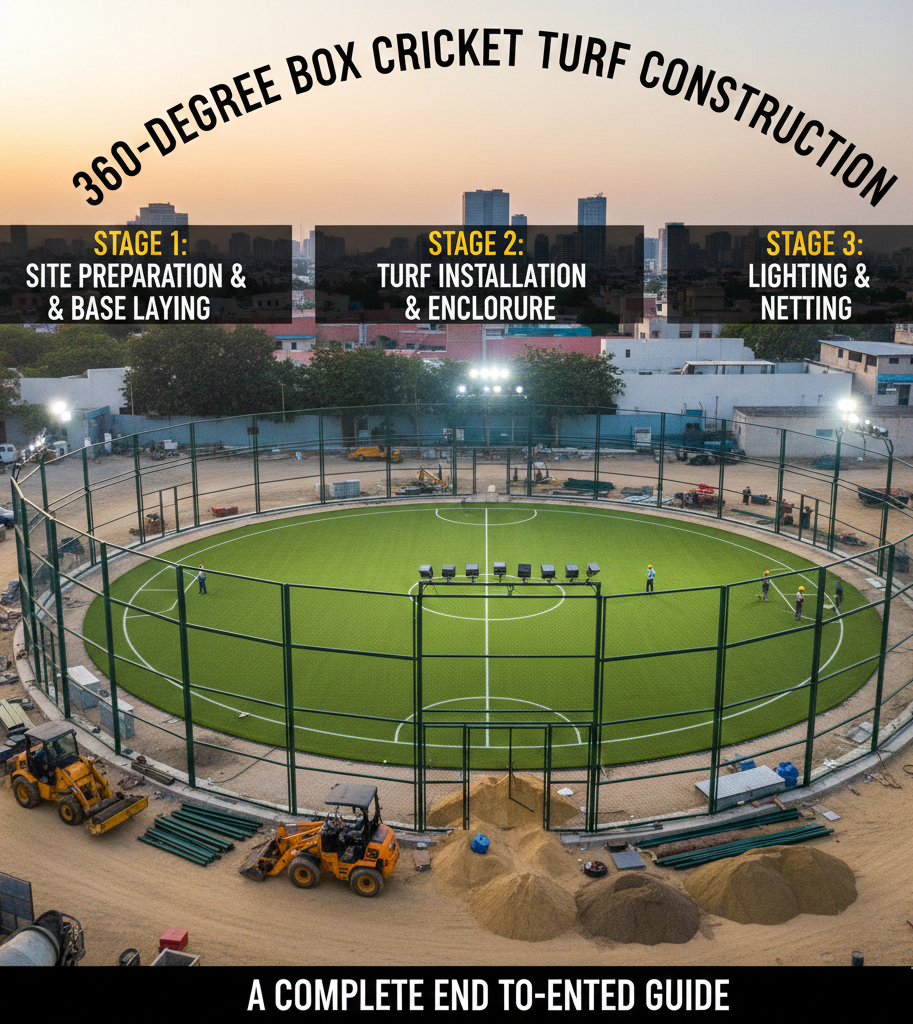
Box cricket has evolved from a casual recreational activity into a full-fledged commercial sports venture. Among its modern formats, 360-degree box cricket stands out for its immersive design, safety-focused enclosure, and all-weather playability. This format surrounds the playing area with nets or rebound walls on all sides—including overhead—creating a continuous, high-energy game environment. In this comprehensive guide, we will explore everything involved in 360-degree box cricket turf construction, from planning and design to materials, installation, costing, and long-term maintenance.
What Is 360-Degree Box Cricket?
360-degree box cricket is a compact version of cricket played within a fully enclosed box. Unlike traditional open box cricket setups, this format features complete enclosure on all four sides and the top, allowing the ball to remain in play at all times. This design increases game pace, reduces stoppages, and improves safety for players and spectators.
The enclosure typically consists of steel frames, high-strength nets, rebound boards, and artificial turf flooring, all engineered to withstand continuous impact and heavy usage.
Planning and Site Assessment
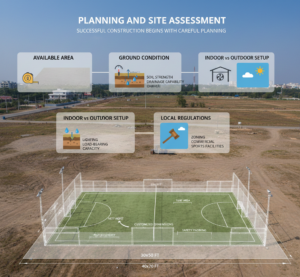
Successful construction begins with careful planning. Before any physical work starts, the site must be evaluated on several parameters:
- Available area: Common sizes range from 30×50 ft to 40×70 ft, but dimensions can be customized.
- Ground condition: Soil strength, drainage capability, and load-bearing capacity are critical.
- Indoor vs outdoor setup: Roofing, ventilation, and lighting requirements vary.
- Local regulations: Permissions related to zoning, noise, and commercial sports facilities should be verified.
A detailed layout drawing is usually prepared at this stage, covering turf area, player entry points, net height, lighting positions, and safety padding.
Foundation and Civil Work
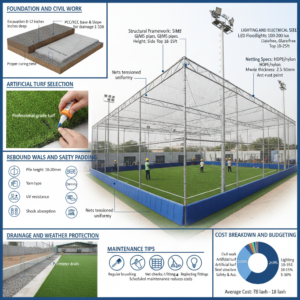
The foundation is the backbone of a durable box cricket turf. Poor civil work often leads to uneven bounce, water accumulation, and premature turf damage.
Key Steps in Foundation Work:
- Excavation: Typically 8–12 inches deep depending on soil quality.
- Hardcore layer: Crushed stone or soling is laid and compacted to provide stability.
- PCC or RCC base: A concrete layer ensures a flat and long-lasting surface.
- Slope for drainage: A subtle slope (usually 1:100) helps drain water efficiently in outdoor setups.
Proper curing time must be allowed before moving to the turf installation stage.
Artificial Turf Selection
Choosing the right artificial turf is one of the most important decisions in 360-degree box cricket construction.
Turf Specifications:
- Pile height: Generally between 10 mm and 20 mm for box cricket
- Yarn type: Polyethylene (PE) for comfort or Polypropylene (PP) for durability
- Density: Higher stitch density ensures better ball bounce and longer life
- UV resistance: Essential for outdoor grounds
- Shock absorption: Reduces stress on players’ joints
Professional-grade turf is glued and seamed carefully to avoid joint visibility and uneven play.
Netting and 360-Degree Enclosure System
The defining feature of a 360-degree box cricket arena is its enclosure system.
Structural Framework:
- Material: Galvanized iron (GI) or mild steel (MS) pipes
- Height: Side nets typically 10–14 feet; top net 18–25 feet
- Coating: Powder coating or anti-rust paint for longevity
Netting Specifications:
- Material: HDPE or nylon
- Mesh size: 40–50 mm for sides, smaller mesh for roof
- Twine thickness: 2.5–3 mm for high-impact resistance
The nets are tensioned uniformly to prevent sagging and ensure consistent rebound.
Rebound Walls and Safety Padding
Many modern box cricket arenas include rebound boards up to 3–4 feet high along the perimeter.
Lighting and Electrical Setup
- LED floodlights with 100–200 lux intensity
- Uniform light distribution to avoid shadows
- Glare-free placement outside the playing line of sight
- Weatherproof fittings for outdoor installations
Drainage and Weather Protection
For outdoor 360-degree box cricket turfs, drainage is non-negotiable.
- Perimeter drains channel water away from the turf
- Permeable base layers prevent water stagnation
- Optional roofing or tensile structures allow all-weather play
Cost Breakdown and Budgeting
The cost of 360-degree box cricket turf construction depends on size, materials, and location.
Approximate Cost Components:
- Civil work and foundation: 20–25%
- Artificial turf: 20–30%
- Steel structure and netting: 25–35%
- Lighting and electricals: 10–15%
- Safety padding and accessories: 5–10%
On average, a standard commercial setup can range from ₹8 lakh to ₹18 lakh, depending on specifications.
Maintenance Tips:
- Regular brushing of turf fibers
- Periodic net tension checks
- Cleaning debris and dust
- Inspecting lighting and electrical fittings
- Replacing damaged padding promptly
Scheduled maintenance reduces long-term repair costs and ensures consistent play quality.
Commercial Potential and ROI
- Short game durations
- High booking frequency
- Minimal staffing requirements
- Year-round usability
With proper marketing and location selection, many facilities achieve ROI within 18–30 months.
Final Thoughts
360-degree box cricket turf construction is a blend of smart design, quality materials, and precise execution.
By focusing on durability, safety, and player experience, a 360-degree box cricket setup can become a long-term asset with strong financial and community value.