

Tennis is a sport where every detail matters—from player technique and fitness to the court surface itself. The type of tennis court flooring has a direct impact on ball bounce, player movement, injury prevention, and overall game experience. Whether you are a sports facility manager, club owner, school administrator, or a private homeowner planning a residential court, selecting the right flooring is crucial.
This guide explores the most common tennis court surfaces—acrylic, clay, grass, and synthetic—their characteristics, advantages, challenges, and suitability, helping you make an informed decision.
Why Tennis Court Flooring Matters
The court surface is not just a foundation for play—it defines the game. The type of flooring influences:
-
Ball Speed and Bounce: Fast surfaces like grass result in lower, faster bounces, while clay slows down the game and allows higher bounces.
-
Player Movement and Safety: Surfaces vary in traction and cushioning, affecting agility, footwork, and joint stress.
-
Maintenance and Longevity: Different surfaces require varying levels of care, impacting cost and durability.
-
Aesthetics and Environment: The look and feel of a court enhance the appeal of a sports facility or residential property.
Choosing the right flooring ensures a balance between performance, safety, maintenance, and budget.
Acrylic Tennis Court Flooring
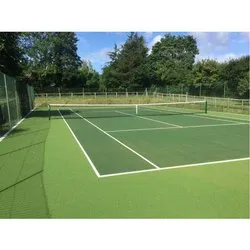
Acrylic surfaces are the most widely used premium tennis court flooring, particularly for clubs and professional facilities.
Characteristics:
-
Made of asphalt or concrete base coated with multiple layers of acrylic or polyurethane.
-
Smooth, uniform surface with excellent grip and traction.
-
Available in multiple colors for aesthetics and heat reduction.
Advantages:
-
Durable and Long-Lasting – Can withstand heavy use for years with minimal repairs.
-
Consistent Playability – Provides predictable ball bounce and speed, ideal for training and competitive play.
-
Low Maintenance – Requires occasional cleaning and periodic recoating.
-
Customizable Surface Texture – Can be adjusted for slow, medium, or fast ball speed.
-
Weather Resistant – UV-stable and resistant to temperature fluctuations.
Considerations:
-
Harder surface may increase joint stress, especially for long practice sessions.
-
Professional installation is required for a perfectly level, long-lasting court.
Best For: Clubs, schools, sports facilities, and residential courts that require durability and consistent performance.
Clay Tennis Court Flooring
Clay is the traditional choice for many professional tournaments, including the French Open.
Characteristics:
-
Made from crushed brick, shale, or stone.
-
Soft, granular surface with slower ball speed.
-
Typically red or green in color.
Advantages:
-
Joint-Friendly Surface – Soft and forgiving, reducing impact on knees and ankles.
-
Encourages Strategic Play – Slower surface prolongs rallies and develops tactical skills.
-
Aesthetically Appealing – Classic look that enhances facility or backyard ambiance.
-
Cooler Surface Temperature – Absorbs less heat, keeping the court comfortable in sunny conditions.
Considerations:
-
High maintenance: daily rolling, brushing, and watering are essential.
-
Weather sensitive: heavy rain can make clay courts unusable temporarily.
-
Requires proper drainage to prevent damage and uneven surfaces.
Best For: Professional training facilities, clubs focusing on competitive tennis, and homeowners who prefer traditional courts with a soft feel.
Grass Tennis Court Flooring
Grass courts offer a unique, fast-paced experience, often associated with prestigious tournaments like Wimbledon.
Characteristics:
-
Natural grass or hybrid turf grown on soil with an underlying drainage system.
-
Fast ball speed with low, uneven bounce.
-
Requires precise mowing, irrigation, and care.
Advantages:
-
Professional Tournament Experience – Preferred by elite players for speed and challenge.
-
Cushioned Surface – Soft and reduces joint strain.
-
Visual Appeal – Lush green court enhances aesthetics of high-end facilities.
-
Comfortable Temperature – Natural grass stays cooler than asphalt or concrete.
Considerations:
-
Very high maintenance: mowing, watering, reseeding, and pest control.
-
Sensitive to climate; excessive rain can make the court unplayable.
-
Higher installation cost and labor-intensive upkeep.
Best For: Luxury resorts, elite clubs, and private residences where aesthetics and prestige are prioritized.
Synthetic Tennis Court Flooring
Synthetic or artificial turf has grown in popularity as a versatile, low-maintenance alternative to natural surfaces.
Characteristics:
-
Made of artificial grass or turf fibers over shock-absorbing layers.
-
Can mimic clay or grass characteristics depending on design.
-
Available in various colors and textures.
Advantages:
-
Soft and Cushioned – Reduces impact on joints and muscles.
-
Low Maintenance – Minimal watering, mowing, or rolling required.
-
Weather Resistant – Can be used in a variety of climates, indoors or outdoors.
-
Customizable – Surface speed and ball bounce can be engineered.
-
Durable – Long lifespan with proper care.
Considerations:
-
Ball bounce may not match professional standards unless premium turf is used.
-
High-quality synthetic turf can be expensive upfront.
-
Periodic brushing and infill replenishment are necessary to maintain performance.
Best For: Schools, recreational centers, multi-use sports facilities, and residential courts seeking low maintenance with good performance.
Factors to Consider When Choosing Tennis Court Flooring
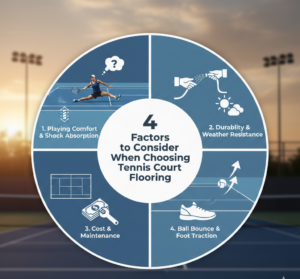
Selecting the right flooring goes beyond preference. Consider the following:
-
Purpose of the Court
-
Professional training or competitive play may favor acrylic or clay surfaces.
-
Recreational or multi-sport facilities often opt for synthetic surfaces for versatility.
-
-
Player Demographics
-
Younger players and beginners may benefit from softer surfaces like clay or synthetic.
-
Advanced players often prefer harder surfaces for speed and precision.
-
-
Climate and Environment
-
Hot regions may benefit from clay or synthetic courts to reduce surface heat.
-
Areas with high rainfall require surfaces with excellent drainage like acrylic or synthetic turf.
-
-
Maintenance Commitment
-
Clay and grass require daily upkeep.
-
Acrylic and synthetic surfaces need periodic maintenance but are less labor-intensive.
-
-
Budget
-
Installation costs vary widely: grass and clay courts tend to be expensive due to labor and materials, while acrylic and synthetic courts offer longer-term cost efficiency.
-
-
Aesthetic Preferences
-
Grass and clay offer traditional elegance, while acrylic and synthetic surfaces provide modern, vibrant visual appeal.
-
Installation Process Overview
Professional installation ensures durability, safety, and optimal playing conditions. Steps include:
-
Site Assessment and Planning
-
Leveling, soil testing, and slope analysis.
-
Layout design with proper run-off areas and orientation.
-
-
Base Construction
-
Crushed stone or gravel sub-base for drainage and stability.
-
-
Surface Installation
-
Acrylic: asphalt/concrete poured and coated.
-
Clay: crushed brick/stone compacted and leveled.
-
Grass: turf laid with proper irrigation.
-
Synthetic: artificial turf layered with shock-absorbing padding.
-
-
Line Marking and Net Setup
-
Durable paint or thermoplastic markings.
-
Regulation net posts installed professionally.
-
-
Optional Enhancements
-
LED lighting, fencing, windbreaks, and seating areas for comfort and functionality.
-
Maintenance Tips
Each surface type requires different care:
-
Acrylic: Sweep, clean, and recoat every few years.
-
Clay: Daily brushing, watering, and rolling.
-
Grass: Regular mowing, irrigation, reseeding, and pest control.
-
Synthetic: Brushing, infill replenishment, and periodic washing.
Proper maintenance extends court life to 15–25 years for most premium surfaces.
Conclusion
Choosing the right tennis court flooring—acrylic, clay, grass, or synthetic—is a vital decision for performance, safety, and long-term investment. Each surface type has unique advantages:
-
Acrylic: Durable, low-maintenance, and consistent for professional play.
-
Clay: Soft, joint-friendly, and ideal for strategic gameplay.
-
Grass: Fast-paced, visually striking, and prestigious.
-
Synthetic: Versatile, low-maintenance, and adaptable to multiple conditions.
The decision should consider intended usage, player demographics, climate, maintenance capacity, budget, and aesthetics. Professional installation is crucial to ensure longevity, safety, and top-quality performance.