



Introduction
Pickleball has quickly become one of the fastest-growing sports worldwide, and India is no exception. With its simple rules, fast rallies, and appeal across all age groups, many communities, schools, and clubs are now adding pickleball facilities. If you already have a tennis court, you don’t need to build a new court from scratch—converting it into a pickleball court is a practical, cost-effective solution.
In this blog, we’ll explain how to convert a tennis court into a pickleball court, including layout, dimensions, flooring, and important considerations.
Tennis Court vs. Pickleball Court – Key Differences
Before conversion, it’s important to understand the size difference between the two courts:
- Tennis Court Dimensions: 78 feet long × 36 feet wide (doubles).
- Pickleball Court Dimensions: 44 feet long × 20 feet wide (for both singles and doubles).
This means a single tennis court can easily accommodate multiple pickleball courts, making it a highly efficient use of space.
Options for Conversion
1. Single Pickleball Court on a Tennis Court
The simplest method is to overlay one pickleball court on an existing tennis court. This involves painting pickleball boundary lines on the surface while retaining tennis markings. A temporary or portable pickleball net can be placed at the correct height (34 inches at the center).
✅ Best for casual play and multi-sport usage.
2. Two Pickleball Courts on One Tennis Court
A more common option is dividing one tennis court into two pickleball courts side by side. This requires permanent or semi-permanent pickleball lines, along with portable or fixed nets.
✅ Ideal for schools, clubs, and communities.
3. Four Pickleball Courts on One Tennis Court
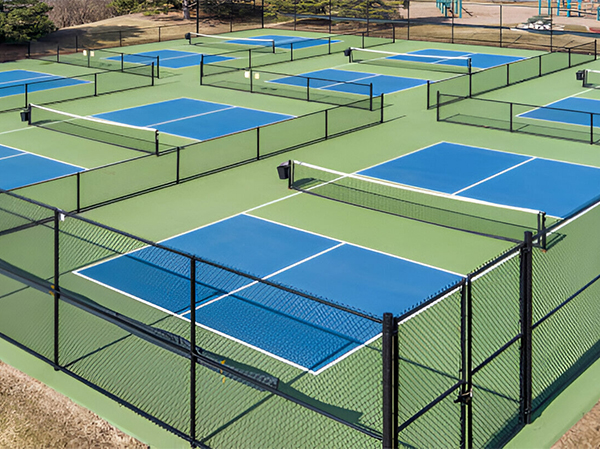
For maximum efficiency, especially in clubs and sports complexes, a single tennis court can be converted into four pickleball courts (two on each side). This setup allows multiple games to run simultaneously and increases court usage.
✅ Perfect for tournaments, academies, and high-traffic facilities.
Steps to Convert a Tennis Court to Pickleball
Court Measurement & Layout
- Mark the correct dimensions (20’ x 44’) for each pickleball court.
- Use contrasting paint colors for tennis and pickleball lines to avoid confusion.
Net Adjustment
- Tennis net height: 36 inches (at posts).
- Pickleball net height: 34 inches (center).
- You can use adjustable tennis nets, or install separate pickleball nets for proper playability.
Surface Preparation
- Ensure the surface is smooth, crack-free, and slip-resistant.
- If required, resurface with acrylic or synthetic coatings for better bounce and durability.
Additional Installations
- Fencing: Helps keep the ball within the play area.
- Lighting: Essential for evening matches.
- Color Coating: Blue, green, or red shades are popular for visibility.
Benefits of Converting Tennis Courts to Pickleball
- Cost-Effective: No need to build a new court from scratch.
- Space Utilization: One tennis court can fit up to four pickleball courts.
- Multi-Sport Facility: Allows both tennis and pickleball on the same surface.
- Community Engagement: Pickleball attracts players of all ages, increasing participation.
- Low Maintenance: Synthetic or acrylic pickleball courts are easier to maintain than tennis courts.
Maintenance Tips for Converted Courts
- Sweep regularly to remove dust and debris.
- Wash the surface monthly to prevent moss and algae.
- Repaint lines every 3–5 years for visibility.
- Inspect nets and posts periodically.
Conclusion
Converting a tennis court into a pickleball court is a smart investment for schools, sports clubs, housing societies, and recreational centers. With simple modifications like line markings, net adjustments, and surface upgrades, you can create a high-quality pickleball facility that meets international standards.
As pickleball continues to grow, this conversion not only saves costs but also maximizes space, making your facility future-ready.
Frequently Asked Questions (FAQs) on Tennis Court to Pickleball Conversion
1. Can you play pickleball on a tennis court?
Yes, you can play pickleball on a tennis court by adding pickleball boundary lines and adjusting the net height. Portable nets are often used for a quick setup.
2. How many pickleball courts fit on one tennis court?
Depending on the layout, you can fit 1, 2, or 4 pickleball courts on a single tennis court. Four courts are common in clubs and academies to maximize space.
3. What is the size difference between a tennis court and a pickleball court?
- Tennis court: 78 feet × 36 feet (doubles).
- sports court: 44 feet × 20 feet.
This makes pickleball courts much smaller, allowing multiple courts within a single tennis court space.
4. Do you need a new surface to convert a tennis court to pickleball?
Not always. If your tennis court is in good condition, you only need to paint pickleball lines and install nets. However, resurfacing with acrylic or synthetic flooring is recommended for better durability and performance.
5. What is the net height difference between tennis and pickleball?
- Tennis net: 36 inches at the posts, 34 inches at the center.
- Pickleball net: 36 inches at the posts, 34 inches at the center.
Although similar, pickleball nets are slightly lower in the middle, so proper adjustment or a dedicated pickleball net is ideal.
6. How much does it cost to convert a tennis court into pickleball courts?
The cost depends on the number of courts, surface condition, and additional features like fencing, lighting, and resurfacing. On average, conversion is much more affordable than building a new court.
7. Can tennis and pickleball lines be on the same court?
Yes. Many facilities use dual markings with different colors to distinguish between tennis and pickleball lines. This allows both sports to be played on the same court.

“This blog is a great resource for both beginners and professionals in sports court construction.”