

Badminton has become one of the most popular indoor sports in India, gaining immense recognition across schools, universities, residential societies, sports academies, and professional training centers. The rise of Indian athletes on the international stage, including multiple world champions and Olympic medalists, has spurred a surge in demand for high-quality badminton court construction in India.
Badminton is not only an engaging sport for fitness enthusiasts but also a highly technical game where precision in court dimensions, flooring quality, and net installation directly influences performance, safety, and competitive fairness. Today, institutions and communities are investing in professionally designed badminton courts that comply with Badminton World Federation (BWF) standards, ensuring both recreational and competitive usability.
This comprehensive guide provides everything you need to know about badminton court construction in India, including court dimensions, types of courts, flooring options, construction process, maintenance, cost analysis, and frequently asked questions.
Why Badminton Court Construction is Essential in India
Badminton’s suitability to Indian conditions makes it a preferred choice for indoor sports infrastructure. Unlike outdoor sports, badminton can be played year-round, unaffected by seasonal rain, extreme heat, or air pollution. The sport requires comparatively compact space yet delivers intensive cardiovascular exercise, agility training, and hand-eye coordination development.
For schools, universities, and residential communities, a badminton court serves multiple purposes:
- Fitness & Recreation: Encourages physical activity and overall wellness.
- Professional Training: Supports coaching for competitive players.
- Tournaments & Events: Enables inter-school, inter-college, district, and national-level competitions.
- Community Engagement: Acts as a hub for social and recreational activities.
Investing in a properly designed and constructed court provides long-term value, as high-quality badminton courts can remain functional for decades with minimal maintenance.
Standard Badminton Court Dimensions in India
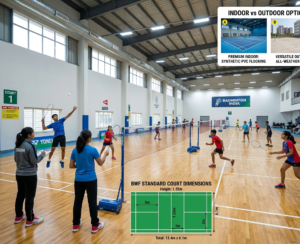
Adherence to official BWF court dimensions is critical for professional training, coaching, and tournament eligibility. Courts built without these standards risk safety issues, unfair play, and disqualification from certified events.
Official Court Measurements
| Specification | Measurement |
|---|---|
| Court Length | 13.40 meters (44 ft) |
| Court Width (Doubles) | 6.10 meters (20 ft) |
| Court Width (Singles) | 5.18 meters (17 ft) |
| Short Service Line | 1.98 meters (6 ft 6 in) from the net |
| Long Service Line (Doubles) | 0.76 meters (2 ft 6 in) inside the back boundary |
| Net Height at Posts | 1.55 meters (5 ft 1 in) |
| Net Height at Center | 1.524 meters (5 ft) |
Clearance & Safety Requirements
- Side and Back Clearance: Minimum 1.5–2 meters
- Recommended Ceiling Height:
- Minimum: 7.5 meters
- Tournament standard: 9–12 meters
Adequate clearance allows players to execute high clears, smashes, and jumps safely while ensuring long-term usability for professional-level matches.
Indoor vs Outdoor Badminton Court Construction
Indoor badminton courts are the preferred choice for schools, clubs, and professional training academies.
Advantages:
- Usable year-round regardless of weather
- Controlled lighting and ventilation for optimal play
- Preferred for coaching and official tournaments
Limitations:
- Higher initial investment due to hall construction
- Requires proper HVAC, lighting, and ventilation systems
Outdoor Courts
Outdoor courts are suitable for residential societies, parks, and recreational centers.
Advantages:
- Lower construction cost
- Quick installation for casual or community use
- Ideal for fitness and informal play
Limitations:
- Exposed to sunlight, rain, and dust
- Shorter flooring lifespan
- Limited suitability for competitive training
Flooring Options for Badminton Court Construction in India
The flooring system is the most crucial element of a badminton court. Proper flooring ensures player safety, reduces injury risk, and enhances performance.
1. Wooden Sprung Flooring (Professional Indoor Courts)
Features:
- Maple or engineered hardwood with shock-absorbing substructure
- Superior grip, energy return, and joint protection
- Preferred for international-level training and tournaments
Maintenance:
- Polishing or recoating every 3–5 years
2. Synthetic PVC / PU Flooring (Popular Choice)
Features:
- PVC mats of 4.5–7 mm thickness
- Installed over RCC or wooden base
- Anti-slip, cushioned, and durable
- Suitable for schools, colleges, and sports academies
Advantages:
- Cost-effective
- Low maintenance
- Long lifespan and consistent playing surface
3. Concrete-Based Courts (Budget Option)
Features:
- RCC slab with painted lines
- Hard surface with minimal shock absorption
- Primarily for recreational use
Note: Can be upgraded later with synthetic mats for professional-level play.
Base Construction & Moisture Protection
A high-quality base is critical for court durability. Improper base construction often leads to flooring failures.
Recommended Base Specifications:
- RCC slab thickness: 100–125 mm
- Sub-base: Well-compacted granular layer
- Moisture barrier: Mandatory for indoor courts
- Outdoor slope: ~1% for drainage
Proper moisture protection prevents wood warping, adhesive failure, and premature flooring damage.
Lighting Requirements
Lighting is crucial for visibility, player comfort, and professional performance.
Recommended Levels:
- Recreational / Training courts: 300–500 lux
- Professional / Tournament courts: 750–1000 lux
Best Practices:
- Evenly distributed light to avoid shadows
- Anti-glare fixtures for player comfort
- Correct positioning for tournaments
Court Equipment & Accessories
A professional badminton court setup includes:
- BWF-standard net and poles
- Correct court markings with anti-slip paint
- Safety buffer zones
- Optional seating/viewing areas
- Scoreboards and storage spaces
- Indoor ventilation or air-conditioning (for hotter regions)
Cost of Badminton Court Construction in India (2025 Estimates)
Cost varies based on flooring, site preparation, and accessories.
| Flooring / Court Type | Approximate Cost |
|---|---|
| Synthetic PVC Flooring | ₹75 – ₹110 per sq. ft |
| Wooden Flooring (Sprung) | ₹180 – ₹250 per sq. ft |
| Complete Indoor Court (Turnkey) | ₹6 – ₹12 lakhs |
| Outdoor RCC Court | ₹3 – ₹5 lakhs |
Typical completion time for a standard indoor court is 4–6 months, depending on weather and site readiness.
Step-by-Step Badminton Court Construction Process
- Site Survey & Planning – Soil testing, space measurement, and ceiling height analysis
- Base Preparation – Excavation, compaction, and sub-base formation
- RCC Slab Construction – Reinforced concrete slab with precise leveling
- Moisture Barrier Installation – Essential for indoor courts
- Flooring Installation – Wooden or synthetic flooring system
- Court Marking & Equipment Setup – BWF-compliant lines and net installation
- Lighting & Finishing Work – Fixtures, ventilation, and seating arrangements
- Testing & Final Handover – Surface bounce testing and quality inspection
Maintenance & Long-Term Care
Routine maintenance ensures longevity and optimal performance:
- Daily: Dry mopping to remove dust
- Weekly: Light wet cleaning (avoid excess water)
- Annual: Inspection for cracks, wear, and line visibility
Expected Lifespan:
- Wooden floors: 3–5 years between recoating
- Synthetic floors: 7–10 years before replacement
Common Mistakes to Avoid:
- Skipping moisture barriers
- Poor slab leveling
- Low-quality flooring
- Incorrect lighting installation
Frequently Asked Questions (FAQs)
1. What are the standard badminton court dimensions?
- 13.40 m in length; 6.10 m width for doubles; 5.18 m for singles.
2. Can outdoor courts be used for tournaments?
- No, outdoor courts are mainly for recreational play. Indoor courts are mandatory for tournaments.
3. Which flooring is best for professional indoor play?
- Wooden sprung flooring with shock absorption.
4. How much clearance is required around a court?
- Minimum 1.5–2 meters on sides and back; ceiling 9–12 meters for tournaments.
5. How long does a synthetic badminton court last?
- With proper care, 7–10 years before replacement.
Conclusion
Badminton court construction in India is a critical investment in sports, fitness, and community development. Whether building a single recreational court or a multi-court facility for professional academies, success depends on careful planning, adherence to BWF standards, selection of high-quality flooring, and expert execution.
A professionally designed badminton court enhances player safety, improves performance, and supports competitive training for years. Partnering with experienced sports infrastructure specialists ensures end-to-end solutions—from design and material selection to installation and final inspection—creating facilities that meet international standards and cater to local needs.
Investing in badminton court construction today builds the foundation for tomorrow’s champions while promoting a culture of fitness and sportsmanship across India.