

Badminton is one of the fastest-growing sports worldwide, combining agility, strategy, and speed. Whether it’s played professionally, recreationally, or as part of a fitness setup, the right court dimensions are essential for ensuring fair play, safety, and enjoyment.
When it comes to outdoor badminton court construction, understanding the standard court size, layout, and marking details is the first and most critical step in building a professional-grade facility.
Let’s explore the complete guide to outdoor badminton court size, surface specifications, and installation standards that every builder, architect, and sports enthusiast should know.
🏗️ 1️⃣ Standard Outdoor Badminton Court Size
The Badminton World Federation (BWF) has defined the official court dimensions that apply to both indoor and outdoor courts.
🔹 Official Badminton Court Size
-
Length: 13.40 meters (44 feet)
-
Width: 6.10 meters (20 feet)
-
Net Height: 1.55 meters (5 feet 1 inch) at the posts, and 1.524 meters (5 feet) at the center
🔹 Play Area (Including Safety Zones)
For safe and comfortable play, an outdoor badminton court should include additional space around the markings:
-
Length (including free zones): 16 meters (approx. 52.5 feet)
-
Width (including side zones): 9 meters (approx. 29.5 feet)
This ensures adequate run-off and player movement space, preventing accidents or boundary interference.
🎯 2️⃣ Court Layout & Marking Details
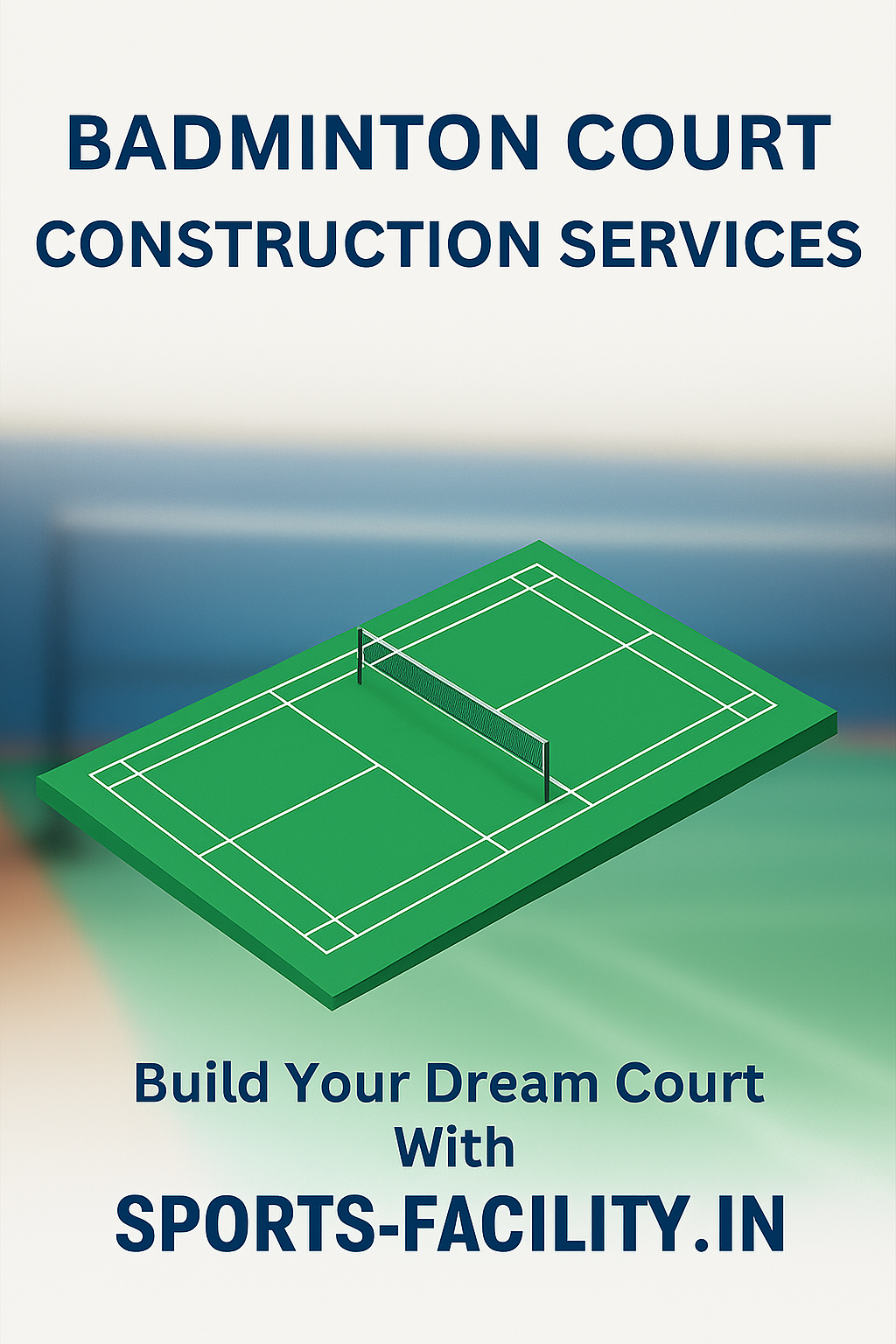
A badminton court is divided into two equal halves by a central net. The layout differs slightly for singles and doubles play.
🔸 Key Markings
| Marking Name | Measurement | Purpose |
|---|---|---|
| Sidelines for Doubles | 6.10m (20ft) apart | Marks the outer width boundary for doubles play |
| Sidelines for Singles | 5.18m (17ft) apart | Narrower boundary for singles matches |
| Baseline | 13.40m apart | Defines the end boundary of the court |
| Center Line | Divides each side into two service courts | |
| Short Service Line | 1.98m (6.5ft) from the net | Marks the minimum distance for a valid serve |
| Long Service Line (Doubles) | 0.76m (2.5ft) inside the back boundary | Defines service limit for doubles |
| Long Service Line (Singles) | Baseline itself | Defines full-length service area |
🔸 Line Thickness
All lines on a badminton court should be:
-
40mm wide (1.57 inches)
-
Clearly visible, ideally painted white or yellow for outdoor surfaces
🌤️ 3️⃣ Outdoor vs. Indoor Badminton Court Dimensions
While the playing dimensions remain identical, the construction approach and materials differ significantly.
| Feature | Indoor Court | Outdoor Court |
|---|---|---|
| Surface Material | Wooden or Synthetic PU | Acrylic, PP Tiles, or Synthetic Turf |
| Weather Resistance | Controlled environment | Must be UV- and water-resistant |
| Drainage System | Not required | Essential for rainwater flow |
| Lighting Requirement | Ceiling lights | Floodlights or LED poles |
| Wind & Sun Factors | None | Requires orientation planning and fencing |
Outdoor badminton courts are designed to withstand sunlight, rain, and temperature variations, which makes surface choice and base preparation extremely important.
⚙️ 4️⃣ Construction Standards for Outdoor Badminton Courts
To achieve professional-grade quality, construction should follow IS and BWF-approved guidelines.
Step-by-Step Process
-
Site Survey & Leveling
-
The surface should be flat with proper slope (1%) for drainage.
-
Any uneven area should be filled and compacted.
-
-
Base Preparation
-
A compacted sub-base layer (GSB/WMM) ensures surface stability.
-
Proper edge curbing prevents cracks and erosion.
-
-
Surface Layer Installation
-
Choose from Acrylic Coating, PU System, or Interlocking PP Tiles.
-
These surfaces offer grip, durability, and weather resistance.
-
-
Court Marking & Painting
-
Markings are done after the surface curing period (usually 48–72 hours).
-
UV-resistant paint ensures longevity.
-
-
Net Post Installation
-
Heavy-duty steel or aluminum posts are installed 1.55m high.
-
The net is 6.1m wide, secured with tension cables.
-
-
Lighting & Fencing
-
Install LED floodlights (100–200 lux) for evening play.
-
Chain link or nylon fencing prevents shuttle loss and enhances safety.
-
🧱 5️⃣ Recommended Surface Materials for Outdoor Courts
The right surface ensures longevity and player comfort.
| Surface Type | Description | Advantages |
|---|---|---|
| Acrylic Flooring | Multi-layer coating system over asphalt | Slip-resistant, UV-stable, colorful finish |
| PU Synthetic Surface | Poured polyurethane over base | Shock-absorbing, smooth feel, durable |
| PP Interlocking Tiles | Modular tiles clipped over sub-base | Fast installation, weatherproof |
| Cement Concrete Surface | Plain finish with acrylic paint | Low cost, good for basic community courts |
For Lucknow and North Indian climates, acrylic or PP modular surfaces are highly recommended due to heat and rain resilience.
🌱 6️⃣ Orientation, Drainage & Lighting
Proper orientation and utilities ensure all-weather usability.
-
Court Orientation: North–South direction minimizes sun glare during play.
-
Drainage: A minimum slope of 1:100 prevents water accumulation.
-
Lighting: 4–6 floodlights (200W–400W) provide balanced illumination.
-
Fencing Height: Minimum 10–12 feet for outdoor safety.
These design elements make the court practical, functional, and professional.
🏢 7️⃣ Standard Badminton Court Dimensions Summary
| Category | Metric (Meters) | Imperial (Feet) |
|---|---|---|
| Court Length | 13.40m | 44 ft |
| Court Width (Singles) | 5.18m | 17 ft |
| Court Width (Doubles) | 6.10m | 20 ft |
| Net Height (Center) | 1.524m | 5 ft |
| Short Service Line Distance | 1.98m | 6.5 ft |
| Long Service Line (Doubles) | 0.76m inside baseline | 2.5 ft |
| Minimum Run-Off Zone | 1.5m each side | 5 ft approx. |
💰 8️⃣ Cost Estimate for Outdoor Badminton Court Construction
| Surface Type | Approx. Cost (per sq.ft.) | Durability |
|---|---|---|
| Cement Base + Acrylic Coating | ₹120 – ₹180 | 5–7 years |
| PU Synthetic Surface | ₹250 – ₹350 | 8–10 years |
| PP Interlocking Tiles | ₹300 – ₹400 | 10+ years |
| Synthetic Turf | ₹350 – ₹450 | 7–9 years |
Note: Prices vary depending on base condition, area, and customization.
💡 9️⃣ Pro Tips for Outdoor Badminton Court Design
✅ Choose Non-Reflective Colors: Blue or green reduce glare and improve shuttle visibility.
✅ Add Wind Screens or Fencing: Protects against wind disturbance.
✅ Ensure Drainage Channels: Prevents rainwater stagnation.
✅ Regular Maintenance: Clean and repaint lines annually.
✅ Avoid Trees Too Close: Prevent leaf fall and surface damage.
🏆 10️⃣ Why Standard Court Size Matters
Using the correct court dimensions ensures:
-
Fair and consistent gameplay
-
Safe movement and balanced distances
-
Compatibility with tournament requirements
-
Professional aesthetics and functionality
Even for recreational setups, following standard badminton court measurements guarantees a superior experience for players.
🏁 Conclusion
Understanding the outdoor badminton court size is the foundation of any successful court construction project. From dimension accuracy to surface material selection, every detail impacts play quality, safety, and longevity.
A well-planned badminton court not only encourages fitness but also becomes a centerpiece for community recreation and sporting excellence.
Whether you’re constructing a public sports complex, school facility, or residential court, adhering to BWF-approved court size and layout ensures that your space meets professional and recreational standards alike.