
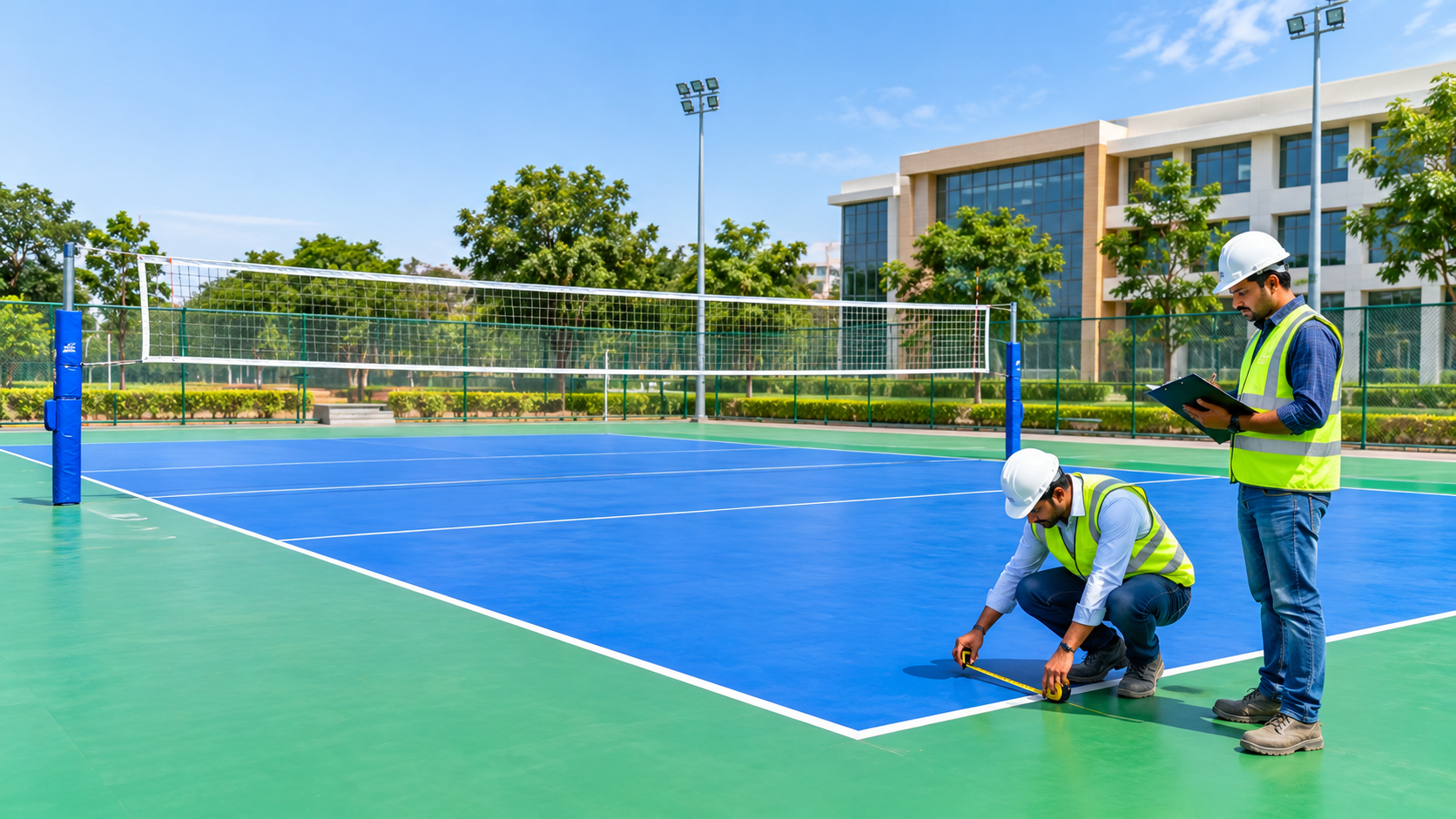
Choosing the right contractor is one of the most important decisions when planning a volleyball court construction project. Whether you want to build a volleyball court for a school, college, sports academy, residential society, sports club, or professional training facility, the quality of construction directly affects player safety, performance, durability, and long-term maintenance costs.
In India, the demand for professionally constructed sports facilities is increasing. Educational institutions, sports academies, private developers, and government organisations are investing in modern sports infrastructure. However, finding a reliable volleyball court contractor who understands technical requirements, surface preparation, drainage systems, sports flooring, and installation standards can be challenging.
A contractor may offer an attractive quotation, but that does not necessarily mean the final court will meet the required playing standards. Proper planning, quality materials, skilled workmanship, and technical knowledge are equally important.
So, how do you identify the right volleyball court construction company in India?
This guide explains the important factors you should consider before hiring a contractor and how to make a confident investment in your sports infrastructure project.
1. Look for Experience in Volleyball Court Construction
The first thing to check is the contractor’s experience in sports infrastructure development.
Building a volleyball court requires more than preparing a concrete surface and painting boundary lines. It involves several technical stages, including site inspection, ground preparation, levelling, base construction, surface installation, drainage planning, and sports equipment installation.
An experienced volleyball court contractor understands how these elements work together to create a safe and functional playing environment.
Before selecting a company, ask questions such as:
- How many volleyball court projects have you completed?
- Have you worked with schools, colleges, sports academies, or government institutions?
- Can you share photographs and videos of completed projects?
- Do you have experience with both indoor and outdoor volleyball courts?
- Can you arrange a site visit to an existing project?
A contractor with relevant project experience is generally better equipped to identify construction challenges and recommend suitable solutions.
Pro Tip: Give more importance to actual completed projects than attractive promotional photographs. Real project references provide a better understanding of a contractor’s capabilities.
2. Check Knowledge of Official Volleyball Court Dimensions
Technical knowledge is essential when selecting a volleyball court construction company.
According to the official FIVB Volleyball Rules 2025–2028, a standard volleyball playing court measures:
- Length: 18 metres
- Width: 9 metres
- Playing area: 162 square metres
- Attack line: 3 metres from the centre line on each side
- Minimum free zone: 3 metres around the playing court
- Minimum unobstructed playing height: 7 metres
These dimensions are important for constructing a court suitable for standard volleyball activities.
However, the overall site requirement is larger than the actual playing area because sufficient space must be available around the court for player movement and safety.
A reliable contractor should understand these measurements and plan the entire playing area accordingly.
For international-level competitions, additional requirements apply, including larger free zones and greater unobstructed height.
Always confirm whether the contractor follows the relevant FIVB requirements or the specific specifications provided by your institution or sports authority.
3. Understand Different Types of Volleyball Court Surfaces
One of the most important decisions in volleyball court construction is selecting the right playing surface.
The ideal surface depends on the intended use, available budget, climatic conditions, maintenance requirements, and whether the court will be installed indoors or outdoors.
A professional contractor should explain the advantages and limitations of different flooring options rather than recommending the same material for every project.
A. Acrylic Volleyball Court Flooring
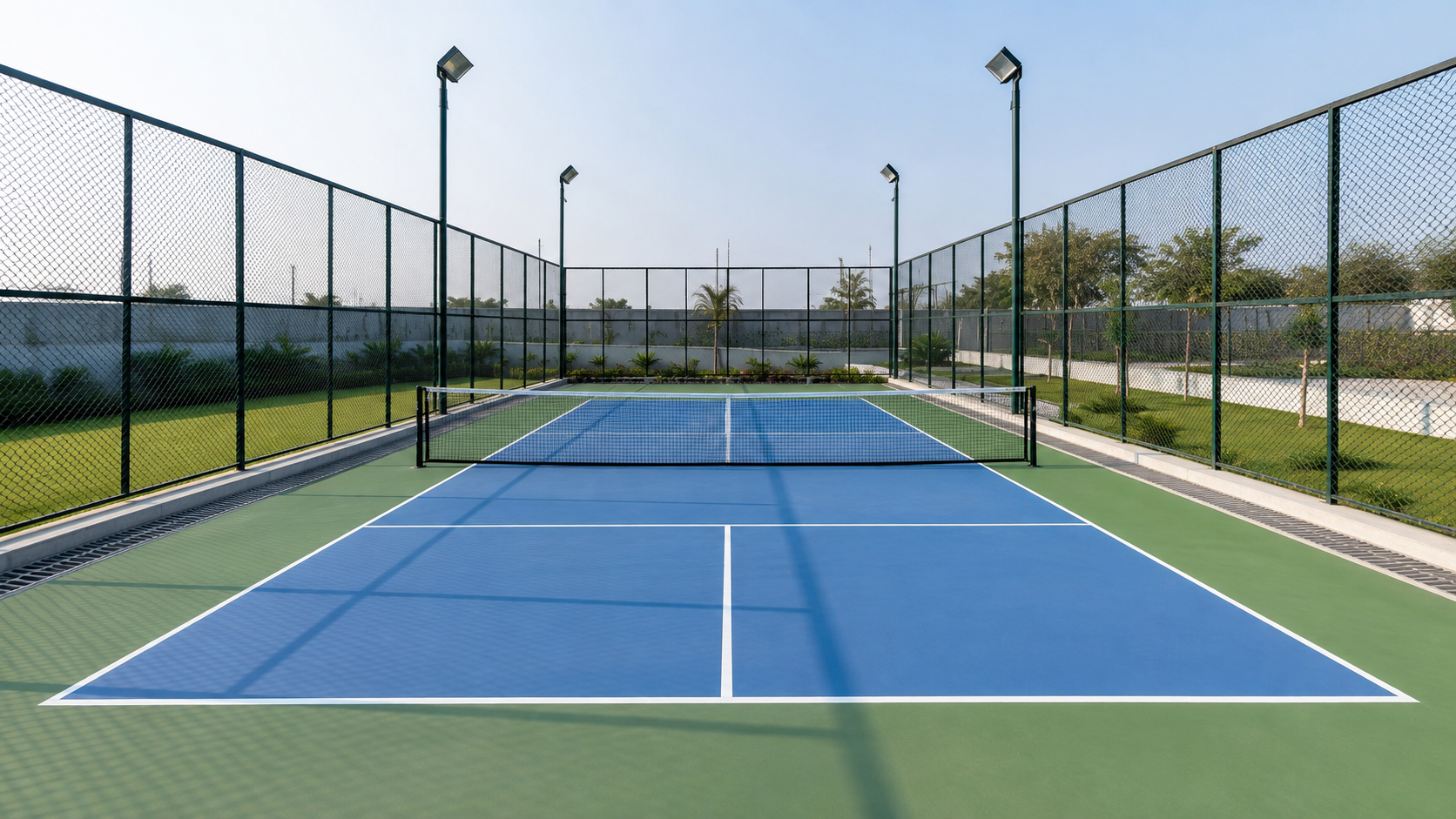
Acrylic sports flooring is a popular option for outdoor volleyball courts.
It provides a consistent playing surface and can be customised with sports colours and court markings. Depending on the specified system, acrylic flooring may include multiple coating layers over a properly prepared base.
Benefits:
- Suitable for outdoor sports facilities.
- Available in different colour combinations.
- Provides a uniform playing surface.
- Relatively easy to maintain.
- Can be installed over suitable concrete or asphalt bases.
B. Synthetic Sports Flooring
Synthetic sports flooring is commonly considered for indoor sports facilities and specialised sports environments.
Different systems offer different levels of cushioning, shock absorption, grip, and surface performance.
Benefits:
- Consistent playing characteristics.
- Options for indoor sports applications.
- Different cushioning systems are available.
- Professional appearance.
- Suitable for multi-purpose sports facilities when correctly specified.
C. Wooden Sports Flooring
Wooden sports flooring is a premium option for certain indoor sports halls.
It offers a traditional indoor sports playing experience and can be designed with specialised subfloor systems.
Benefits:
- Professional indoor sports appearance.
- Suitable for dedicated sports halls.
- Can provide controlled shock absorption when properly designed.
- Appropriate for specialised indoor facilities.
D. Concrete or Cement-Based Courts
Concrete or cement-based construction can be used as a structural base for an outdoor volleyball court.
However, the final playing surface must be properly finished and assessed for safety. Simply constructing a hard concrete slab does not automatically create a suitable sports court.
The contractor should recommend an appropriate surface system based on the intended level of play.
Important: Do not select a volleyball court surface based only on price. Surface performance, player comfort, weather resistance, and maintenance requirements should also be considered.
4. Evaluate Site Preparation and Drainage Planning
A well-constructed volleyball court starts below the playing surface.
Many problems associated with outdoor sports courts occur because of poor site preparation and inadequate drainage.
Before construction begins, the contractor should inspect the site and evaluate:
- Existing soil conditions.
- Ground levels and slope.
- Waterlogging or drainage problems.
- Soil stability and compaction requirements.
- Existing underground utilities.
- Accessibility for construction equipment.
- Available space for the court and surrounding safety zones.
For outdoor volleyball courts, proper drainage is particularly important during the monsoon season in India.
Standing water can damage surface coatings, affect playing conditions, and increase maintenance requirements.
A professional contractor should provide a suitable drainage plan and explain how rainwater will move away from the playing surface.
Never ignore the foundation and drainage system simply because these elements are not highly visible after construction.
5. Ask About Construction Materials and Quality Standards
The durability of a volleyball court depends heavily on the quality of materials used during construction.
Before finalising a contractor, ask for details about the proposed construction materials.
These may include:
- Soil filling and compaction materials.
- Granular sub-base materials.
- Concrete or asphalt specifications.
- Reinforcement details, where applicable.
- Acrylic or synthetic sports flooring systems.
- Sports-grade line marking materials.
- Volleyball poles and net systems.
- Drainage pipes and related accessories.
The contractor should provide clear specifications instead of using general descriptions such as premium quality or international standard materials.
You should also ask whether the company can provide product data sheets, technical specifications, and applicable test certificates for the proposed flooring system.
For institutional and government projects, ensure that the proposed specifications match the tender requirements and applicable technical standards.
6. Compare Quotations from Multiple Volleyball Court Contractors
Price is an important factor, but choosing the cheapest quotation can sometimes lead to higher expenses in the future.
When comparing volleyball court construction quotations, make sure that every contractor is quoting for the same scope of work.
A detailed quotation should ideally include:
- Site inspection and measurement.
- Site clearing and excavation.
- Earthwork and soil compaction.
- Base preparation and construction.
- Drainage arrangements.
- Sports flooring installation.
- Court marking and painting.
- Volleyball poles and net installation.
- Labour and transportation.
- Testing, inspection, and project handover.
Ask for an itemised Bill of Quantities (BOQ) wherever possible.
This makes it easier to identify differences between quotations and understand whether a contractor has excluded important construction activities.
Also clarify GST, payment terms, additional work charges, and any other applicable expenses before signing the agreement.
Remember: A transparent quotation is often a better indicator of professional project management than an unusually low price.
7. Verify Previous Projects and Customer Feedback
A company’s portfolio can tell you a lot about its construction experience.
Before hiring a volleyball court contractor in India, review the company’s completed projects and check whether its previous work matches your requirements.
Look for projects involving:
- School and college volleyball courts.
- Sports academy infrastructure.
- Indoor volleyball courts.
- Outdoor volleyball courts.
- Sports complexes.
- Institutional and commercial sports facilities.
If possible, speak directly with previous customers.
Ask them about construction quality, project completion time, communication, after-sales support, and whether the contractor delivered the work according to the agreed specifications.
You can also check online reviews, company references, and business credentials.
A reliable contractor should be comfortable explaining its experience and sharing genuine project information.
8. Check Whether the Contractor Provides Complete Project Solutions
Working with a company that can manage the entire volleyball court construction process can make project execution easier.
Instead of coordinating separately with civil contractors, flooring installers, equipment suppliers, and other vendors, you can consider a company offering integrated sports infrastructure services.
Depending on your project requirements, these services may include:
- Site inspection and consultation.
- Volleyball court layout planning.
- Civil construction and base preparation.
- Sports flooring installation.
- Acrylic sports court development.
- Synthetic flooring solutions.
- Volleyball net and pole installation.
- Court marking and finishing.
- Drainage system development.
- Maintenance and repair services.
A single-point project coordination approach can reduce communication gaps and help maintain consistency throughout construction.
However, make sure that the contractor has the technical capability and resources to manage all the promised activities.
9. Understand the Importance of Project Timeline and Execution
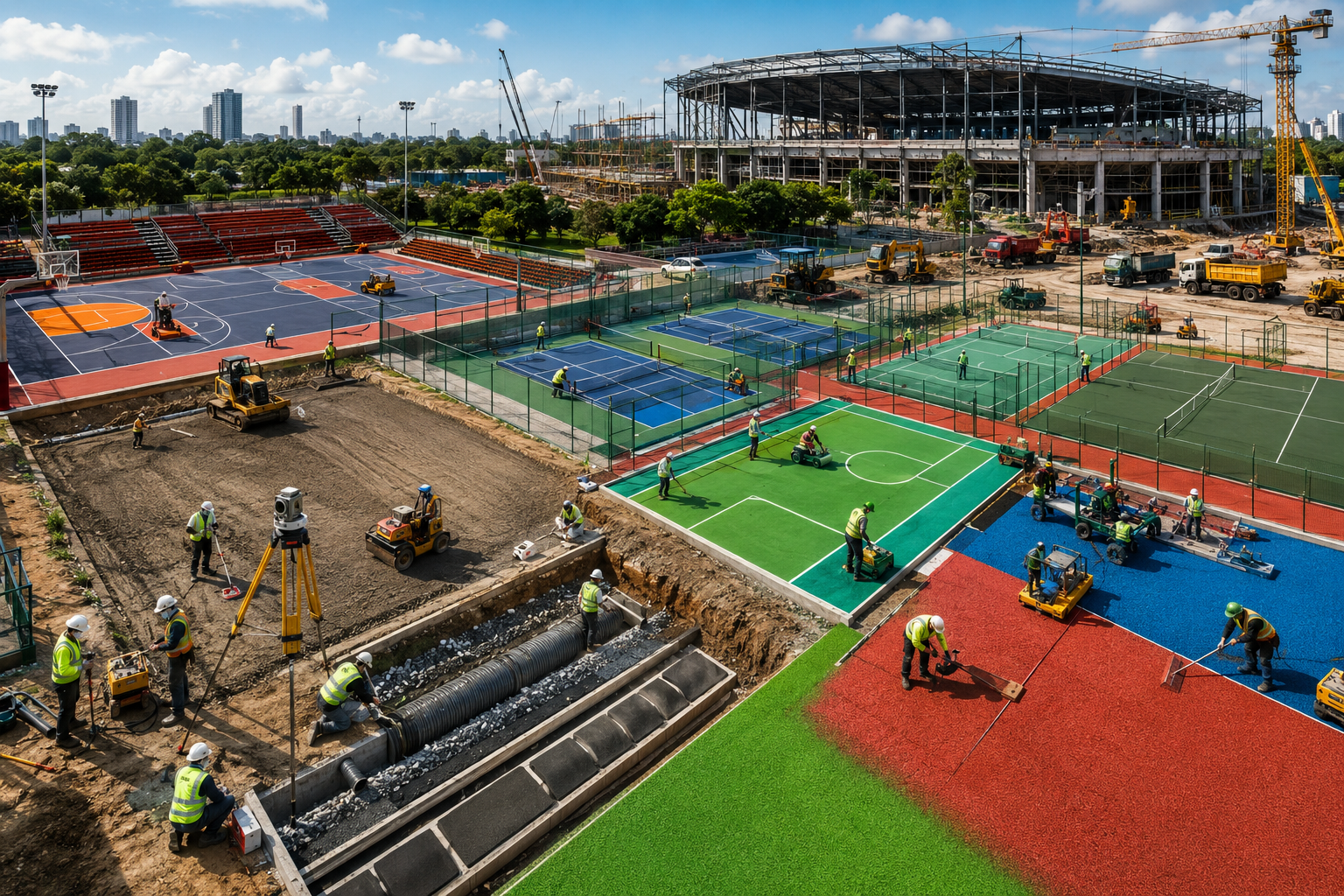
A volleyball court construction project involves multiple stages, and each stage must be completed in the correct sequence.
For example, applying sports flooring before the base is sufficiently prepared or cured can create problems with surface performance and durability.
Before starting the project, ask the contractor for a realistic construction schedule.
A typical project may include:
Stage 1: Site Inspection and Planning
The contractor evaluates the site, takes measurements, and prepares the construction plan.
Stage 2: Ground Preparation
Excavation, levelling, filling, and compaction are completed according to the approved design.
Stage 3: Base Construction
The required concrete or asphalt foundation is prepared.
Stage 4: Sports Flooring Installation
The selected acrylic or synthetic sports flooring system is installed after the base meets the required conditions.
Stage 5: Court Marking and Equipment Installation
Court lines, volleyball poles, and net systems are installed.
Stage 6: Final Inspection and Handover
The completed court is inspected for dimensions, surface quality, drainage, and equipment installation.
The timeline will depend on site conditions, weather, construction specifications, and the selected flooring system.
Ask for a written schedule and regular progress updates.
10. Check Warranty, Maintenance, and After-Sales Support
Volleyball court construction does not end with project handover.
Like every sports facility, a volleyball court requires regular inspection and maintenance to retain its playing quality.
Before finalising your contractor, understand the warranty and maintenance arrangements.
Important questions include:
- What warranty is provided for the installed flooring system?
- Does the warranty cover installation defects?
- What maintenance activities are recommended?
- Is repair support available if the surface gets damaged?
- Are replacement materials available?
- Can the company provide periodic maintenance services?
Remember that warranties for flooring materials, workmanship, and accessories may differ.
Always request written warranty terms rather than relying on verbal commitments.
A contractor who provides proper after-sales support can help protect your investment over the long term.
11. Important Questions to Ask Before Hiring a Volleyball Court Contractor
Before signing a construction agreement, use this checklist to evaluate the contractor.
| Questions | Why They Matter |
|---|---|
| Do you have experience in volleyball court construction? | Confirms relevant project experience. |
| Can you show completed projects? | Helps evaluate actual workmanship. |
| Which flooring system do you recommend? | Helps identify the most suitable surface. |
| Do you provide a detailed BOQ? | Improves cost transparency. |
| How will you manage drainage? | Helps prevent waterlogging. |
| What materials will you use? | Ensures construction specifications are clear. |
| What is the expected completion time? | Helps with project planning. |
| Do you provide a written warranty? | Clarifies post-construction responsibilities. |
| Do you provide maintenance support? | Helps manage long-term upkeep. |
Taking time to ask these questions can prevent misunderstandings and help you select a contractor who understands your project’s requirements.
12. Why Choosing the Right Volleyball Court Construction Company Matters
A volleyball court is a long-term investment in sports development.
Whether it is being developed for a school, college, residential community, professional academy, or commercial sports facility, the quality of construction influences how effectively the facility can be used.
An experienced contractor can help you:
- Develop a court according to the required playing dimensions.
- Select suitable flooring materials.
- Improve surface consistency and playing safety.
- Plan effective drainage.
- Reduce avoidable construction mistakes.
- Maintain project quality.
- Manage long-term maintenance requirements.
The objective should not simply be to construct a volleyball court at the lowest possible cost. It should be to develop a durable, functional, and properly planned sports facility that meets the needs of its players.
Conclusion: Choose a Volleyball Court Contractor Based on Quality, Not Just Price
Finding a reliable volleyball court contractor in India requires careful research, technical evaluation, and proper project planning.
Before making your decision, check the contractor’s experience, completed projects, technical knowledge, material specifications, construction methodology, pricing transparency, and after-sales support.
A professionally constructed volleyball court provides a better playing environment, supports sports development, and delivers long-term value for schools, colleges, academies, clubs, and sports organisations.
Take the time to compare contractors, understand the construction process, and select a company that prioritises quality at every stage.
Planning to Build a Volleyball Court in India?
Whether you need an outdoor volleyball court, an indoor sports facility, or a complete volleyball court construction solution, working with an experienced sports infrastructure company can make your project more efficient.
Get in touch with a professional volleyball court construction contractor to discuss your site requirements, flooring options, construction specifications, and project budget.
Frequently Asked Questions (FAQs)
1. How much does volleyball court construction cost in India?
The cost of volleyball court construction in India depends on several factors, including site conditions, court dimensions, flooring material, foundation requirements, drainage arrangements, and additional sports equipment.
An outdoor court with a basic playing surface may have different construction costs compared with a professional indoor court featuring specialised sports flooring.
For an accurate estimate, request a site inspection and detailed quotation from a contractor.
2. What is the standard size of a volleyball court in India?
According to FIVB rules, the standard volleyball playing court measures 18 metres in length and 9 metres in width. A minimum free zone of 3 metres is required around the playing court under the general rules.
Additional space may be required depending on the intended level of competition.
3. Which flooring is best for an outdoor volleyball court?
Acrylic sports flooring is a commonly considered option for outdoor volleyball courts. It provides a uniform surface and is available in different colours.
The final selection should depend on the base condition, weather exposure, player requirements, and maintenance expectations.
4. How long does it take to construct a volleyball court?
The construction period depends on the site condition, foundation work, selected flooring system, weather, and project size.
A contractor should provide a realistic timeline after inspecting the site and finalising the construction specifications.
5. Can a volleyball court be constructed inside an existing sports complex?
Yes. A volleyball court can be developed within an existing sports complex if sufficient space, suitable flooring conditions, adequate clearance, and other technical requirements are available.
A site inspection is recommended before starting the project.
6. What should I check before hiring a volleyball court contractor?
Check the contractor’s previous projects, construction experience, flooring knowledge, material quality, detailed quotation, drainage planning, warranty terms, and maintenance support.
Always ask for a written scope of work before confirming the project.
7. Is acrylic flooring suitable for school and college volleyball courts?
Acrylic sports flooring can be suitable for outdoor school and college volleyball courts when installed over a properly prepared base using an appropriate sports flooring system.
The selected system should match the expected usage and playing requirements.
8. Do volleyball court contractors provide nets and poles?
Many sports infrastructure contractors offer volleyball poles, nets, and related accessories as part of their project services. However, confirm the equipment specifications and installation costs before finalising the quotation.
9. Is drainage necessary for an outdoor volleyball court?
Yes. Proper drainage is important for outdoor volleyball courts, particularly in areas that experience heavy rainfall. Effective drainage helps prevent water accumulation and protects the playing surface.
10. How can I find the best volleyball court construction company in India?
Research companies with relevant sports infrastructure experience, check their completed projects, compare technical quotations, verify customer feedback, and review their warranty and maintenance support before making a decision.
The best contractor is one who understands your project requirements and offers a suitable construction solution rather than simply promising the lowest price.