Introduction
Pickleball is quickly becoming one of the most popular emerging sports in India. Schools, sports academies, residential societies, fitness clubs, hotels, resorts, corporate campuses, and commercial sports facilities are investing in dedicated pickleball courts to meet growing demand. However, building a quality court involves much more than installing a net and painting court lines. The pickleball court flooring system plays a major role in player safety, ball response, traction, durability, and overall playing experience.
Choosing the right pickleball court flooring contractors in India is therefore an important decision. A contractor may offer an attractive quotation, but the lowest price does not necessarily mean the best long-term value. The quality of the base, drainage, surface materials, installation technique, curing process, line marking, and finishing can determine whether a court performs reliably for years or requires expensive repairs soon after installation.
This guide explains the major factors you should consider before selecting a pickleball court flooring contractor in India.
Why Pickleball Court Flooring Matters
A pickleball court experiences frequent lateral movement, sudden stops, quick changes of direction, jumping, and repetitive footwork. Players need a surface that provides reliable traction without becoming excessively hard or slippery.
The flooring also needs to support consistent ball behaviour. Uneven surfaces, cracks, depressions, poor drainage, or incorrectly applied coatings can affect the bounce and make the court uncomfortable or unpredictable to play on.
For outdoor courts, flooring must additionally withstand India’s strong sunlight, seasonal rainfall, humidity, dust, and temperature variations. A properly engineered acrylic sports surface over a suitable concrete or asphalt base is a common solution for outdoor pickleball facilities. USA Pickleball also identifies hard surfaces such as concrete and asphalt as suitable outdoor playing surfaces when properly prepared.
This is why selecting an experienced sports flooring contractor is more important than simply hiring a general civil contractor.
Understand the Standard Pickleball Court Dimensions
Before discussing flooring, make sure the contractor understands the correct court layout.
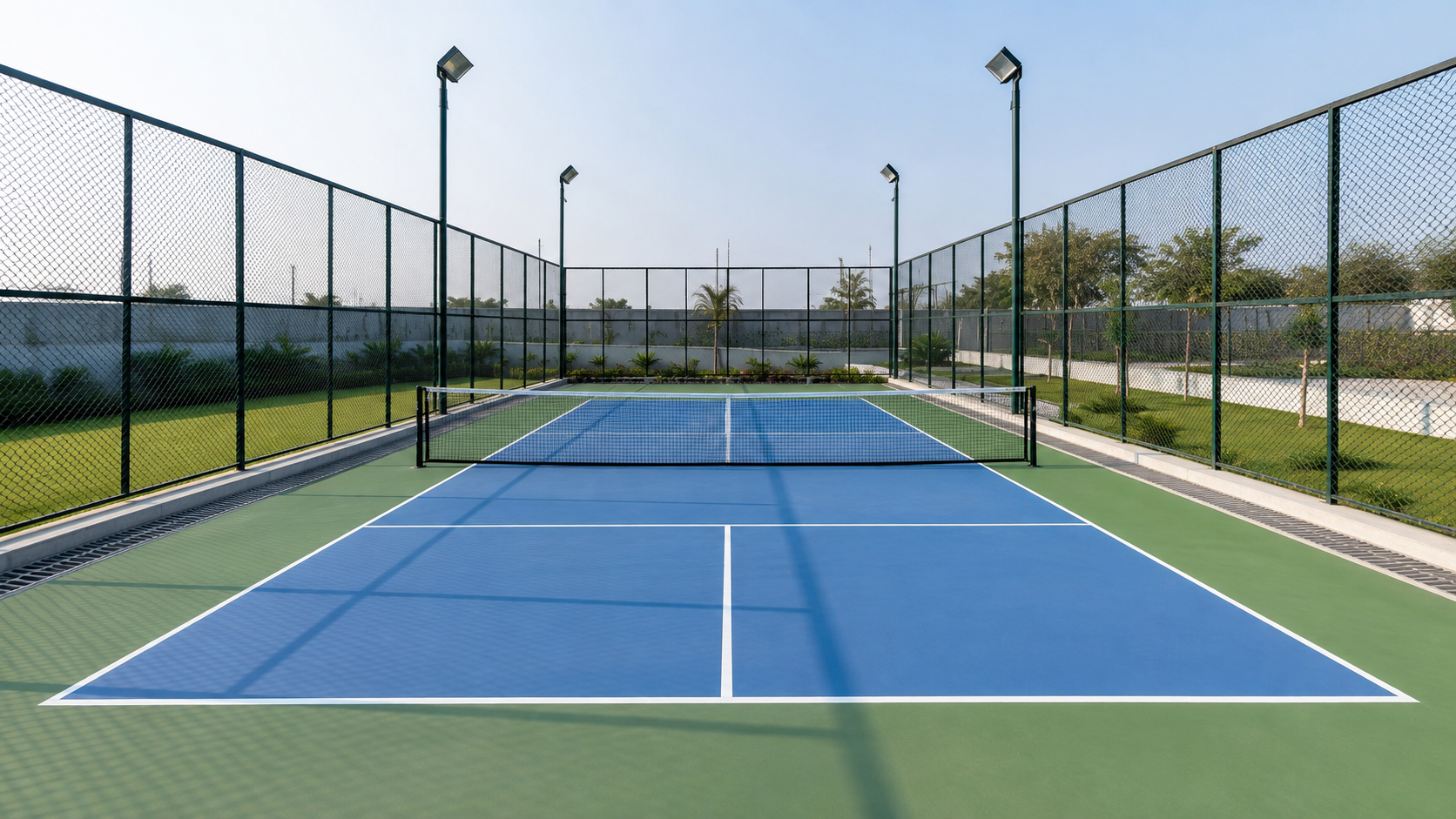
A standard pickleball court measures 20 feet wide by 44 feet long, or approximately 6.10 metres by 13.41 metres. This dimension applies to both singles and doubles play. The non-volley zone, commonly called the “kitchen,” extends 7 feet from the net on both sides.
The playing area is only part of the planning requirement. Players also need safe movement space around the court. USA Pickleball recommends a minimum playing surface of approximately 30 feet × 60 feet for a court installation, although additional space may be desirable for comfortable recreational or competitive use.
A professional contractor should therefore inspect the complete site before beginning construction rather than simply measuring the 20 × 44 ft playing rectangle.
1. Choose a Contractor With Sports Flooring Experience
The first thing to investigate is the contractor’s experience with sports surfaces.
General construction knowledge is useful, but pickleball flooring requires specialist understanding. The contractor should know how different surfaces behave under sports-specific movement and how base preparation affects the finished coating.
Ask potential contractors:
- How many pickleball courts have you completed?
- Have you installed acrylic sports flooring before?
- Do you construct the RCC or asphalt base yourself?
- Can you provide photographs of completed projects?
- Do you provide installation and maintenance support?
- What flooring system do you recommend for my site?
- What materials and number of coating layers are included?
- What warranty is provided?
A reliable contractor should be able to explain the complete construction system rather than simply quote a price per square foot.
2. Evaluate the Quality of the Base
One of the biggest mistakes in sports court construction is focusing heavily on the top coating while ignoring the foundation underneath it.
Acrylic flooring cannot compensate for a badly constructed base. If the concrete slab moves, cracks, contains major undulations, or drains water incorrectly, problems can eventually appear in the finished sports surface.
The base should be properly designed according to soil conditions, site usage, drainage requirements, and the selected flooring system.
Depending on the project, contractors may work with reinforced concrete, asphalt, or an existing structurally sound surface. For many new Indian outdoor courts, RCC with a professionally installed acrylic system is a practical option.
A recent Indian Institute of Management Udaipur tender specification for a synthetic acrylic sports surface for volleyball and pickleball, for example, requires the underlying base to be smooth, level, dense, clean, crack-free, and properly sloped for drainage before the synthetic system is installed.
That principle is important for every project.
3. Check the Drainage Design
Water is one of the biggest threats to an outdoor pickleball court.
A court that looks perfectly level may still create water-logging problems after heavy rain. Standing water can enter cracks, affect coatings, encourage surface deterioration, and make the court unusable until it dries.
A professional contractor should evaluate:
- Existing ground levels
- Natural water flow
- Court slope
- Perimeter drainage
- Nearby buildings and walls
- Rainwater discharge points
- Soil conditions
- Monsoon-related water accumulation
Don’t accept a quotation that only mentions “drainage included.” Ask the contractor to explain how rainwater will leave the court.
4. Understand the Available Pickleball Flooring Options
There is no single flooring solution that is ideal for every pickleball project. The right surface depends on whether the court is indoors or outdoors, expected usage, budget, player requirements, and the condition of the existing base.
Acrylic Sports Flooring
Acrylic is one of the most widely used solutions for outdoor pickleball courts.
A properly designed acrylic sports surface can provide good traction, consistent play characteristics, weather resistance, and relatively straightforward maintenance. Modern systems may include several layers consisting of primer, resurfacer, cushion materials where specified, colour coats, and line marking.
For Indian outdoor conditions, UV stability and correct surface texture are particularly important.
Cushioned Acrylic Flooring
Cushioned acrylic systems add elastic layers beneath the playing surface to improve comfort and reduce the harsh feel associated with conventional hard courts.
This can be useful for clubs, academies, premium recreational facilities, and facilities expecting long playing sessions.
The additional layers generally increase project cost, but they may provide a more comfortable playing experience.
PU Sports Flooring
Polyurethane flooring can be considered for premium indoor applications where cushioning and player comfort are priorities. PU systems are seamless and can provide a softer underfoot response than a conventional hard acrylic surface.
However, the contractor should not automatically recommend PU simply because it is marketed as a premium material. The flooring should match the environment and intended use. Acrylic is commonly preferred for outdoor courts, while cushioned PU or other elastic systems may be considered for premium indoor installations.
Modular Interlocking Tiles
Polypropylene or similar modular sports tiles can be useful where rapid installation, replacement, or drainage characteristics are important.
They may be considered for some schools, housing societies, temporary facilities, rooftops, or conversion projects. However, they have different performance characteristics from seamless acrylic systems.
A contractor should explain the advantages and limitations of each option instead of presenting one product as universally suitable.
5. Ask for a Complete Flooring Specification
Never select a contractor based only on the phrase “premium acrylic flooring.”
Ask exactly what is included.
A professional quotation should identify items such as:
- Surface preparation
- Primer
- Resurfacing layer
- Cushion layers, if applicable
- Acrylic colour coats
- Texture or aggregate
- Line marking
- Crack treatment
- Expansion/control joint treatment
- Curing time
- Final inspection
The number of layers can vary according to the selected system. One Indian institutional tender, for example, specifies an eight-layer acrylic synthetic sports flooring system, including primer, resurfacer, four cushion layers and additional finishing layers.
The important point is not simply to demand a particular number of layers. Instead, ask the contractor to provide the manufacturer’s technical specification and explain the purpose of each layer.
6. Check Material Quality and UV Resistance
India has highly varied climatic conditions. Outdoor courts in Delhi, Rajasthan, Uttar Pradesh, Maharashtra, Telangana, Karnataka, Tamil Nadu, and other regions can experience intense sunlight and high surface temperatures.
The contractor should therefore use sports-grade materials appropriate for outdoor exposure.
Ask for:
- Product manufacturer details
- Technical datasheet
- UV-resistance information
- Application instructions
- Batch information
- Recommended curing conditions
- Warranty documentation
Avoid contractors who refuse to disclose the product system being installed.
A professional sports flooring project should have traceable materials rather than unidentified coatings purchased solely because they are inexpensive.
7. Inspect the Contractor’s Previous Projects
One of the simplest ways to evaluate a pickleball flooring contractor is to inspect previous work.
Ask for recent project references and, where possible, visit an existing court.
When inspecting the court, look for:
- Uniform surface texture
- Clean and straight court lines
- No visible bubbles
- No peeling coating
- No major cracks
- No standing water
- Smooth transitions
- Proper fencing
- Secure net posts
- Good overall finishing
Don’t only inspect a court immediately after installation. If possible, look at a project that has been in operation for several months or years. Long-term performance provides much more useful information than freshly completed photographs.
8. Verify Court Line Marking Accuracy
Court markings may appear simple, but accuracy matters.
The contractor should understand the standard court layout and clearly mark the:
- Baseline
- Sidelines
- Centerline
- Non-volley zone
- Service areas
USA Pickleball’s official rulebook specifies court lines at 2 inches wide and requires them to contrast clearly with the playing surface.
The lines should be straight, consistent, sharply defined, and properly positioned.
Poor line marking can make an otherwise attractive court look unprofessional and can create confusion during play.
9. Don’t Ignore Crack Treatment
Concrete naturally moves due to temperature changes, moisture conditions, and structural stresses.
That means a contractor must have a clear strategy for existing cracks, control joints, and movement joints.
Ask:
“How will you treat cracks and joints before applying the acrylic surface?”
The answer should involve appropriate preparation and a compatible repair or crack-bridging system where required.
Simply filling a crack with ordinary cement and covering it with paint is not a professional long-term solution.
10. Look at the Contractor’s Construction Process
A reliable contractor should follow a defined sequence.
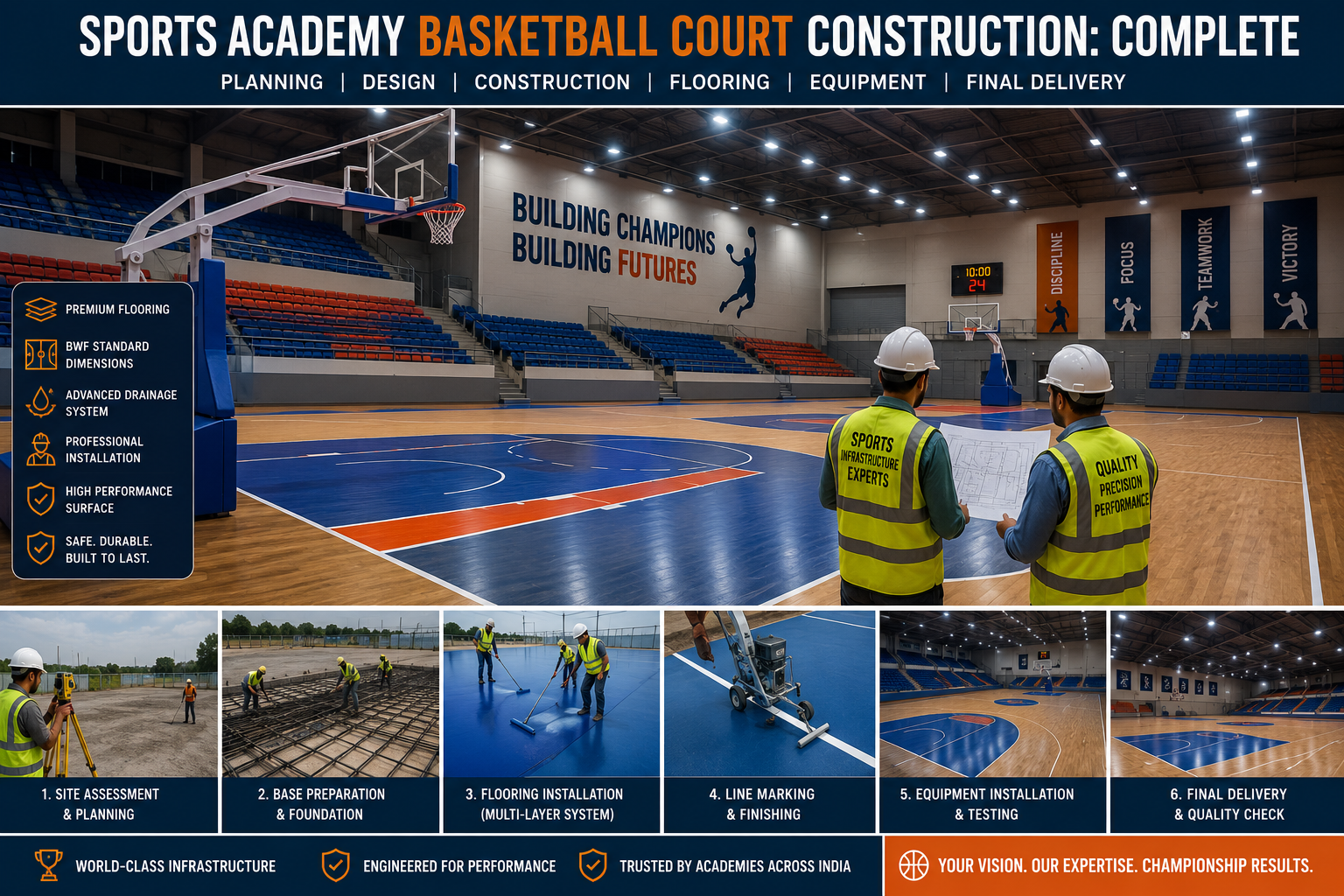
A typical pickleball court flooring project may involve:
Site Inspection
The contractor checks dimensions, soil, existing surfaces, drainage, access, utilities, and surrounding conditions.
Base Preparation
The ground is prepared, compacted, and engineered according to the project requirements.
Concrete or Asphalt Construction
The selected base is installed with appropriate reinforcement, levels, joints, slope, and curing.
Surface Preparation
The base is cleaned and inspected before sports flooring application.
Primer and Resurfacer
The initial coating layers establish adhesion and help create a uniform surface.
Cushioning
If a cushioned system is selected, elastic layers are applied according to the manufacturer’s specifications.
Colour Coating
The playing surface receives the specified sports coating and texture.
Line Marking
Court markings are accurately measured and applied.
Final Inspection
The contractor checks surface appearance, drainage, markings, equipment, and overall finishing.
This systematic approach reduces the possibility of defects and rework.
11. Compare Quotes Carefully
A common mistake is comparing three contractors purely on total price.
For example:
Contractor A: ₹4.5 lakh
Contractor B: ₹5.5 lakh
Contractor C: ₹6.5 lakh
At first glance, Contractor A appears to be the best option.
But what if Contractor A excludes:
- Proper RCC base
- Drainage
- Crack treatment
- Fencing
- Premium surface layers
- Lighting
- Equipment
- Surface warranty?
The cheaper quotation may ultimately become the more expensive project.
Instead of comparing only the final amount, compare the scope of work.
Request an itemised quotation showing civil work, flooring, fencing, lighting, equipment, transport, taxes, and any optional upgrades separately.
Current Indian market guides show that pickleball court construction costs can vary substantially depending on site conditions, flooring specification, base construction, fencing, lighting, and other accessories.
Therefore, there is no single “correct” price for every court.
12. Check Warranty and After-Sales Support
A contractor’s responsibility should not end when the final payment is received.
Ask what happens if:
- The surface develops premature peeling
- Cracks appear
- Drainage problems occur
- Line markings fade
- Coating becomes damaged
- Fencing requires adjustment
Get warranty terms in writing.
Also ask whether the contractor provides periodic maintenance and resurfacing services.
A professional relationship with a sports flooring company can be valuable because acrylic surfaces eventually require maintenance or recoating depending on usage and environmental exposure.
13. Consider Maintenance Before Construction
A good contractor should explain how to maintain the finished court.
Routine maintenance can include:
- Removing leaves and debris
- Keeping the surface clean
- Preventing dirt accumulation
- Clearing drainage channels
- Checking cracks
- Inspecting fencing
- Checking net posts
- Avoiding unsuitable cleaning chemicals
- Addressing surface damage early
Small maintenance issues should be repaired before they become major structural or coating problems.
14. Check Whether the Contractor Can Handle Complete Court Construction
Ideally, your contractor should be capable of coordinating the entire project.
A complete pickleball court may require:
- Site development
- Civil foundation work
- Sports flooring
- Court markings
- Fencing
- Net posts
- Pickleball net
- Sports lighting
- Electrical work
- Drainage
- Accessories
Using multiple unrelated contractors can create coordination problems. A turnkey sports infrastructure contractor can simplify communication because one team manages the technical relationship between the base, flooring, equipment, and finishing.
15. Choose Contractors Who Understand Indian Conditions
India is not climatically uniform.
A flooring solution that works well in a dry northern region may require different planning in a coastal or high-rainfall location.
Your contractor should consider:
Summer: UV exposure and high surface temperatures.
Monsoon: Heavy rain, drainage, humidity, and moisture.
Winter: Temperature fluctuations and potential surface movement.
Soil: Expansive, weak, or poorly compacted ground conditions.
Usage: Recreational, academy, commercial, school, residential, or tournament-level play.
This local understanding is one of the strongest reasons to choose a specialist pickleball court flooring contractor rather than an inexperienced installer.
Questions to Ask Before Hiring a Pickleball Court Flooring Contractor
Before signing the contract, ask these questions:
- What type of flooring do you recommend and why?
- What is the complete layer specification?
- What material brands will be used?
- Is the flooring UV-stabilised?
- What type of base will be constructed?
- How will drainage be managed?
- How will cracks and joints be treated?
- What curing period is required?
- Are court markings included?
- Is fencing included?
- Are net posts and nets included?
- Is lighting included?
- What is excluded from the quotation?
- What warranty do you provide?
- Do you provide maintenance and resurfacing?
- Can I inspect completed projects?
- Do you provide a written technical specification?
If a contractor gives clear answers and documentation, you are in a much stronger position to make an informed decision.
Common Mistakes to Avoid
Choosing the Lowest Quotation
Cheap construction can result in poor base preparation, inferior coatings, inadequate drainage, or reduced surface thickness.
Hiring a General Contractor Without Sports Flooring Experience
Sports flooring has different technical requirements from ordinary civil or painting work.
Ignoring Drainage
A beautiful court can become unusable if rainwater repeatedly accumulates on the playing surface.
Using Unspecified Materials
Always know what product system is being installed.
Skipping Base Inspection
Existing concrete should be checked for cracks, level, strength, moisture, and drainage before resurfacing.
Rushing the Installation
Sports coatings require suitable weather and curing conditions. Rushing the process can compromise adhesion and finish.
Focusing Only on Appearance
A bright court is not necessarily a high-performance court. Surface uniformity, traction, drainage, structural stability, and durability matter more than colour.
Final Checklist for Selecting the Right Contractor
Before awarding the project, make sure the contractor provides:
- Experienced sports flooring team
- Correct 20 × 44 ft court layout
- Appropriate surrounding run-off area
- Properly engineered base
- Reliable drainage design
- Sports-grade acrylic, PU, or selected flooring system
- UV-resistant materials for outdoor courts
- Professional crack and joint treatment
- Accurate court markings
- Quality net posts and net
- Proper fencing where required
- Suitable LED sports lighting if needed
- Written scope of work
- Product specifications
- Project timeline
- Warranty terms
- Maintenance guidance
- Previous project references
Conclusion
Selecting pickleball court flooring contractors in India should be based on technical capability, material quality, construction experience, project transparency, and long-term support—not simply the lowest quotation.
The flooring system is one of the most important parts of the court, but it can only perform properly when installed over a correctly engineered base. Drainage, surface preparation, crack treatment, UV resistance, coating quality, line marking, and curing all contribute to the final result.
For most outdoor installations, acrylic sports flooring is a practical and widely used choice, while cushioned acrylic, PU, or modular systems may be appropriate for specific indoor, premium, or specialised applications. The right contractor should evaluate your site and explain why a particular system suits your requirements rather than selling the same specification to every customer.
A professionally constructed pickleball court is an investment in player safety, facility reputation, and long-term operating value. Take time to compare technical specifications, inspect previous projects, understand exactly what your quotation includes, and select a contractor who can manage the project from site preparation to final sports flooring installation.
When these factors are handled correctly, your pickleball court can provide a consistent, attractive, durable, and enjoyable playing environment for years to come.