



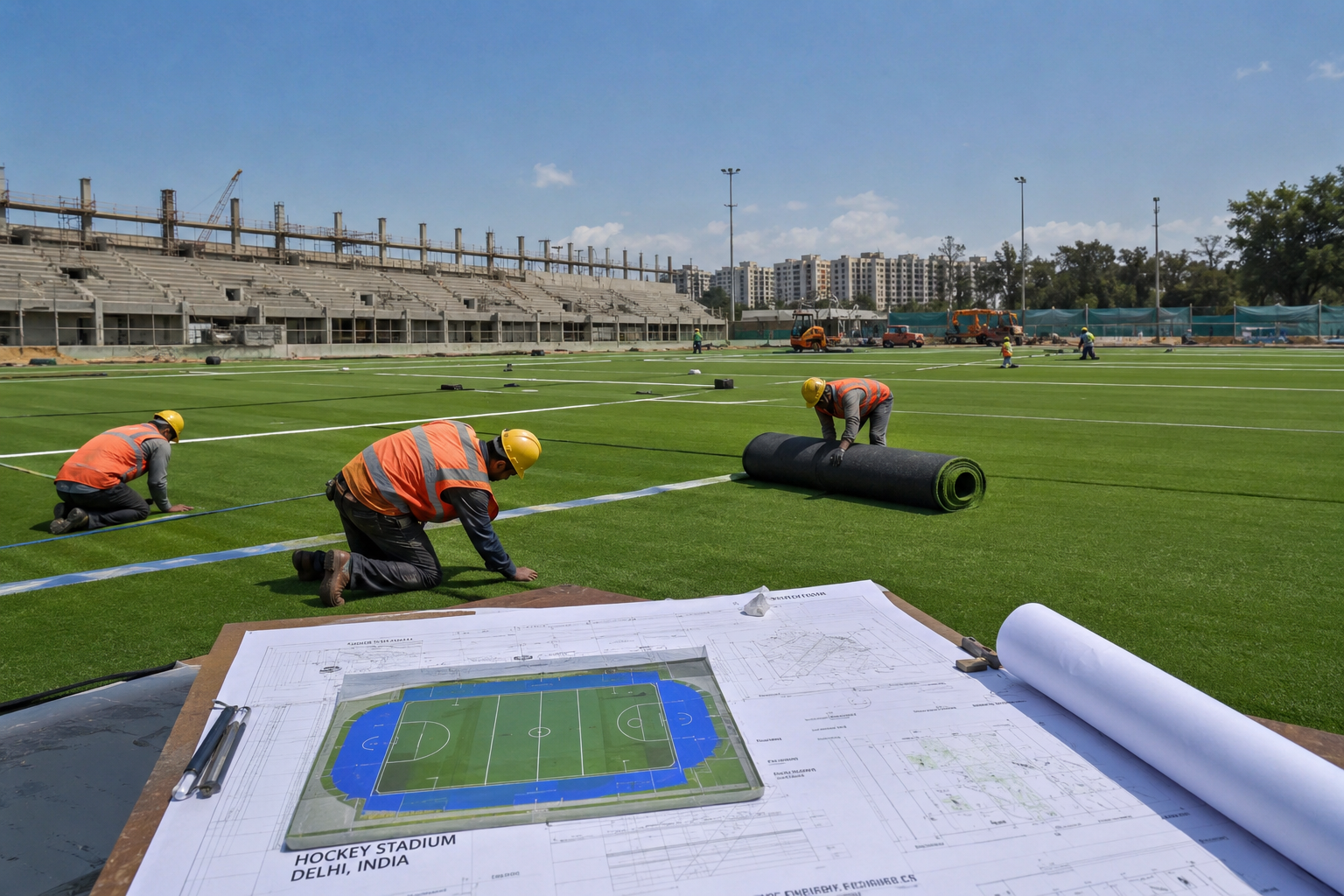
Introduction: Growing Demand for Hockey Infrastructure in Delhi
Delhi, the capital city of India, is rapidly evolving as a sports infrastructure hub. With increasing awareness of fitness, school-level sports competitions, government initiatives, and professional hockey leagues, the demand for hockey court construction in Delhi has grown significantly in recent years.
Hockey, being one of India’s most celebrated sports, requires high-quality playing surfaces that meet international standards. Whether it is for schools, academies, sports complexes, universities, or private stadiums, a professionally built hockey turf plays a crucial role in player performance and safety.
Modern hockey courts are no longer just open grounds. They are engineered sports surfaces designed with precision, advanced materials, and strict dimensional standards set by the International Hockey Federation (FIH).
This detailed guide explains everything about hockey court construction in Delhi, including design process, materials, cost factors, types of surfaces, installation steps, and maintenance.
Understanding Hockey Court Construction
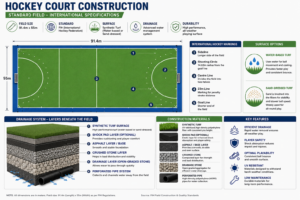
Hockey court construction is a specialized engineering process that involves designing and building a flat, durable, and high-performance playing surface.
A standard hockey field has strict requirements:
- Length: 91.4 meters
- Width: 55 meters
- Surface: Synthetic turf (water-based or sand-dressed)
- Markings: International hockey markings
- Drainage system: Essential for outdoor fields
In Delhi, construction must also consider climate conditions such as extreme heat, monsoon rainfall, and dust accumulation.
Types of Hockey Turf Used in Delhi
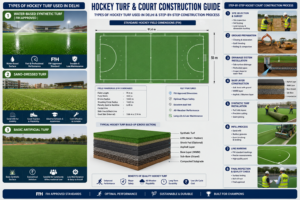
Choosing the right surface is the most important step in hockey court construction.
1. Water-Based Synthetic Turf (FIH Approved)
This is the most advanced hockey surface used in international matches.
Features:
- Requires watering before play
- Extremely smooth and fast surface
- Reduces friction and injuries
- Used in professional stadiums
Best for:
- International-level stadiums
- Sports academies
- Professional training centers
2. Sand-Dressed Turf
This type of turf has sand filled between fibers to improve stability.
Features:
- Medium speed surface
- Lower maintenance than water-based turf
- Cost-effective option
Best for:
- Schools
- Colleges
- Local sports complexes
3. Artificial Turf (Basic Grade)
A more affordable option for beginners and recreational play.
Features:
- Low installation cost
- Moderate durability
- Minimal maintenance
Best for:
- Training grounds
- Community playgrounds
Step-by-Step Hockey Court Construction Process
Constructing a hockey court in Delhi requires precision engineering and expert planning.
Step 1: Site Selection and Survey
The first step is selecting a suitable land area. Engineers conduct:
- Soil testing
- Level measurement
- Water drainage assessment
- Environmental study
A perfectly leveled base ensures long-term durability.
Step 2: Ground Preparation
The ground is cleared of debris, rocks, and vegetation. Then:
- Excavation is done
- Soil is compacted using rollers
- A stable base layer is created
This prevents future surface unevenness.
Step 3: Drainage System Installation
Delhi experiences heavy monsoon rains, so drainage is critical.
A proper system includes:
- Underground pipes
- Perforated drainage channels
- Sloped base design
This ensures water does not accumulate on the field.
Step 4: Base Layer Construction
A strong base layer is created using:
- Stone dust
- Fine gravel
- Asphalt or concrete (depending on project type)
This layer ensures stability for turf installation.
Step 5: Synthetic Turf Installation
The turf is rolled out and aligned carefully.
- Turf rolls are joined using adhesives
- Seams are sealed properly
- Surface is stretched evenly
Precision is critical for a professional finish.
Step 6: Infill Process (if required)
For sand-dressed or hybrid turf:
- Silica sand is spread evenly
- Rubber granules may be added
- Brushing ensures uniform distribution
Step 7: Marking and Line Painting
International standard white lines are marked:
- Goal circles
- Center line
- Shooting circles
- Boundary lines
These markings follow FIH guidelines.
Step 8: Final Inspection
Before handing over:
- Surface testing is done
- Ball roll speed is checked
- Drainage performance is verified
Cost of Hockey Court Construction in Delhi
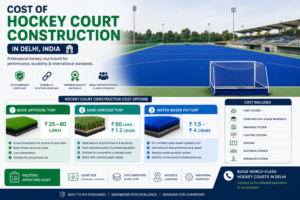
The cost depends on multiple factors such as turf type, land size, and infrastructure quality.
Approximate Cost Range:
- Basic artificial turf court: ₹25 lakh – ₹60 lakh
- Sand-dressed turf court: ₹60 lakh – ₹1.2 crore
- Water-based FIH turf: ₹1.5 crore – ₹4 crore
Cost Influencing Factors:
- Quality of turf material
- Drainage system complexity
- Base construction material
- Lighting installation
- Location and labor cost
- Accessories like goal posts, fencing, seating
Essential Features of a Modern Hockey Court
A modern hockey field in Delhi includes several advanced features:
1. LED Flood Lighting
Allows night matches and training sessions.
2. Chain-Link Fencing
Ensures safety and boundary control.
3. Shock Absorption Layer
Reduces injury risk for players.
4. Water Sprinkler System
Used in water-based turfs for smooth gameplay.
5. Spectator Seating
For tournaments and events.
Benefits of Professional Hockey Court Construction
Investing in a high-quality hockey field offers multiple benefits:
- Enhances player performance
- Reduces injury risks
- Long-lasting infrastructure
- Suitable for tournaments
- Increases sports participation
- Improves institutional reputation
Hockey Court Construction for Schools and Academies in Delhi
Many schools and sports academies in Delhi are now installing synthetic hockey turfs to promote sports education.
Benefits for schools:
- Encourages student participation
- Supports inter-school competitions
- Helps in athlete training
- Adds value to campus infrastructure
Maintenance of Hockey Turf in Delhi
Proper maintenance ensures long life and performance.
Regular Maintenance Includes:
- Brushing turf fibers
- Cleaning dust and debris
- Checking seams and joints
- Watering (for water-based turf)
- Repairing damaged sections
Seasonal Maintenance:
- Pre-monsoon drainage inspection
- Winter surface cleaning
- Summer heat protection measures
Challenges in Hockey Court Construction in Delhi
Despite high demand, several challenges exist:
- Extreme temperature variations
- High dust pollution
- Water drainage issues
- Space limitations in urban areas
- Budget constraints
Professional contractors overcome these challenges with advanced engineering solutions.
Choosing the Right Hockey Court Contractor in Delhi
Selecting the right construction company is crucial.
What to Look For:
- Experience in sports infrastructure
- FIH-approved turf suppliers
- Strong engineering team
- Completed project portfolio
- After-installation support
- Transparent pricing
A reliable contractor ensures long-term performance and durability.
Future of Hockey Infrastructure in Delhi
Delhi is expected to become a major hub for hockey training in India. With government support and private investment, many new synthetic turfs and sports complexes are being developed.
Future trends include:
- Smart sports turf technology
- Eco-friendly materials
- Automated watering systems
- AI-based performance tracking
Conclusion
Hockey court construction in Delhi is a rapidly growing industry driven by sports development, institutional demand, and professional training requirements. A well-designed hockey field not only improves player performance but also enhances the sports ecosystem of the region.
From selecting the right turf type to installing advanced drainage systems and ensuring proper maintenance, every step plays a vital role in building a world-class hockey ground.
Whether for schools, academies, or professional stadiums, investing in high-quality hockey infrastructure ensures long-term benefits and supports the growth of Indian hockey at every level.
Hockey Court Construction in Delhi – Short FAQ
1. What is the standard size of a hockey court?
A standard hockey field is 91.4 meters long and 55 meters wide, as per international FIH guidelines.
2. Which turf is best for hockey courts in Delhi?
Water-based synthetic turf is best for professional use, while sand-dressed turf is commonly used in schools and academies.
3. How much does hockey court construction cost in Delhi?
The cost usually ranges from ₹25 lakh to ₹4 crore, depending on turf type, base work, and facilities.
4. How long does it take to build a hockey court?
On average, construction takes 6 to 12 weeks, depending on project size and weather conditions.
5. Is drainage important for hockey fields in Delhi?
Yes, proper drainage is essential due to monsoon rains and waterlogging risks.
6. Can hockey courts be built in schools?
Yes, many schools in Delhi install synthetic hockey turfs for training and competitions.
7. How long does synthetic hockey turf last?
Good quality turf lasts around 8 to 12 years with proper maintenance.
8. What maintenance is required for hockey courts?
Regular cleaning, brushing, seam checks, and occasional infill maintenance are require