A tennis court is more than just a playing area. It is a space where players develop their skills, compete, stay active, and enjoy the game. Whether you are planning a new tennis facility or upgrading an existing court, choosing the right flooring is one of the most important decisions you will make.
The quality of tennis court flooring directly affects the playing experience, ball bounce, player movement, safety, and long-term maintenance requirements. A surface that works well for a professional tennis academy may not necessarily be the best choice for a school, residential sports complex, or recreational club.
With several options available, including acrylic hard courts, synthetic grass, clay, and cushioned sports surfaces, selecting the right one can feel confusing. Each flooring system has its own advantages, limitations, installation requirements, and maintenance needs.
So, how do you find the right solution for your facility?
The answer depends on your budget, climate, expected usage, player requirements, and long-term goals. In this guide, we will explore the major types of tennis court flooring, important selection factors, and practical tips to help you make an informed decision.
1. Understand the Different Types of Tennis Court Flooring
Before choosing a tennis court surface, it is important to understand how different flooring materials perform. Each option offers a different combination of playing speed, comfort, durability, and maintenance requirements.
Let’s look at the most popular tennis court flooring systems.
Acrylic Tennis Court Flooring
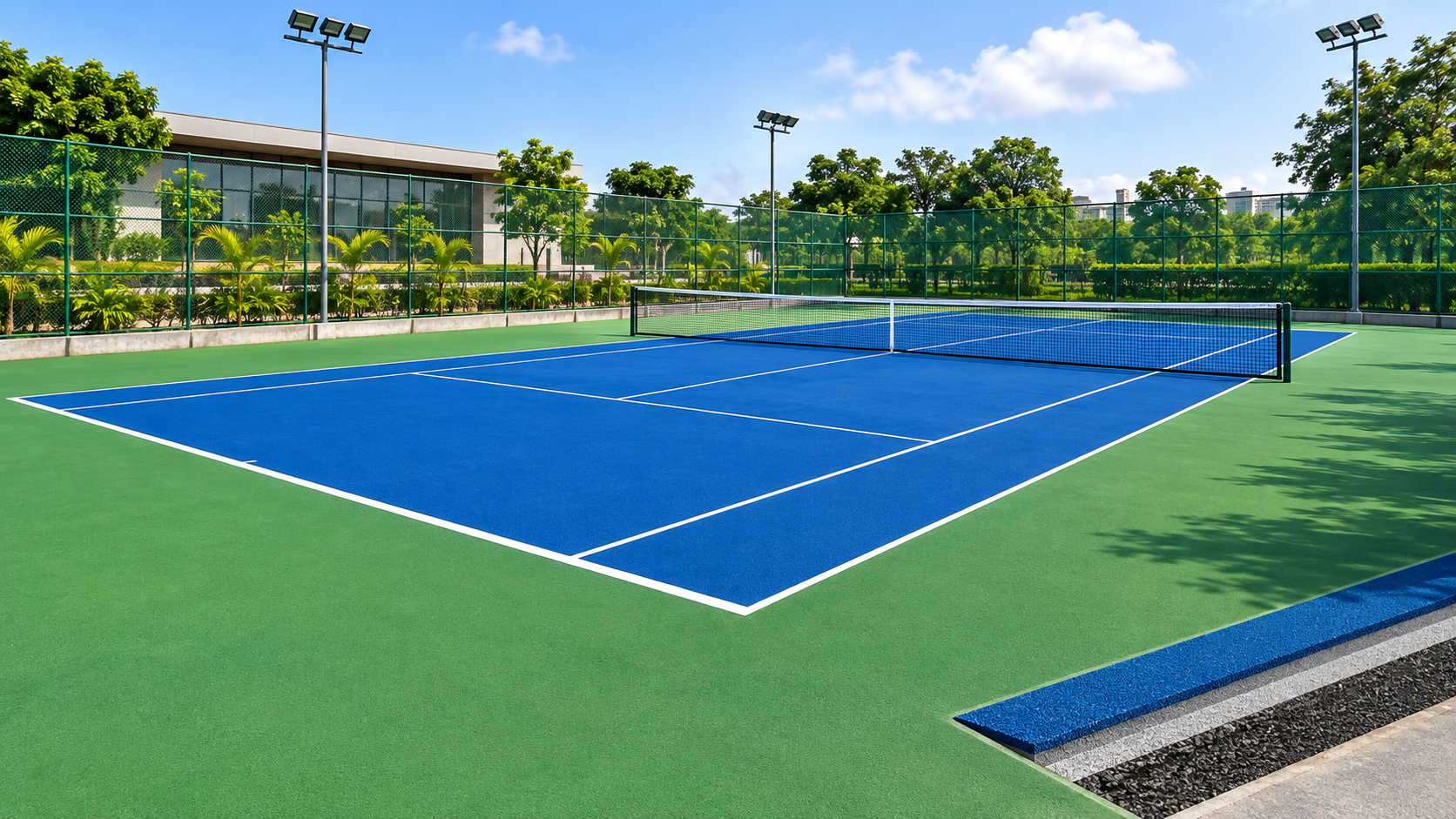
Acrylic tennis court flooring is one of the most widely used solutions for professional and recreational tennis facilities. It generally consists of multiple layers of acrylic-based coatings applied over a properly prepared asphalt or concrete base.
This system creates a smooth, textured, and visually attractive playing surface. It also allows facility owners to select different colours and adjust playing characteristics through the appropriate coating system.
Key benefits of acrylic tennis court flooring:
- Provides a consistent and predictable ball bounce.
- Offers good resistance to regular outdoor use.
- Available in different colours and surface textures.
- Requires relatively straightforward routine maintenance.
- Suitable for tennis academies, sports clubs, schools, and commercial facilities.
- Can be installed with cushioned layers for additional playing comfort.
Acrylic flooring is particularly suitable for facilities looking for a professional-looking hard court with a balance of performance and maintenance convenience.
However, the quality of the underlying base is extremely important. Poor drainage, cracks, or uneven construction can affect the performance and lifespan of the finished surface.
Synthetic Grass Tennis Court Flooring
Synthetic grass is another popular choice, particularly for recreational facilities and sports complexes.
It uses artificial grass fibres installed over a prepared base, usually with a suitable sand or other specified infill system. The finished surface provides a different playing experience compared with conventional acrylic courts.
Advantages of synthetic grass flooring:
- Creates a natural grass-like appearance.
- Provides a relatively comfortable playing surface.
- Can be suitable for outdoor recreational facilities.
- Available in different pile heights and specifications.
- Does not require the regular mowing associated with natural grass.
Synthetic grass requires appropriate brushing, infill management, cleaning, and periodic inspection. The quality of the fibres, backing, infill, and installation all influence its performance.
Before selecting this option, check the product’s tennis-specific performance characteristics rather than choosing artificial grass based on appearance alone.
Clay Tennis Court Flooring
Clay courts are well known for their slower playing speed and higher ball bounce. They are commonly associated with traditional tennis facilities and professional tournaments.
Traditional clay surfaces use specially prepared mineral materials, such as crushed brick or other suitable aggregates.
Benefits of clay tennis courts:
- Produces a slower playing experience.
- Encourages longer rallies and strategic gameplay.
- Allows players to slide when the surface is properly maintained.
- Offers a distinctive traditional tennis experience.
However, clay courts require more regular attention than many hard-court systems. Watering, brushing, surface levelling, and periodic material replacement are important parts of their maintenance.
If your facility has limited maintenance staff or wants a relatively low-maintenance flooring solution, traditional clay may not be the most practical choice.
Natural Grass Tennis Court Flooring
Natural grass is one of the traditional tennis court surfaces. It provides a distinctive appearance and a fast-paced playing experience.
Grass courts generally produce a lower and sometimes less predictable ball bounce compared with many hard-court surfaces.
Advantages include:
- Attractive natural appearance.
- Fast playing characteristics.
- A distinctive experience for tennis enthusiasts.
- Suitable for specialised sports clubs and premium facilities.
However, natural grass requires considerable maintenance, including mowing, watering, fertilisation, pest management, and regular surface preparation.
It is generally better suited to facilities with the resources and expertise required to maintain a natural playing surface.
Cushioned Tennis Court Flooring
Cushioned tennis court flooring is designed to provide additional comfort compared with conventional hard-court systems.
It typically uses specialised elastic or cushioning layers beneath or within an acrylic sports surface system.
The cushioning can help modify the impact response of the playing surface, depending on the system specification.
Why consider cushioned tennis flooring?
- Offers a more comfortable playing experience.
- Can help reduce the harsh feel associated with conventional hard courts.
- Suitable for training centres and facilities with frequent player activity.
- Available in different system configurations.
- Can provide a professional finish with appropriate surface coatings.
The important thing is to select a tested sports flooring system designed specifically for tennis rather than using generic rubber flooring or unrelated cushioning materials.
2. Consider the Type of Players Using Your Facility
One of the biggest mistakes facility owners make is selecting flooring based only on appearance or initial installation cost.
Instead, think about who will use the court regularly.
A professional tennis academy has different requirements from a residential tennis court or a school sports facility.
For example:
Professional tennis academies
Professional training facilities generally need consistent ball bounce, reliable traction, and a surface that supports regular training sessions. Acrylic and cushioned acrylic systems can be suitable options depending on the playing requirements.
Schools and educational institutions
Schools should prioritise durability, manageable maintenance, player comfort, and suitability for different age groups. A properly designed acrylic tennis court may be a practical solution.
Residential and recreational facilities
For residential communities and recreational clubs, appearance, ease of cleaning, maintenance requirements, and overall playing comfort are important considerations.
Commercial sports complexes
Commercial facilities need flooring that can handle regular bookings and repeated use. Durability, maintenance planning, repair options, and long-term operating costs should all be considered.
Understanding the primary users of your tennis court will help narrow down the available flooring options.
3. Evaluate the Local Climate and Weather Conditions
Weather conditions can have a major influence on tennis court flooring performance.
A surface that performs well in one region may require additional maintenance or a different construction approach in another.
Before finalising your flooring system, consider the following environmental factors:
Temperature: Outdoor courts exposed to intense sunlight need suitable materials that can withstand temperature changes and UV exposure.
Rainfall: Facilities in areas with heavy rainfall should prioritise effective drainage and appropriate surface construction.
Humidity: High humidity can affect drying times and encourage unwanted biological growth in areas that remain damp.
Dust and pollution: Outdoor courts in dusty environments may require more frequent cleaning to maintain surface appearance and playing characteristics.
For example, in many parts of India, tennis court construction needs to account for high summer temperatures, monsoon rainfall, and seasonal dust.
Acrylic outdoor tennis court flooring can be a practical choice in many such locations, provided the base, drainage, coating system, and installation are properly designed for local conditions.
Remember that even the best flooring material cannot compensate for poor site preparation or inadequate drainage.
4. Check the Playing Performance and Surface Characteristics
The main purpose of tennis court flooring is to provide a suitable playing environment.
Therefore, it is important to evaluate how the surface affects the game.
Some of the most important characteristics include:
Ball bounce: The surface should provide suitable and consistent ball bounce across the playing area.
Court speed: Different flooring materials influence how quickly the ball travels after bouncing.
Traction: Players need appropriate grip to accelerate, stop, and change direction safely.
Surface texture: Texture affects both player movement and the interaction between the ball and the playing surface.
Impact response: The surface construction can influence how the court feels underfoot during regular play.
The International Tennis Federation (ITF) uses a Court Pace Classification system that places classified tennis surface products into five categories:
- Category 1 – Slow
- Category 2 – Medium-slow
- Category 3 – Medium
- Category 4 – Medium-fast
- Category 5 – Fast
This classification can help facility owners compare playing speed when evaluating suitable products.
However, court pace is only one part of the decision. It does not independently establish the overall quality, safety, or suitability of a flooring system.
Always discuss the intended playing characteristics with your tennis court flooring contractor before selecting a product.
5. Look Beyond the Initial Installation Cost
Budget is an important consideration in every sports infrastructure project. However, choosing the cheapest tennis court flooring option may result in higher expenses over time.
A better approach is to calculate the total cost of ownership.
This includes:
- Site preparation and excavation.
- Base construction.
- Surface materials and installation.
- Drainage arrangements.
- Court line marking.
- Maintenance and cleaning.
- Periodic resurfacing or repairs.
- Long-term operational expenses.
For instance, an acrylic court may have a higher initial installation cost than some basic alternatives, but its maintenance requirements and expected service life may make it a suitable long-term investment.
Similarly, natural grass may look attractive, but its regular maintenance can increase operating expenses.
Ask contractors to provide a detailed quotation that clearly separates material costs, labour, base preparation, drainage, and additional services.
Do not compare two quotations based only on the final price. Make sure both contractors are proposing comparable flooring systems and construction specifications.
6. Give Proper Attention to the Base Construction
A tennis court’s performance depends on much more than the visible top layer.
The foundation beneath the flooring plays a major role in determining the quality and longevity of the entire court.
Depending on the selected system and site conditions, the base may involve properly designed asphalt or concrete construction with suitable preparation and drainage.
Important considerations include:
Ground preparation: The site should be properly assessed and prepared before construction begins.
Surface levels: The base must have the appropriate levels and slopes specified for the selected court system.
Drainage: Rainwater should be managed effectively to prevent unwanted water accumulation.
Crack prevention: The base should be designed and constructed to minimise cracking and movement that could affect the surface.
Surface readiness: Before applying acrylic coatings or installing synthetic grass, the base should meet the flooring manufacturer’s preparation requirements.
A professionally installed tennis court begins with a well-planned foundation. Skipping essential preparation work can lead to cracking, uneven surfaces, drainage problems, and premature repairs.
7. Consider Maintenance Requirements Before Making a Decision
Maintenance is often overlooked during the planning stage, but it has a direct impact on the long-term performance of tennis court flooring.
Different surfaces require different levels of care.
Acrylic courts generally require regular cleaning, removal of debris, inspection of cracks, and periodic resurfacing when necessary.
Synthetic grass courts need brushing, infill maintenance where applicable, and cleaning to prevent dirt accumulation.
Clay courts require regular watering, brushing, levelling, and replenishment of surface materials.
Natural grass courts need frequent mowing, watering, fertilisation, and specialised maintenance.
Before selecting your flooring system, ask yourself:
- How frequently will the court be used?
- Is maintenance staff available on-site?
- How much time can be allocated to cleaning and upkeep?
- Are specialised maintenance services easily available?
- What is the expected cost of periodic resurfacing?
The right tennis court flooring should match not only your playing requirements but also your ability to maintain it properly.
8. Choose an Experienced Tennis Court Flooring Contractor
Even high-quality materials can deliver disappointing results when installation is not carried out correctly.
That is why selecting the right contractor is just as important as choosing the flooring material.
Look for a company with experience in tennis court construction, sports flooring installation, and surface maintenance.
Before finalising a contractor, consider these points:
Previous project experience: Ask to see completed tennis court projects and, where possible, visit an installed facility.
Material specifications: Request details about the flooring products, coating layers, infill, and system configuration.
Technical knowledge: The contractor should be able to explain the installation process, base requirements, drainage, and surface preparation.
Workmanship: Check whether the company follows the manufacturer’s recommended installation procedures.
Warranty and after-sales support: Understand what the warranty covers and whether maintenance or repair services are available.
Project timeline: Ask for a realistic schedule covering site preparation, installation, curing, and handover.
A reliable contractor should be willing to explain why a particular flooring system is suitable for your facility instead of simply recommending the most expensive option.
9. Compare Tennis Court Flooring Options Before Finalising
Here is a quick comparison to help you understand the major differences between common tennis court surfaces.
| Flooring type | Playing characteristics | Maintenance requirements |
|---|---|---|
| Acrylic hard court | Consistent bounce, medium to fast depending on system | Low to moderate |
| Synthetic grass | Surface-dependent, often lower and faster bounce | Moderate |
| Traditional clay | Slower play and higher bounce | High |
| Natural grass | Fast play and lower bounce | Very high |
| Cushioned acrylic | Adjustable playing characteristics with added cushioning | Low to moderate |
Note: Actual performance and maintenance requirements depend on the specific product, construction, installation quality, usage, and environmental conditions.
For many schools, clubs, sports academies, and commercial facilities, acrylic tennis court flooring is worth considering because it offers a practical combination of playing consistency, design flexibility, and manageable maintenance.
However, the final decision should always be based on the facility’s actual requirements.
10. Common Mistakes to Avoid When Choosing Tennis Court Flooring
A well-planned tennis court can serve a facility for years. However, a few common mistakes can create unnecessary expenses and maintenance problems.
Here are some issues to avoid:
Choosing flooring only because of its appearance
An attractive colour or grass-like finish does not automatically mean the surface is suitable for tennis. Always check its playing characteristics and technical specifications.
Ignoring drainage requirements
Poor drainage can result in water accumulation, surface damage, and interruptions to court usage.
Selecting unsuitable materials
Not every outdoor sports flooring product is designed for tennis. Make sure the system is intended for tennis court applications.
Overlooking maintenance costs
A surface with a low installation price may require more frequent maintenance and repairs.
Hiring contractors without checking their experience
Poor installation practices can affect the entire court, even when premium materials are used.
Not checking product specifications
Ask for technical data, manufacturer recommendations, relevant testing information, and applicable certifications before approving the system.
Avoiding these mistakes can help you make a more informed investment and reduce the likelihood of future problems.
11. A Practical Checklist Before Installing Tennis Court Flooring
Before starting your tennis court flooring project, take time to review the following points:
- Identify the primary users of the facility.
- Decide whether the court will be used for professional training or recreational play.
- Compare acrylic, synthetic grass, clay, and cushioned flooring systems.
- Assess local weather conditions and drainage requirements.
- Confirm the quality and suitability of the base construction.
- Review the product’s technical specifications.
- Compare installation and long-term maintenance costs.
- Check the contractor’s previous projects.
- Understand warranty conditions and after-sales support.
- Plan a regular inspection and maintenance schedule.
Following this checklist will make it easier to compare different proposals and select a system that meets your expectations.
Conclusion: Invest in the Right Tennis Court Flooring for Long-Term Performance
Choosing the best tennis court flooring for your facility requires careful planning and a clear understanding of your requirements. There is no single flooring system that works perfectly for every project.
Acrylic tennis court flooring is a strong option for facilities looking for consistent playing characteristics, design flexibility, and manageable maintenance. Synthetic grass may be more suitable for recreational environments, while clay and natural grass offer specialised playing experiences for facilities prepared to handle their maintenance needs.
The most important thing is to consider the complete flooring system, including the foundation, drainage, playing characteristics, installation quality, and long-term maintenance.
A properly planned and professionally installed tennis court can provide a better playing experience, support regular sports activities, and deliver lasting value to your facility.
If you are planning a new tennis court or considering upgrading an existing one, take time to consult an experienced sports flooring specialist. The right technical guidance at the beginning can help you avoid costly mistakes and achieve a court that meets your expectations.
Looking for a reliable tennis court flooring solution? Connect with an experienced tennis court flooring professional to discuss your project requirements, explore suitable surface options, and find the right system for your facility.