Introduction
Choosing the right running track surface is one of the most important decisions when planning a professional athletics track, school sports facility, university playground, stadium, or recreational running area. A high-quality running track does more than provide a smooth surface for athletes. It plays a significant role in athletic performance, running comfort, injury prevention, durability, and long-term maintenance.
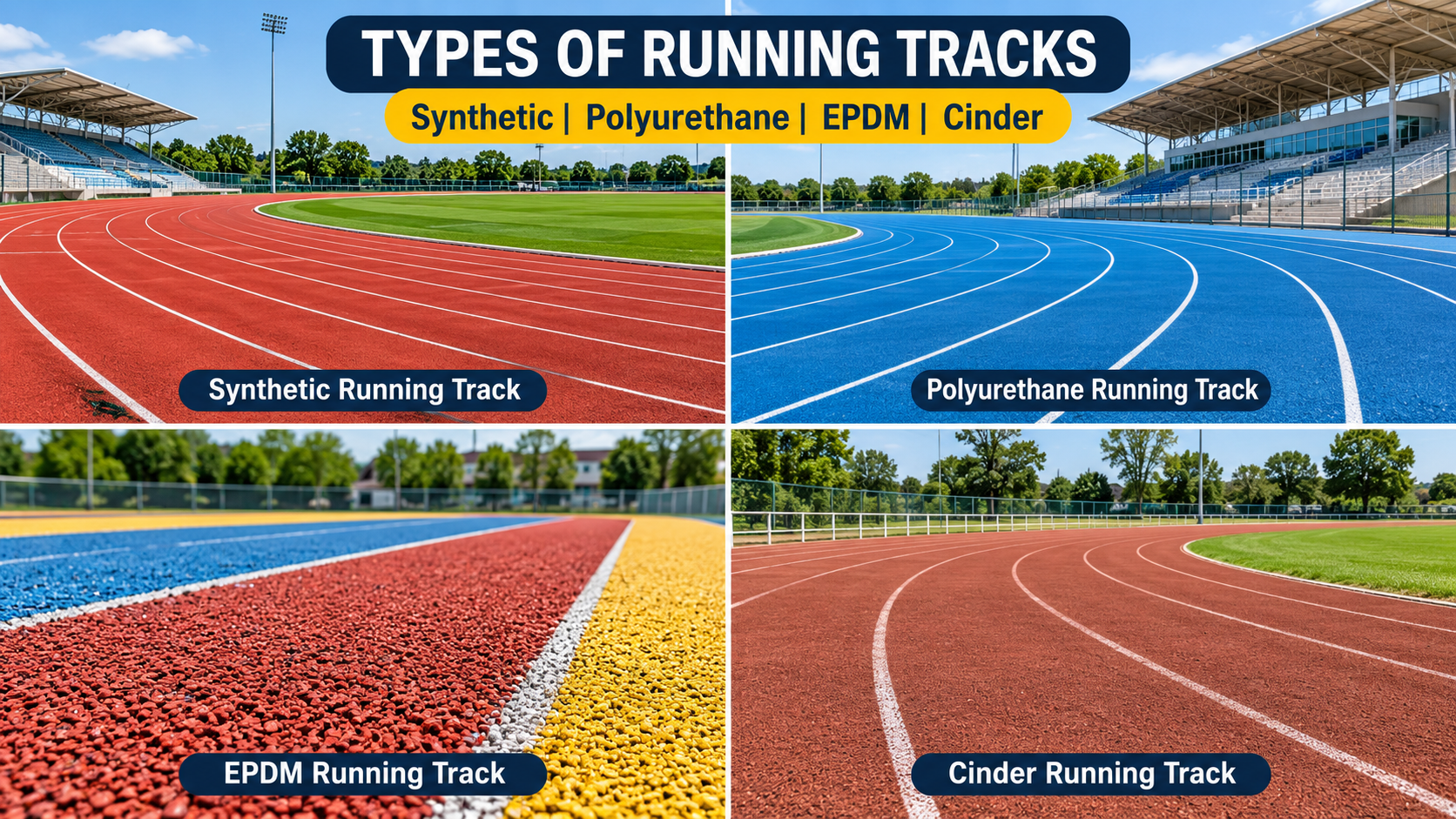
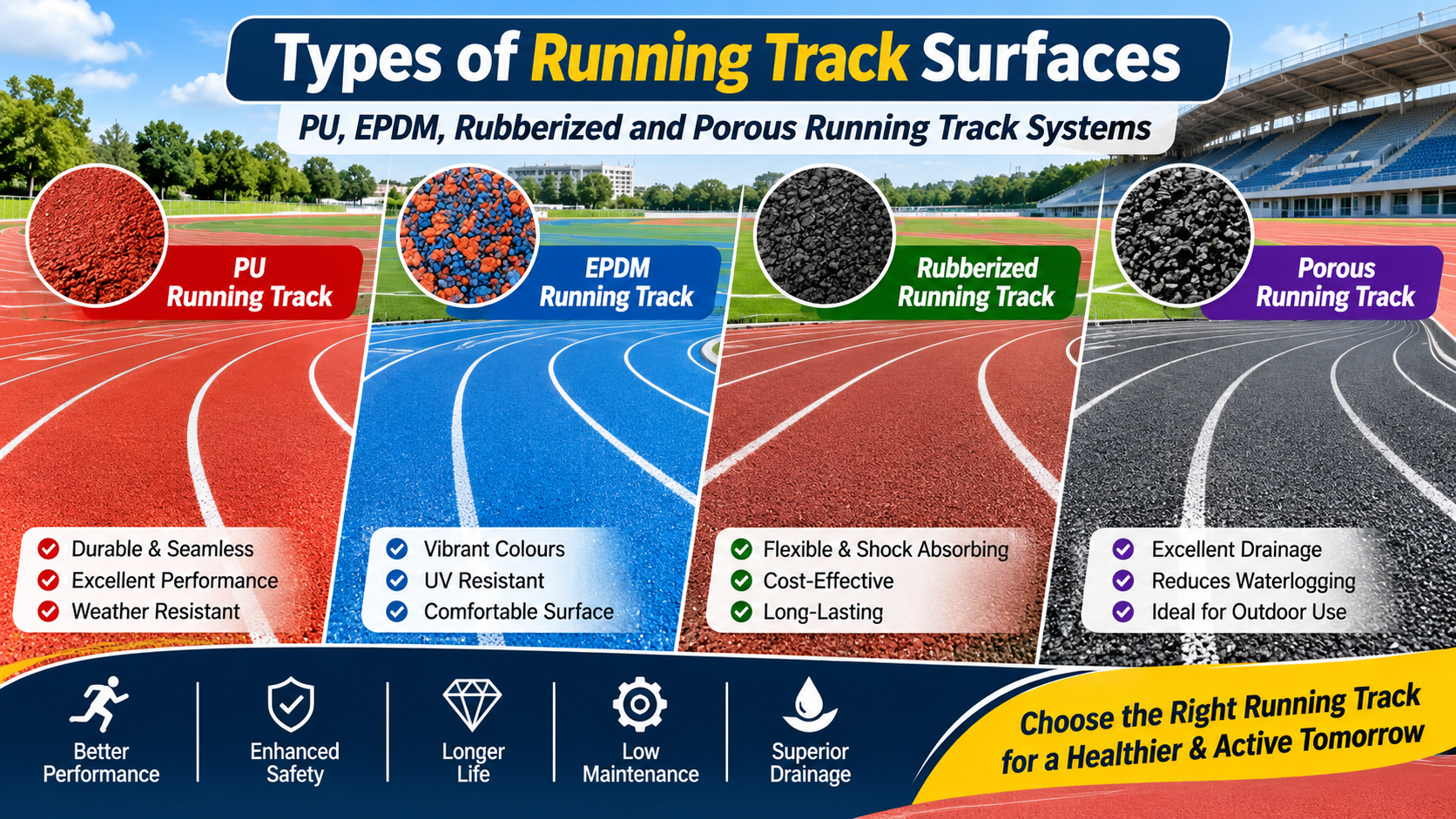
With advancements in sports infrastructure and synthetic flooring technology, several types of running track surfaces are now available. Among the most popular options are Polyurethane (PU) running tracks, EPDM running tracks, rubberized running tracks, and porous running track systems. Each system has its own characteristics, installation requirements, advantages, and applications.
Whether you are developing an international-standard athletics stadium, a school running track, a college sports ground, or a community fitness facility, understanding these different running track surface systems can help you make an informed investment.
In this comprehensive guide, we will explore the major types of synthetic running track surfaces, their materials, construction methods, benefits, limitations, and suitability for different sports facilities.
1. PU Running Track Surface (Polyurethane Running Track)
Polyurethane, commonly known as PU, is one of the most widely used materials in modern synthetic athletics track construction. PU running tracks are designed to provide athletes with a consistent, resilient, and durable running surface.
These tracks are commonly installed in professional sports stadiums, athletic training centres, universities, and competition facilities where surface performance and durability are important considerations.
What Is a PU Running Track?
A PU running track is a synthetic sports surface manufactured using polyurethane-based resin systems, often combined with rubber granules. The polyurethane binder holds the materials together and creates a flexible, seamless, and weather-resistant surface.
Depending on the construction method, PU running tracks can be installed as full polyurethane systems, sandwich systems, or spray-coated systems.
Types of PU Running Track Systems
A. Full PU Running Track System
A full PU running track is a premium synthetic surface in which polyurethane materials form the main structural and wearing layers. The system generally consists of a prepared base, polyurethane layers, and a specialised surface finish.
Key characteristics include:
- Excellent surface consistency.
- Controlled shock absorption and energy return.
- Seamless synthetic construction.
- Good resistance to regular athletic use.
- Suitability for professional sports facilities.
Full PU systems are particularly suitable for stadiums and high-performance athletics facilities.
B. Sandwich PU Running Track System
A sandwich running track combines a resilient rubber base layer with a polyurethane sealing layer and a top coating.
The lower layer generally contains rubber granules bonded with polyurethane resin. The upper layer provides a smooth, durable, and textured finish.
Benefits include:
- A comfortable and resilient running surface.
- Good durability under regular use.
- A balance between performance and installation cost.
- Reduced surface maintenance compared with many traditional sports surfaces.
C. Spray-Coated PU Running Track System
Spray-coated PU tracks typically feature a rubber-based elastic layer with a polyurethane coating containing EPDM granules. The coating is applied to create a textured and slip-resistant finish.
This type of system is commonly considered for training facilities, educational institutions, and recreational sports infrastructure.
Advantages of PU Running Tracks
- Consistent running characteristics.
- Excellent flexibility and resilience.
- Weather-resistant surface properties.
- Seamless appearance.
- Suitable for intensive athletic activities.
- Available in multiple colours.
- Can be designed to meet applicable athletics performance requirements.
Applications of PU Running Tracks
PU running track systems are suitable for professional athletics stadiums, international sports facilities, school playgrounds, college campuses, sports academies, and athletic training centres.
2. EPDM Running Track Surface
What Is an EPDM Running Track?
An EPDM running track is a synthetic surface system made using coloured EPDM rubber granules combined with a suitable polyurethane binder.
The granules are mixed with the binder and installed over a properly prepared base or resilient layer. Once cured, they form a flexible and textured surface.
EPDM rubber is available in different colours, allowing architects, sports facility developers, and project owners to create visually attractive running tracks.
Key Features of EPDM Running Track Surfaces
1. Excellent Colour Stability
EPDM granules are available in a wide range of colours, including red, green, blue, terracotta, and grey. High-quality UV-stable EPDM materials help maintain their appearance when exposed to outdoor sunlight.
2. Weather Resistance
EPDM rubber offers good resistance to outdoor environmental conditions. It can withstand exposure to sunlight, rain, and temperature variations when installed using an appropriate system.
3. Flexibility and Comfort
The elastic properties of EPDM rubber provide a comfortable surface for jogging, walking, and recreational running.
4. Slip Resistance
The textured finish of EPDM surfaces can provide suitable traction for users. Actual slip resistance depends on granule size, binder content, installation quality, and surface texture.
5. Design Flexibility
Different colours and patterns can be incorporated into EPDM flooring, making it suitable for schools, parks, sports complexes, and recreational facilities.
Advantages of EPDM Running Tracks
- Attractive coloured finish.
- Good resistance to UV exposure.
- Flexible and resilient surface.
- Suitable for outdoor applications.
- Comfortable for recreational activities.
- Available in different thicknesses and granule sizes.
- Relatively straightforward routine cleaning.
Applications of EPDM Running Track Systems
EPDM surfaces are frequently used in school running tracks, jogging pathways, fitness zones, recreational parks, children’s play areas, warm-up zones, and multi-purpose sports facilities.
It is important to understand that an EPDM surface is not automatically suitable for professional athletics competition. Its performance depends on the complete surface system, including the binder, base, thickness, texture, and tested performance characteristics.
3. Rubberized Running Track Surface
Rubberized running tracks are synthetic sports surfaces manufactured using rubber granules combined with specialised binding materials.
These surfaces are popular because rubber provides flexibility, impact absorption, and a relatively comfortable running experience.
Rubberized running track systems can be manufactured using recycled rubber, virgin rubber, EPDM granules, or a combination of different rubber materials.
What Is a Rubberized Running Track?
A rubberized running track generally consists of rubber granules bonded together using polyurethane or another suitable binder.
The construction may include a shock-absorbing rubber layer and a coloured or textured top surface.
The exact composition varies according to the intended application, performance requirements, and project budget.
Types of Rubberized Running Track Systems
A. SBR Rubber Running Track
SBR stands for Styrene Butadiene Rubber. It is commonly used in the base layer of synthetic sports surfaces because of its elastic properties and cost advantages.
SBR rubber granules are often manufactured from recycled rubber materials.
Advantages include:
- Cost-effective material option.
- Good shock absorption.
- Suitable for resilient base layers.
- Helps provide flexibility to the track structure.
However, SBR is generally less colour-stable than premium coloured EPDM granules when exposed to outdoor conditions. It is therefore commonly covered with a suitable wearing layer.
B. EPDM-Topped Rubberized Track
This system uses an elastic rubber base with an EPDM granule finish.
The lower rubber layer provides resilience, while the upper EPDM layer offers colour, texture, and weather-resistant surface properties.
It is commonly selected for educational institutions, jogging tracks, and sports facilities.
C. Recycled Rubber Running Track
Recycled rubber running tracks use processed rubber materials, often sourced from end-of-life tyres, as part of the surface construction.
They can provide a cost-effective solution for recreational facilities and selected sports applications.
However, material quality, contamination control, granule consistency, binder compatibility, and environmental compliance must be evaluated before installation.
Advantages of Rubberized Running Tracks
- Good impact-absorbing characteristics.
- Flexible surface construction.
- Comfortable for regular running and jogging.
- Multiple material and colour combinations.
- Potential use of recycled materials.
- Suitable for recreational and athletic training facilities.
Where Are Rubberized Running Tracks Used?
Rubberized running tracks are commonly installed in schools, colleges, sports academies, residential sports complexes, jogging parks, fitness centres, and outdoor recreational areas.
The correct rubber formulation and surface design should always be selected according to the intended level of athletic use.
4. Porous Running Track Surface System
Porous running track systems are designed to allow water to pass through the surface rather than collecting on top of it.
This construction approach is particularly useful for outdoor sports facilities where effective rainwater drainage is an important consideration.
Porous running tracks are generally constructed using a permeable wearing course over a suitable porous base or drainage structure.
What Is a Porous Running Track?
A porous running track is a specially designed synthetic or granular surface system that allows water to drain through interconnected openings within the surface structure.
Unlike conventional impermeable surfaces, where rainwater flows towards external drainage channels, porous systems allow water to move vertically through the surface into the underlying drainage layer.
The complete system must be designed to manage water efficiently.
Construction of a Porous Running Track
A typical porous running track construction may include the following layers:
1. Prepared Subgrade
The existing soil is excavated, levelled, compacted, and prepared to provide a stable foundation.
2. Granular Sub-Base
A suitable aggregate layer is installed to provide structural support and help distribute loads.
3. Porous Asphalt or Permeable Base
A porous asphalt layer or other engineered permeable base is installed to facilitate drainage and provide a suitable foundation for the surface system.
4. Porous Rubber Surface
A specially designed porous rubber mixture may be installed using selected rubber granules and a suitable binder formulation.
5. Surface Finishing
The final surface is checked for evenness, texture, drainage performance, and compliance with the project specifications.
Advantages of Porous Running Track Systems
- Allows water to drain through the surface.
- Reduces surface water accumulation when properly designed.
- Can improve usability after rainfall.
- Supports outdoor sports facility drainage planning.
- Provides a suitable option for selected recreational and athletic applications.
Important Considerations
Porous running tracks require careful material selection and construction planning. The binder quantity, aggregate grading, porosity, sub-base design, and drainage outlet arrangement all influence the final performance.
Blocked pores, unsuitable materials, poor compaction, or inadequate drainage design can reduce water permeability.
Porous systems should also be evaluated for athletic performance, as high water permeability alone does not guarantee suitable shock absorption, traction, or competition compliance.
5. Comparison Between PU, EPDM, Rubberized and Porous Running Track Systems
Selecting the right running track surface requires an understanding of the differences between the available systems.
The following comparison highlights their general characteristics.
| Parameter | PU Running Track | EPDM Running Track | Rubberized Track | Porous Track |
|---|---|---|---|---|
| Main material | Polyurethane resin | EPDM rubber granules | Rubber granules and binder | Permeable rubber or engineered surface |
| Surface finish | Smooth or textured | Granular texture | Elastic texture | Open or permeable texture |
| Shock absorption | System-dependent | System-dependent | System-dependent | System-dependent |
| Colour options | Multiple | Extensive | Multiple | Depends on material |
| Water drainage | Depends on design | Depends on design | Depends on design | Designed for permeability |
| Typical applications | Professional and training tracks | Recreational and sports areas | Training and recreational facilities | Outdoor sports facilities |
| Maintenance | Periodic inspection and cleaning | Periodic inspection and cleaning | Periodic inspection and cleaning | Includes pore and drainage maintenance |
Important: PU, EPDM, and rubberized describe material or surface-system characteristics, whereas porous describes a drainage characteristic. These categories are not always mutually exclusive. For example, an EPDM-topped rubber system may also be designed as a porous running track.
6. How to Choose the Right Running Track Surface
The best running track surface depends on the facility’s purpose, expected traffic, available investment, climatic conditions, and performance requirements.
Before selecting a surface system, consider the following factors.
1. Purpose of the Running Track
The first consideration is how the running track will be used.
2. Project Budget
Different synthetic running track systems have different material, labour, equipment, and maintenance costs.
Full PU systems are generally positioned as premium options, while some rubberized and recreational EPDM systems can offer more economical solutions.
However, the lowest initial installation cost should not be the only selection criterion. Long-term durability and maintenance expenses should also be considered.
3. Climate and Weather Conditions
Outdoor tracks are exposed to sunlight, rain, humidity, and temperature changes.
In areas receiving heavy rainfall, drainage design becomes particularly important.
For locations with strong sunlight, UV-resistant materials and appropriate surface coatings can help maintain long-term appearance.
4. Shock Absorption and Athlete Comfort
A running track should provide suitable impact absorption, traction, and energy return according to the intended sporting application.
The right combination of surface thickness, rubber formulation, binder, and base construction determines these performance characteristics.
5. Maintenance Requirements
Every running track requires periodic inspection and maintenance.
Regular cleaning, removal of dirt and debris, inspection of surface joints, checking drainage outlets, and timely repair of damaged areas can extend the service life of the facility.
7. Running Track Construction Process
Regardless of the selected surface, proper installation is essential for achieving long-term performance.
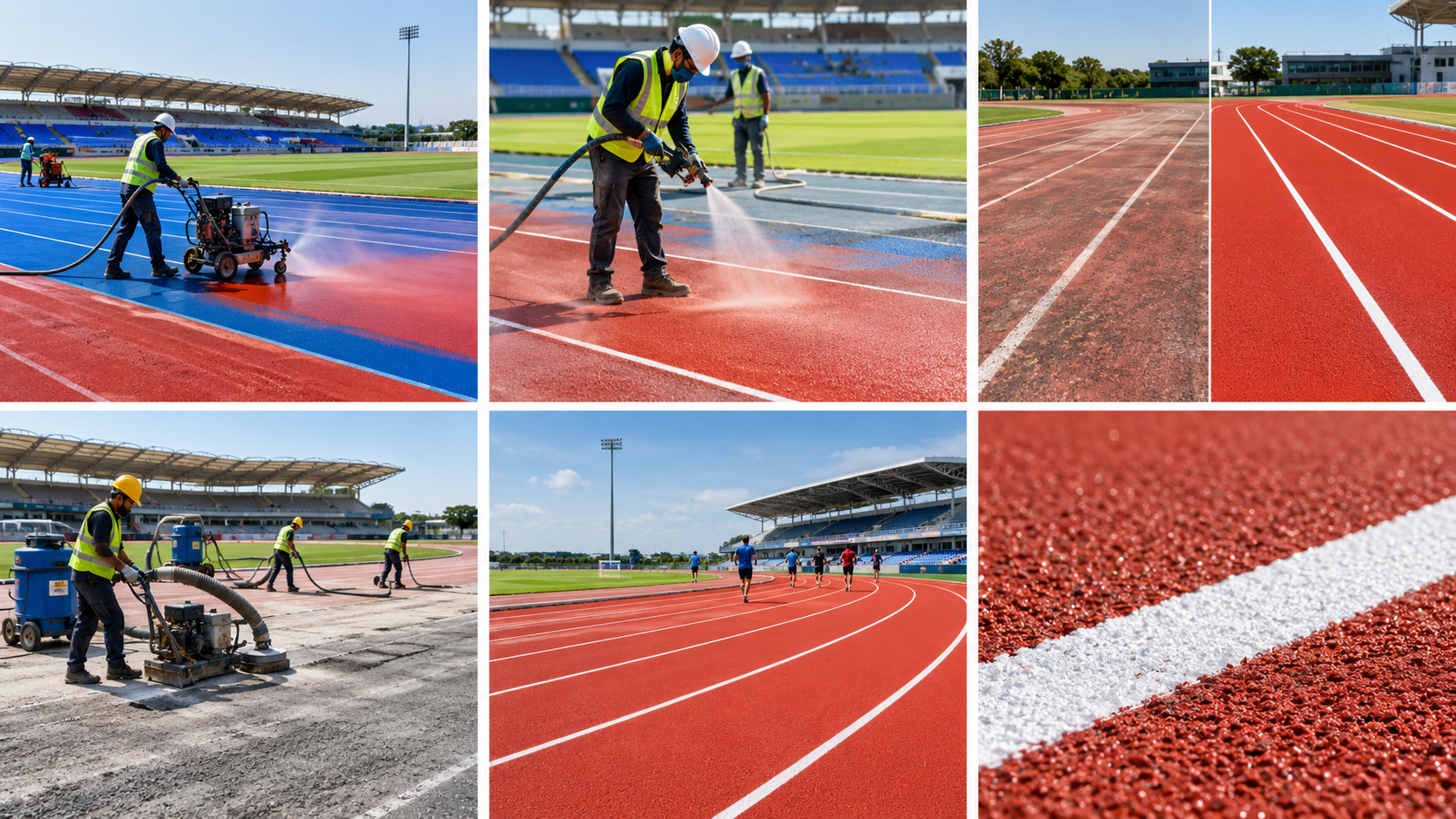
A professionally constructed running track generally involves the following stages:
Step 1: Site Inspection and Planning
The construction team evaluates the existing ground, site dimensions, soil conditions, levels, drainage requirements, and intended track layout.
Step 2: Earthwork and Subgrade Preparation
The existing ground is excavated, levelled, and compacted according to the engineering specifications.
Step 3: Base Construction
Suitable aggregate, asphalt, or concrete layers are installed depending on the selected running track system.
Step 4: Surface Installation
The selected PU, EPDM, rubberized, or porous surface materials are installed using the recommended application process.
Step 5: Line Marking
Track lanes, starting positions, finishing lines, and event markings are measured and applied according to the approved layout.
Step 6: Quality Inspection
The completed track is inspected for surface uniformity, dimensions, drainage, thickness, and relevant performance requirements.
For professional competition facilities, additional testing and certification may be required.
8. Why Professional Running Track Installation Matters
A high-quality running track depends on more than the surface material itself. The quality of the foundation, drainage system, installation technique, material compatibility, and finishing process all contribute to the final result.
Improper base preparation can lead to uneven surfaces, cracking, water accumulation, and premature deterioration.
Similarly, incorrect mixing ratios, poor binder application, and inadequate curing can affect surface strength and performance.
Working with an experienced sports infrastructure contractor helps ensure that the selected system is installed according to the manufacturer’s technical specifications and project requirements.
Before finalising a contractor, review previous sports flooring projects, material specifications, installation experience, warranty conditions, and quality-control procedures.
9. Which Running Track Surface Is Best?
There is no single running track surface that is ideal for every sports facility.
- PU running tracks: A strong option for professional athletics facilities and high-performance sports infrastructure.
- EPDM running tracks: Suitable for recreational running, educational institutions, jogging pathways, and colourful sports flooring applications.
- Rubberized running tracks: A practical option for flexible, resilient, and comfortable sports surfaces.
- Porous running tracks: Worth considering for outdoor facilities where surface permeability and effective rainwater drainage are important.
The right decision should be based on the complete surface-system specification rather than the material name alone.
For professional athletics facilities, the selected system should be evaluated against applicable World Athletics requirements, including relevant testing and certification provisions where competition use requires them.
Conclusion
Selecting the right running track surface is an important step in developing a safe, durable, and high-performing sports facility. PU, EPDM, rubberized, and porous running track systems each offer different advantages depending on their material composition, construction method, drainage characteristics, and intended application.
PU running tracks are widely recognised for professional synthetic athletics surfaces. EPDM systems offer attractive colours and weather-resistant rubber finishes. Rubberized tracks provide flexible and resilient flooring options, while porous systems offer specialised water-drainage advantages.
However, the long-term success of any running track project depends on proper site preparation, high-quality materials, professional installation, effective drainage, and regular maintenance.
Whether you are planning a school athletics track, a university sports ground, a professional stadium, or a recreational jogging facility, selecting the appropriate running track system can help create a reliable sports surface that serves athletes and communities for years to come.
Looking for the right running track construction solution? Consult an experienced sports flooring specialist to evaluate your site, understand your performance requirements, and select a suitable PU, EPDM, rubberized, or porous running track system.
Frequently Asked Questions (FAQs)
1. What are the main types of running track surfaces?
The main types include polyurethane (PU) running tracks, EPDM rubber tracks, rubberized running tracks, and porous running track systems. The most suitable option depends on the facility’s purpose, budget, performance requirements, and drainage needs.
2. Which material is best for professional running tracks?
Polyurethane-based synthetic systems are widely used for professional athletics tracks. However, the complete system must meet the applicable performance specifications and competition requirements.
3. What is the difference between PU and EPDM running tracks?
PU refers to polyurethane resin used as a binder, coating, or structural surface material. EPDM refers to a type of synthetic rubber commonly supplied as granules. Many synthetic running tracks use both materials together.
4. Are EPDM running tracks suitable for outdoor use?
Yes. Quality EPDM granules offer good UV and weather resistance, making them suitable for outdoor sports flooring when installed with a compatible binder and properly designed base.
5. What is a porous running track?
A porous running track is designed to allow water to pass through its surface and into an underlying drainage structure. This helps manage rainwater and reduce surface water accumulation.
6. How long does a synthetic running track last?
The service life depends on the material quality, construction method, installation standards, usage intensity, weather exposure, and maintenance practices. Regular inspection and timely repairs can help extend its useful life.
7. Can rubberized running tracks be used in schools?
Yes. Rubberized surfaces are commonly considered for school sports grounds, jogging tracks, recreational running areas, and fitness facilities. The selected system should match the intended activities and safety requirements.
8. Which running track surface is best for rainy areas?
A properly engineered porous running track can be a suitable option in areas with frequent rainfall. However, the complete drainage system, including the base and drainage outlets, must be designed correctly.
9. What is the difference between SBR and EPDM rubber?
SBR is commonly used as an economical rubber material, particularly in resilient base layers. EPDM is often selected for coloured top layers because of its better colour and outdoor weathering characteristics.
10. What factors affect running track construction costs?
Important factors include track dimensions, site preparation, soil conditions, base construction, selected surface system, material thickness, drainage arrangements, line marking, labour, and quality-testing requirements.