
Designing a Football Court: Standard Measurements and Guidelines
A football court, also known as a soccer field, requires careful planning to meet both professional and recreational standards. Whether for schools, clubs, or sports complexes, understanding the correct dimensions, layout, and construction requirements is essential for player safety and game quality.
Standard Football Field Dimensions
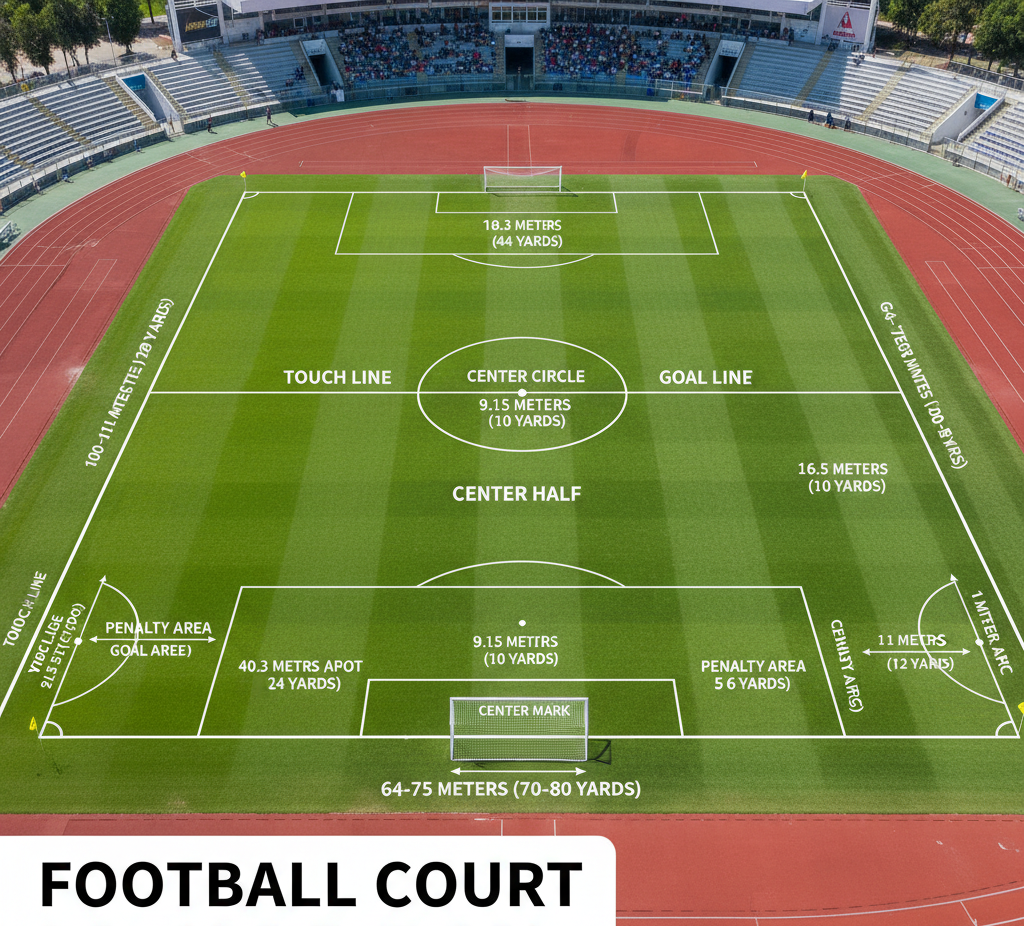
Football fields can vary depending on the level of play — professional, international, or recreational. According to FIFA regulations:
| Feature | Dimensions (Meters) | Dimensions (Feet) |
|---|---|---|
| Length (Touchline) | 90 – 120 m | 295 – 394 ft |
| Width (Goal line) | 45 – 90 m | 148 – 295 ft |
| International Matches | 100 – 110 m | 328 – 361 ft |
| International Width | 64 – 75 m | 210 – 246 ft |
| Goal Size | 7.32 m x 2.44 m | 24 ft x 8 ft |
| Penalty Area | 16.5 m from goal line | 54 ft |
| Goal Area | 5.5 m from goal line | 18 ft |
| Penalty Spot | 11 m from goal line | 36 ft |
| Center Circle Radius | 9.15 m | 30 ft |
Note: Recreational or school-level fields may be smaller but should maintain proportional dimensions for safe and fair play.
Football Court Construction Steps
1. Site Selection and Planning
-
Choose a flat, well-drained area with adequate space for full-size or smaller fields.
-
Consider accessibility, orientation (preferably north-south), and surrounding safety zones.
2. Ground Preparation
-
Clear the site of debris, rocks, and vegetation.
-
Level the ground and ensure a slight slope (1–2%) for proper water drainage.
3. Sub-Base and Soil Stabilization
-
Compact soil and add layers of crushed stone or gravel for stability.
-
Ensure proper drainage pipes to prevent water accumulation.
4. Turf or Surface Installation
-
Natural Grass:
-
Use high-quality, durable grass suited to your climate.
-
Irrigation systems are essential for maintenance.
-
-
Artificial Turf:
-
Synthetic turf provides year-round playability with lower maintenance.
-
Shock pads can be added to reduce player impact.
-
5. Line Marking
-
Use professional, weather-resistant paint for clear boundary lines: touchlines, goal lines, center circle, penalty area, and goal area.
6. Goalposts and Nets
-
Install regulation-size goalposts and nets at each end.
-
Ensure posts are securely anchored for player safety.
7. Optional Features
-
Fencing: To prevent balls from leaving the field.
-
Lighting: For evening or night play.
-
Seating & Spectator Stands: For clubs or school fields.
Tips for a Professional Football Court
-
Follow FIFA or local football association guidelines for competition fields.
-
Ensure proper slope and drainage to prevent waterlogging.
-
Choose the right turf type based on usage frequency and climate.
-
Use high-quality materials for goalposts, nets, and surface installation.
Applications
Football courts are suitable for:
-
Professional clubs and academies
-
School and college sports facilities
-
Community recreation centers
-
Residential or private sports areas
Conclusion
A properly constructed football court with accurate measurements is essential for a safe, fair, and enjoyable game. Whether building for professional use or recreational play, adhering to standard dimensions, quality materials, and proper installation ensures a field that lasts for years while providing the best playing experience.