The popularity of padel is growing rapidly across the world, and India is becoming an exciting market for this fast-paced racket sport. From sports clubs and fitness centres to hotels, resorts, residential communities and commercial sports facilities, more businesses are exploring padel court construction as a long-term investment.
However, before starting a project, one important question comes to mind: How much does it cost to build a padel court?
The answer depends on several factors, including the court design, construction materials, glass quality, artificial turf, lighting, foundation work, installation requirements and whether the facility is indoor or outdoor. A basic court and a premium commercial padel court can have significantly different construction budgets.
Understanding these costs before starting construction can help you make better decisions, avoid unnecessary expenses and build a court that delivers long-term performance.
In this guide, we will explain everything you need to know about padel court construction costs, including material expenses, construction requirements, pricing factors, installation processes, maintenance costs and tips for choosing the right construction company.
Whether you are planning to build a single court or develop a complete sports facility, this article will help you understand the investment involved.
1. How Much Does Padel Court Construction Cost?
The cost of padel court construction varies depending on the quality of materials, project location, site conditions and construction specifications.
In India, published estimates range from approximately ₹9 lakh for certain basic installed court packages to ₹35 lakh or more for higher-specification commercial projects. Premium indoor and panoramic installations can cost considerably more.
For practical budgeting, it is important to distinguish between a basic court package and a complete commercial installation.
Here is an indicative cost guide:
| Type of padel court | Estimated construction cost |
|---|---|
| Basic outdoor court package | ₹9–14 lakh |
| Standard commercial outdoor court | ₹18–25 lakh |
| Premium outdoor padel court | ₹25–35 lakh |
| Indoor padel court | ₹35–55 lakh+ |
| Premium panoramic court | ₹28–45 lakh+ |
Note: These are indicative planning ranges for the Indian market, not fixed quotations. The scope of supply, civil foundation, GST, transport, roofing and installation inclusions can differ between suppliers.
A basic package may cover the main structural components, glass panels, turf and standard accessories, while a commercial turnkey project may include foundation preparation, drainage, lighting, professional installation and additional engineering work.
For example, some published Indian supplier estimates start at ₹11.5 lakh for a locally manufactured court system, while premium European systems start at approximately ₹25 lakh, excluding certain additional expenses.
ChampCourts+2
Our recommendation: Always request a detailed quotation that clearly explains what is included in the total construction price. A lower initial quotation does not necessarily mean a more affordable project in the long run.
2. Understanding the Different Components of Padel Court Construction Cost
A padel court is not simply an enclosed playing area with artificial grass. It is an engineered sports structure that requires appropriate materials, a stable foundation and carefully planned installation.
Let’s understand the major cost components.
A. Steel Structure and Framework
The steel structure is one of the most important parts of a padel court. It supports the glass panels, metal mesh and other enclosure components.
A properly designed steel framework provides structural stability and helps the court withstand regular playing activity and environmental conditions.
The cost depends on:
-
Quality and grade of steel.
-
Thickness of structural sections.
-
Galvanisation and corrosion protection.
-
Powder coating and finishing.
-
Design complexity.
-
Transportation and installation requirements.
For outdoor courts, corrosion protection is particularly important because the structure is continuously exposed to rain, sunlight, humidity and temperature changes.
Choosing poor-quality steel to reduce initial expenses can result in corrosion, structural deterioration and expensive repairs.
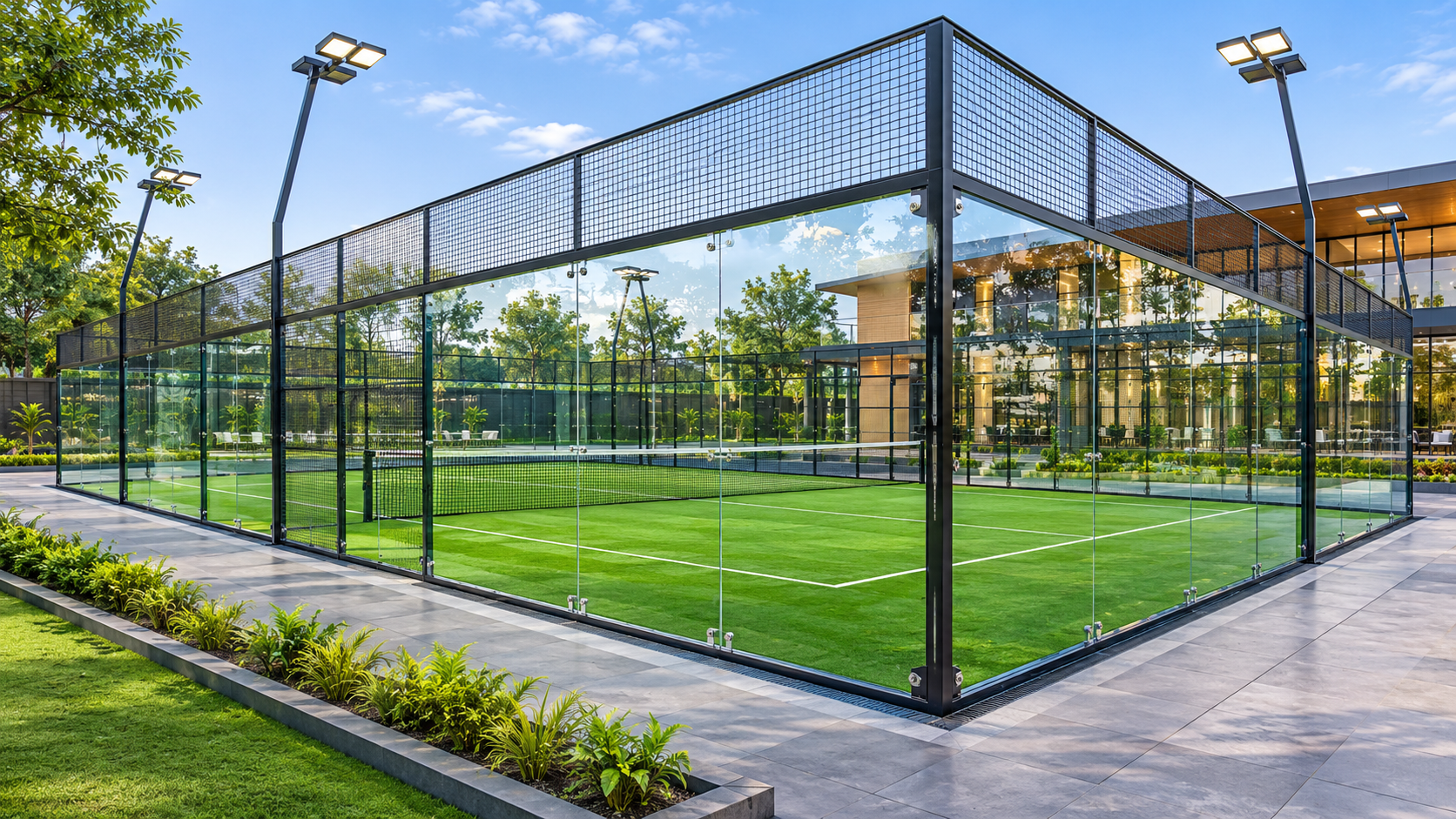
B. Tempered Glass Panels
Glass panels are a defining feature of a padel court. They allow players to use the walls during gameplay while providing spectators with a clear view of the match.
Most standard padel courts use specially manufactured tempered safety glass.
The cost depends on the glass thickness, manufacturing quality, panel dimensions and overall court design.
Common specifications include:
-
10 mm tempered glass.
-
12 mm tempered glass.
-
Standard glass enclosure systems.
-
Premium panoramic glass systems.
Panoramic courts generally have a more open appearance and offer improved spectator visibility. They are particularly attractive for professional clubs, tournaments and premium sports facilities.
However, the glass must be properly engineered, manufactured and installed. Incorrect installation can create safety concerns and affect the overall performance of the court.
C. Artificial Padel Turf
The playing surface directly affects the quality of the game. Therefore, artificial turf should be selected according to padel-specific performance requirements rather than simply choosing the cheapest synthetic grass available.
A suitable padel turf system generally includes:
-
Synthetic turf fibres.
-
Appropriate pile height.
-
Silica sand infill.
-
Suitable backing material.
-
UV-resistant properties.
-
Proper drainage characteristics.
The turf should provide consistent ball bounce, comfortable movement and adequate player traction.
Poor-quality turf can wear out quickly, become uneven or affect playing conditions.
When comparing suppliers, ask about the turf specification, UV resistance, installation method and maintenance requirements.
D. Foundation and Civil Construction
The foundation is another major expense that should never be overlooked.
Before installing the steel framework and glass enclosure, the construction team must prepare a stable and level base.
Civil construction may include:
-
Site clearing and excavation.
-
Soil preparation and compaction.
-
Concrete foundation or slab construction.
-
Reinforcement work.
-
Surface levelling.
-
Drainage arrangements.
-
Perimeter foundation work.
The exact foundation design depends on soil conditions, groundwater levels, site slope and structural requirements.
For example, a site with loose soil or poor drainage may require additional preparation compared with an already developed sports facility.
A properly constructed foundation helps prevent settlement, uneven playing surfaces and structural alignment problems.
E. LED Lighting System
Lighting is essential for players who want to enjoy padel during evening hours or in indoor facilities.
A professional LED lighting system provides better visibility and helps maintain consistent playing conditions.
The overall lighting cost depends on:
-
Number of LED fixtures.
-
Wattage and light distribution.
-
Pole height and positioning.
-
Electrical installation.
-
Required illumination levels.
-
Energy efficiency.
Commercial clubs may require higher lighting performance than private recreational courts.
Instead of focusing only on the wattage of the lights, evaluate the actual illumination across the playing surface and minimise glare for players.
F. Installation and Labour
Even high-quality construction materials cannot deliver the expected performance without professional installation.
Installation work generally involves assembling the steel structure, positioning glass panels, fixing the metal mesh, laying artificial turf, installing the net and completing the lighting system.
The installation budget depends on the project location, labour availability, equipment requirements, transportation and complexity of the court design.
Hiring an experienced padel court construction company can help avoid installation errors and unnecessary delays.
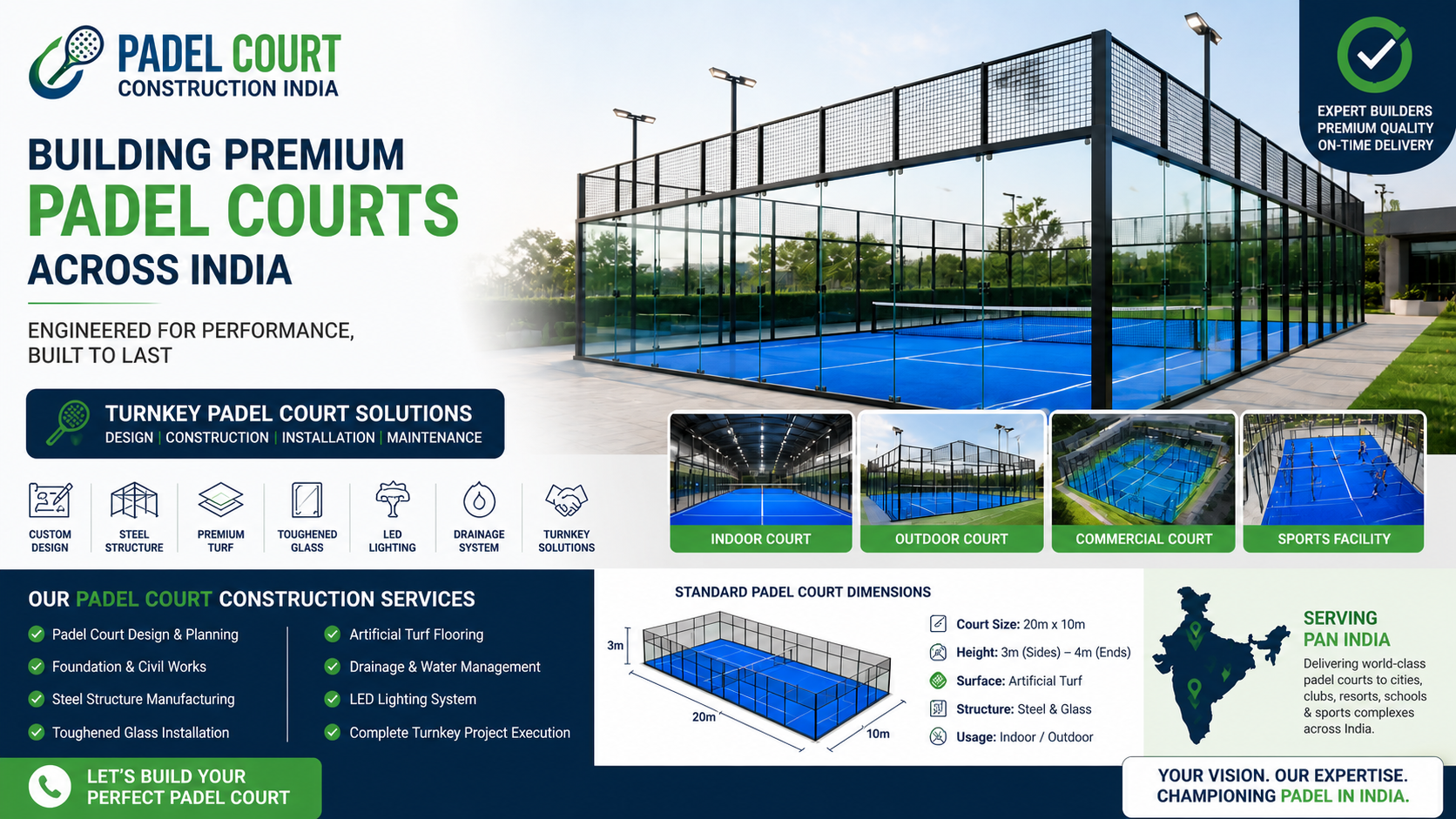
3. What Is the Standard Size of a Padel Court?
Before estimating construction expenses, you need to understand the space requirements.
According to the standard padel court specifications, a regulation playing area measures:
20 m × 10 m
Standard padel court dimensions
Playing area
200 square metres
Approximate area
2,153 sq. ft.
A regulation padel court has a fully enclosed rectangular playing area.
The court features glass walls, metal mesh sections, an artificial turf surface and a central net. The enclosure allows the ball to rebound from the walls, which is an essential part of the sport.
However, the actual land requirement should be greater than 200 square metres.
You may need additional space for:
-
Player access and entry gates.
-
Walkways and maintenance access.
-
Lighting equipment.
-
Spectator areas.
-
Seating and waiting areas.
-
Safety clearance around the court.
If you are planning a commercial padel facility, consider the space required for reception, changing rooms, washrooms, parking and other amenities.
Proper space planning from the beginning can prevent expensive modifications later.
4. Factors That Affect Padel Court Construction Cost
Why do two padel court construction projects sometimes have completely different budgets?
The reason is that every project has different requirements. Several factors can influence the final construction price.
1. Indoor vs Outdoor Construction
One of the biggest cost decisions is whether you want an indoor or outdoor padel court.
Outdoor padel courts
Outdoor courts are generally more affordable when the site already has suitable open space. They do not necessarily require an additional building or roofing structure.
However, outdoor installations need proper drainage, weather-resistant materials and protection against environmental conditions.
Indoor padel courts
Indoor courts provide a controlled playing environment throughout the year. They are also suitable for locations where rain, extreme heat or other weather conditions may affect outdoor activities.
However, indoor projects may require:
-
Roofing and structural framework.
-
Adequate ceiling height.
-
Ventilation systems.
-
Electrical arrangements.
-
Appropriate lighting.
-
Additional fire and building safety provisions.
If you are constructing an entirely new indoor sports facility, the building structure can significantly increase the investment.
2. Standard Glass vs Panoramic Glass
Glass selection also influences the construction budget.
Standard padel courts generally have visible structural supports between glass panels. Panoramic designs offer a more open appearance and are often selected by premium sports clubs.
The choice depends on your budget, intended audience and facility positioning.
If your goal is to create a premium commercial sports destination, panoramic glass may improve the overall appearance and spectator experience.
3. Quality of Construction Materials
The quality of materials has a direct impact on durability and maintenance expenses.
For example, better steel protection can reduce corrosion risks, while high-quality artificial turf can maintain playing characteristics for longer.
Similarly, professionally manufactured tempered glass can improve safety and reliability.
Instead of comparing construction companies only by price, compare their material specifications, warranties and installation standards.
4. Location and Transportation
Construction costs can vary between cities because of transportation expenses, labour availability, material sourcing and local site conditions.
For projects in locations far from manufacturing or distribution centres, transporting steel structures, glass panels and turf may increase the overall budget.
Site accessibility is also important. Difficult unloading conditions or restricted construction access can add to installation expenses.
5. Number of Courts
Building multiple padel courts together can be more economical than constructing separate courts at different times.
This is because several project expenses can be shared, including:
-
Site mobilisation.
-
Transportation.
-
Construction equipment.
-
Labour management.
-
Engineering and planning.
-
Certain civil works.
For example, a sports club planning two or four courts may achieve better overall project economics by developing the facility in a single construction phase.
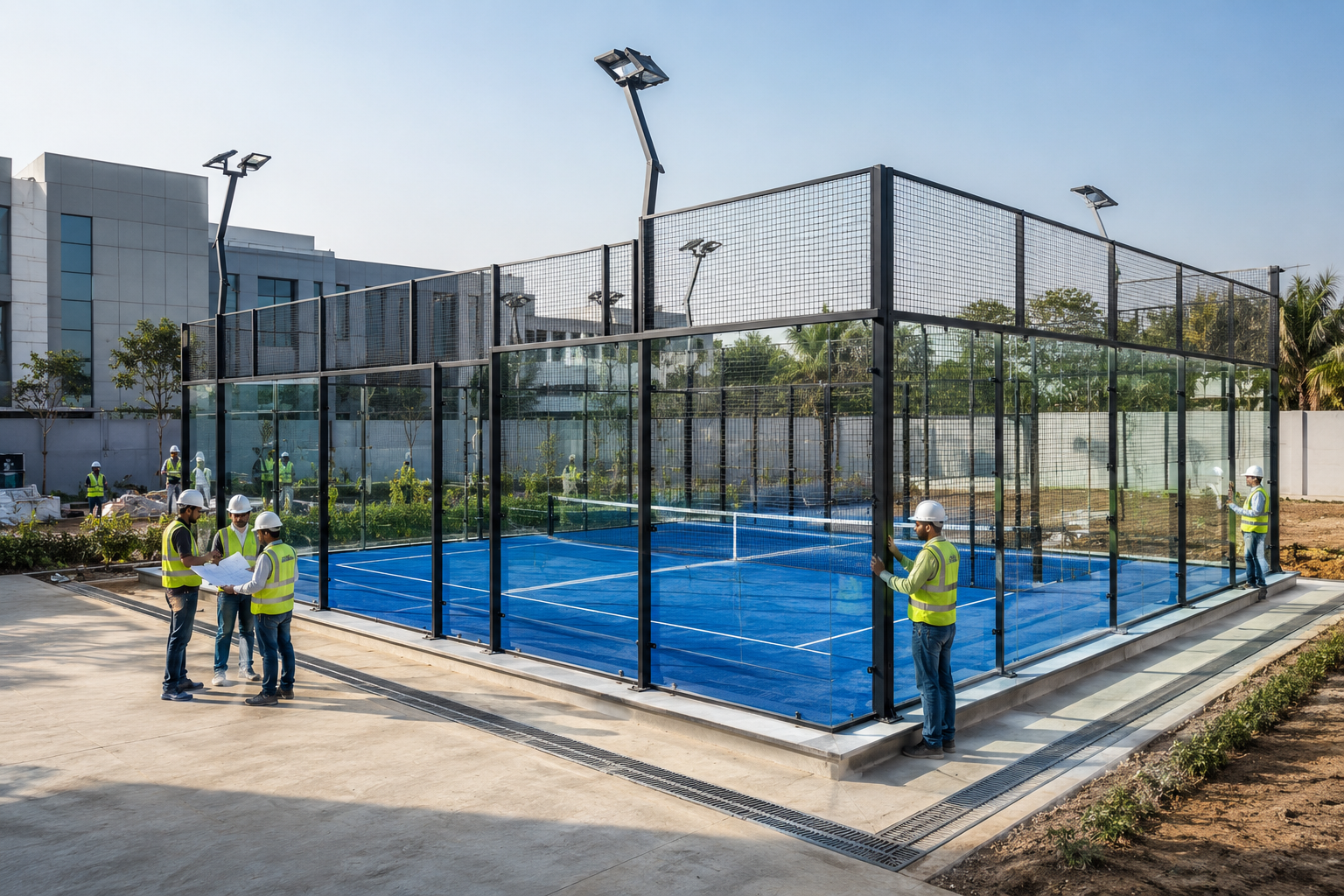
5. Step-by-Step Padel Court Construction Process
Understanding the construction process helps you plan your budget, monitor progress and communicate effectively with your contractor.
Here are the major stages involved in professional padel court construction.
The construction team evaluates the available land, soil conditions, access, dimensions, drainage and project requirements. A suitable design and preliminary budget are prepared.
Step 2: Ground Preparation and Foundation
The site is cleared, levelled and prepared. Foundation and concrete work are completed according to the engineering requirements of the court.
Step 3: Steel Structure Installation
The steel framework is assembled and secured. Accurate alignment is essential to support the glass enclosure and ensure structural stability.
Step 4: Glass and Mesh Installation
Tempered glass panels and metal mesh sections are installed. The team checks positioning, fixing points and enclosure stability.
Step 5: Artificial Turf Installation
Padel-specific artificial turf is installed, joined and prepared with the appropriate silica sand infill. The surface is checked for consistency.
Step 6: Lighting and Accessories
LED lighting, net posts, central net and other necessary accessories are installed.
Step 7: Final Inspection and Handover
The contractor checks the playing surface, glass, structure, lighting, drainage and safety arrangements before handing over the completed facility.
Following these stages in the correct sequence helps ensure that the completed court meets the required design and performance expectations.
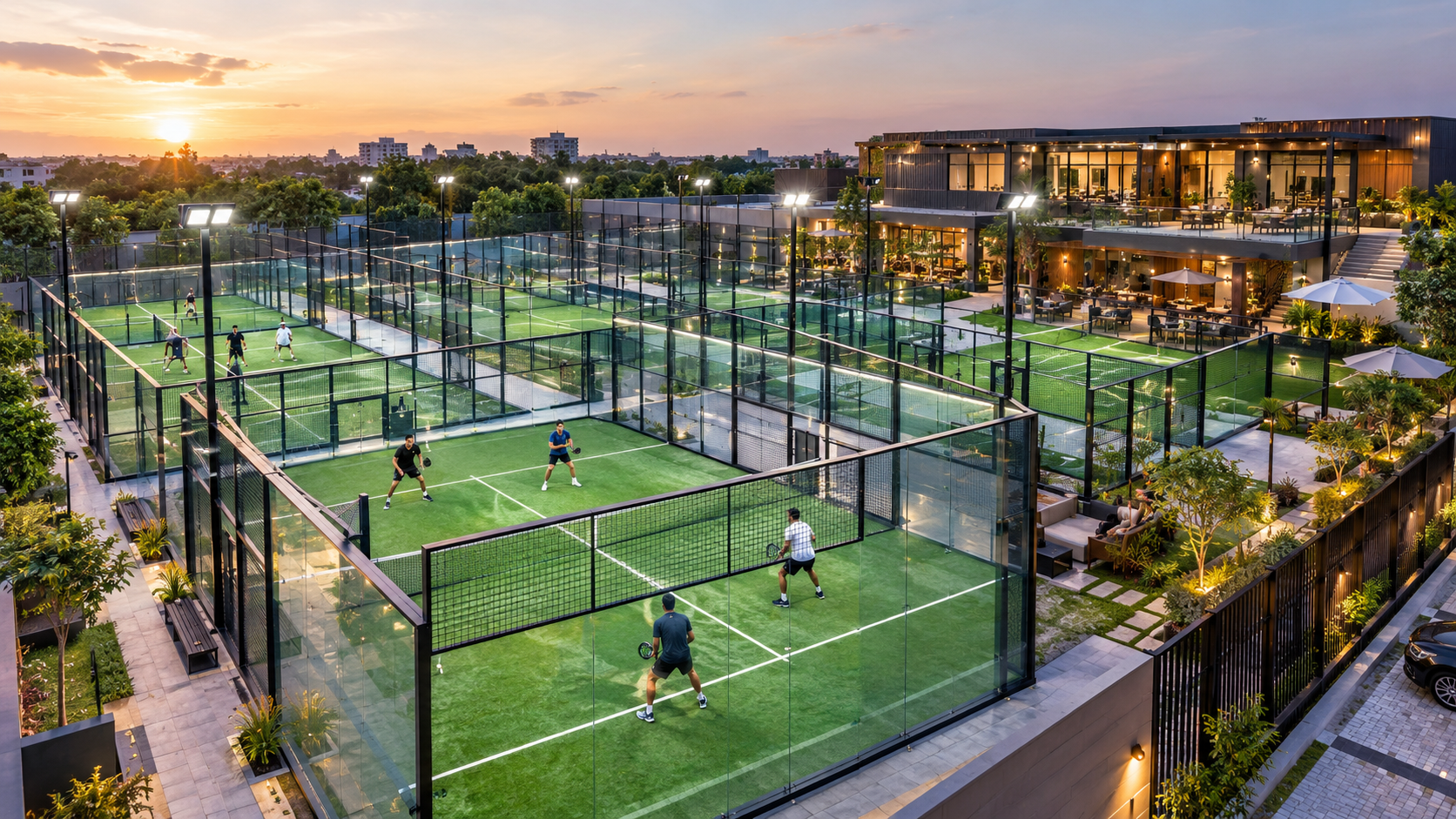
6. How Much Space Do You Need to Build Multiple Padel Courts?
If you are planning to establish a commercial padel club, building multiple courts can offer several advantages.
It creates opportunities to organise tournaments, coaching sessions, group bookings and recreational activities simultaneously.
However, the total land requirement depends on the arrangement of courts and the supporting facilities.
Consider these factors when planning your site:
-
Distance between adjacent courts.
-
Entry and exit routes.
-
Player movement and safety.
-
Spectator seating.
-
Reception and waiting areas.
-
Washrooms and changing rooms.
-
Parking and access roads.
For example, a two-court facility requires more than twice the playing-area footprint once shared access, circulation and amenities are included.
A professional sports infrastructure consultant can help prepare an efficient layout that uses the available land effectively.
7. Additional Expenses to Consider Before Starting Construction
Many investors focus only on the court installation price. However, a commercial padel facility involves several additional expenses.
Ignoring these costs can create budget problems during the project.
Here are some expenses you should include in your financial planning.
| Additional expense | Why it matters |
|---|---|
| Land purchase or lease | Provides the location for your facility |
| GST and applicable taxes | Affects the final project investment |
| Transportation | Covers delivery of construction materials |
| Roofing | Required for certain indoor or covered projects |
| Electrical connection | Supports lighting and other equipment |
| Reception area | Helps manage customers and bookings |
| Changing rooms | Improves player convenience |
| Washrooms | Essential facility infrastructure |
| Seating and furniture | Supports players and spectators |
| Marketing and branding | Helps attract customers |
| Maintenance budget | Keeps the court in good condition |
You should also maintain a contingency reserve of approximately 10–15% of your estimated project budget.
This reserve can help manage unexpected site conditions, material price changes and additional construction requirements.
8. Padel Court Maintenance Cost and Long-Term Expenses
Building a padel court is only the first investment. Regular maintenance is equally important for keeping the facility safe, attractive and suitable for everyday playing activities.
A well-maintained court can provide a better playing experience and help reduce unexpected repair expenses.
Here are the main maintenance activities:
Artificial turf maintenance: The turf should be brushed regularly to distribute silica sand evenly and maintain a consistent playing surface. Debris, leaves and dust should also be removed.
Glass cleaning: Glass panels should be cleaned periodically to maintain visibility and remove dirt, fingerprints and watermarks.
Steel structure inspection: Check the framework, joints, bolts and protective coatings for signs of corrosion or damage.
Lighting maintenance: Inspect LED fixtures, wiring and electrical connections to ensure consistent illumination.
Drainage inspection: Outdoor courts should be checked regularly to ensure rainwater flows away properly and does not accumulate around the playing area.
Net and accessory replacement: Nets, posts and other frequently used components may require periodic adjustment or replacement.
Turf infill may also need replenishment, and the playing surface may eventually require replacement depending on its quality, usage and maintenance. Some supplier specifications recommend turf infill top-ups every three to four years.
ChampCourts+1
A preventive maintenance schedule is generally more economical than waiting for major problems to develop.
9. Is Building a Padel Court a Good Business Investment?
Padel is attracting attention because it combines social interaction, physical activity and competitive gameplay.
Unlike some traditional sports, padel can be enjoyed by beginners as well as experienced players. Its doubles format also makes it suitable for group activities and recreational sports communities.
For entrepreneurs, this creates several potential business opportunities.
Revenue Opportunities
A professionally managed padel facility can generate income through different services.
1. Hourly Court Bookings
Players can reserve courts for a specific duration. This is one of the most straightforward revenue models for a commercial padel club.
2. Membership Packages
Monthly, quarterly and annual memberships can encourage repeat customers and provide more predictable revenue.
3. Coaching and Training
Professional coaching sessions for beginners, children and competitive players can create additional income opportunities.
4. Tournaments and Events
Organising local competitions, corporate sports events and recreational tournaments can increase facility visibility and customer engagement.
5. Equipment Rentals
Offering racket and ball rentals makes the sport more accessible to beginners who do not own their equipment.
6. Food and Beverage Services
A small café, refreshment counter or player lounge can improve the customer experience and provide another revenue stream.
What Determines Profitability?
Although padel court construction can create an interesting business opportunity, profitability depends on several factors:
-
Initial construction investment.
-
Land rental or ownership expenses.
-
Hourly booking rates.
-
Average daily court utilisation.
-
Staff salaries.
-
Electricity and maintenance.
-
Local competition.
-
Marketing and customer acquisition.
For example, a court that receives consistent bookings throughout the week may generate better returns than a premium facility with low customer utilisation.
Therefore, before investing, conduct local market research and prepare a realistic financial projection.
Do not assume that building a court automatically guarantees business success.
10. How to Choose the Right Padel Court Construction Company
Selecting the right construction partner is one of the most important decisions in your project.
A reliable contractor should understand both the engineering requirements and the playing characteristics of a professional padel court.
Here are some important things to check before finalising a company.
Check previous projects: Ask to see completed installations and, if possible, visit an existing court constructed by the company.
Understand material specifications: Request details about the steel framework, glass thickness, artificial turf, lighting and foundation design.
Ask about international standards: Check whether the proposed court follows the relevant International Padel Federation (FIP) specifications.
Compare detailed quotations: Make sure different contractors are quoting for the same scope of work. Compare material quality, installation, transportation, civil work and taxes.
Review warranty terms: Understand what is covered under structural, glass and other product warranties.
Evaluate installation experience: Professional installation requires specialised knowledge and careful coordination.
Check after-sales support: A good construction partner should be able to assist with maintenance guidance, repairs and replacement requirements.
Choosing a company based only on the lowest quotation can be a costly mistake. Focus on overall quality, safety, transparency and long-term value.
11. Tips to Reduce Padel Court Construction Costs Without Compromising Quality
You do not necessarily need to choose the most expensive materials or designs to build a high-quality padel court.
Smart planning can help control construction expenses while maintaining essential performance standards.
Here are some practical recommendations:
-
Plan the site carefully: Select a location with suitable ground conditions to reduce unnecessary excavation and foundation expenses.
-
Choose the right court design: A standard glass court may be sufficient for a recreational facility, while panoramic designs can be considered for premium clubs.
-
Build multiple courts together: Shared logistics and construction activities can reduce certain costs per court.
-
Select durable materials: Better-quality materials may cost more initially but can reduce repair and replacement expenses.
-
Use energy-efficient lighting: Efficient LED systems can help manage electricity consumption.
-
Get multiple quotations: Compare at least three detailed proposals before selecting a contractor.
-
Plan future expansion: If you intend to add more courts later, consider the layout and utility requirements during the initial development stage.
The objective should not be to build the cheapest court. It should be to build a reliable facility that offers long-term value.
12. Frequently Asked Questions About Padel Court Construction Cost
Q1. What is the minimum cost to build a padel court in India?
Some basic installed padel court packages start at approximately ₹9–14 lakh. However, a complete commercial installation can require a higher investment depending on the foundation, materials, lighting, installation and additional facilities.
Q2. How much land is required for one padel court?
A standard padel court has an enclosed playing area of 200 square metres, measuring 20 metres by 10 metres. Additional land is required for access, safety clearance, maintenance and other facilities.
Q3. How long does it take to construct a padel court?
The installation of a standard court system can take approximately one to two weeks once the foundation is ready and all materials are available. However, the complete project may take several additional weeks depending on civil work, transportation, site preparation and approvals.
Q4. Which is better: an indoor or outdoor padel court?
Both options have advantages. Outdoor courts can be more economical when suitable land is available. Indoor courts offer protection from weather conditions and can provide more consistent playing availability throughout the year.
The right choice depends on your location, budget and business requirements.
Q5. What type of glass is used in padel court construction?
Padel courts generally use specially manufactured tempered safety glass, commonly available in 10 mm and 12 mm specifications. The appropriate specification should be determined by the court design and engineering requirements.
Q6. Can I build a padel court on an existing sports ground?
Yes, an existing sports ground may be suitable if it has sufficient space, appropriate soil conditions and the required foundation capacity. However, the site must be inspected before construction begins.
Q7. Does padel court construction include lighting?
It depends on the contractor’s quotation. Some court packages include LED lighting, while others quote it separately. Always confirm the number of fixtures, illumination specifications and electrical installation costs.
Q8. Is it possible to build two or four padel courts together?
Yes. Multiple courts can be developed within the same sports facility. Building them together can improve construction efficiency and reduce certain shared expenses.
Q9. How long does a padel court last?
The lifespan depends on the quality of the steel structure, glass, turf, installation and maintenance. Some manufacturer specifications advertise structural lifespans exceeding ten years, but individual components may need maintenance or replacement earlier.
ChampCourts+1
Q10. What should I check before accepting a construction quotation?
Check the court dimensions, steel specifications, glass thickness, turf quality, foundation scope, drainage, lighting, installation charges, transportation, taxes and warranty conditions. Request a written breakdown rather than relying on a single overall price.
Conclusion: Plan Your Padel Court Construction with the Right Budget
Padel court construction is an exciting opportunity for sports entrepreneurs, fitness clubs, hotels, resorts and residential communities looking to introduce a modern recreational facility.
However, a successful project requires more than purchasing glass panels, artificial turf and a steel structure. It involves proper site assessment, engineering, foundation preparation, material selection, professional installation and long-term maintenance planning.
The total investment can vary considerably depending on the court specification and project requirements. While basic packages may start around ₹9–14 lakh, a complete commercial facility can require ₹18–35 lakh or more per court.
The best approach is to understand your requirements, compare detailed quotations and work with an experienced padel court construction company.
Whether you are developing a single recreational court or planning a multi-court sports complex, investing in quality construction from the beginning can help create a safe, durable and enjoyable playing environment.
Ready to build your own padel court? Connect with a professional padel court construction company to discuss your site requirements, explore suitable court designs and receive a customised project estimate.