Introduction
Pickleball is one of the fastest-growing sports in the world, attracting players of different ages and skill levels. Combining elements of tennis, badminton, and table tennis, it offers an exciting playing experience that requires agility, coordination, and quick decision-making. As the sport continues to gain popularity, the demand for professionally designed indoor and outdoor pickleball courts is also increasing.
However, building a high-quality pickleball court involves more than selecting the right dimensions, installing a net, and marking the playing lines. One of the most important decisions is choosing the best flooring for pickleball courts.
The playing surface directly affects ball bounce, player movement, traction, comfort, and overall game performance. A poorly selected floor can create slippery conditions, inconsistent ball behaviour, premature surface damage, and unnecessary maintenance expenses. In contrast, the right flooring system provides a consistent playing experience, improves player confidence, and increases the lifespan of the court.
Whether you are developing a residential pickleball court, a sports academy, a school facility, a recreational club, or a commercial sports complex, understanding the available flooring options is essential.
In this complete guide, we will explore different types of pickleball court flooring, their advantages and disadvantages, installation requirements, maintenance considerations, and the factors you should evaluate before making your investment.
1. Why Is Choosing the Right Pickleball Court Flooring Important?
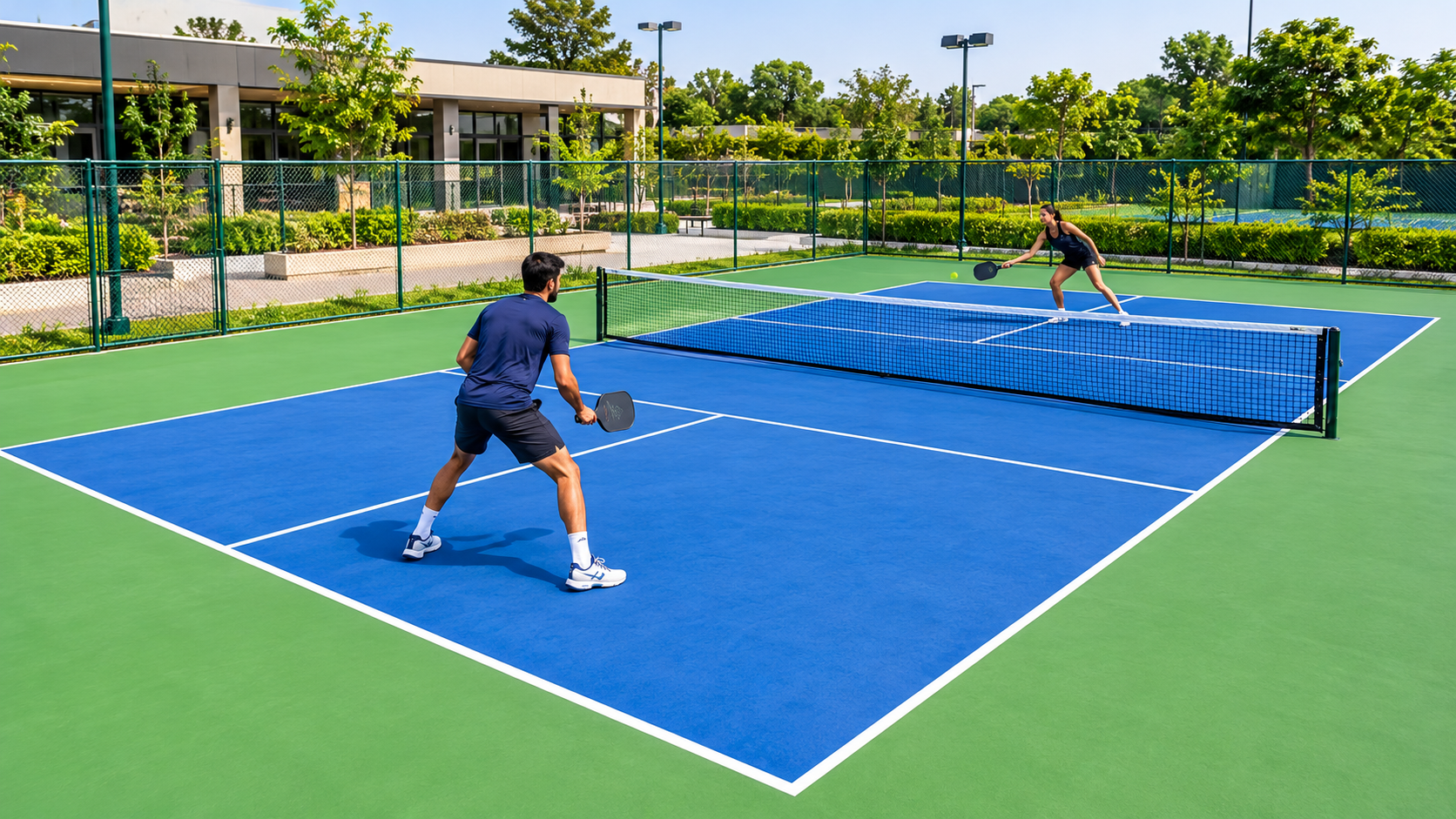
Pickleball is a fast-paced sport involving frequent lateral movements, sudden stops, quick direction changes, and repeated footwork. The court surface must support these movements while providing predictable ball behaviour.
Here are some reasons why flooring selection matters.
Player safety: The right surface provides suitable traction and reduces the risk of slipping during rapid movements.
Consistent ball bounce: A uniform playing surface helps the ball bounce predictably, allowing players to control their shots more effectively.
Playing comfort: Appropriate surface characteristics can improve comfort during extended playing sessions.
Weather resistance: Outdoor courts require materials that can withstand sunlight, rainfall, temperature fluctuations, and moisture.
Long-term durability: A quality flooring system reduces frequent repairs and helps maintain court performance over time.
Professional appearance: Properly installed sports flooring creates a clean, attractive, and professional playing environment.
Therefore, flooring should be considered a fundamental part of pickleball court construction rather than simply a finishing material.
2. Different Types of Pickleball Court Flooring
There are several flooring systems available for pickleball courts. Each material has unique characteristics, installation requirements, performance levels, and maintenance needs.
Let’s examine the most popular options.
A. Acrylic Sports Flooring
The coating system generally includes a primer or bonding layer, resurfacer, textured colour coats, and court line markings. Depending on the product specification, additional cushioning layers can also be incorporated.
Key advantages:
-
Provides consistent ball bounce and playing characteristics.
-
Offers good grip for quick movements and direction changes.
-
Available in different colours and surface textures.
-
Resists outdoor weather conditions when properly specified.
-
Requires relatively straightforward routine maintenance.
-
Suitable for schools, clubs, sports academies, and commercial facilities.
Potential disadvantages:
-
Requires a properly constructed and level base.
-
Surface cracks can develop if the underlying foundation moves.
-
Periodic repainting and resurfacing may be necessary.
-
Application depends on suitable weather and curing conditions.
Best suited for: Permanent outdoor pickleball courts where consistent gameplay, durability, and professional appearance are priorities.
Overall, acrylic flooring is an excellent all-round option for dedicated pickleball facilities.
B. Concrete Flooring
Concrete is widely used as a foundation for outdoor pickleball courts. It offers a firm, stable surface and can support different sports coating systems.
A professionally constructed concrete slab provides a strong foundation for acrylic sports flooring. It can also be used as a basic playing surface, although an appropriate sports coating is generally preferable for dedicated facilities.
Key advantages:
-
High structural strength and stability.
-
Long service life when correctly designed and constructed.
-
Consistent foundation for sports coatings.
-
Relatively low routine maintenance.
-
Suitable for permanent outdoor installations.
Potential disadvantages:
-
Hard underfoot, especially during extended playing sessions.
-
Poorly constructed concrete can develop cracks.
-
Bare concrete may provide less controlled traction.
-
Repairs can become expensive if structural damage occurs.
Best suited for: Permanent outdoor pickleball courts, recreational complexes, and facilities requiring a durable foundation.
One important consideration is that concrete flooring and acrylic sports flooring are not necessarily competing options. In many professional outdoor installations, concrete serves as the base while acrylic provides the actual playing surface.
C. Asphalt Flooring
Asphalt is another common foundation material used in outdoor sports courts. It consists of aggregates combined with a bituminous binder to create a paved playing surface.
It can be a practical choice for recreational courts and projects where the existing asphalt pavement is in good condition.
Key advantages:
-
Generally lower initial construction costs than concrete.
-
Relatively quick installation.
-
Suitable for acrylic sports coating applications.
-
Can be repaired and resurfaced when necessary.
-
Works well for many outdoor recreational applications.
Potential disadvantages:
-
Can soften under extreme surface temperatures.
-
May develop cracks or depressions over time.
-
Requires appropriate drainage and base preparation.
-
Long-term performance depends heavily on construction quality.
Best suited for: Budget-conscious outdoor projects and existing asphalt courts that require conversion into pickleball facilities.
For locations experiencing intense summer heat, the asphalt mix, pavement design, and expected loading should be evaluated carefully before selecting this option.
D. Modular Interlocking Sports Tiles
Modular sports tiles are manufactured using materials such as polypropylene and other engineered polymers. Individual tiles connect through an interlocking mechanism to form a continuous playing surface.
These flooring systems are popular for sports facilities that require faster installation, surface replacement flexibility, or conversion of existing spaces.
Key advantages:
-
Relatively quick installation.
-
Individual damaged tiles can be replaced.
-
Some designs provide cushioning and impact absorption.
-
Open-grid structures allow water to drain through.
-
Available in different colours and configurations.
-
Can be suitable for indoor and outdoor applications.
Potential disadvantages:
-
Higher initial investment than some conventional surfaces.
-
Performance depends on tile quality and installation.
-
Surface joints may influence ball behaviour.
-
Thermal expansion can affect outdoor installations.
-
Dirt can collect underneath the tiles.
Best suited for: Multi-purpose sports facilities, temporary courts, recreational complexes, and locations where replaceable flooring is important.
When purchasing modular flooring, check UV resistance, locking strength, drainage design, surface texture, and suitability for pickleball rather than relying only on appearance.
E. Cushioned Acrylic Flooring
Cushioned acrylic flooring combines a conventional acrylic sports surface with specialised cushioning layers underneath.
These layers are generally created using rubber granules or other resilient materials integrated into a compatible sports surfacing system.
The purpose is to provide a slightly softer playing experience without losing the predictable ball response associated with hard courts.
Key advantages:
-
Improved underfoot comfort compared with standard hard acrylic.
-
Additional impact absorption.
-
Suitable for facilities with frequent daily play.
-
Maintains a familiar hard-court playing experience.
-
Available in different cushioning specifications.
Potential disadvantages:
-
Higher installation costs.
-
Requires specialised application.
-
Cushioning performance varies between systems.
-
Still needs a stable and properly prepared foundation.
Best suited for: Professional clubs, sports academies, premium recreational facilities, and venues expecting frequent use.
It is worth remembering that cushioning does not eliminate the risk of sports injuries. Proper footwear, conditioning, and safe playing practices remain important.
F. Indoor Polyurethane Sports Flooring
Polyurethane, commonly known as PU flooring, is widely used in indoor sports environments. It creates a seamless sports surface with controlled flexibility and a comfortable playing feel.
Depending on its construction, PU flooring can include multiple layers that provide resilience, durability, and surface protection.
Key advantages:
-
Seamless and attractive appearance.
-
Comfortable underfoot compared with conventional concrete.
-
Available in different thicknesses and performance specifications.
-
Suitable for indoor multi-sport facilities.
-
Easy to clean when maintained according to manufacturer recommendations.
Potential disadvantages:
-
Requires professional installation.
-
Can be more expensive than basic hard-court options.
-
Performance varies between PU formulations.
-
Not every indoor PU system is automatically suitable for pickleball.
Best suited for: Indoor sports arenas, schools, fitness centres, and multipurpose sports halls.
For pickleball applications, the selected PU system should provide suitable traction and predictable ball bounce. A generic gym or badminton floor should not be assumed to deliver the same performance.
3. Comparison of Different Pickleball Flooring Materials
Choosing between different flooring materials becomes easier when their major characteristics are compared.
| Flooring type | Durability | Player comfort | Maintenance |
|---|---|---|---|
| Acrylic | High | Moderate | Low to moderate |
| Concrete | Very high as a base | Low | Low |
| Asphalt | Moderate to high | Low | Moderate |
| Modular tiles | Depends on quality | Moderate to high | Low to moderate |
| Cushioned acrylic | High | High relative to hard acrylic | Moderate |
| PU sports flooring | High indoors | Moderate to high | Moderate |
Note: These are general comparisons. Actual performance depends on product quality, construction, installation, usage, and environmental conditions.
4. Indoor vs Outdoor Pickleball Court Flooring
The right flooring material also depends on whether the court is being developed indoors or outdoors.
Outdoor Pickleball Court Flooring
Outdoor courts experience direct exposure to sunlight, rainfall, dust, temperature changes, and moisture.
Therefore, outdoor flooring must provide:
-
Strong UV and weather resistance.
-
Effective water drainage.
-
Reliable grip in suitable playing conditions.
-
Resistance to surface deterioration.
-
Consistent ball bounce.
-
Protection against premature cracking and fading.
Acrylic-coated concrete is an excellent choice for many permanent outdoor courts. Acrylic-coated asphalt can also be suitable when the pavement is properly designed and maintained.
Indoor Pickleball Court Flooring
Indoor facilities have different requirements because they are protected from direct rainfall and sunlight.
Important considerations include:
-
Consistent surface traction.
-
Appropriate shock absorption.
-
Controlled ball bounce.
-
Resistance to regular foot traffic.
-
Easy cleaning and maintenance.
-
Compatibility with other indoor sports.
PU sports flooring, cushioned sports systems, and suitable modular tiles are potential options for indoor pickleball facilities.
For existing indoor sports halls, the flooring should be evaluated before adding pickleball court markings. A surface designed for another sport may need adjustments to provide the right playing characteristics.
5. How to Choose the Best Flooring for Your Pickleball Court
Selecting the right pickleball court flooring requires evaluating several factors beyond the initial installation price.
Here are the most important considerations.
1. Climate and Weather Conditions
Climate plays a significant role in flooring performance, particularly for outdoor courts.
In regions with high temperatures, intense sunlight, and seasonal rainfall, flooring materials must withstand thermal expansion, moisture, and UV exposure.
For example, UV-stabilised acrylic coatings can help maintain colour and surface performance under strong sunlight. Proper drainage is equally important in areas experiencing heavy monsoon rainfall.
2. Player Comfort and Safety
Player safety should always be a priority when designing a sports facility.
A flooring system should provide sufficient traction without becoming excessively rough or sticky. Too little grip can increase slipping, while excessive friction can interfere with natural foot movement.
Cushioned acrylic and suitable PU systems may offer additional comfort for players who spend several hours on the court.
3. Ball Bounce and Playing Performance
Pickleball requires a consistent playing surface because ball bounce directly influences gameplay.
Uneven flooring, loose tiles, surface depressions, and poorly repaired cracks can create unpredictable ball movement.
Choose a system specifically designed for racket sports or pickleball rather than a general-purpose flooring material.
4. Installation Budget
Your budget should include more than the flooring material itself.
Consider expenses such as:
-
Ground preparation and excavation.
-
Base construction.
-
Drainage arrangements.
-
Flooring material and installation.
-
Surface coating and line marking.
-
Fencing and lighting.
-
Future maintenance and repairs.
A cheaper flooring system may require more frequent repairs, while a higher-quality system can provide better long-term value.
5. Maintenance Requirements
Every sports flooring system requires some level of maintenance.
Before making a decision, understand how frequently the surface needs cleaning, inspection, repairs, and resurfacing.
For commercial facilities with daily usage, selecting a flooring system that is easy to maintain can significantly reduce operational difficulties.
6. Pickleball Court Flooring Installation Process
Professional installation is essential for achieving a durable, safe, and high-performing pickleball court.
Although installation procedures vary depending on the selected flooring material, the following steps are generally involved.
Step 1: Site Inspection and Preparation
The first stage involves evaluating the proposed location, soil conditions, available space, and drainage requirements.
The ground must be properly prepared before construction begins.
Step 2: Base Construction
A suitable concrete or asphalt foundation is developed according to the project’s structural requirements.
The base should be stable, properly compacted where applicable, and designed to prevent water accumulation.
Step 3: Surface Preparation
Before applying the sports flooring, the foundation must be cleaned and inspected.
Cracks, depressions, and other surface defects should be repaired using compatible materials.
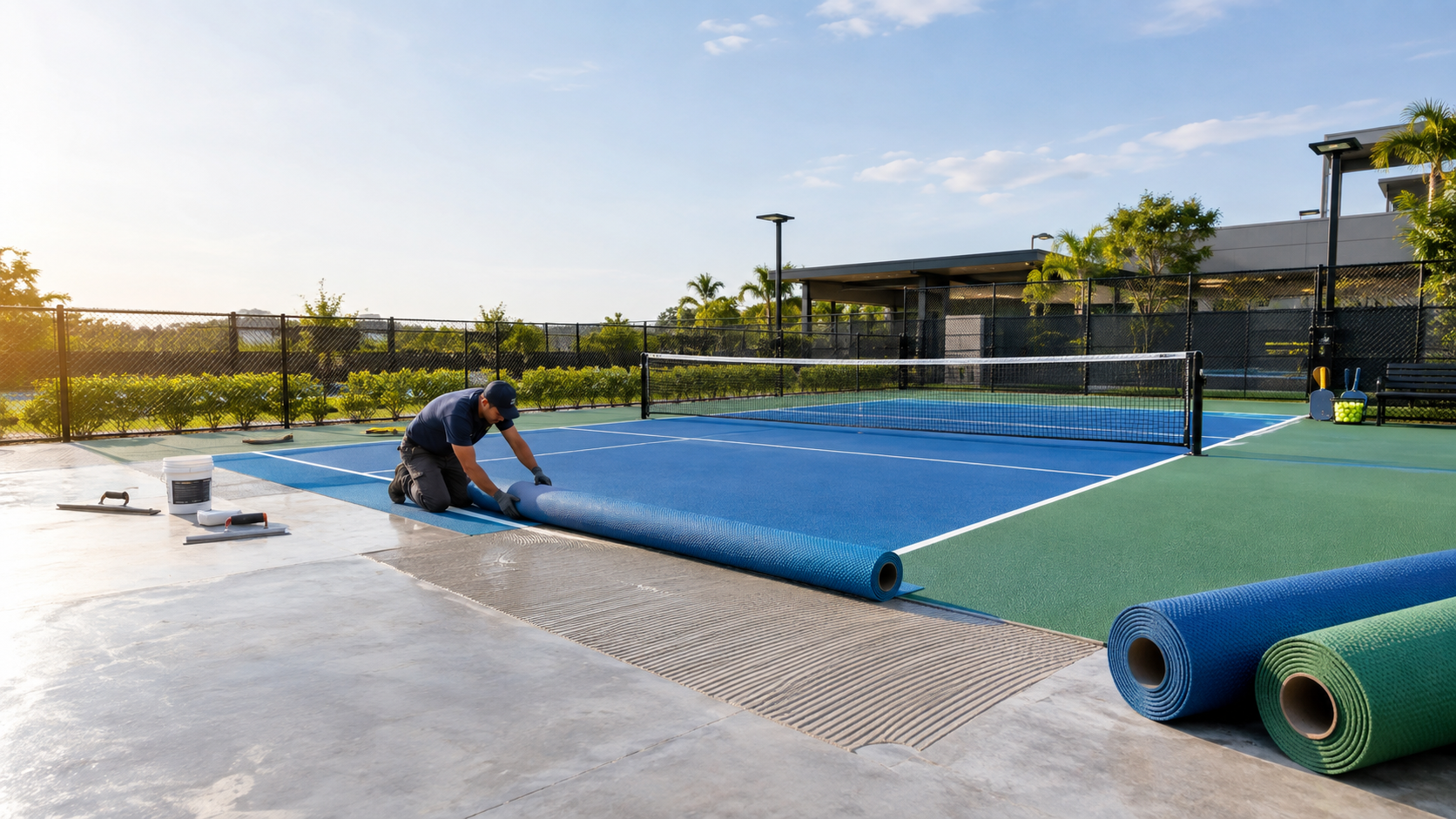
Step 4: Flooring Application
The selected flooring system is installed according to the manufacturer’s technical specifications.
For acrylic systems, this generally involves surface preparation, priming where required, resurfacing, textured colour coats, and finishing.
Step 5: Court Line Marking
After the flooring has cured, the playing lines are marked accurately.
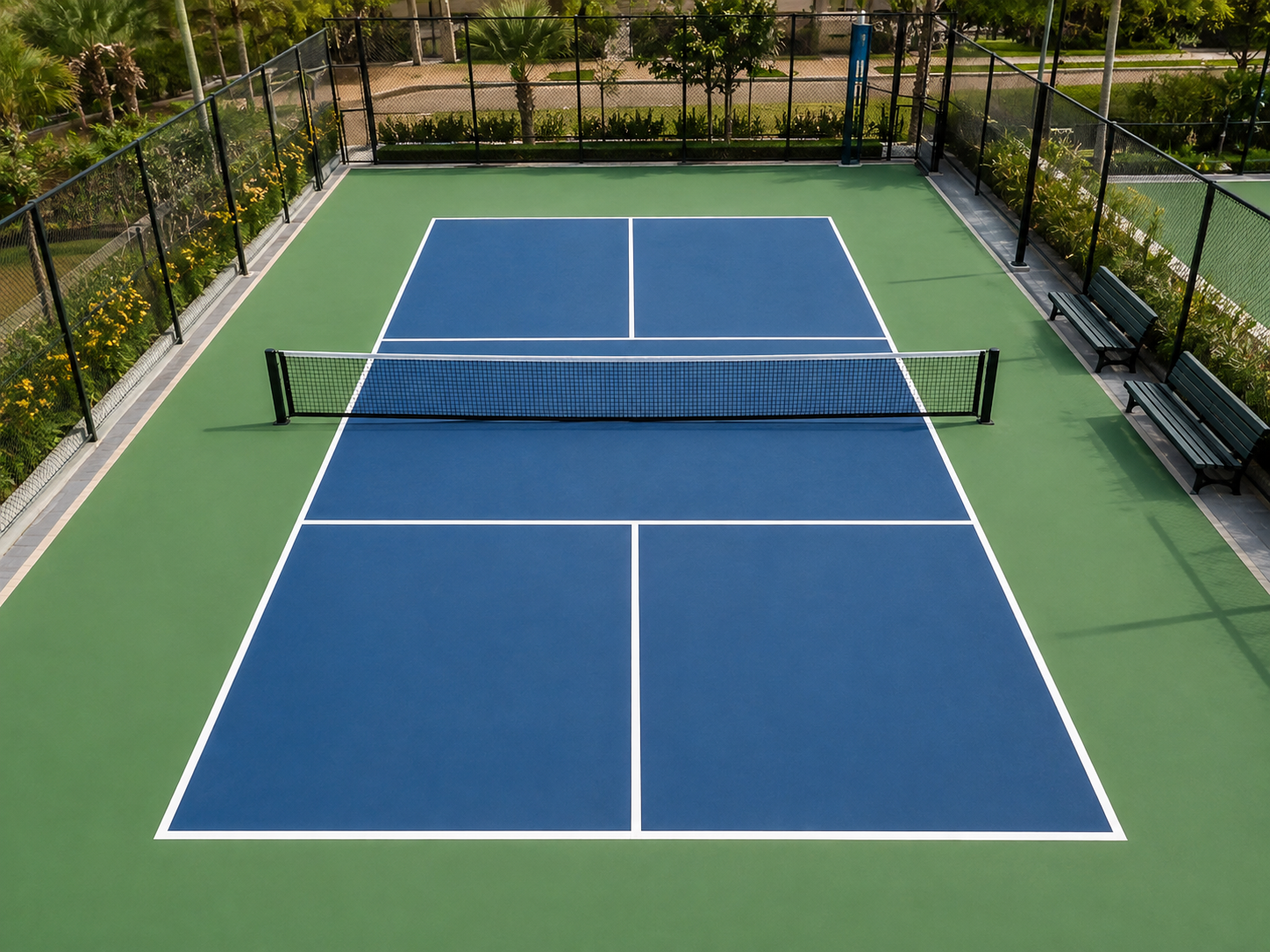
A standard pickleball court has playing dimensions of 20 feet wide and 44 feet long. The non-volley zone, commonly known as the kitchen, extends 7 feet from the net on both sides.
Step 6: Final Inspection
The completed court should be inspected for surface uniformity, traction, drainage, line accuracy, and playing quality.
The flooring manufacturer and contractor should also specify the required curing period before the court is opened for use.
7. Pickleball Court Flooring Maintenance Tips
Regular maintenance helps protect your investment and keeps the playing surface in good condition.
Here are some practical maintenance recommendations.
Clean the surface regularly: Remove dust, leaves, mud, and other debris using suitable cleaning equipment.
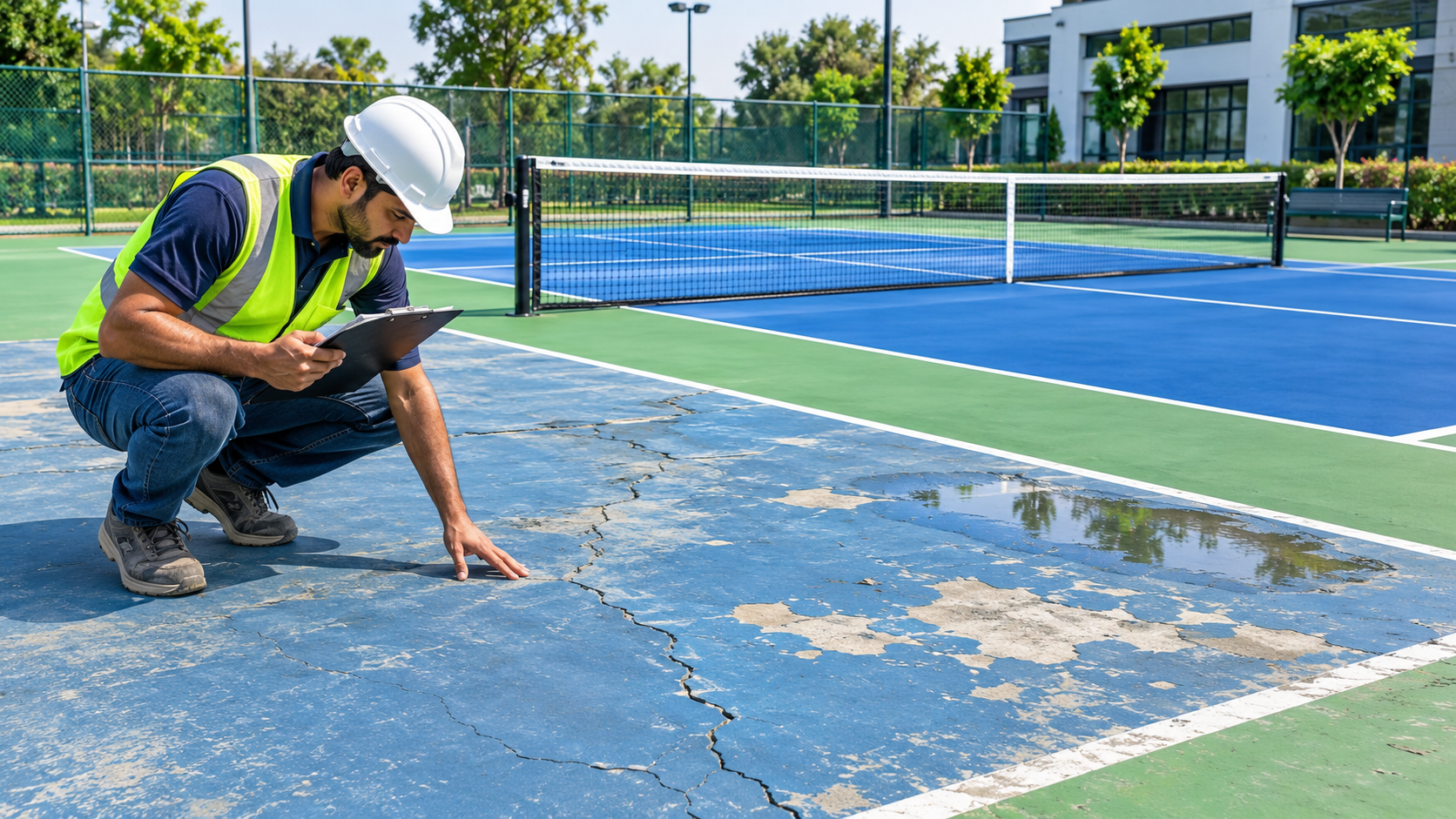
Inspect for cracks: Examine the playing area periodically for cracks, loose tiles, or surface damage.
Avoid standing water: Check drainage arrangements, particularly after rainfall. Water accumulation can contribute to surface deterioration.
Use appropriate cleaning products: Avoid harsh chemicals that may damage the flooring or affect its texture.
Check court markings: Inspect line markings for fading and repaint them when necessary.
Schedule professional inspections: Periodic assessments can help identify small problems before they develop into expensive repairs.
Protect outdoor surfaces: Avoid unnecessary vehicle movement and heavy equipment on sports flooring unless the system is designed to withstand such loads.
The maintenance schedule should always follow the flooring manufacturer’s recommendations.
8. Common Mistakes to Avoid When Selecting Pickleball Flooring
Even a well-designed sports facility can experience problems when flooring decisions are made without proper planning.
Avoid these common mistakes:
-
Choosing flooring based only on price: The cheapest option may not provide the required durability or playing performance.
-
Ignoring drainage: Poor drainage can lead to standing water, surface deterioration, and interruptions to play.
-
Using ordinary paint instead of sports coatings: General-purpose paint may not provide the required grip, texture, or durability.
-
Ignoring climate conditions: Flooring should be selected according to local temperature, sunlight, and rainfall.
-
Hiring inexperienced installers: Incorrect preparation and application can shorten the life of even premium flooring materials.
-
Overlooking maintenance expenses: Consider the complete lifecycle cost rather than focusing exclusively on installation.
-
Selecting unsuitable indoor flooring: Not every gymnasium or badminton floor provides the correct ball response for pickleball.
Avoiding these mistakes can help create a court that delivers reliable performance for years.
9. What Is the Best Pickleball Court Flooring in India?
The Indian climate creates specific challenges for outdoor sports flooring. High summer temperatures, intense UV exposure, dust, and monsoon rainfall can affect the performance of different materials.
For most permanent outdoor pickleball courts in India, UV-stabilised acrylic sports flooring over a properly engineered RCC concrete base is a strong overall recommendation.
This combination offers several advantages:
-
A stable foundation.
-
Consistent playing characteristics.
-
Good surface traction.
-
Attractive colour options.
-
Suitability for outdoor sports facilities.
-
Manageable long-term maintenance.
For premium facilities, cushioned acrylic flooring can be considered when additional underfoot comfort is a priority.
For indoor sports halls, PU sports flooring or other purpose-designed indoor systems may be more appropriate.
Modular interlocking tiles can also be considered for multipurpose spaces, temporary installations, and projects where replaceable flooring is important.
However, there is no universal solution for every project. Soil conditions, site dimensions, expected player traffic, budget, and installation quality should all influence the final selection.
10. How Much Does Pickleball Court Flooring Cost?
The cost of pickleball court flooring depends on several variables, including the material, foundation, installation method, surface area, and location.
Acrylic coatings generally require a lower investment than specialised cushioned systems or premium modular tiles. However, the cost of the complete court also depends on civil construction and additional infrastructure.
| Cost factor | What affects the price? |
|---|---|
| Base construction | Concrete grade, reinforcement, and ground preparation |
| Acrylic flooring | Coating quality, number of layers, and texture |
| Cushioned flooring | Cushioning material and thickness |
| Modular tiles | Material quality, design, and tile thickness |
| Installation | Labour, transportation, and site accessibility |
| Additional facilities | Lighting, fencing, and drainage |
For an accurate quotation, request a detailed project estimate covering the foundation, flooring system, installation, line marking, and finishing.
It is also advisable to compare product specifications and warranties rather than selecting a contractor solely on the basis of the lowest quotation.
11. Why Professional Flooring Installation Matters
The performance of a pickleball court depends not only on the material but also on the quality of installation.
Even premium acrylic or modular flooring can underperform if the foundation is uneven, drainage is inadequate, or the surface is installed incorrectly.
Experienced sports flooring professionals understand the technical requirements of sports facilities, including substrate preparation, coating application, surface texture, curing, and line marking.
Professional installation can help ensure:
-
Proper surface preparation.
-
Consistent flooring thickness.
-
Accurate court dimensions.
-
Appropriate traction and ball response.
-
Better resistance to environmental conditions.
-
Reduced risk of premature surface failure.
When choosing a contractor, review previous sports court projects, product documentation, installation experience, and warranty conditions.
A professional installation is an investment in the long-term performance of your sports facility.
Frequently Asked Questions (FAQs)
1. What is the best flooring for pickleball courts?
Acrylic sports flooring over a properly constructed concrete or asphalt base is one of the best options for outdoor pickleball courts. It offers consistent ball bounce, suitable traction, durability, and relatively straightforward maintenance.
2. Is acrylic flooring good for pickleball?
Yes. Acrylic flooring is widely used for outdoor pickleball courts because it provides a textured playing surface, consistent ball response, and good resistance to weather when the correct products and installation methods are used.
3. Is concrete better than acrylic for pickleball courts?
Concrete and acrylic serve different purposes. Concrete generally provides the foundation, while acrylic creates the finished playing surface. Combining the two is an excellent solution for permanent outdoor courts.
4. Can modular tiles be used for pickleball courts?
Yes. Modular interlocking tiles are suitable for certain indoor and outdoor pickleball facilities. They offer relatively quick installation, drainage options, and the ability to replace individual damaged tiles.
5. Which flooring is best for indoor pickleball courts?
PU sports flooring, cushioned sports systems, and suitable modular tiles are potential choices for indoor pickleball courts. The selected system should provide appropriate traction, player comfort, and predictable ball bounce.
6. Is cushioned acrylic flooring worth the investment?
Cushioned acrylic can be worth the additional investment for clubs and facilities with frequent daily usage. Its cushioning layers provide a softer feel underfoot compared with standard hard acrylic flooring.
7. How long does pickleball court flooring last?
The lifespan depends on the flooring material, installation quality, climate, and playing frequency. Acrylic coatings generally need periodic renewal, while the underlying concrete foundation can last considerably longer when properly designed and maintained.
8. Can an existing tennis court be converted into a pickleball court?
Yes. Existing tennis courts can often be converted into pickleball facilities by evaluating the foundation, resurfacing where necessary, and adding accurate pickleball court markings. Multiple pickleball courts may also fit within an existing tennis court area, depending on available space and safety clearances.
Conclusion
Choosing the best flooring for pickleball courts is one of the most important decisions when developing a successful sports facility. The right surface influences player safety, ball bounce, playing comfort, maintenance requirements, and the overall experience.
Acrylic sports flooring remains an excellent all-round choice for permanent outdoor courts, particularly when installed over a professionally constructed concrete base. Cushioned acrylic is worth considering for premium facilities, while PU flooring and modular tiles offer alternative solutions for indoor and multipurpose sports environments.
Before finalising your flooring selection, evaluate your climate, site conditions, expected usage, installation budget, and long-term maintenance requirements.
Most importantly, work with experienced sports flooring professionals who understand the technical requirements of pickleball court construction.
A well-planned flooring system does more than create an attractive court. It provides the foundation for enjoyable gameplay, reliable performance, and a sports facility that players will want to return to.