A professionally designed squash court is more than four walls, a playing surface, and a few lines on the floor. The quality of construction directly affects ball response, player movement, safety, acoustics, durability, and the overall playing experience. For this reason, choosing the right squash court manufacturer and construction company in India is an important decision for sports academies, schools, colleges, clubs, hotels, fitness centres, residential communities, and professional sports facilities.
Sports Facility India provides complete squash court construction solutions designed around the requirements of modern sports facilities. From initial site inspection and court planning to structural work, wall systems, flooring, lighting, ventilation, accessories, finishing, and final installation, every stage can be planned as part of one integrated project.
Whether you are developing a single squash court or a multi-court sports complex, proper planning at the beginning can help improve performance, control maintenance requirements, and create a professional environment for players.
What Is a Squash Court?
A squash court is an enclosed sports space specifically designed for squash. Unlike many outdoor sports facilities, a squash court depends heavily on the dimensions, wall construction, floor quality, lighting, acoustics, and playing environment.
Players continuously change direction, accelerate, stop, and strike the ball against the walls. Even small inconsistencies in the court can affect the way the ball behaves.
A properly constructed squash court generally includes:
- Front wall
- Side walls
- Rear wall
- Professional sports flooring
- Squash court markings
- Glass or suitable rear viewing system
- Doors and access systems
- Court lighting
- Ventilation
- Appropriate wall finishes
- Protective and safety features
The complete system should be planned together rather than treating every component as a separate construction activity.
Squash Court Manufacturer and Construction Company in India
When selecting a squash court construction company in India, it is important to look beyond the basic construction price. A reliable contractor should understand the technical requirements of squash and coordinate civil work, structural systems, flooring, lighting, and finishing.
Sports Facility India focuses on complete sports infrastructure solutions, allowing clients to manage their squash court project through a coordinated construction process.
Our approach can include:
- Site inspection and feasibility assessment
- Court layout and space planning
- Structural design and engineering
- Base and civil construction
- Wall and panel installation
- Sports flooring installation
- Glass or rear-wall installation
- Court marking
- Lighting installation
- Ventilation planning
- Sports accessories
- Finishing and quality inspection
- Final handover
This integrated approach helps maintain consistency between different stages of construction.
Why Professional Squash Court Construction Matters
A squash court is a high-use sports environment. Players repeatedly move at speed and rely on predictable surfaces and walls.
Poor construction can lead to problems such as:
- Uneven flooring
- Inconsistent ball rebound
- Excessive floor wear
- Poor traction
- Wall movement or damage
- Insufficient lighting
- Condensation and moisture problems
- Difficult maintenance
- Premature repair requirements
Professional construction focuses on eliminating these issues during the planning and installation stages.
A well-designed court should provide a balanced combination of performance, safety, durability, appearance, and maintenance efficiency.
Types of Squash Courts We Can Construct
Different customers have different requirements. A squash court for a residential development may have different priorities from a professional sports academy or a commercial fitness centre.
1. Indoor Squash Courts
Indoor squash courts provide controlled playing conditions throughout the year. They are commonly developed in:
- Sports clubs
- Schools
- Universities
- Sports academies
- Fitness centres
- Hotels
- Residential communities
- Corporate facilities
- Indoor stadiums
Indoor construction also provides greater control over lighting, temperature, ventilation, and environmental conditions.
2. Glass-Back Squash Courts
Glass-back courts are popular in clubs, academies, tournaments, and premium sports facilities because spectators can observe the game clearly.
The rear glass wall creates an open visual appearance while maintaining the enclosed characteristics required for squash.
3. Commercial Squash Courts
Commercial facilities require durable construction because the court may be used by many players every day.
For such projects, material selection, flooring durability, wall protection, ventilation, lighting, and maintenance planning become particularly important.
4. Institutional Squash Courts
Schools, colleges, universities, and educational institutions can use squash courts as part of their sports infrastructure.
The design can be planned around:
- Available space
- Student usage
- Safety requirements
- Maintenance budget
- Number of courts
- Indoor facility layout
5. Residential and Private Squash Courts
Luxury residential developments, private clubs, villas, and premium fitness facilities may require customized squash court installations.
These projects often focus on aesthetics as well as performance, including glass viewing areas, premium flooring, customized lighting, and architectural integration.
Squash Court Construction Process
A successful squash court project starts long before the flooring is installed. Each stage needs to be coordinated carefully.
Site Inspection
The first step is understanding the available location.
Our team can evaluate:
- Available floor area
- Ceiling height
- Existing structure
- Floor condition
- Access for materials
- Electrical requirements
- Ventilation possibilities
- Moisture conditions
- Drainage considerations
- Future maintenance access
Site inspection helps identify potential construction challenges before work begins.
Court Planning and Design
Once the site has been assessed, the court layout can be developed.
The design considers the playing area, wall positions, entry door, rear viewing area, flooring, lighting, ventilation, and surrounding circulation space.
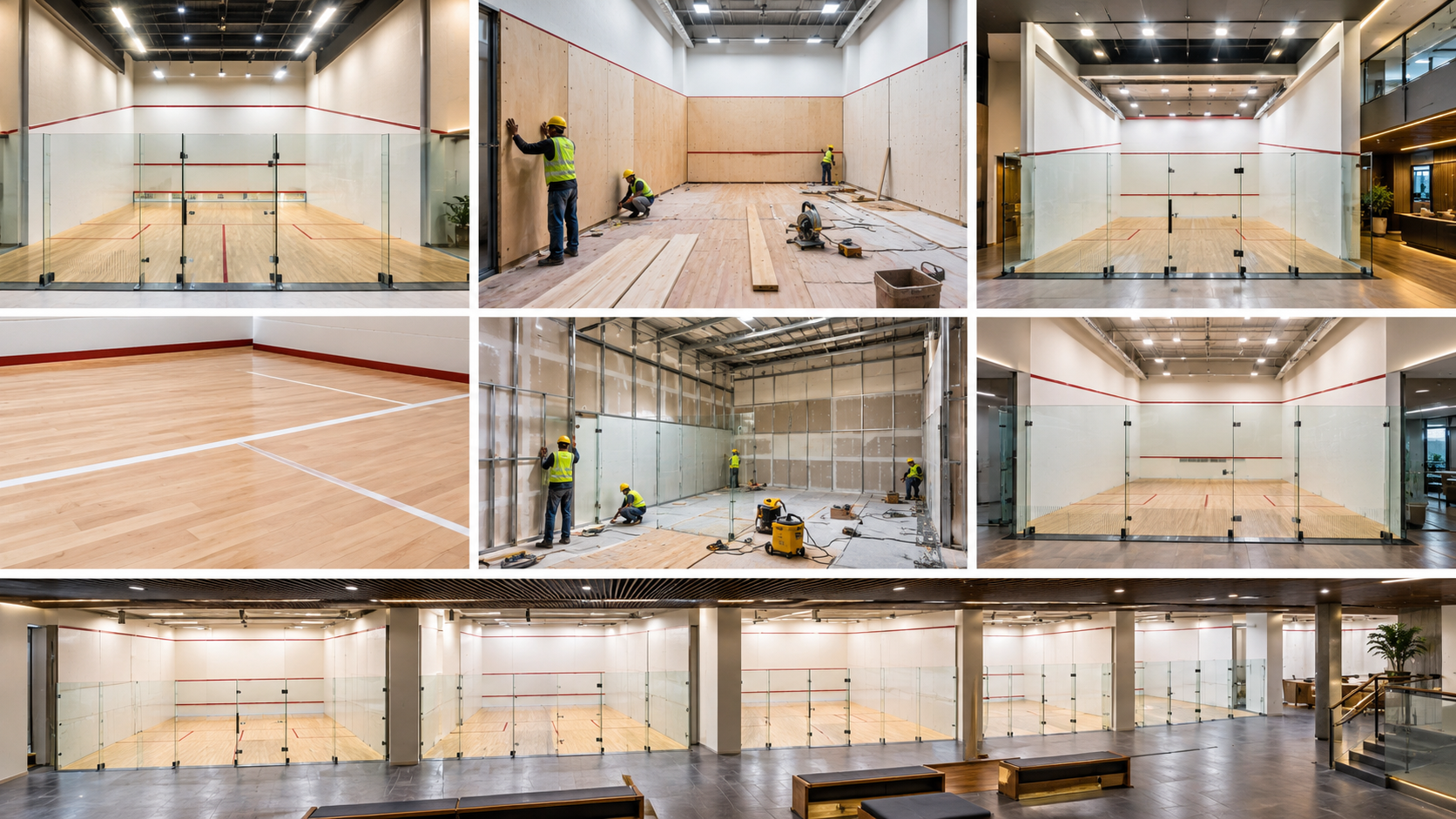
For multi-court projects, the overall facility layout can also be planned to optimize available space.
Civil and Structural Preparation
The base structure must be sufficiently stable to support the complete court system.
Depending on the project, preparation may include:
- Floor leveling
- Concrete work
- Structural framing
- Wall preparation
- Moisture treatment
- Surface correction
- Electrical provisions
- Ventilation provisions
The exact construction method depends on the site and selected court system.
Wall System Installation
The walls are among the most important components of a squash court.
They need to provide a consistent playing response while remaining structurally stable.
The construction system may incorporate engineered panels, structural supports, specialized wall finishes, and appropriate protective layers.
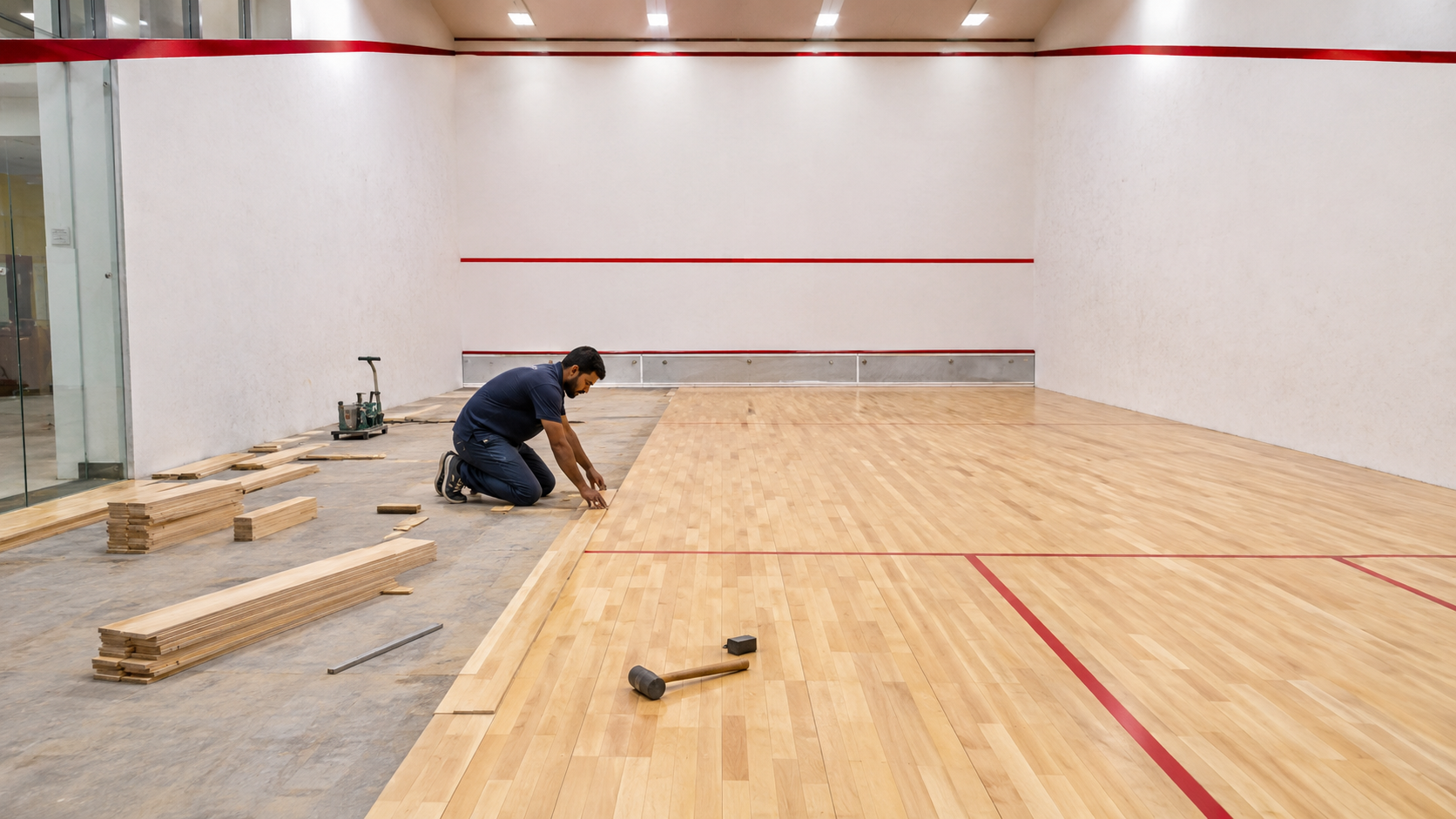
Squash Court Flooring
The playing surface must provide suitable grip, controlled movement, durability, and player comfort.
Depending on the project, flooring solutions can be selected based on:
- Shock absorption
- Surface traction
- Durability
- Maintenance requirements
- Player usage
- Budget
- Facility type
Professional installation is essential because an otherwise high-quality flooring product can perform poorly if the underlying base is not properly prepared.
Glass Rear Wall Installation
For glass-back courts, specialized safety glass is installed using an appropriate structural support system.
The rear wall needs to provide visibility while maintaining structural integrity and player safety.
Lighting Installation
Lighting is a critical part of a squash court.
Poor lighting can create shadows, glare, and visibility problems, making it difficult for players to track the ball.
A professional lighting plan considers:
- Light distribution
- Glare control
- Shadow reduction
- Fixture positioning
- Energy efficiency
- Maintenance access
Court Marking
Accurate court markings provide clear visual references for players.
Lines should be properly positioned, sharply defined, and compatible with the selected flooring system.
Quality Inspection
Before handover, the complete court should be inspected.
The inspection can cover:
- Floor surface
- Wall alignment
- Glass installation
- Court markings
- Lighting
- Doors
- Finishing
- Safety features
- General workmanship
Only after the required checks are completed should the facility be handed over for use.
Squash Court Dimensions and Planning
One of the most important considerations when constructing a squash court is dimensional accuracy.
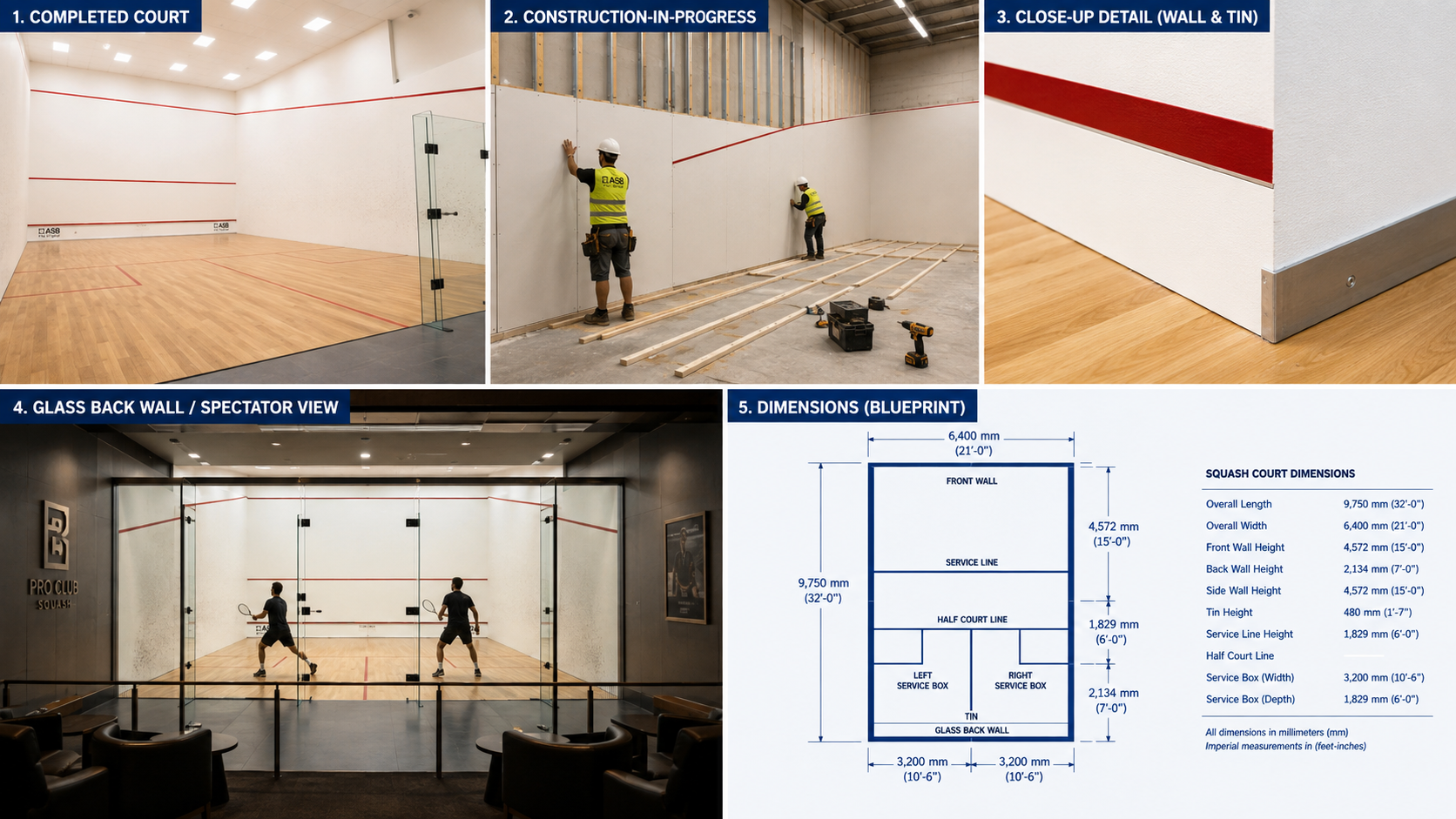
A standard international squash court is generally planned around a playing area of approximately 9.75 metres in length and 6.40 metres in width.
However, the total construction footprint needs to be larger than the playing area because additional space may be required for:
- Wall structures
- Glass systems
- Door access
- Structural framing
- Circulation
- Lighting
- Services
- Maintenance access
Therefore, simply measuring an empty room and assuming it is large enough for a squash court can lead to planning problems.
A professional site assessment should be completed before construction begins.
Squash Court Flooring Options
Flooring plays a major role in player comfort and court performance.
A suitable squash floor should provide controlled traction without making movement unnecessarily difficult. It should also withstand repeated foot traffic and rapid directional changes.
Wooden Squash Flooring
Timber flooring is a popular option for premium indoor squash facilities.
Benefits can include:
- Natural playing feel
- Attractive appearance
- Good movement characteristics
- Professional finish
- Suitable cushioning when correctly engineered
The flooring system must be installed over an appropriately prepared base.
Sports Synthetic Flooring
Synthetic sports flooring can be considered where clients require a practical and relatively easy-to-maintain surface.
The appropriate product depends on the court design, player requirements, usage level, and manufacturer specifications.
Important Features of a Professional Squash Court
A quality squash court should not be judged only by appearance.
Important factors include:
Consistent Ball Rebound
The walls need to provide predictable ball response. Variations in wall construction can affect the playing experience.
Safe Foot Movement
The floor should provide suitable traction while supporting quick movement and changes of direction.
Shock Management
A properly engineered sports floor can help reduce the stress associated with repetitive movement.
Controlled Lighting
Lighting should allow players to follow the ball without unnecessary glare or distracting shadows.
Ventilation
Because squash involves intense physical activity inside an enclosed environment, ventilation is an important consideration.
Acoustic Control
Squash can generate considerable sound from ball impacts, player movement, and racket contact. Appropriate materials and building design can help manage unwanted noise.
Squash Court Construction for Sports Academies
Sports academies often require courts capable of handling intensive daily use.
An academy project may include several courts along with:
- Reception area
- Player changing rooms
- Viewing areas
- Fitness facilities
- Coaching areas
- Equipment storage
- Administrative spaces
A multi-court facility should be planned as a complete sports environment rather than simply installing several individual courts.
Squash Court Construction for Schools and Colleges
Educational institutions increasingly invest in dedicated sports infrastructure to provide students with more opportunities for physical activity and competitive training.
A squash court can be incorporated into:
- School sports complexes
- College campuses
- University sports centres
- Residential schools
- Training institutions
For educational facilities, durability, safety, ease of maintenance, and efficient use of available space are particularly important.
Squash Court Construction for Hotels and Resorts
Premium hotels and resorts can use squash courts as part of their wellness and recreational facilities.
A professionally constructed court can complement:
- Gymnasiums
- Swimming pools
- Fitness studios
- Indoor sports areas
- Wellness centres
- Clubhouses
Design can be customized to match the architectural style and premium character of the property.
Why Choose Sports Facility India?
Selecting the right construction partner can have a long-term impact on the performance and maintenance of your squash facility.
Sports Facility India provides a complete approach to sports court development, from initial planning to final execution.
Complete Project Management
Instead of coordinating multiple contractors independently, clients can work with one team for the major stages of the court development.
Customized Court Solutions
Every site is different. Court planning can be adapted according to available space, usage requirements, facility type, and project objectives.
Quality-Focused Construction
Material selection and installation methods are considered with long-term performance in mind.
Professional Installation
Experienced installation is essential for flooring, wall systems, glass components, markings, and other specialist elements.
Pan-India Project Support
Sports Facility India works on sports infrastructure projects across different locations in India, subject to project requirements and site conditions.
Maintenance-Oriented Design
The objective is not simply to build an attractive court but to create a facility that can remain functional and manageable over time.
Factors Affecting Squash Court Construction Cost in India
There is no single fixed price for building a squash court because the total project cost depends on several variables.
Important factors include:
- Number of courts
- Court construction system
- Structural requirements
- Flooring selection
- Glass wall specifications
- Wall finishing
- Lighting system
- Ventilation
- Site condition
- Civil work
- Existing building structure
- Transportation
- Installation complexity
- Location
- Customization
- Accessories
A single-court project in an existing building may have completely different costs from a new multi-court sports facility.
For this reason, a proper quotation should be prepared after reviewing the site, drawings, specifications, and project requirements.
How to Reduce Long-Term Squash Court Maintenance
Construction quality is only one part of maintaining a sports facility.
Regular maintenance can help preserve court performance and appearance.
Recommended practices include:
- Clean the floor regularly.
- Remove dust and dirt using suitable cleaning equipment.
- Avoid aggressive chemicals unless approved for the flooring system.
- Inspect wall surfaces periodically.
- Check glass systems and hardware.
- Maintain lighting fixtures.
- Keep ventilation systems functional.
- Address moisture problems quickly.
- Repair damaged surfaces before they become larger problems.
- Follow the flooring manufacturer’s maintenance recommendations.
A planned maintenance routine can help extend the useful life of the facility.
Squash Court Manufacturer vs. General Contractor
A general contractor may be capable of managing conventional building work, but a specialist sports construction company understands the unique requirements of a squash facility.
Squash court construction involves several specialized considerations, including:
- Playing dimensions
- Wall rebound characteristics
- Sports flooring
- Court markings
- Lighting
- Glass systems
- Player safety
- Acoustics
- Ventilation
- Sports-specific finishing
Choosing a company with experience in sports infrastructure can therefore make the planning and execution process more efficient.
Complete Squash Court Solutions Under One Roof
For a new sports facility, managing different suppliers for every component can create coordination challenges.
A complete squash court solution can bring multiple requirements together:
Site Survey → Design → Civil Work → Structure → Walls → Flooring → Glass → Lighting → Marking → Accessories → Quality Inspection → Handover
This integrated approach can reduce communication gaps and make project management easier.
Frequently Asked Questions About Squash Court Construction
How much does it cost to build a squash court in India?
The cost depends on the construction system, flooring, glass wall, civil work, lighting, site condition, location, and customization. A site assessment and project specification are recommended before preparing an accurate quotation.
How long does squash court construction take?
Project duration varies according to the number of courts, existing site conditions, civil work, material availability, and installation requirements. A realistic timeline can be provided after reviewing the project scope.
Can you construct a squash court inside an existing building?
Yes. Existing buildings can often be converted into squash facilities if they provide suitable structural conditions, dimensions, access, ceiling height, ventilation, and other technical requirements.
Can you build multiple squash courts?
Yes. Multi-court facilities can be planned for sports academies, clubs, schools, universities, hotels, residential communities, and commercial sports centres.
What flooring is best for a squash court?
The ideal flooring depends on the court design, player requirements, usage intensity, budget, and maintenance expectations. Specialist sports flooring should be selected and professionally installed.
Can a glass-back squash court be constructed?
Yes. Glass-back systems can be incorporated into suitable squash court designs, particularly for clubs, academies, premium facilities, and spectator-oriented environments.
Do squash courts require special lighting?
Yes. Proper lighting is important because players need clear visibility of a fast-moving ball. Lighting should be planned to minimize glare, distracting shadows, and uneven illumination.
Can the squash court design be customized?
Yes. Court systems can be customized around the available space, number of courts, architectural requirements, flooring preferences, viewing areas, lighting, and overall facility design.
Build a Professional Squash Court with the Right Construction Partner
A successful squash court project begins with the right planning and the right construction team. From structural preparation and wall systems to sports flooring, glass installation, lighting, ventilation, and final finishing, every component contributes to the quality of the finished facility.
If you are planning a squash court construction project in India, Sports Facility India can help develop a solution according to your site, facility requirements, usage level, and project objectives.
Whether the requirement is for a school, college, sports academy, club, hotel, residential community, fitness centre, or commercial sports facility, professional planning can help create a court that delivers reliable performance and long-term value.
Looking for a squash court manufacturer and construction company in India? Contact Sports Facility India to discuss your project requirements, site conditions, court specifications, and complete construction solution.