Introduction
Choosing the right badminton court flooring is one of the most important decisions when developing an indoor sports facility. The quality of the playing surface directly affects player comfort, movement, foot grip, shock absorption, and overall playing performance. Whether you are planning a badminton court for a school, college, sports academy, stadium, club, hotel, or residential community, selecting suitable flooring is essential for creating a safe and long-lasting sports environment.
Badminton is a fast-paced indoor sport that involves sudden movements, quick direction changes, jumping, lunging, and frequent footwork. A poorly selected flooring system may create problems such as excessive slipping, insufficient cushioning, uncomfortable movement, and premature surface damage. On the other hand, professionally selected and installed badminton flooring provides a consistent playing experience while supporting player safety and facility durability.
Today, different badminton court flooring options are available, including synthetic PVC flooring, vinyl sports flooring, wooden sports flooring, and other specialized indoor sports surfaces. Each material offers different performance characteristics, maintenance requirements, installation methods, and cost considerations.
Understanding these differences can help facility owners, architects, contractors, and sports administrators make informed decisions.
This guide explains how to choose the best badminton court flooring for indoor sports facilities, covering flooring types, essential performance features, installation considerations, maintenance requirements, and factors that influence the overall investment.
1. Understand the Requirements of Your Indoor Badminton Facility
Before selecting a flooring material, it is important to understand how the badminton court will be used. Different indoor sports facilities have different requirements depending on player levels, playing frequency, available space, and operational needs.
For example, a badminton court designed for recreational activities may have different flooring requirements compared with a professional training academy or competition venue.
Consider the following factors:
-
Playing level: Determine whether the court will be used for recreational games, school sports, regular training, or competitive badminton.
-
Daily usage: Facilities with frequent playing sessions require durable flooring that can withstand repeated foot movement.
-
Player safety: The surface should provide suitable traction, cushioning, and shock absorption.
-
Available budget: Compare initial installation expenses with long-term maintenance and replacement costs.
-
Indoor conditions: Consider humidity, ventilation, temperature, and the condition of the existing concrete or subfloor.
-
Maintenance requirements: Select a flooring system that can be cleaned and maintained without complicated procedures.
A clear understanding of these requirements makes it easier to select a flooring solution that matches the purpose of the facility.
2. Explore Different Types of Badminton Court Flooring
There are several flooring materials used in indoor badminton facilities. Each option has its own advantages, limitations, and suitable applications.
A. PVC Synthetic Badminton Court Flooring
PVC synthetic flooring is one of the popular choices for modern indoor badminton courts. It is manufactured using specialized synthetic materials designed to provide a suitable playing surface for indoor sports.
These flooring systems are generally supplied in rolls or sheets and installed over a properly prepared subfloor.
Key advantages:
-
Provides consistent playing surface characteristics.
-
Offers cushioning and shock absorption, depending on the system.
-
Supports quick footwork and directional movement.
-
Available in different colours and surface finishes.
-
Relatively easy to clean and maintain.
-
Suitable for badminton academies, schools, clubs, and indoor sports complexes.
When choosing PVC flooring, check the thickness, construction layers, surface texture, and sports performance specifications. Not every commercial vinyl floor is suitable for badminton.
B. Wooden Badminton Court Flooring
Wooden sports flooring is a traditional option for premium indoor sports halls and multi-purpose stadiums. It provides a natural playing surface and can be designed with specialized subfloor systems to improve sports performance.
Some wooden sports flooring installations use sprung or resilient subfloor constructions that help manage impact forces during physical activities.
Key advantages:
-
Natural and attractive sports surface.
-
Suitable for premium indoor sports facilities.
-
Can provide excellent playing comfort with an appropriate sprung system.
-
Supports multi-purpose indoor sports applications.
-
Can offer a long service life with proper installation and maintenance.
However, wooden flooring requires careful moisture management, appropriate ventilation, and regular maintenance. Its suitability should be evaluated according to the intended badminton application and relevant sports specifications.
C. Vinyl Sports Flooring
Vinyl sports flooring is another option for indoor badminton facilities. It is available in different constructions, including sports-specific multi-layer systems.
Unlike ordinary residential or commercial vinyl, sports-grade vinyl flooring is designed to meet the movement and impact requirements of physical activities.
Key advantages:
-
Smooth and uniform playing surface.
-
Available in multiple colours and finishes.
-
Easy cleaning and routine maintenance.
-
Can provide suitable traction and cushioning when designed for indoor sports.
-
Works well in educational institutions, recreational centres, and sports clubs.
Before purchasing, verify that the product is specifically manufactured for badminton or indoor sports use rather than general-purpose flooring.
D. Polyurethane Sports Flooring
Polyurethane flooring is a synthetic surface system used in certain indoor sports applications. It is generally installed as a seamless coating over a properly prepared substrate.
Depending on the system design, it can offer a uniform finish, resilient surface characteristics, and easy maintenance.
Key advantages:
-
Seamless surface appearance.
-
Available in different colours.
-
Can be designed with specific performance characteristics.
-
Suitable for selected multi-purpose indoor sports applications.
However, not every polyurethane system is appropriate for badminton. The surface must provide the required grip, deformation, and playing characteristics for the intended sport.
3. Check Shock Absorption and Player Comfort
Shock absorption is an essential feature when selecting badminton court flooring. During a game, players repeatedly jump, land, accelerate, and change directions. These activities create impact forces that travel through the feet and lower body.
A suitable sports flooring system helps manage these forces and provides a more comfortable playing environment.
When comparing flooring products, consider:
-
Shock absorption performance.
-
Vertical deformation characteristics.
-
Surface resilience.
-
Cushioning consistency across the court.
-
Suitability for repeated sporting activities.
The right level of cushioning depends on the complete flooring construction, including the surface material, backing layers, and subfloor system.
Avoid selecting flooring based only on softness. An excessively soft surface can affect movement and stability. The objective is to achieve an appropriate balance between impact management and controlled foot movement.
4. Evaluate Grip and Slip Resistance
Badminton players move rapidly across the court, often changing direction within seconds. Therefore, the flooring must provide reliable traction without restricting natural movement.
A surface that is excessively slippery can increase the risk of falls, while an overly rough surface may interfere with quick footwork.
The best badminton flooring should provide:
-
Consistent grip during lateral movements.
-
Controlled sliding resistance.
-
A suitable surface texture.
-
Stable footing during sudden stops.
-
Consistent traction throughout the playing area.
Ask manufacturers for documented slip-resistance and sports-performance test results. Also consider how dust, sweat, and cleaning residues may affect the surface during regular use.
5. Select the Correct Badminton Court Dimensions and Layout
Flooring selection should always be considered alongside proper court dimensions and layout planning.
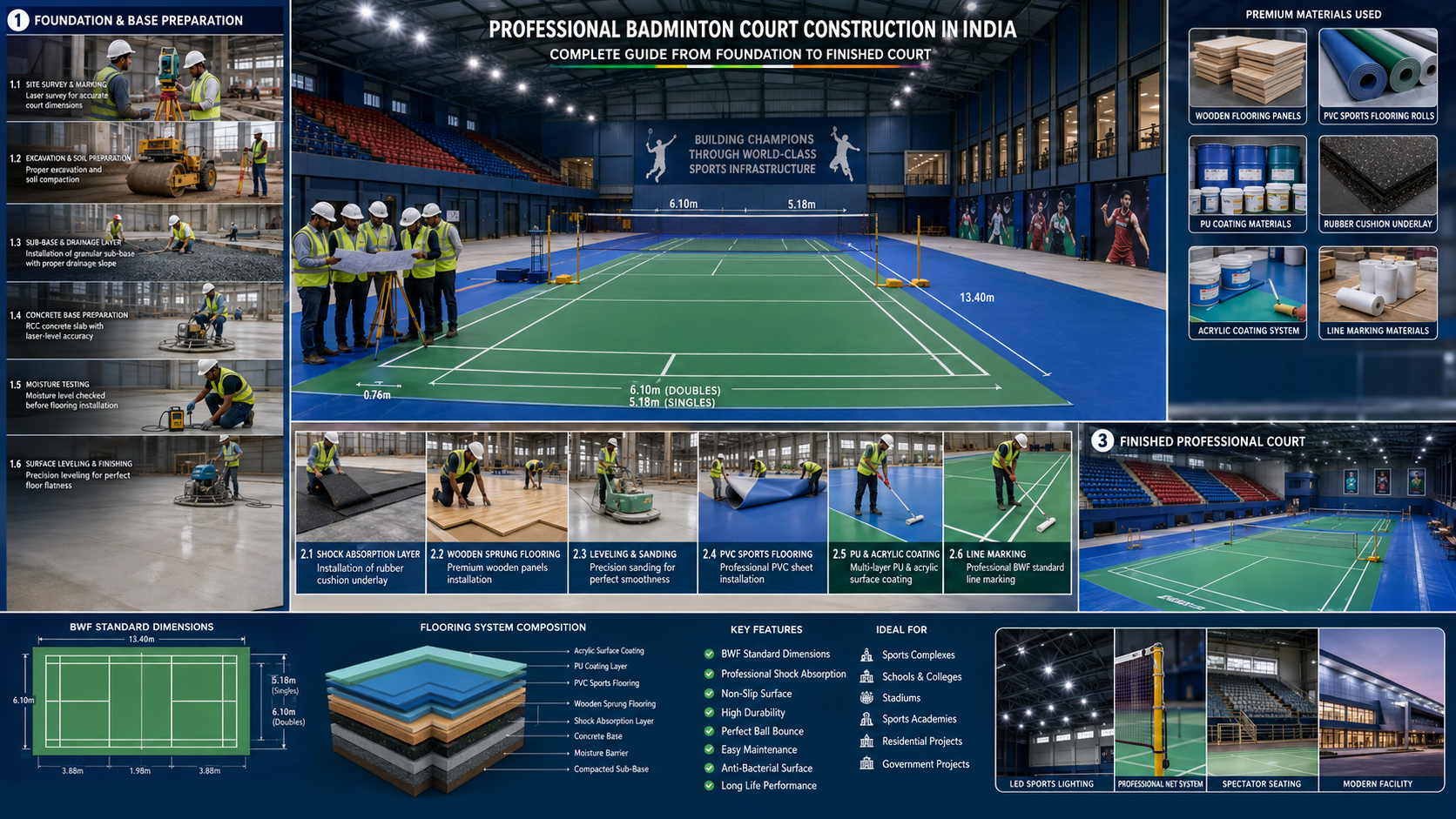
According to standard badminton court dimensions:
| Court specification | Measurement |
|---|---|
| Court length | 13.40 metres |
| Doubles court width | 6.10 metres |
| Singles court width | 5.18 metres |
| Total playing area for doubles | 81.74 sq. metres |
Apart from the actual playing area, indoor facility planning should include sufficient surrounding space for player movement, umpire positioning, spectators, and safe access.
Important layout considerations include:
-
Accurate boundary and service line markings.
-
Suitable clearance around the playing court.
-
Appropriate ceiling height.
-
Proper lighting arrangement.
-
Adequate ventilation.
-
Safe entry and exit points.
The final court layout should follow the applicable badminton regulations and the requirements of the intended competition or recreational use.
6. Consider Flooring Thickness and Construction Quality
Flooring thickness is an important consideration, but a thicker product is not automatically better.
Different badminton flooring systems are manufactured with different layer constructions. These may include a wear layer, printed or decorative layer, reinforcement layer, foam or cushioning backing, and supporting components.
Before selecting a product, examine its overall construction.
Important specifications to check:
-
Total flooring thickness.
-
Wear-layer thickness.
-
Material composition.
-
Surface texture.
-
Dimensional stability.
-
Impact and shock absorption results.
-
Abrasion resistance.
-
Product warranty.
-
Manufacturer’s installation guidelines.
Ask for a technical data sheet rather than relying only on product descriptions or verbal promises.
A professionally selected flooring system should offer consistent performance throughout the entire badminton court.
7. Check the Quality of the Subfloor Before Installation
Even premium badminton flooring cannot deliver its intended performance if it is installed over an unsuitable base.
Subfloor preparation is one of the most important stages of indoor sports flooring installation. An uneven or damaged base may cause visible imperfections, bonding problems, surface irregularities, and premature flooring failure.
Before installation, the contractor should inspect:
Surface level: The concrete or other approved base should be sufficiently even and prepared according to the flooring manufacturer’s tolerances.
Moisture condition: Excessive moisture can affect adhesives, flooring stability, and the long-term performance of the installation.
Cracks and damage: Existing cracks, holes, and damaged areas should be properly assessed and repaired.
Cleanliness: Dust, oil, loose particles, and other contaminants should be removed before installation.
Surface compatibility: The subfloor should be suitable for the selected flooring system and adhesive.
Proper preparation improves installation quality and helps prevent avoidable maintenance problems.
8. Understand Professional Badminton Flooring Installation
The installation process has a direct impact on the durability, appearance, and performance of a badminton court.
Professional installation generally involves several stages.
Step 1: Site inspection and measurement
The installation team evaluates the indoor space, checks the available dimensions, and examines the existing subfloor.
Step 2: Base preparation
The surface is cleaned, levelled, and repaired wherever necessary. Moisture conditions are also checked according to the flooring manufacturer’s requirements.
Step 3: Material selection
The appropriate flooring material is selected according to the facility’s requirements, budget, and expected usage.
Step 4: Flooring installation
The flooring is positioned and installed using the recommended adhesive, joining technique, and installation procedure.
Step 5: Joint and edge finishing
The seams, edges, and transitions are completed carefully to achieve a uniform and stable surface.
Step 6: Court line marking
Badminton court markings are applied accurately using compatible materials and the required dimensions.
Step 7: Final inspection
The completed installation is inspected for surface consistency, joint quality, line accuracy, and visible defects. The flooring should be allowed to cure or settle for the period specified by the manufacturer before use.
9. Compare Flooring Costs and Long-Term Value
The cost of badminton court flooring depends on several factors. Instead of choosing a product solely because it has a lower installation price, evaluate its expected performance, maintenance requirements, and service life.
The total project cost may include:
-
Flooring material and accessories.
-
Subfloor preparation and levelling.
-
Adhesives and installation materials.
-
Labour and installation charges.
-
Badminton court line marking.
-
Transportation and material handling.
-
Maintenance and future repair expenses.
Factors that influence badminton flooring prices:
| Cost factor | How it affects the project |
|---|---|
| Flooring material | Different materials have different price ranges |
| Thickness and construction | Multi-layer systems may cost more |
| Court dimensions | Larger areas require more material |
| Subfloor condition | Additional preparation increases costs |
| Installation complexity | Specialised installation requires skilled labour |
| Product quality | Performance specifications and durability affect pricing |
For an accurate estimate, request a site inspection and a detailed quotation from an experienced sports flooring contractor.
A quality flooring system may involve a higher initial investment, but its long-term value can be better when it offers reliable performance, manageable maintenance, and fewer replacement requirements.
10. Choose Flooring According to the Type of Indoor Facility
Not every indoor badminton facility has the same requirements. The most suitable flooring depends on the purpose of the venue and the people using it.
Badminton Academies and Training Centres
Badminton academies generally experience frequent playing sessions, regular training, and continuous foot movement. Flooring should provide consistent traction, suitable cushioning, and resistance to everyday wear.
Sports-grade PVC flooring is worth considering for facilities that require a practical and performance-oriented surface.
Schools and Colleges
Educational institutions require flooring that supports recreational games, physical education, and organised sports activities.
Easy cleaning, durability, player comfort, and reasonable maintenance costs are important considerations.
Sports Complexes and Indoor Stadiums
Large indoor sports facilities may accommodate tournaments, professional coaching, and multiple sporting activities.
The flooring should be selected according to the primary sport, expected usage, and relevant competition requirements. Multi-purpose facilities should also consider whether the same surface can safely accommodate other sports.
Hotels and Residential Communities
Hotels, residential societies, and private clubs often develop badminton courts to provide recreational and fitness opportunities.
For these facilities, visual appearance, maintenance convenience, durability, and comfortable playing conditions are important selection criteria.
11. Understand Indoor Environmental Conditions
Indoor environmental conditions can influence the performance and lifespan of badminton court flooring.
Although indoor courts are protected from direct rainfall and sunlight, humidity, moisture, temperature changes, and ventilation can still affect flooring materials.
Consider these factors during project planning:
Humidity management: High humidity may affect wooden flooring and certain adhesive systems. Proper environmental control is important.
Ventilation: Adequate airflow helps maintain comfortable playing conditions and supports moisture management.
Temperature: Follow the manufacturer’s recommended temperature range for flooring installation and operation.
Lighting: Install suitable sports lighting to provide clear visibility without excessive glare.
Roof and water leakage: Check the building structure to prevent water entering the sports area and damaging the flooring.
Environmental planning should be completed before installation rather than waiting for problems to appear after the court becomes operational.
12. Maintenance Tips to Extend the Life of Badminton Court Flooring
Regular maintenance helps preserve the appearance, grip, and functional performance of badminton court flooring.
Even high-quality sports flooring requires proper care to remain in good condition.
Follow these maintenance practices:
-
Clean the surface regularly: Remove dust, dirt, and loose particles using a suitable dust mop or cleaning equipment.
-
Use approved cleaning solutions: Select cleaning products recommended by the flooring manufacturer.
-
Avoid excessive water: Do not allow water to collect on the playing surface.
-
Inspect the flooring periodically: Check for damaged areas, loose joints, surface wear, and other visible issues.
-
Control footwear: Encourage players to use clean, non-marking indoor sports shoes.
-
Prevent unnecessary damage: Avoid dragging heavy equipment or furniture across the court.
-
Maintain indoor conditions: Monitor humidity, temperature, and ventilation as recommended for the selected flooring.
-
Repair damaged areas promptly: Address small problems before they develop into larger maintenance issues.
A regular cleaning and inspection schedule helps facility managers maintain a clean, attractive, and functional playing environment.
13. Common Mistakes to Avoid When Selecting Badminton Court Flooring
Selecting flooring without understanding its technical characteristics can lead to unnecessary expenses and performance problems.
Here are some common mistakes that indoor sports facility owners should avoid.
Choosing ordinary commercial flooring: General-purpose vinyl or decorative flooring may not provide the sports-specific grip, shock absorption, and surface characteristics required for badminton.
Focusing only on the purchase price: Low-cost materials may not provide the expected durability or playing performance.
Ignoring subfloor preparation: Installing premium flooring over an uneven or moisture-affected base can create long-term problems.
Overlooking technical specifications: Always check product data sheets, testing information, and manufacturer recommendations.
Selecting unsuitable cushioning: Excessively hard or soft surfaces may affect comfort, movement, and stability.
Ignoring professional installation: Incorrect adhesive application, poor joint finishing, and inaccurate line marking can reduce the quality of the completed court.
Not planning for maintenance: Every flooring system requires appropriate cleaning and periodic inspection.
Avoiding these mistakes helps ensure that the investment delivers better long-term value.
14. Essential Features to Look for in the Best Badminton Court Flooring
Before finalising your flooring supplier, compare products using a clear technical checklist.
| Important feature | Why it matters |
|---|---|
| Shock absorption | Helps manage impact during jumping and landing |
| Slip resistance | Supports controlled foot movement |
| Surface uniformity | Provides consistent playing conditions |
| Durability | Handles regular sports activities |
| Dimensional stability | Helps maintain the installed surface |
| Wear resistance | Reduces premature surface deterioration |
| Easy maintenance | Simplifies daily cleaning |
| Quality installation | Supports long-term flooring performance |
| Technical certification | Provides evidence of tested product characteristics |
Where applicable, ask whether the flooring has been tested against recognised indoor sports flooring standards, such as EN 14904, and whether the test results apply to the complete installed system.
For competitive facilities, also verify the current requirements of the relevant badminton governing body and the flooring product’s approval status. A manufacturer’s general claim of being suitable for sports should not be treated as formal competition approval.
15. Why Professional Badminton Court Flooring Installation Matters
Selecting the right material is only one part of developing a quality badminton court. Professional installation ensures that the selected flooring performs according to its intended specifications.
An experienced sports flooring contractor understands the technical requirements involved in indoor court development, including subfloor preparation, material selection, installation methods, joint finishing, and court marking.
Professional installation offers several benefits:
-
Better surface uniformity.
-
Proper flooring adhesion and joint finishing.
-
Accurate badminton court dimensions.
-
Appropriate installation techniques.
-
Reduced chances of premature flooring damage.
-
Better long-term maintenance and performance.
For facilities planning to host competitive events, it is particularly important to select products and installation systems that meet the applicable governing-body requirements.
The Badminton World Federation (BWF) specifies wooden sprung flooring or an equivalent approved subfloor for certain high-level competition courts, together with approved badminton court mats. Requirements vary according to tournament category.
badmintonpanam.org+1
16. Why Choose Sports Facility India for Badminton Court Flooring?
Developing a professional badminton court requires proper planning, quality materials, and an understanding of indoor sports flooring requirements.
Sports Facility India provides sports infrastructure solutions for institutions, sports academies, clubs, residential communities, and commercial sports facilities.
Our badminton court flooring solutions focus on creating functional indoor playing environments that support player comfort, surface consistency, and long-term usability.
Our approach includes:
-
Badminton court flooring consultation.
-
Site inspection and project planning.
-
Flooring material selection.
-
Subfloor preparation guidance.
-
Professional flooring installation.
-
Badminton court line marking.
-
Quality inspection and finishing.
-
Maintenance recommendations.
Whether you are developing a new badminton academy, upgrading an existing sports hall, or planning an indoor sports complex, choosing an appropriate flooring system is essential for achieving a reliable result.
Our objective is to provide flooring solutions that match the technical requirements, intended usage, and budget of each project.
17. Final Checklist Before Purchasing Badminton Court Flooring
Before placing your order, make sure you have evaluated the following points:
Completing this checklist can help you avoid unsuitable products and make a more informed purchasing decision.
Conclusion
Choosing the best badminton court flooring for an indoor sports facility requires more than comparing materials and prices. It involves evaluating player safety, shock absorption, surface grip, durability, installation quality, maintenance requirements, and the intended use of the facility.
PVC synthetic sports flooring, vinyl sports flooring, wooden sports flooring, and polyurethane systems each offer different characteristics. The right choice depends on the technical specifications of the product, the construction of the complete flooring system, and the requirements of the sports facility.
For schools, colleges, badminton academies, clubs, and indoor stadiums, investing in professionally selected and installed sports flooring helps create a comfortable, functional, and dependable playing environment.
Before finalising your project, consult an experienced badminton court flooring contractor, compare technical data sheets, and request information about product testing and installation procedures.
Planning to develop a professional indoor badminton court? Contact Sports Facility India to explore badminton court flooring solutions, discuss your project requirements, and get guidance on selecting a suitable sports flooring system.
Frequently Asked Questions (FAQs)
1. Which flooring is best for an indoor badminton court?
Sports-grade PVC flooring, specialised vinyl sports flooring, and wooden sprung flooring are common options. The best choice depends on the playing level, budget, facility requirements, and relevant sports standards.
2. Is PVC flooring suitable for badminton courts?
Yes. Sports-grade PVC flooring is suitable for many indoor badminton facilities. It can provide cushioning, consistent surface characteristics, and suitable traction when designed specifically for badminton.
3. What is the standard size of a badminton court?
A standard badminton court measures 13.40 metres in length and 6.10 metres in width for doubles. The singles court width is 5.18 metres.
4. What thickness is recommended for badminton court flooring?
There is no single thickness suitable for every badminton court. It depends on the flooring material, construction, cushioning system, and manufacturer specifications. Always compare the complete system rather than thickness alone.
5. Is wooden flooring better than synthetic badminton flooring?
Both options can be suitable. Wooden sprung flooring is commonly used in premium sports halls and high-level competition venues, while synthetic flooring offers practical solutions for many academies, schools, and recreational facilities.
6. How important is shock absorption in badminton court flooring?
Shock absorption helps manage the impact created during jumping, landing, and rapid movement. A suitable flooring system can improve playing comfort and reduce excessive impact on players.
7. How do you maintain synthetic badminton court flooring?
Regular dust removal, appropriate cleaning solutions, moisture control, and periodic surface inspections help maintain synthetic badminton flooring. Players should also use clean, non-marking indoor sports shoes.
8. Can badminton flooring be installed over an existing concrete floor?
Yes. Many synthetic sports flooring systems can be installed over an existing concrete base, provided it is structurally sound, sufficiently level, clean, dry, and compatible with the selected system.
9. What factors affect badminton court flooring costs?
Material quality, flooring thickness, court dimensions, subfloor preparation, installation complexity, transportation, and maintenance requirements influence the overall project cost.
10. How long does badminton court flooring last?
The lifespan depends on material quality, installation workmanship, daily usage, environmental conditions, and maintenance. Follow the manufacturer’s service-life guidance and warranty conditions.
11. Is the same flooring suitable for professional and recreational badminton?
Not necessarily. Recreational courts and professional competition venues may have different performance and certification requirements. Competition facilities should follow the applicable BWF regulations and approval requirements.
12. Why should I hire a professional badminton court flooring contractor?
A professional contractor can help with material selection, subfloor assessment, installation, court dimensions, line marking, and quality inspection. This helps reduce installation errors and supports long-term flooring performance.