Basketball is a fast-paced sport that requires speed, balance, agility, and excellent coordination. Whether it is a professional basketball arena, a school playground, a sports academy, or a residential basketball court, the playing surface plays an important role in the overall experience. The right basketball court flooring not only improves playing performance but also provides better safety, durability, and comfort for players.
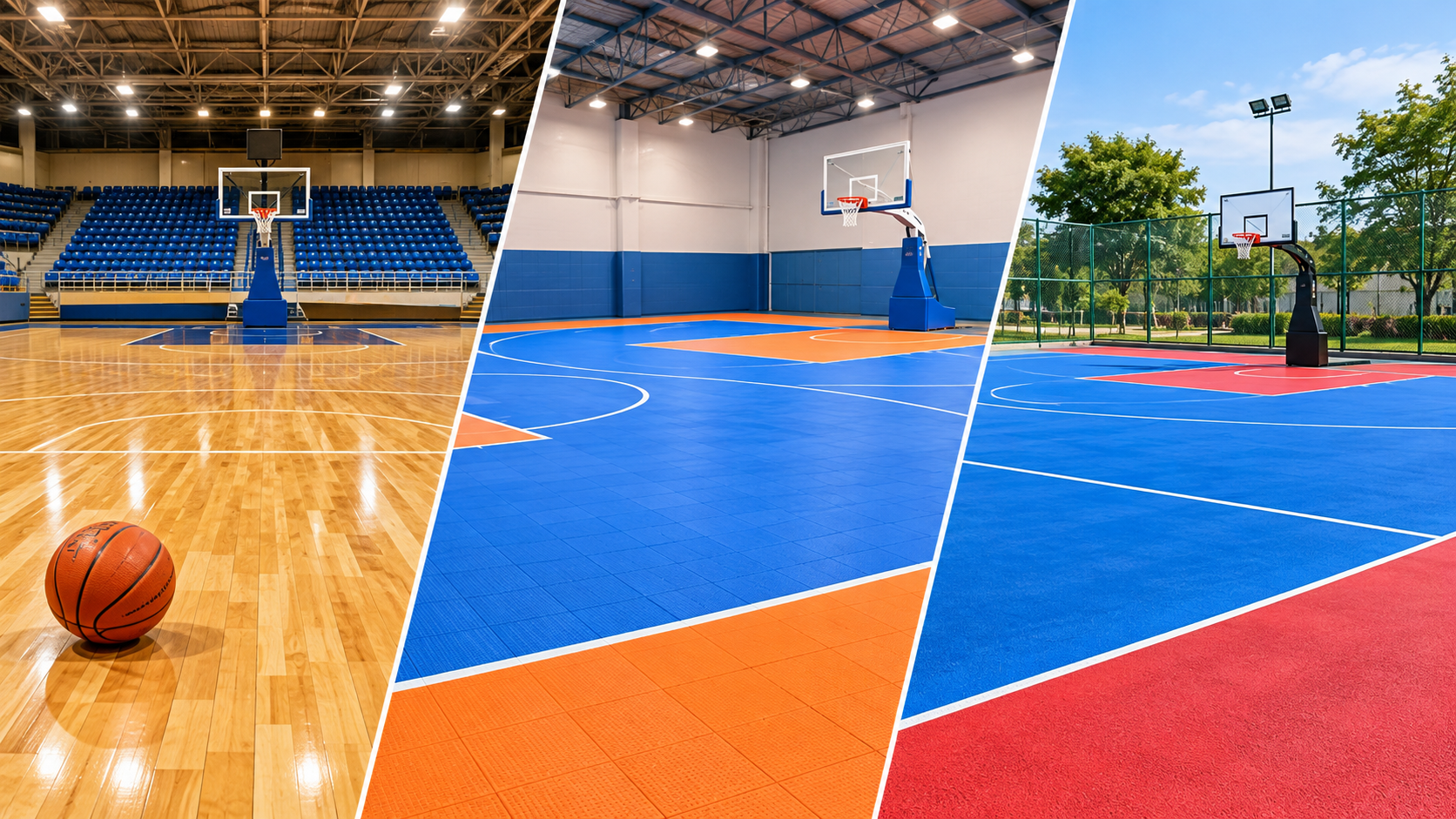
Today, there are several types of basketball court flooring available in the market. Among the most popular options are wooden flooring, PVC sports flooring, and acrylic basketball court flooring. Each flooring type offers different advantages depending on the court’s location, budget, usage, and maintenance requirements.
Choosing the right basketball flooring can sometimes be confusing, especially when every material has its own features and benefits. Some surfaces are designed for indoor professional games, while others are more suitable for outdoor basketball courts that experience changing weather conditions.
In this blog, we will explore the three major types of basketball court flooring, understand their advantages and disadvantages, compare their costs and maintenance requirements, and help you decide which flooring solution is best for your basketball court.
Why Is Choosing the Right Basketball Court Flooring Important?
Basketball involves continuous running, jumping, sudden stopping, turning, and quick changes in direction. A poor-quality playing surface can affect player performance and increase the possibility of slips, falls, and injuries.
A properly designed basketball court floor provides several important benefits:
-
Player safety: A suitable sports surface provides controlled grip and reduces the chances of slipping during intense movements.
-
Shock absorption: Sports flooring with appropriate cushioning helps reduce the impact of repeated jumping and running.
-
Better ball response: A consistent playing surface supports predictable basketball bounce and ball movement.
-
Playing comfort: Proper flooring makes long training sessions and competitive matches more comfortable.
-
Long-term durability: Quality basketball flooring can withstand regular sports activities and heavy usage.
-
Professional appearance: Attractive flooring with accurate court markings creates a professional playing environment.
Therefore, selecting the right flooring material is an important part of basketball court construction and sports facility development.
1. Wooden Basketball Court Flooring
Wooden basketball court flooring is one of the most traditional and premium flooring solutions used in professional indoor basketball arenas. It is particularly popular in professional sports facilities, universities, indoor stadiums, and basketball training centres.
Most professional wooden basketball courts use specially selected hardwood, particularly maple, because of its strength, durability, and consistent playing characteristics.
The smooth and polished finish of wooden flooring gives basketball courts a premium appearance. It also offers a familiar playing experience for athletes who regularly participate in indoor basketball competitions.
Advantages of Wooden Basketball Flooring
1. Excellent Playing Experience
Hardwood flooring offers a consistent playing surface that supports quick movements, controlled footwork, and predictable ball bounce. This makes it a preferred choice for professional indoor basketball facilities.
2. Natural Shock Absorption
A properly engineered sprung wooden sports floor can provide impact absorption and controlled surface deformation. This helps improve player comfort during jumping, landing, and running.
3. Premium Appearance
Wooden basketball flooring gives an indoor court a professional and attractive appearance. Its natural texture and polished finish make it suitable for high-end sports arenas.
4. Long-Term Value
With appropriate installation, cleaning, refinishing, and maintenance, a quality wooden basketball floor can serve a facility for many years.
5. Suitable for Professional Competitions
Hardwood sports flooring is widely used in professional indoor basketball environments because it can be engineered to deliver consistent playing characteristics.
Disadvantages of Wooden Basketball Flooring
Although wooden flooring offers several benefits, there are certain limitations to consider:
-
Higher initial installation costs compared with many synthetic flooring options.
-
Requires regular cleaning and specialised maintenance.
-
Sensitive to excessive moisture and humidity.
-
Not generally suitable for uncovered outdoor basketball courts.
-
May require periodic sanding and refinishing to maintain its appearance and performance.
Best Applications of Wooden Flooring
Wooden basketball court flooring is best suited for:
-
Professional indoor basketball stadiums.
-
Sports academies and training centres.
-
School and university indoor sports halls.
-
Indoor basketball competition venues.
-
Premium multipurpose sports facilities.
Overall, wooden flooring is an excellent option for facilities that prioritise professional playing performance, appearance, and long-term indoor sports use.
2. PVC Basketball Court Flooring
. Depending on the product, it may include multiple layers designed to provide cushioning, stability, wear resistance, and surface grip.
Many schools, sports clubs, recreational centres, and multipurpose indoor facilities consider PVC flooring because it offers a practical alternative to traditional wooden flooring.
Advantages of PVC Basketball Court Flooring
1. Comfortable Playing Surface
Quality sports-grade PVC flooring can include cushioning layers that help absorb impact during running, jumping, and landing. The level of comfort depends on the flooring system and its construction.
2. Easy Maintenance
PVC flooring is generally easy to clean. Regular sweeping and damp mopping with manufacturer-approved cleaning products can help maintain its appearance.
3. Multiple Design Options
PVC basketball flooring is available in different colours, patterns, and finishes. This allows sports facility owners to create attractive courts with customised designs and playing zones.
4. Good Indoor Versatility
PVC flooring can be used in indoor basketball courts, school sports halls, recreational facilities, and multipurpose sports spaces.
5. Consistent Surface Finish
A properly installed sports-grade PVC system offers a relatively uniform playing surface, which is important for regular basketball activities.
6. Practical Installation
Depending on the product and installation method, PVC sports flooring can be installed efficiently compared with some traditional hardwood systems.
Disadvantages of PVC Basketball Flooring
Despite its advantages, PVC flooring also has some limitations:
-
Product quality varies significantly between manufacturers.
-
Low-quality materials may wear out faster under heavy usage.
-
Installation requires proper subfloor preparation.
-
Some PVC systems may not provide the same playing characteristics as professional sprung hardwood floors.
-
It is generally designed for indoor use and should not be assumed suitable for outdoor exposure.
Best Applications of PVC Flooring
PVC basketball flooring is suitable for:
-
Indoor basketball training courts.
-
School and college sports facilities.
-
Recreational basketball courts.
-
Multipurpose indoor sports halls.
-
Sports clubs and fitness centres.
If you are looking for a practical indoor basketball flooring solution with convenient maintenance and different design options, PVC sports flooring can be a suitable choice.
3. Acrylic Basketball Court Flooring
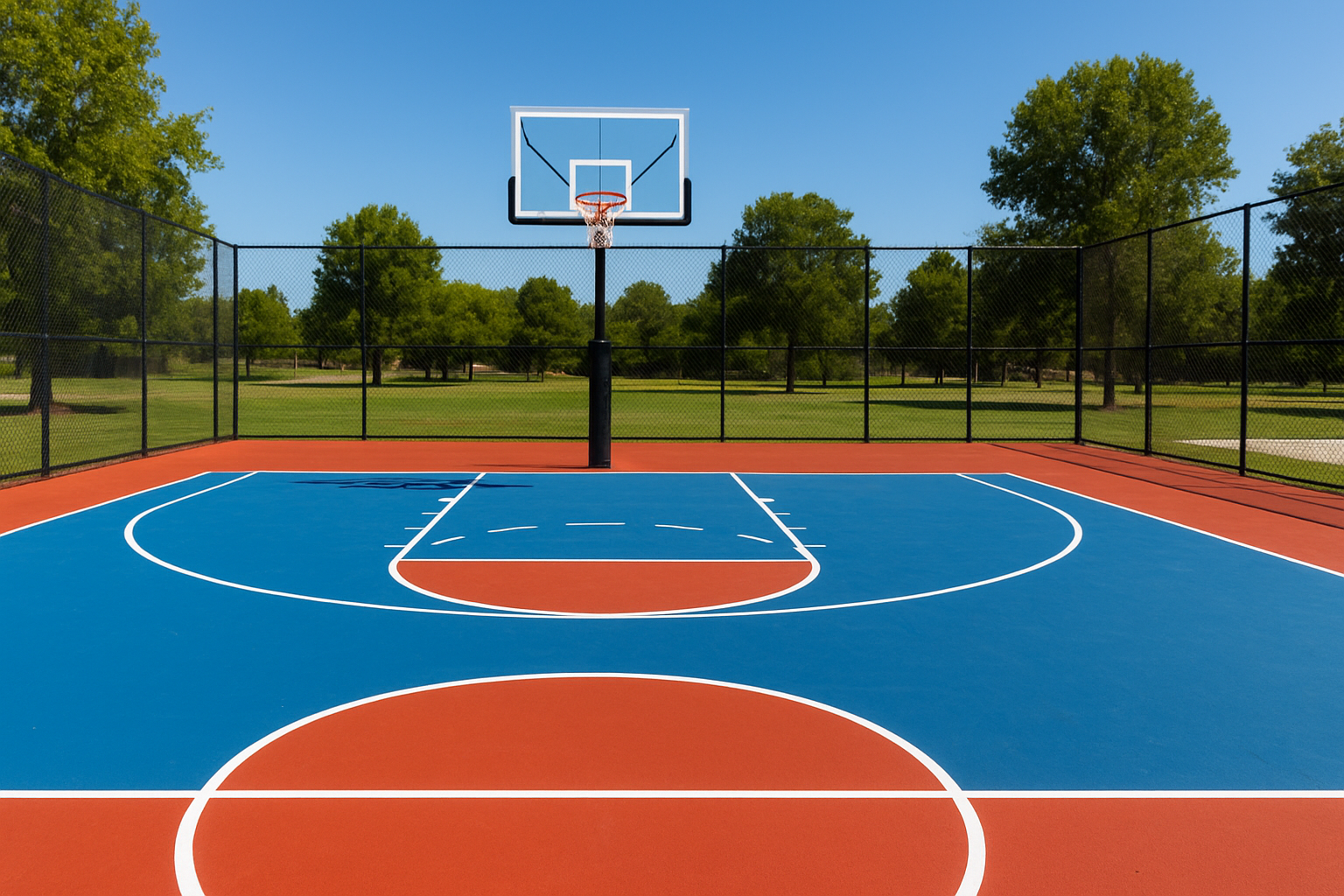
Acrylic basketball court flooring is one of the most widely used solutions for outdoor basketball courts. It is a synthetic sports surface system applied over a properly prepared concrete or asphalt base.
Acrylic sports flooring is especially popular for outdoor basketball courts because it offers good weather resistance, colour stability, and a durable playing surface when installed and maintained correctly.
It is available in various colours, including blue, green, red, and other customised combinations. Facility owners can also choose different surface textures and coating systems depending on their playing requirements.
Unlike wooden and most PVC sports flooring systems, acrylic flooring is specifically suitable for many outdoor sports applications.
Advantages of Acrylic Basketball Court Flooring
1. Excellent Outdoor Performance
Acrylic basketball flooring is designed for outdoor sports environments. A suitable system can withstand sunlight, rain exposure, and regular outdoor usage, subject to the manufacturer’s specifications and correct installation.
2. Weather Resistance
Outdoor basketball courts are exposed to changing temperatures, sunlight, and moisture. Quality acrylic sports flooring systems are formulated to handle these conditions and maintain their surface finish.
3. UV Resistance and Colour Retention
Acrylic coatings are available with UV-resistant formulations that help reduce colour fading caused by prolonged sunlight exposure.
4. Good Surface Grip
Acrylic sports flooring can be formulated with textured finishes to provide controlled traction. This helps players maintain stability while running, stopping, and changing direction.
5. Customisable Court Colours
One of the biggest advantages of acrylic flooring is its design flexibility. Basketball court owners can select different colour combinations for the playing area and surrounding zones.
6. Cost-Effective Outdoor Solution
Compared with premium hardwood sports flooring, acrylic flooring can be a more economical option for outdoor basketball court construction, depending on the base preparation and selected system.
7. Easy Maintenance
Acrylic basketball courts generally require routine sweeping and periodic washing to remove dust, dirt, and debris. Damaged areas may need localised repairs or recoating.
Disadvantages of Acrylic Basketball Court Flooring
Acrylic flooring also has some limitations that should be considered before installation:
-
Requires a properly prepared concrete or asphalt base.
-
Surface cracks may develop if the underlying base moves or deteriorates.
-
Can become slippery if dirt, algae, or standing water accumulate.
-
Does not provide the same cushioning as a properly engineered sprung wooden floor.
-
May require periodic recoating depending on usage and environmental conditions.
Best Applications of Acrylic Basketball Flooring
Acrylic basketball court flooring is ideal for:
-
Outdoor basketball courts.
-
School playgrounds.
-
College and university sports grounds.
-
Residential basketball courts.
-
Community sports facilities.
-
Sports academies.
-
Public parks and recreational areas.
For outdoor basketball court construction, acrylic sports flooring is an excellent option because it combines durability, attractive appearance, and practical maintenance requirements.
4. Wooden vs PVC vs Acrylic Basketball Court Flooring: Key Differences
Now that we have explored the three major types of basketball court flooring, it is important to understand how they compare.
Although all three materials can be used for basketball courts, their performance and applications are different.
| Features | Wooden Flooring | PVC Flooring | Acrylic Flooring |
|---|---|---|---|
| Main application | Indoor | Indoor | Outdoor and suitable sports areas |
| Appearance | Premium, natural | Modern, synthetic | Colourful, customised |
| Shock absorption | Depends on sprung system | Depends on product | Generally limited |
| Maintenance | Moderate to high | Low to moderate | Low to moderate |
| Weather exposure | Not suitable for uncovered outdoor use | Generally not suitable outdoors | Designed for outdoor use |
| Initial investment | Generally high | Varies by product | Generally economical to moderate |
| Installation base | Engineered subfloor | Prepared indoor subfloor | Concrete or asphalt |
| Customisation | Available | Available | Extensive |
Important: Actual performance depends on the complete flooring system, product specifications, subfloor quality, installation workmanship, and maintenance. Not all products within one flooring category offer identical playing characteristics.
5. Which Basketball Court Flooring Is Best for Indoor Courts?
Selecting the best indoor basketball flooring depends on the purpose of the facility, expected player activity, available budget, and performance requirements.
Here are the most suitable options for different indoor environments.
Wooden Flooring for Professional Indoor Courts
If you are constructing a professional indoor basketball arena, hardwood flooring is a strong choice. It offers a traditional basketball playing experience and can provide excellent performance when installed as a properly engineered sports floor.
It is particularly suitable for professional competitions, high-level training, and premium indoor sports facilities.
PVC Flooring for Schools and Multipurpose Sports Halls
PVC sports flooring is a practical option for schools, colleges, recreational centres, and indoor sports halls.
It provides different design possibilities and can offer cushioning depending on the selected product. It is especially useful when a facility needs a versatile indoor sports surface.
What Should You Consider?
Before choosing indoor basketball flooring, consider:
-
The number of players using the court daily.
-
Whether the court will host professional matches or recreational games.
-
The required shock absorption and surface friction.
-
The quality of the existing subfloor.
-
Available installation and maintenance budgets.
-
Whether the facility will be used for other indoor sports.
The right flooring should match the actual playing requirements rather than simply focusing on appearance or initial price.
6. Which Basketball Court Flooring Is Best for Outdoor Courts?
Outdoor basketball courts require flooring that can handle direct sunlight, rain, temperature changes, and continuous player movement.
Acrylic basketball court flooring is generally one of the most suitable choices for these environments.
Why Choose Acrylic Flooring for Outdoor Basketball Courts?
Acrylic sports flooring provides several practical benefits for outdoor sports facilities.
-
Designed for outdoor exposure.
-
Available in UV-resistant formulations.
-
Offers customisable colours and court markings.
-
Can be applied over suitable concrete and asphalt surfaces.
-
Requires relatively straightforward routine cleaning.
-
Provides a professional finish for schools, academies, and recreational courts.
However, successful installation depends on proper drainage, base preparation, crack treatment, and the correct application of each coating layer.
If you are planning to build an outdoor basketball court, choosing a suitable acrylic flooring system can help create a durable and attractive playing environment.
7. Factors to Consider Before Choosing Basketball Court Flooring
Choosing basketball court flooring is not simply about selecting a material. Several important factors should be evaluated to ensure the court delivers the expected performance.
1. Indoor or Outdoor Location
The first consideration is where the basketball court will be constructed.
For indoor courts, wooden and PVC sports flooring are common options. For outdoor courts, acrylic sports flooring is generally more appropriate.
2. Budget and Installation Cost
Every flooring material has a different cost structure. Wooden flooring generally requires a higher initial investment, while PVC and acrylic systems offer different price points depending on their specifications.
Always compare the complete project cost, including surface preparation, installation, markings, accessories, and maintenance.
3. Player Safety and Comfort
Player safety should be a priority when selecting a basketball floor.
Consider surface grip, shock absorption, surface consistency, and ball response. A flooring system should provide appropriate traction without being excessively rough or slippery.
4. Durability and Usage Frequency
A basketball court used every day requires a flooring system designed for regular sports activities.
Consider the expected number of users, training hours, competition frequency, and maintenance schedule before making a decision.
5. Maintenance Requirements
Different basketball flooring materials require different maintenance procedures.
Wooden floors may need specialised cleaning and refinishing. PVC flooring generally requires regular cleaning, while acrylic flooring may need periodic repairs and recoating.
6. Quality of Installation
Even premium-quality flooring can perform poorly if it is installed incorrectly.
Professional installation helps ensure proper surface preparation, material application, court dimensions, finishing, and line marking.
8. Basketball Court Flooring Installation Process
Proper installation is essential for achieving a smooth, durable, and consistent basketball playing surface.
Although the installation process varies depending on the flooring material, most basketball court projects follow a few important stages.
Step 1: Site Inspection and Planning
The first step is to inspect the proposed basketball court location.
The contractor evaluates the available area, surface condition, drainage, dimensions, and intended use of the court.
Step 2: Subfloor Preparation
The base surface must be properly prepared before flooring installation.
For acrylic courts, the concrete or asphalt base should be stable, clean, and sufficiently cured. For wooden and PVC flooring, the indoor subfloor must meet the relevant flatness and moisture requirements.
Step 3: Surface Repair and Levelling
Any cracks, uneven areas, holes, or surface defects should be identified and treated using suitable repair materials.
Proper levelling helps create a consistent foundation for the sports flooring system.
Step 4: Flooring Material Application
The installation method depends on the selected material.
-
Wooden flooring involves installing the specified subfloor or sprung system, followed by hardwood boards, sanding, sealing, and finishing.
-
PVC flooring involves preparing the subfloor and installing the selected sports flooring system according to the manufacturer’s instructions.
-
Acrylic flooring involves applying the specified primer, resurfacer, acrylic coating layers, and textured finish as required by the system.
Step 5: Basketball Court Line Marking
Once the flooring surface is ready, basketball court markings are applied according to the required court layout and dimensions.
Clear markings help players, coaches, and officials identify the playing zones.
Step 6: Final Inspection
The completed basketball court should be inspected for surface consistency, finishing quality, line accuracy, and any installation defects.
The court should only be opened for use after the flooring system has properly cured or settled according to the manufacturer’s instructions.
9. How to Maintain Basketball Court Flooring for Long-Term Performance
Regular maintenance is important for keeping a basketball court safe, clean, and visually attractive.
Different flooring materials require different care procedures.
Wooden Basketball Floor Maintenance
-
Sweep or dust-mop the surface regularly.
-
Use approved cleaning products.
-
Avoid excessive water during cleaning.
-
Protect the surface from moisture.
-
Inspect the floor for scratches and damaged areas.
-
Schedule professional refinishing when required.
PVC Basketball Floor Maintenance
-
Remove dust and dirt through regular sweeping.
-
Use a damp mop with an approved cleaner.
-
Avoid harsh chemicals and abrasive cleaning equipment.
-
Inspect joints and surface areas periodically.
-
Follow the manufacturer’s maintenance guidelines.
Acrylic Basketball Floor Maintenance
-
Remove leaves, dust, and debris regularly.
-
Wash the surface when necessary.
-
Keep drainage outlets free from blockages.
-
Check for cracks and coating damage.
-
Repair damaged areas before the problem spreads.
-
Consider periodic recoating based on surface condition.
A consistent maintenance routine helps preserve the flooring quality and improves the overall usability of the basketball court.
10. How Much Does Basketball Court Flooring Cost?
The cost of basketball court flooring depends on several factors, including the selected material, court dimensions, subfloor condition, installation requirements, and project location.
Wooden basketball flooring generally involves a higher investment because of the hardwood material, specialised subfloor construction, and finishing requirements.
PVC sports flooring costs vary according to material thickness, product quality, cushioning layers, and installation method.
Acrylic basketball court flooring can be a cost-effective solution for outdoor projects, although the total price depends on the number of coating layers, base preparation, and selected surface system.
Factors Affecting Basketball Court Flooring Cost
-
Flooring material: Wooden, PVC, and acrylic systems have different material costs.
-
Court dimensions: Larger courts require more materials and installation work.
-
Base preparation: Concrete repair, levelling, and crack treatment can influence the total budget.
-
Installation charges: Professional installation costs depend on the flooring system and project complexity.
-
Court markings: Custom colours and basketball line markings can affect the overall project cost.
-
Maintenance requirements: Long-term cleaning, repairs, and refinishing should also be considered.
It is always advisable to request a detailed quotation based on the actual court dimensions and site conditions instead of choosing flooring based only on the lowest price.
11. Common Mistakes to Avoid When Selecting Basketball Court Flooring
Selecting unsuitable flooring can affect the playing experience and increase future maintenance expenses.
Here are some common mistakes that should be avoided:
Choosing flooring based only on price: Low-cost materials may not offer the required durability, grip, or sports performance.
Ignoring the court location: Indoor and outdoor basketball courts have different flooring requirements. A material suitable for an indoor sports hall may not perform well outdoors.
Overlooking shock absorption: Player comfort is important, especially in facilities where athletes train for several hours daily.
Ignoring drainage requirements: Outdoor basketball courts need proper drainage to prevent water accumulation and related surface problems.
Hiring inexperienced installers: Incorrect installation can result in uneven surfaces, coating defects, and premature damage.
Neglecting maintenance: Even high-quality basketball flooring requires regular inspection and appropriate cleaning.
Avoiding these mistakes can help sports facility owners make a better investment and maintain their basketball courts for longer.
12. Conclusion: Which Basketball Court Flooring Should You Choose?
Wooden, PVC, and acrylic basketball court flooring each offer different advantages. The best option depends on your court location, playing requirements, available budget, and long-term maintenance expectations.
Wooden flooring is an excellent choice for professional indoor basketball arenas where playing performance and premium appearance are important.
PVC sports flooring is a practical option for indoor sports halls, schools, and recreational facilities that require a versatile and easy-to-maintain surface.
Acrylic basketball court flooring is particularly suitable for outdoor basketball courts because of its weather-resistant formulations, colour options, and relatively simple maintenance requirements.
Before finalising your decision, consider the quality of the flooring material, installation process, player safety, and expected usage of the court.
Looking for professional basketball court flooring solutions? Choose an experienced sports flooring contractor who can understand your project requirements, recommend the right flooring system, and provide quality installation services.
A properly selected and professionally installed basketball court floor can create a better playing environment for athletes while adding long-term value to your sports facility.
Frequently Asked Questions (FAQs)
1. Which flooring is best for a basketball court?
The best flooring depends on the court location and intended use. Wooden flooring is popular for professional indoor basketball courts, PVC flooring is suitable for many indoor multipurpose sports facilities, and acrylic flooring is a popular choice for outdoor basketball courts.
2. Is acrylic flooring good for outdoor basketball courts?
Yes. Acrylic sports flooring is designed for outdoor applications and offers weather-resistant surface coatings, customisable colours, and good traction when correctly installed and maintained.
3. Is wooden flooring better than PVC flooring for basketball?
Wooden flooring is often preferred for professional indoor basketball because of its traditional playing characteristics. PVC flooring can be a practical alternative for schools, recreational facilities, and multipurpose sports halls. The better option depends on the required performance and budget.
4. How long does basketball court flooring last?
The lifespan depends on the flooring material, product quality, installation, frequency of use, and maintenance. Properly maintained wooden floors can last for many years, while PVC and acrylic systems also offer long-term performance when used within their intended applications.
5. Can acrylic flooring be installed on concrete?
Yes. Acrylic basketball court flooring can be installed over suitable concrete surfaces. However, the concrete must be properly prepared, stable, sufficiently cured, and free from significant surface defects.
6. Is PVC flooring suitable for outdoor basketball courts?
Most indoor PVC sports flooring products are not designed for prolonged outdoor exposure. If you need an outdoor basketball court, choose a flooring system specifically approved for outdoor conditions.
7. Which basketball court flooring requires less maintenance?
PVC and acrylic flooring generally require less specialised maintenance than wooden sports flooring. However, all flooring types need regular cleaning and periodic inspection.
8. What is the difference between acrylic and wooden basketball flooring?
Wooden flooring is generally used for indoor basketball courts and can provide a sprung playing system with controlled shock absorption. Acrylic flooring is commonly used outdoors and consists of synthetic surface coatings applied over a suitable concrete or asphalt base.
9. What is the best flooring for a school basketball court?
For outdoor school basketball courts, acrylic flooring is often a suitable option. For indoor school sports halls, PVC or wooden flooring may be considered depending on the budget, usage, and performance requirements.
10. Can one basketball court be used for multiple sports?
Yes. A multipurpose sports court can accommodate basketball and other sports if the flooring system is suitable for each activity. Appropriate court markings and surface specifications should be planned before installation.