Introduction
Badminton has evolved from a recreational indoor game into a highly organized sport with strong demand across sports clubs, fitness centers, gyms, schools, academies, residential communities, and commercial recreation facilities. As more people look for professionally managed spaces for fitness, training, and competitive play, investing in a well-designed badminton court can create significant value for a sports facility.
However, successful badminton court construction involves much more than installing a playing surface and marking court lines. The quality of the foundation, sports flooring, lighting, ventilation, ceiling height, drainage where applicable, safety systems, and finishing details all influence player performance and long-term facility costs.
For sports clubs, gyms, and commercial facilities, a professionally constructed badminton court should be planned around usage levels, available space, player requirements, maintenance expectations, and the overall business model of the facility.
What Is Badminton Court Construction?
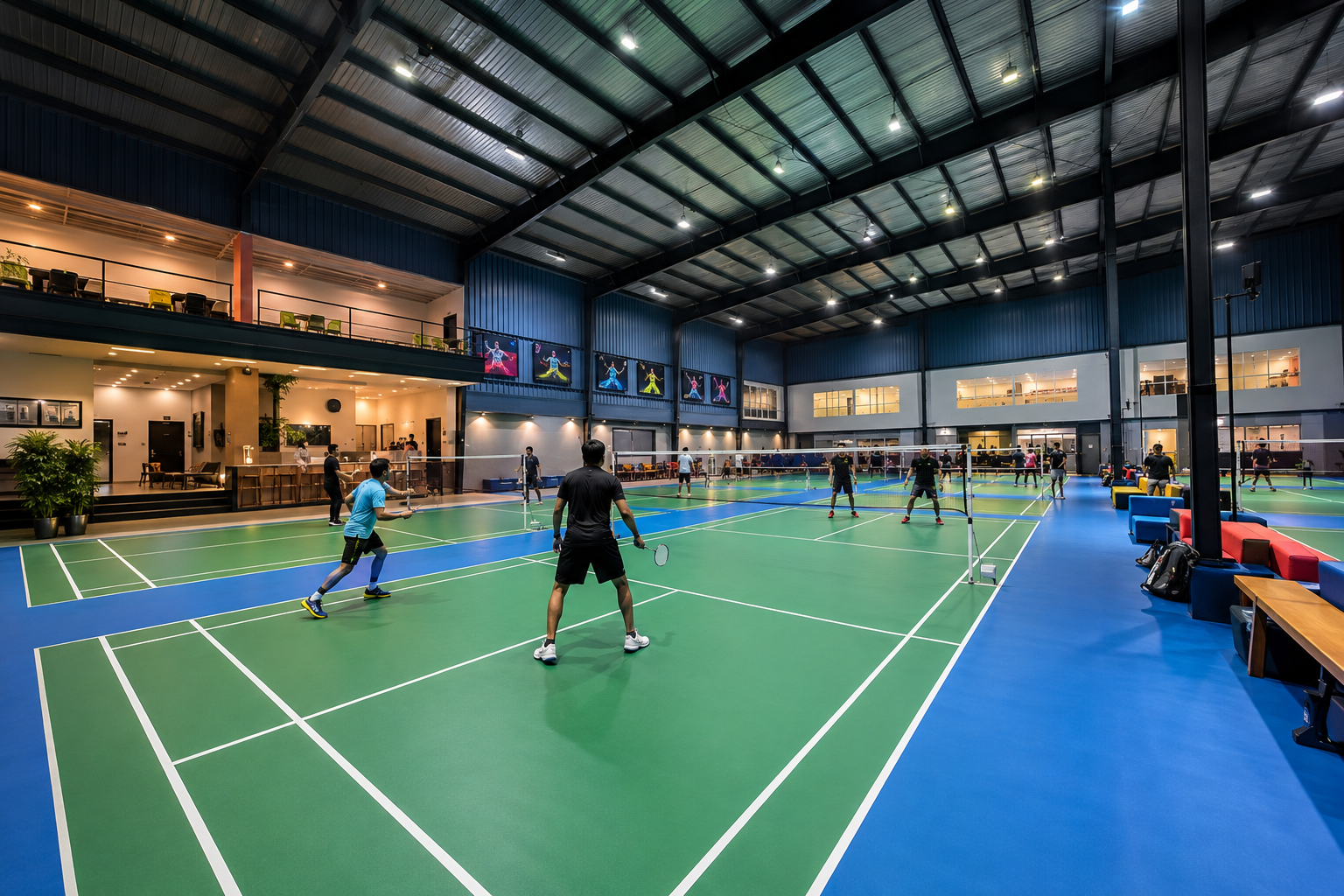
Badminton court construction is the complete process of planning, preparing, building, surfacing, marking, lighting, and equipping a dedicated badminton playing area. It can include indoor and outdoor installations, although professionally operated badminton facilities generally prefer controlled indoor environments because they provide better protection from wind, rain, excessive sunlight, and temperature variations.
A complete badminton court project may involve:
- Site inspection and measurements
- Court layout and space planning
- Base and foundation preparation
- Sports flooring installation
- Court line marking
- Badminton net posts and nets
- Professional LED lighting
- Ceiling and roof planning
- Wall protection
- Ventilation systems
- Safety padding
- Drainage for outdoor installations
- Electrical and structural work
- Finishing and quality inspection
The objective is to create a safe, durable, comfortable, and visually professional sports environment that can withstand regular usage.
Why Sports Clubs Are Investing in Badminton Courts
Sports clubs increasingly use badminton courts as an important part of their recreational and fitness offerings. Unlike many large-field sports, badminton can be accommodated within a comparatively compact indoor facility while supporting individual practice, coaching, doubles matches, tournaments, and recreational sessions.
A professionally built court can help a sports club:
- Expand its range of sporting activities
- Attract new members
- Improve member retention
- Offer professional coaching programs
- Host local competitions
- Generate revenue through court bookings
- Develop junior training programs
- Increase facility utilization
- Strengthen its overall sports infrastructure
The court should therefore be treated as a long-term facility investment rather than simply a flooring project.
Badminton Court Construction for Gyms
Modern gyms are expanding beyond conventional strength and cardio equipment. Many fitness centers are adding recreational sports facilities to create a more complete wellness experience.
A badminton court can complement a gym by providing members with a dynamic activity that combines cardiovascular exercise, agility, coordination, balance, and movement.
For gym owners, the construction process should focus on efficient space utilization. The available floor area must be evaluated carefully to determine whether a single court, multiple courts, or a multipurpose sports hall would provide the best return on investment.
Important considerations include:
- Available floor dimensions
- Clear ceiling height
- Flooring specifications
- Lighting arrangement
- Ventilation
- Player circulation
- Spectator space
- Equipment storage
- Changing facilities
- Emergency access
- Maintenance requirements
A well-planned badminton facility can make a gym more versatile and attractive to different customer groups.
Commercial Badminton Court Construction
Commercial badminton facilities are typically designed for high-frequency usage. Courts may be occupied throughout the day by casual players, corporate groups, professional athletes, coaching batches, and tournament participants.
This makes durability particularly important.
Commercial court construction should consider the expected number of playing hours per day and the number of users. Materials selected for flooring, wall finishes, lighting, nets, posts, and other components should be suitable for repeated use.
A commercial badminton facility may generate revenue through:
- Hourly court rentals
- Monthly memberships
- Coaching programs
- Sports camps
- Tournaments
- Corporate bookings
- Junior academies
- Equipment rentals
- Events and competitions
Because every facility has different operational requirements, court construction should be customized instead of relying on a standard one-size-fits-all approach.
Planning the Space for a Badminton Court
Space planning is one of the first and most important stages of badminton court construction.
The actual playing court is only one part of the total facility. Additional space is required around the court for player movement, safety, access, equipment, and maintenance.
A standard doubles badminton court measures approximately 13.4 metres long and 6.1 metres wide. However, the overall construction area needs to be larger because players require adequate clearance around the playing area.
For multiple courts, spacing between adjacent courts must also be carefully considered.
The planning process should account for:
- Court dimensions
- Safety clearance
- Net-post positions
- Walkways
- Spectator areas
- Lighting locations
- Equipment storage
- Doors and emergency exits
- Ventilation equipment
- Ceiling and structural requirements
Good space planning helps prevent problems after construction has already started.
Choosing the Right Badminton Court Flooring
Flooring is arguably one of the most important elements of a badminton facility. Players make frequent jumps, rapid directional changes, lunges, and sudden stops, so the surface needs to provide an appropriate balance of grip, cushioning, stability, and energy response.
Common badminton flooring systems include PVC sports flooring, polyurethane sports flooring, synthetic surfaces, and other specialized indoor sports systems.
PVC Sports Flooring
PVC or vinyl sports flooring is widely used in professional and commercial badminton facilities. It can provide a controlled playing surface with suitable traction and shock-management properties when installed over an appropriate base system.
Advantages can include:
- Good durability
- Consistent surface performance
- Easy maintenance
- Professional appearance
- Suitable grip
- Comfortable player movement
- Availability in different colors
PU Sports Flooring
Polyurethane flooring systems can be used in premium indoor sports environments where cushioning, durability, and seamless finishing are important.
PU surfaces can be designed as multilayer systems with an elastic base and durable top coating. They are suitable for facilities that require a high-quality sports environment and long-term performance.
Modular Sports Flooring
Interlocking sports tiles can also be considered for selected facilities. They can offer comparatively quick installation and convenient replacement of individual sections.
The best flooring system depends on the building structure, expected usage, budget, maintenance strategy, and performance requirements.
Importance of the Foundation
Even premium sports flooring cannot perform properly if the underlying base is poorly prepared.
The foundation should be stable, level, clean, and suitable for the selected flooring system. Depending on the existing site, construction may require concrete work, leveling, crack treatment, moisture control, and surface preparation.
An uneven or unstable base can eventually contribute to:
- Surface irregularities
- Flooring damage
- Poor ball response
- Player discomfort
- Premature repairs
- Increased maintenance costs
Professional contractors therefore inspect the substrate before flooring installation begins.
Court Marking and Layout Accuracy
Accurate court markings are essential for a professional badminton facility.
The lines must be clearly visible and correctly positioned according to the intended court configuration. Poorly applied markings can affect gameplay and make a facility appear unprofessional.
Court marking should use suitable sports-grade materials that adhere properly to the selected flooring while maintaining clear visibility.
For commercial facilities with multiple courts, consistent alignment between every court is particularly important.
Badminton Net and Post Installation
The net system is another essential part of the court.
Professional badminton net posts should be securely positioned and installed without compromising the playing surface. The net must be correctly tensioned and positioned at the appropriate height for the intended playing setup.
For commercial facilities, durable equipment is recommended because nets and posts can experience frequent handling.
The surrounding area should also provide enough clearance for players and staff to move safely around the equipment.
Lighting Design for Indoor Badminton Courts
Lighting can have a major impact on player visibility and comfort.
Badminton requires players to track a fast-moving shuttlecock, making glare and uneven illumination particularly problematic. A professionally designed lighting system should provide consistent illumination across the court without creating distracting bright spots.
LED sports lighting is commonly considered for modern indoor facilities because it can provide:
- Efficient energy consumption
- Long operating life
- Consistent illumination
- Reduced maintenance
- Better control of lighting levels
Light placement should be planned carefully so fixtures do not create excessive glare or interfere with the player’s view of the shuttle.
Ceiling Height and Indoor Facility Design
Ceiling clearance is especially important for badminton because the shuttlecock travels high above the net during many types of shots.
A low ceiling can restrict gameplay and reduce the quality of the facility. The building should therefore be assessed before construction to confirm that the available clear height is appropriate for the intended level of play.
Structural beams, hanging lights, fans, ducts, and other overhead elements should also be positioned so they do not interfere with the playing area.
Ventilation and Temperature Management
Indoor badminton facilities can become warm quickly when several players are active simultaneously.
Effective ventilation helps maintain a more comfortable environment and can also support better indoor air quality.
Depending on the facility, solutions may include:
- Mechanical ventilation
- Air-conditioning
- Fresh-air systems
- Exhaust systems
- Industrial fans positioned outside critical playing zones
Air movement must be carefully controlled because strong airflow can affect the flight of the shuttlecock.
Safety Features for Commercial Badminton Facilities
Player safety should remain a priority throughout construction.
A professional facility may incorporate:
- Shock-absorbing sports flooring
- Rounded or protected structural edges
- Wall padding in selected areas
- Non-slip surfaces
- Safe electrical installations
- Clearly marked exits
- Adequate court clearance
- Proper lighting
- Secure net-post installation
- Appropriate ventilation
- Emergency access routes
The final design should reduce avoidable hazards while maintaining an enjoyable playing environment.
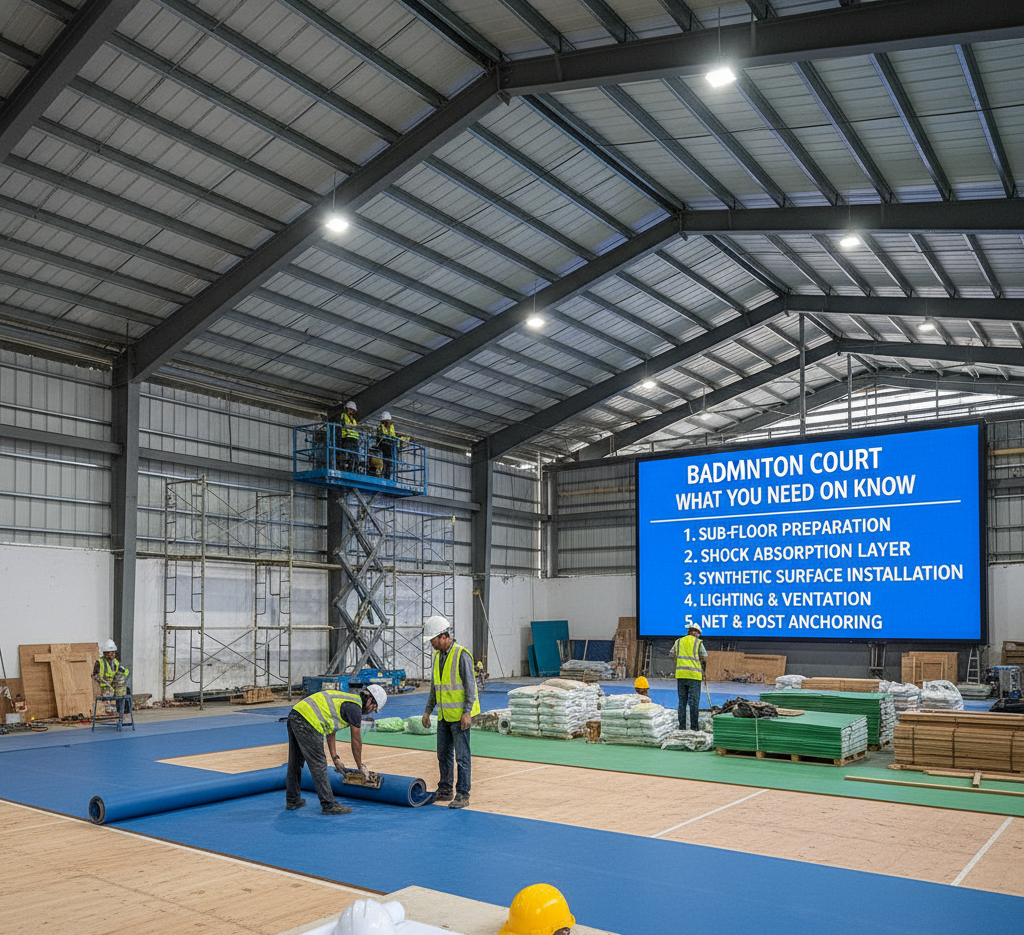
Badminton Court Construction Process
A structured construction workflow helps maintain quality and control project costs.
1. Site Inspection
The project begins with an assessment of the available location. Dimensions, floor condition, ceiling height, access, electrical requirements, and structural limitations are reviewed.
2. Design and Layout
The court arrangement is developed according to the available space and the client’s objectives. Multiple-court facilities require detailed planning to optimize circulation and player safety.
3. Base Preparation
The floor is repaired, leveled, cleaned, and prepared for the selected sports flooring system.
4. Flooring Installation
The selected sports flooring is installed according to the manufacturer’s technical requirements. Proper adhesive application, joint treatment, curing, and finishing are essential.
5. Court Marking
Accurate badminton lines are applied after the playing surface is ready.
6. Equipment Installation
Net posts, badminton nets, protective equipment, and other sports accessories are installed.
7. Lighting and Electrical Work
Sports lighting and related electrical systems are installed and tested.
8. Final Inspection
The completed facility is inspected for surface quality, line accuracy, equipment stability, lighting performance, and overall finishing.
Single Court vs Multiple Badminton Courts
The choice between a single court and a multi-court facility depends on the business model and available space.
A single court can be suitable for:
- Small gyms
- Residential clubs
- Schools
- Community centers
- Compact fitness facilities
Multiple courts are often more appropriate for:
- Dedicated badminton academies
- Commercial sports centers
- Large gyms
- Sports clubs
- Tournament venues
- Coaching facilities
Multiple courts can improve revenue potential because several groups can use the facility simultaneously.
Indoor Badminton Court vs Outdoor Court
Indoor badminton courts generally provide better playing conditions because the shuttlecock is highly sensitive to wind.
Outdoor installations may be possible for recreational applications, but they require careful consideration of weather, sunlight, drainage, surface durability, and wind conditions.
For commercial and training facilities, an indoor environment is generally preferred because it provides greater control over playing conditions and facility operations.
Maintenance of Badminton Courts
Regular maintenance helps preserve the playing quality and appearance of the court.
A maintenance program may include:
- Routine dust removal
- Appropriate floor cleaning
- Immediate treatment of spills
- Periodic flooring inspection
- Checking court markings
- Net inspection
- Post stability checks
- LED fixture inspection
- Ventilation maintenance
- Repair of damaged areas
Cleaning methods should always be compatible with the installed flooring system.
Avoid using harsh chemicals or unsuitable equipment that could damage the surface.
How Much Does Badminton Court Construction Cost?
The cost of badminton court construction varies considerably depending on project specifications.
Major cost factors include:
- Number of courts
- Building condition
- New construction or renovation
- Flooring type
- Foundation requirements
- Lighting system
- Ceiling work
- Electrical installation
- Ventilation or air-conditioning
- Net and post quality
- Wall protection
- Spectator areas
- Changing rooms
- Site location
- Material quality
Instead of focusing only on the initial price, commercial operators should evaluate the total lifecycle cost. A slightly higher-quality flooring system may provide better durability, player comfort, and maintenance performance over many years.
A professional site assessment is the best way to develop an accurate project estimate.
Applications of Professionally Built Badminton Courts
Badminton courts can be developed for a wide range of facilities, including:
- Sports clubs
- Gyms
- Fitness centers
- Badminton academies
- Schools
- Colleges
- Universities
- Corporate campuses
- Residential societies
- Hotels
- Resorts
- Community centers
- Commercial sports arenas
- Private recreation facilities
- Government sports complexes
Each application can require a different approach to court configuration, flooring, lighting, equipment, and facility management.
Why Choose Professional Badminton Court Construction?
Professional construction can help ensure that every major component works together as part of a complete sports environment.
An experienced badminton court construction company can provide support with:
- Site evaluation
- Court design
- Space optimization
- Foundation preparation
- Sports flooring
- Lighting
- Court markings
- Net systems
- Safety solutions
- Equipment installation
- Quality inspection
- Maintenance guidance
This integrated approach reduces coordination issues and can provide greater consistency across the finished project.
Key Factors to Consider Before Starting
Before investing in badminton court construction, facility owners should evaluate:
Available space: Confirm that sufficient room exists for courts, circulation, safety clearance, and supporting facilities.
Target users: Determine whether the court will serve recreational players, coaching students, professional athletes, or mixed users.
Usage frequency: High-traffic facilities require durable materials and strong maintenance planning.
Flooring requirements: Select a sports surface according to player safety, performance, budget, and expected lifespan.
Lighting: Design lighting specifically for badminton rather than using ordinary commercial fixtures.
Ceiling clearance: Check the clear height and identify potential obstructions.
Ventilation: Prevent excessive heat while controlling air movement around the playing area.
Budget: Include construction, equipment, lighting, maintenance, and future replacement costs.
Expansion: If future growth is expected, consider whether the building can accommodate additional courts.
Frequently Asked Questions
What is the standard size of a badminton court?
A standard doubles badminton court is approximately 13.4 metres long and 6.1 metres wide. Additional surrounding space is required for safe player movement and facility access.
Which flooring is best for badminton courts?
PVC sports flooring and PU sports flooring are commonly considered for professional indoor badminton facilities. The appropriate choice depends on the facility’s usage, base condition, performance expectations, and budget.
Can a badminton court be built in an existing gym?
Yes. Existing gyms can often be converted into badminton facilities after evaluating floor dimensions, ceiling height, structural conditions, lighting, ventilation, and available circulation space.
How many badminton courts can fit in one facility?
The number depends on the overall building dimensions, required clearances, supporting areas, ceiling conditions, and the desired facility layout.
Is indoor construction better for badminton?
Indoor facilities generally provide more controlled playing conditions because wind and weather have less influence on shuttlecock movement.
How long does badminton court construction take?
Project duration depends on the site condition, construction scope, number of courts, flooring system, electrical work, and other finishing requirements. A detailed project schedule can be prepared after site inspection.
Conclusion
Badminton court construction for sports clubs, gyms, and commercial facilities requires careful planning across flooring, foundation, court layout, lighting, ceiling clearance, ventilation, safety, equipment, and long-term maintenance.
A professionally designed court can become a valuable part of a sports business by supporting memberships, court rentals, coaching programs, competitions, and recreational activities. The key is to select suitable materials and construction methods based on the intended usage rather than choosing components based solely on initial cost.
Whether you are planning a single badminton court for a gym or developing a multi-court commercial badminton academy, professional planning and construction can help create a durable, safe, attractive, and performance-oriented sports environment.
With the right design, quality sports flooring, reliable equipment, appropriate lighting, and regular maintenance, a badminton facility can provide an excellent experience for players while delivering long-term value to the sports club or commercial operator.