



Introduction
Sports infrastructure has evolved significantly over the past decade, with increasing attention given to athlete safety, long-term durability, sustainability, and performance. In 2026, sports flooring is no longer viewed as just a surface—it is an essential component of every sports facility. Whether it is an indoor badminton court, an outdoor basketball court, a jogging track, a school playground, or a professional stadium, the quality of the flooring directly affects player comfort, game performance, maintenance costs, and the overall lifespan of the facility.
Modern sports flooring systems are engineered to withstand intensive use while providing excellent shock absorption, slip resistance, weather protection, and consistent playing characteristics. Choosing the right flooring solution can reduce injuries, improve athletic performance, lower maintenance expenses, and maximize the return on investment for sports infrastructure projects.
As governments, educational institutions, residential communities, fitness centers, sports academies, and commercial developers continue investing in sports facilities, selecting the best sports flooring for construction has become more important than ever. Every sport has unique surface requirements, and every location presents different environmental conditions. A flooring system suitable for an indoor volleyball court may not perform well on an outdoor tennis court exposed to sunlight and heavy rainfall.
This comprehensive guide explains everything you need to know about sports flooring in 2026, including the latest technologies, flooring materials, construction methods, performance standards, maintenance requirements, and factors to consider before making an investment.
Why Sports Flooring Is Important in Modern Construction
Sports flooring serves much more than an aesthetic purpose. It creates a safe and reliable environment where athletes can perform confidently while minimizing the risk of injuries.
A professionally constructed sports floor offers consistent ball bounce, excellent traction, shock absorption, and long-term structural stability. These characteristics contribute to better athletic performance while protecting players from joint stress, muscle fatigue, slips, and impact-related injuries.
Modern sports flooring systems are specifically designed to withstand thousands of hours of daily use without significant deterioration. This makes them suitable for schools, universities, sports academies, public parks, fitness centers, residential communities, commercial gyms, and international competition venues.
Quality sports flooring also improves facility management by reducing maintenance requirements, lowering repair costs, and maintaining an attractive appearance for many years.
Growing Demand for Sports Flooring in 2026
The sports construction industry continues to expand rapidly due to increasing awareness of health, fitness, and recreational activities. Governments and private organizations are investing heavily in sports infrastructure to encourage active lifestyles and support professional athletic development.
Several trends are driving the demand for advanced sports flooring systems:
- Expansion of public sports parks
- Development of smart cities
- Growth of residential sports amenities
- Increased investment in school sports facilities
- Rising number of sports academies
- Indoor fitness centers and gymnasiums
- Multi-purpose sports complexes
- Corporate wellness facilities
- International sporting events
- Community recreation projects
These developments have created a strong demand for durable, environmentally friendly, and low-maintenance sports flooring solutions capable of performing in diverse climatic conditions.
What Makes a Good Sports Flooring System?
Not every flooring material is suitable for sports applications. Professional sports flooring is engineered using specialized materials and construction techniques that provide optimal performance throughout its service life.
The best sports flooring systems share several important characteristics.
Excellent Shock Absorption
One of the most important features is impact absorption. High-quality flooring reduces stress on the knees, ankles, hips, and lower back during running, jumping, and sudden directional changes.
This is particularly important in sports such as basketball, volleyball, badminton, athletics, and indoor training.
Superior Slip Resistance
Athletes constantly accelerate, stop, pivot, and change direction. Proper traction helps prevent slipping without restricting natural movement.
Modern sports flooring provides balanced grip under both dry and slightly wet conditions while maintaining player confidence throughout the game.
Long-Term Durability
Sports surfaces experience continuous wear from foot traffic, sports equipment, furniture movement, and environmental exposure.
Premium flooring systems are designed to resist:
- Surface wear
- Abrasion
- Cracking
- UV damage
- Water penetration
- Heavy loads
- Temperature fluctuations
Durability significantly reduces maintenance expenses over the flooring’s lifetime.
Consistent Playing Performance
Professional sports flooring maintains consistent ball bounce, predictable movement, and uniform traction across the entire playing area.
Uneven or poorly constructed flooring can negatively affect athletic performance and increase injury risks.
Comfortable Playing Experience
Modern flooring systems include cushioning layers that reduce fatigue during extended training sessions.
Comfortable flooring enables athletes to train longer while reducing physical stress.
Easy Maintenance
Facility owners increasingly prefer flooring systems requiring minimal maintenance.
High-quality sports flooring is designed for:
- Easy cleaning
- Dust resistance
- Water resistance
- Chemical resistance
- Stain resistance
- Simple repair procedures
Lower maintenance translates into lower operating costs.
Weather Resistance
Outdoor sports flooring must withstand changing weather conditions throughout the year.
Quality outdoor systems resist:
- Heavy rainfall
- Extreme sunlight
- UV radiation
- High humidity
- Dust accumulation
- Temperature variations
Weather-resistant flooring ensures consistent performance regardless of seasonal changes.
Essential Components of Professional Sports Flooring Construction
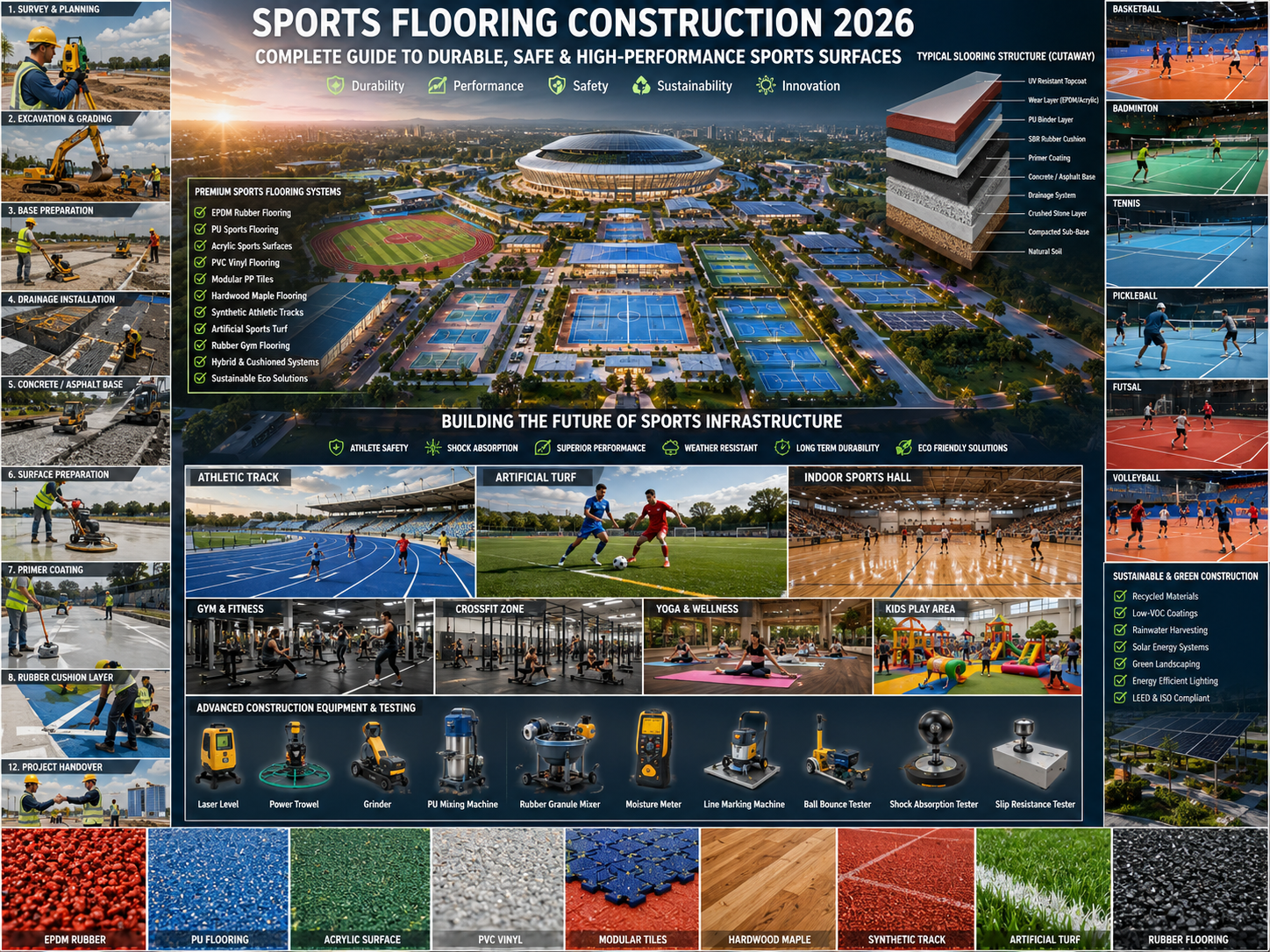
Every sports flooring project consists of multiple engineered layers working together to deliver safety, durability, and performance.
1. Ground Preparation
The construction process begins with thorough site preparation. Proper grading, leveling, and soil compaction create a stable foundation capable of supporting the flooring system.
Poor ground preparation often leads to surface settlement, cracking, and premature failure.
2. Base Layer
The base layer provides structural support and load distribution.
Depending on the project requirements, common base materials include:
- Compacted granular sub-base
- Crushed stone
- Wet mix macadam
- Cement concrete
- Asphalt base
The quality of the base significantly influences the lifespan of the entire sports flooring system.
3. Cushion Layer
Many sports flooring systems include a resilient cushion layer designed to absorb impact energy.
Popular cushion materials include:
- SBR rubber granules
- Recycled rubber
- Elastic polyurethane compounds
- Foam underlays
These materials enhance player comfort and reduce injury risks.
4. Performance Layer
The performance layer determines the flooring’s playing characteristics.
This layer provides:
- Shock absorption
- Ball response
- Surface resilience
- Player traction
- Load distribution
Its composition varies depending on the intended sport.
5. Wear Layer
The top layer protects the flooring from abrasion, weather exposure, and continuous use.
It also provides:
- Slip resistance
- UV protection
- Color stability
- Surface texture
- Easy maintenance
A high-quality wear layer extends the lifespan of the flooring while maintaining its appearance.
Applications of Modern Sports Flooring
Sports flooring systems are designed for a wide range of recreational, educational, and professional environments.
Common applications include:
- Public parks
- Multi-sport complexes
- Schools
- Colleges
- Universities
- Sports academies
- Indoor stadiums
- Outdoor stadiums
- Residential societies
- Fitness centers
- Health clubs
- Community recreation areas
- Corporate campuses
- Hotels and resorts
- Children’s play areas
- Athletic training centers
- Running and jogging tracks
- Basketball courts
- Tennis courts
- Volleyball courts
- Badminton courts
- Pickleball courts
- Gymnasiums
- Indoor arenas
- Multipurpose sports halls
Each application requires a flooring system tailored to its specific performance, safety, and maintenance requirements.
Factors to Consider Before Choosing Sports Flooring
Selecting the right sports flooring involves evaluating several important factors rather than focusing solely on initial cost.
Key considerations include:
- Intended sport and level of play
- Indoor or outdoor installation
- Climate and weather conditions
- Daily usage intensity
- Safety standards and certifications
- Cushioning and shock absorption requirements
- Slip resistance
- Surface durability
- Maintenance requirements
- Expected service life
- Budget and lifecycle cost
- Drainage requirements
- UV resistance
- Sustainability and eco-friendly materials
- Accessibility compliance
- Future repair and replacement needs
Making an informed decision ensures better performance, lower maintenance costs, and a longer-lasting investment.
1. EPDM Rubber Sports Flooring
The Most Comfortable Outdoor Sports Flooring
EPDM (Ethylene Propylene Diene Monomer) rubber flooring remains one of the most trusted sports flooring systems in 2026. Its exceptional durability, flexibility, and shock-absorbing properties make it ideal for outdoor sports and recreational environments.
EPDM granules are mixed with high-performance polyurethane binders to create a seamless, resilient surface capable of withstanding continuous use and harsh weather conditions.
The flooring maintains its elasticity even after years of exposure to sunlight, rain, and temperature fluctuations.
Common Applications
- Jogging tracks
- Running tracks
- Children’s play areas
- Outdoor gyms
- School playgrounds
- Parks
- Walking tracks
- Sports academies
- Residential societies
- Recreation zones
Major Advantages
- Excellent shock absorption
- Comfortable running surface
- Superior slip resistance
- UV-resistant colors
- Weatherproof construction
- Water-resistant
- Crack-resistant
- Long service life
- Low maintenance
- Environmentally friendly
- Attractive color options
- Seamless installation
Limitations
- Higher initial investment than basic concrete flooring
- Professional installation is essential
- Requires proper base preparation for maximum lifespan
Expected Lifespan
Approximately 10–15 years with proper installation and routine maintenance.
2. Acrylic Sports Flooring
The Preferred Choice for Outdoor Courts
Acrylic sports flooring has become the industry standard for outdoor sports courts because of its excellent playing characteristics, affordability, and low maintenance.
Acrylic systems are applied as multiple coating layers over asphalt or concrete to create a durable, textured playing surface.
They provide reliable traction and consistent ball bounce while resisting UV radiation and rain.
Suitable For
- Tennis courts
- Basketball courts
- Pickleball courts
- Volleyball courts
- Multi-purpose sports courts
- School sports grounds
Advantages
- Excellent ball bounce
- UV-resistant colors
- Fast installation
- Easy cleaning
- Waterproof finish
- Slip-resistant texture
- Fade-resistant
- Affordable maintenance
- Multiple color combinations
- Professional appearance
Limitations
- Lower shock absorption compared to rubber systems
- Requires periodic recoating
- Less comfortable for long-distance running
Typical Lifespan
Approximately 8–12 years, depending on usage and maintenance.
3. Polyurethane (PU) Sports Flooring
Premium Indoor Sports Flooring Solution
Polyurethane flooring continues to be one of the highest-performing sports flooring systems for indoor facilities.
Its seamless elastic structure provides exceptional cushioning, durability, and comfort during intensive athletic activities.
PU flooring is highly resistant to abrasion, chemicals, and heavy foot traffic, making it suitable for professional sports venues.
Recommended Applications
- Indoor basketball courts
- Volleyball courts
- Badminton courts
- Gymnasiums
- Fitness centers
- Indoor sports halls
- Multipurpose arenas
- Training centers
Benefits
- Superior shock absorption
- Excellent flexibility
- Comfortable playing experience
- High abrasion resistance
- Seamless finish
- Easy maintenance
- Hygienic surface
- Chemical-resistant
- Durable under heavy traffic
- Professional sports performance
Drawbacks
- Higher installation cost
- Requires experienced installers
- Longer curing time
Expected Lifespan
Typically 12–18 years.
4. PVC Sports Flooring
The Versatile Indoor Sports Surface
PVC sports flooring remains highly popular because it combines durability, affordability, and player comfort.
Manufactured in rolls or tiles, PVC flooring offers excellent shock absorption while remaining easy to clean and maintain.
Modern PVC sports floors include reinforced wear layers and fiberglass stabilization for improved dimensional stability.
Common Uses
- Badminton courts
- Table tennis halls
- Schools
- Indoor gyms
- Fitness studios
- Community centers
- Dance studios
- Indoor recreation facilities
Advantages
- Soft underfoot
- Good shock absorption
- Comfortable walking surface
- Water-resistant
- Stain-resistant
- Easy installation
- Low maintenance
- Cost-effective
- Available in multiple colors
- Noise reduction
Limitations
- Primarily designed for indoor use
- Can be damaged by sharp objects
- Limited resistance to prolonged UV exposure
Service Life
Approximately 8–15 years.
5. Vinyl Sports Flooring
A Reliable Choice for Multi-Purpose Indoor Facilities
Vinyl flooring has evolved considerably and is now widely used in educational institutions, sports halls, and commercial fitness facilities.
Its cushioned construction improves player comfort while maintaining excellent durability.
Best Applications
- Indoor schools
- Sports academies
- Multipurpose halls
- Fitness centers
- Yoga studios
- Recreational centers
Benefits
- Comfortable surface
- Durable wear layer
- Slip-resistant
- Easy cleaning
- Affordable
- Attractive appearance
- Low maintenance
- Good acoustic performance
Limitations
- Not suitable for heavy outdoor exposure
- Requires proper subfloor preparation
Average Lifespan
10–15 years.
6. Artificial Turf Sports Flooring
Natural Appearance with Minimal Maintenance
Artificial turf remains one of the fastest-growing sports flooring systems in 2026.
Modern synthetic turf closely replicates the appearance and playing characteristics of natural grass while eliminating frequent mowing, irrigation, and fertilization.
Common Sports Applications
- Football fields
- Cricket practice pitches
- Hockey facilities
- Multi-sport grounds
- Landscape recreation areas
- School playgrounds
Advantages
- Natural grass appearance
- Year-round usability
- Excellent drainage
- Low maintenance
- Water conservation
- UV-resistant fibers
- Durable construction
- Suitable for heavy use
Limitations
- Surface temperature may increase during extreme summer conditions
- Periodic brushing is required
- Infill maintenance may be necessary
Lifespan
Typically 8–12 years.
7. Modular Sports Tiles
Fast Installation and Flexible Design
Modular sports flooring has become increasingly popular because of its quick installation and excellent versatility.
Interlocking tiles can be installed over existing concrete or asphalt without extensive construction.
Ideal Applications
- Basketball courts
- Tennis courts
- School playgrounds
- Residential sports courts
- Rooftop sports areas
- Community centers
Benefits
- Quick installation
- Replaceable individual tiles
- Good drainage
- Weather-resistant
- Portable
- Slip-resistant
- Low maintenance
- Cost-effective repairs
Limitations
- Slightly different playing feel compared to seamless systems
- Visible expansion joints
Expected Lifespan
Approximately 10–15 years.
8. Hardwood Sports Flooring
The Gold Standard for Professional Indoor Courts
Hardwood flooring remains the preferred surface for professional indoor basketball and volleyball courts. Premium maple wood is commonly used because of its strength, resilience, and consistent playing performance.
Modern hardwood systems include shock-absorbing subfloor assemblies that improve athlete comfort while protecting the wood from structural movement.
Suitable Applications
- Professional basketball arenas
- Indoor volleyball courts
- School gymnasiums
- University sports halls
- Indoor training centers
Advantages
- Outstanding ball bounce
- Professional playing experience
- Elegant appearance
- Long lifespan
- Excellent shock absorption with suspended systems
- Repairable and refinishable
Limitations
- High installation cost
- Sensitive to moisture
- Requires climate-controlled environments
- Regular refinishing needed
Lifespan
With proper maintenance, hardwood sports flooring can last 30–50 years.
Comparison of Popular Sports Flooring Systems
| Flooring Type | Indoor | Outdoor | Shock Absorption | Durability | Maintenance | Best For |
|---|---|---|---|---|---|---|
| EPDM Rubber | Limited | ✔ Excellent | ★★★★★ | ★★★★★ | Low | Jogging tracks, parks, playgrounds |
| Acrylic | Limited | ✔ Excellent | ★★★☆☆ | ★★★★☆ | Low | Tennis, basketball, pickleball |
| Polyurethane (PU) | ✔ Excellent | Limited | ★★★★★ | ★★★★★ | Low | Indoor sports halls |
| PVC | ✔ Excellent | ✖ | ★★★★☆ | ★★★★☆ | Low | Badminton, gyms, schools |
| Vinyl | ✔ Excellent | ✖ | ★★★★☆ | ★★★★☆ | Low | Multipurpose indoor sports |
| Artificial Turf | Limited | ✔ Excellent | ★★★★☆ | ★★★★☆ | Medium | Football, cricket, hockey |
| Modular Tiles | ✔ | ✔ | ★★★☆☆ | ★★★★☆ | Low | Community courts, schools |
| Hardwood | ✔ Excellent | ✖ | ★★★★★ | ★★★★★ | Medium | Professional basketball, volleyball |
Which Sports Flooring Is Best in 2026?
There is no single flooring solution that fits every project. The best choice depends on the intended application:
- For jogging tracks, parks, and children’s play areas: EPDM rubber flooring offers superior comfort, safety, and weather resistance.
- For outdoor tennis, basketball, and pickleball courts: Acrylic sports flooring delivers excellent ball response and long-term durability.
- For professional indoor sports facilities: Polyurethane flooring provides outstanding shock absorption and performance.
- For schools, gyms, and indoor recreation spaces: PVC and vinyl flooring offer a practical balance of comfort, durability, and cost.
- For football, cricket, and multi-use outdoor fields: Artificial turf ensures year-round usability with reduced maintenance.
- For community courts and rooftop sports areas: Modular sports tiles provide quick installation and easy repairs.
- For elite indoor basketball and volleyball arenas: Hardwood remains the benchmark for professional play.
Professional Sports Flooring Construction Process
A high-quality sports floor begins long before the surface material is installed. Proper planning, engineering, and execution determine the durability, safety, and performance of the finished facility. Every stage of construction must follow industry best practices to ensure the surface remains stable and functional for many years.
Site Inspection and Project Planning
Every successful sports flooring project starts with a detailed site survey. Professional engineers evaluate the location, soil condition, drainage, climate, and intended sports activities before recommending the most suitable flooring system.
During this phase, the following factors are assessed:
- Existing ground conditions
- Soil bearing capacity
- Drainage requirements
- Available project area
- Surface slope
- Water runoff
- Climate conditions
- Intended level of play (recreational, school, professional)
- Budget and timeline
- Accessibility requirements
Accurate planning helps avoid costly modifications during construction.
Design and Layout
Once the site assessment is complete, a detailed layout is prepared. The design includes court dimensions, track width, safety zones, drainage systems, lighting positions, and spectator areas if required.
Key design considerations include:
- Compliance with sport-specific dimensions
- Safe clearance around playing areas
- Proper drainage gradients
- Surface orientation to minimize sun glare
- Future expansion possibilities
- Integration with existing infrastructure
A well-planned layout enhances usability and simplifies future maintenance.
Excavation and Ground Preparation
The construction area is excavated to the required depth, removing loose soil, vegetation, debris, and organic material. Proper grading ensures a stable foundation and promotes effective drainage.
Ground preparation typically involves:
- Clearing vegetation
- Excavation
- Soil stabilization
- Leveling
- Compaction using vibratory rollers
- Moisture control
- Verification of design levels
A poorly prepared subgrade can lead to uneven settlement, cracks, and premature surface failure.
Sub-Base Construction
The sub-base distributes structural loads and prevents movement caused by soil expansion or contraction. Crushed stone or wet mix macadam is commonly used because it offers excellent drainage and stability.
A quality sub-base provides:
- Uniform load distribution
- Drainage efficiency
- Frost resistance in colder climates
- Long-term structural support
Each layer is compacted thoroughly to achieve the required density.
Base Layer Installation
The base layer creates a smooth and durable platform for the sports flooring system. Depending on the project, the base may consist of:
- Reinforced cement concrete
- Asphalt
- Engineered concrete slabs
- Specialized elastic bases
The base must be:
- Perfectly level
- Crack-free
- Properly cured
- Structurally stable
- Moisture-resistant
Surface irregularities at this stage can affect the final playing quality.
Cushion Layer Installation
Many modern sports flooring systems include a cushioning layer to improve comfort and reduce impact forces on athletes.
Common cushioning materials include:
- SBR rubber granules
- Recycled rubber
- Elastic polyurethane compounds
- Foam shock pads
- Resilient underlays
This layer enhances shock absorption, minimizes fatigue, and reduces the risk of injuries.
Surface Layer Installation
The top performance layer is applied according to the selected flooring system.
Examples include:
- EPDM rubber granules with polyurethane binder
- Acrylic coating systems
- Polyurethane seamless flooring
- PVC sports flooring rolls
- Vinyl sheets
- Hardwood panels
- Artificial turf
- Modular sports tiles
Precision installation ensures consistent playing characteristics and a professional finish.
Line Marking and Finishing
Court markings are applied using high-performance sports paints that resist fading and wear.
Depending on the facility, markings may include:
- Basketball courts
- Volleyball courts
- Tennis courts
- Badminton courts
- Pickleball courts
- Multi-sport layouts
- Running lane markings
- Safety boundaries
Final inspections verify dimensions, surface quality, and compliance with design specifications.
Quality Standards for Sports Flooring Construction
Professional sports flooring should meet recognized national and international standards to ensure safety, performance, and durability.
Important quality indicators include:
- Slip resistance
- Shock absorption
- Vertical deformation
- Ball rebound consistency
- Surface evenness
- Abrasion resistance
- UV stability
- Water resistance
- Fire performance (for indoor facilities)
- Environmental compliance
Using certified materials and experienced installers helps maintain consistent quality.
Factors Affecting Sports Flooring Costs
Sports flooring costs vary depending on project size, material selection, site conditions, and performance requirements.
The most significant cost factors include:
Flooring Material
Premium materials such as polyurethane and hardwood generally cost more than acrylic coatings or modular tiles due to their advanced performance and durability.
Site Preparation
Poor soil conditions or uneven terrain may require additional excavation, stabilization, or drainage work, increasing overall project costs.
Project Size
Larger installations often reduce the cost per square meter because equipment, labor, and material transportation are used more efficiently.
Base Construction
Concrete or asphalt bases significantly influence the final project cost but provide essential structural support and long-term durability.
Cushioning System
Additional elastic layers improve comfort and safety but also increase material and installation expenses.
Drainage Requirements
Outdoor sports facilities often require specialized drainage systems to prevent water accumulation and extend surface life.
Location
Transportation, labor availability, and local construction costs vary between regions and can affect the overall budget.
Custom Features
Additional features such as logos, colored zones, lighting integration, fencing, spectator seating, and accessibility enhancements may increase project costs.
Rather than focusing only on the initial installation price, owners should evaluate the total lifecycle cost, including maintenance, repairs, and expected service life.
Sports Flooring Maintenance Guide
Proper maintenance preserves appearance, safety, and performance while extending the lifespan of the sports surface.
Daily Maintenance
- Remove dust, leaves, and debris.
- Sweep or vacuum indoor floors.
- Wipe up spills immediately.
- Inspect for visible damage.
Weekly Maintenance
- Wash surfaces with manufacturer-approved cleaning solutions.
- Check drainage systems.
- Inspect line markings.
- Remove dirt from expansion joints if applicable.
Monthly Maintenance
- Inspect for cracks or loose sections.
- Check surface traction.
- Examine edges and transitions.
- Tighten modular tile connections where necessary.
Annual Maintenance
- Conduct a professional inspection.
- Repair damaged areas promptly.
- Recoat acrylic surfaces if required.
- Refresh court markings when necessary.
- Evaluate drainage performance.
Routine maintenance helps prevent small issues from becoming expensive repairs.
Common Mistakes to Avoid During Sports Flooring Construction
Avoiding common construction errors improves performance and reduces long-term maintenance costs.
Some of the most frequent mistakes include:
- Choosing flooring based only on the lowest price
- Inadequate site drainage
- Poor soil compaction
- Uneven concrete or asphalt bases
- Using low-quality materials
- Ignoring manufacturer installation guidelines
- Installing surfaces during unsuitable weather conditions
- Improper curing times
- Incorrect line markings
- Delaying routine maintenance
Working with experienced professionals minimizes these risks.
How to Choose the Right Sports Flooring Contractor
The expertise of the installation contractor has a significant impact on the quality and longevity of a sports flooring project.
When selecting a contractor, consider the following:
- Proven experience in sports flooring construction
- Portfolio of completed projects
- Knowledge of multiple flooring systems
- Use of certified materials
- Skilled installation team
- Transparent quotations
- Compliance with safety standards
- Warranty on workmanship and materials
- Reliable after-sales support
- Positive client testimonials
A reputable contractor should also provide guidance on selecting the most suitable flooring system based on the facility’s intended use and environmental conditions.
Sustainability in Sports Flooring Construction
Environmental responsibility is becoming a key consideration in sports infrastructure development. Many modern flooring systems incorporate recycled materials and are designed to reduce waste, conserve resources, and lower long-term environmental impact.
Sustainable practices include:
- Use of recycled rubber granules
- Low-VOC adhesives and coatings
- Water-efficient maintenance methods
- Long-lasting materials that reduce replacement frequency
- Recyclable modular flooring systems
- Energy-efficient construction techniques
Choosing eco-friendly flooring supports sustainability goals while maintaining high performance.
Emerging Trends in Flooring for 2026
The sports flooring industry continues to evolve with innovations that improve safety, performance, and maintenance efficiency.
Key trends include:
- Advanced shock-absorbing multi-layer systems
- UV-resistant and fade-resistant surface technologies
- Smart sports flooring with embedded performance sensors
- Eco-friendly materials made from recycled content
- Permeable outdoor surfaces for improved drainage
- Custom branding and colored court designs
- Low-maintenance antimicrobial indoor flooring
- Multi-sport surfaces that accommodate various games on a single court
- Modular systems for rapid installation and future expansion
These advancements are helping create sports facilities that are safer, more durable, and better suited to modern recreational and competitive needs.
Featured Snippet Content
What is the Best Sports Flooring for Construction?
The best sports flooring depends on the intended sport, usage, and environment. EPDM rubber flooring is ideal for jogging tracks and playgrounds, acrylic flooring is best for outdoor tennis and basketball courts, polyurethane flooring is preferred for indoor sports halls, PVC flooring suits badminton and gyms, while hardwood remains the top choice for professional indoor basketball courts.
Which Sports Flooring Lasts the Longest?
Hardwood sports flooring can last over 30 years with proper maintenance. Polyurethane flooring typically lasts 12–18 years, while EPDM rubber, modular sports tiles, PVC flooring, and acrylic sports flooring generally provide a service life of 8–15 years depending on installation quality and usage.
What is the Most Comfortable Flooring?
Polyurethane flooring and EPDM rubber flooring are considered among the most comfortable sports surfaces due to their excellent shock absorption, flexibility, and ability to reduce stress on athletes’ joints.
Which Outdoor Flooring Requires the Least Maintenance?
Acrylic sports flooring and EPDM rubber flooring require minimal maintenance. Regular cleaning, periodic inspections, and occasional resurfacing help maintain their appearance and performance for many years.
Which Indoor Flooring is Best?
Polyurethane flooring, PVC flooring, vinyl flooring, and hardwood sports flooring are the leading indoor solutions. The ideal option depends on the sport, budget, and expected level of use.
People Also Ask
What is sports flooring?
Sports flooring is a specially engineered surface designed to provide safety, comfort, traction, shock absorption, and durability for indoor and outdoor sports activities.
Why is flooring important?
Sports flooring improves athletic performance, reduces injury risks, provides consistent playing conditions, and increases the lifespan of sports facilities.
Which flooring is best for basketball courts?
Hardwood is preferred for professional indoor basketball courts, while acrylic and modular sports tiles are excellent choices for outdoor courts.
Which flooring is best for badminton courts?
PVC sports flooring and polyurethane flooring are widely used because they offer excellent grip, cushioning, and durability.
Is EPDM flooring waterproof?
Yes. EPDM rubber flooring is highly water-resistant and performs well under varying weather conditions when installed correctly.
How long does sports flooring last?
Depending on the material, sports flooring can last anywhere from 8 to over 30 years with proper installation and regular maintenance.
What is the safest sports flooring?
Polyurethane and EPDM rubber flooring are considered among the safest options because of their superior shock absorption and slip resistance.
Can flooring be installed outdoors?
Yes. Acrylic flooring, EPDM rubber flooring, artificial turf, and modular sports tiles are specifically designed for outdoor use.
Which flooring is environmentally friendly?
Many modern flooring systems use recycled rubber, low-VOC materials, and recyclable components, making them sustainable and environmentally responsible.
How often should flooring be maintained?
Basic cleaning should be performed daily or weekly depending on usage, while professional inspections are recommended annually.
What is the best flooring for schools?
Schools typically benefit from PVC flooring for indoor sports halls and EPDM rubber flooring for outdoor play areas due to their safety, durability, and low maintenance.
Which flooring is best for outdoor courts?
Acrylic sports flooring is one of the best choices for outdoor basketball, tennis, and multi-purpose courts because it provides excellent ball bounce, UV resistance, and weather durability.
Which sports flooring is easiest to maintain?
EPDM rubber flooring, acrylic flooring, PVC flooring, and modular sports tiles require relatively little maintenance compared to natural surfaces.
How much doesflooring cost?
The overall cost depends on the flooring material, project size, site preparation, base construction, and installation requirements. Premium systems generally have higher upfront costs but lower long-term maintenance expenses.
Which flooring is best for jogging tracks?
EPDM rubber flooring is widely regarded as the preferred choice for jogging and running tracks because of its shock absorption, comfort, and weather resistance.
(CTA)
Build a High-Performance Sports with the Right Flooring
A professionally designed sports floor is an investment in athlete safety, long-term durability, and consistent performance. Whether you are developing a school playground, public park, fitness center, sports academy, residential community, or professional stadium, selecting the right flooring system ensures years of reliable use with minimal maintenance.
Work with experienced sports flooring specialists who understand site preparation, material selection, drainage design, and precision installation. By using premium-quality materials and following industry best practices, you can create a sports facility that delivers comfort, performance, and lasting value.
Whether your project requires EPDM rubber jogging tracks, acrylic sports courts, polyurethane indoor flooring, PVC sports surfaces, hardwood courts, artificial turf, or modular sports tiles, investing in expert construction will help maximize the lifespan and performance of your facility.
Conclusion
Sports flooring is one of the most critical components of modern sports infrastructure. The right surface not only enhances gameplay but also protects athletes, reduces maintenance costs, and extends the life of the facility.
In 2026, advancements in materials and construction techniques have made it possible to build sports surfaces that are safer, more durable, and more sustainable than ever before. By carefully evaluating your project requirements, choosing the appropriate flooring system, and partnering with experienced professionals, you can create a sports facility that meets the needs of athletes today and for many years to come.
A well-constructed sports floor is more than just a playing surface—it is the foundation for performance, safety, and long-term success.

