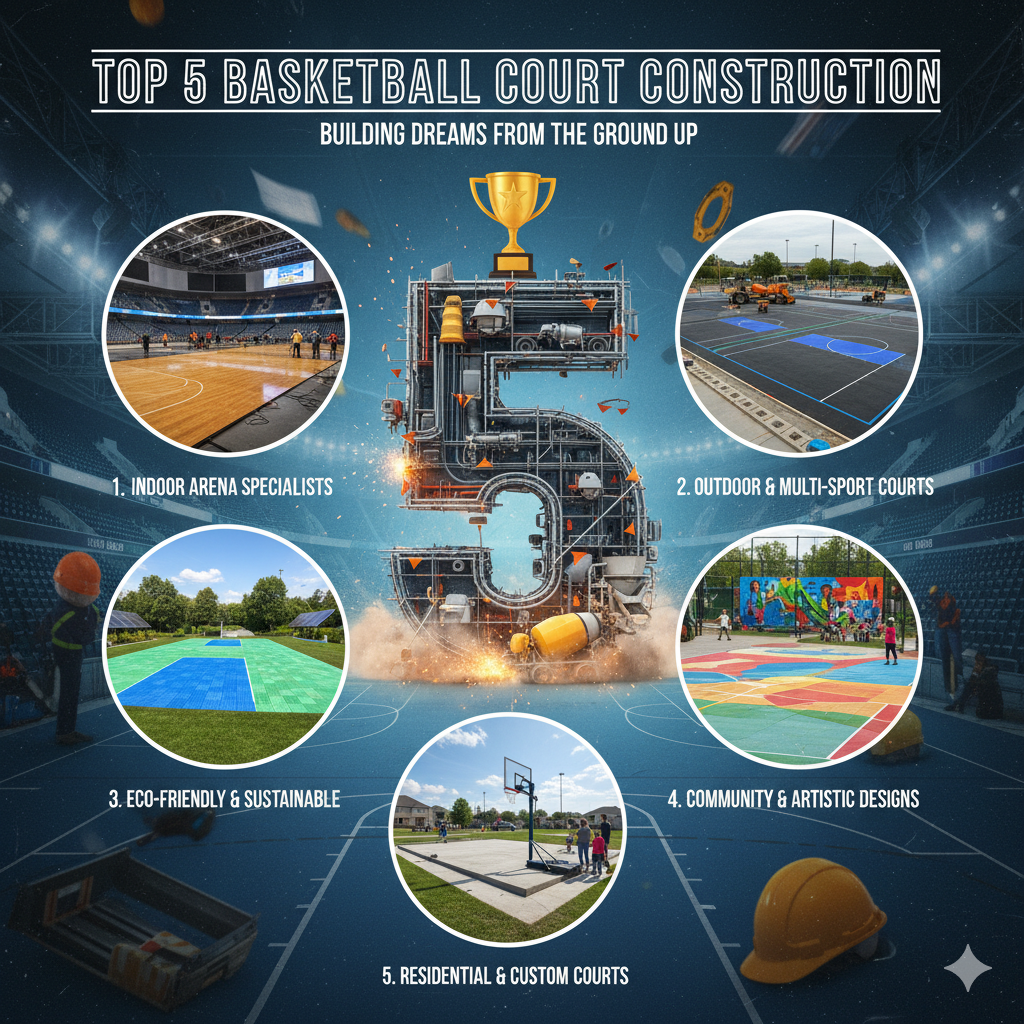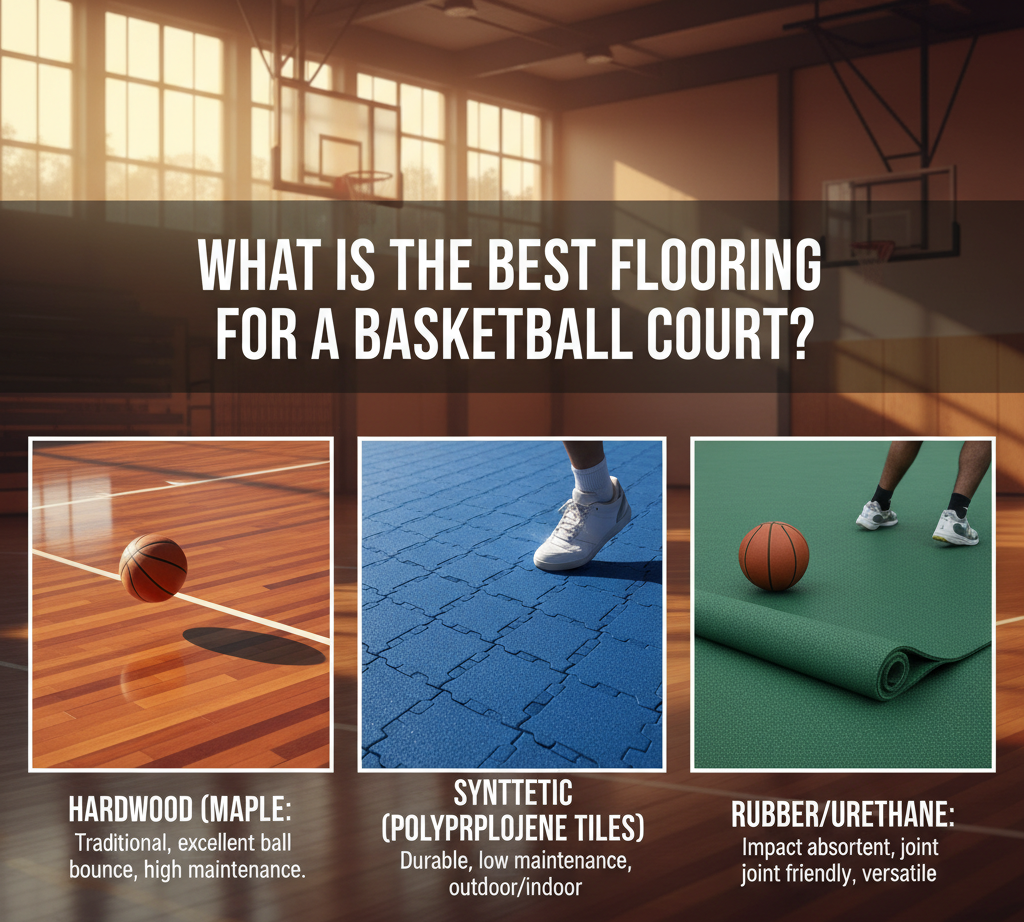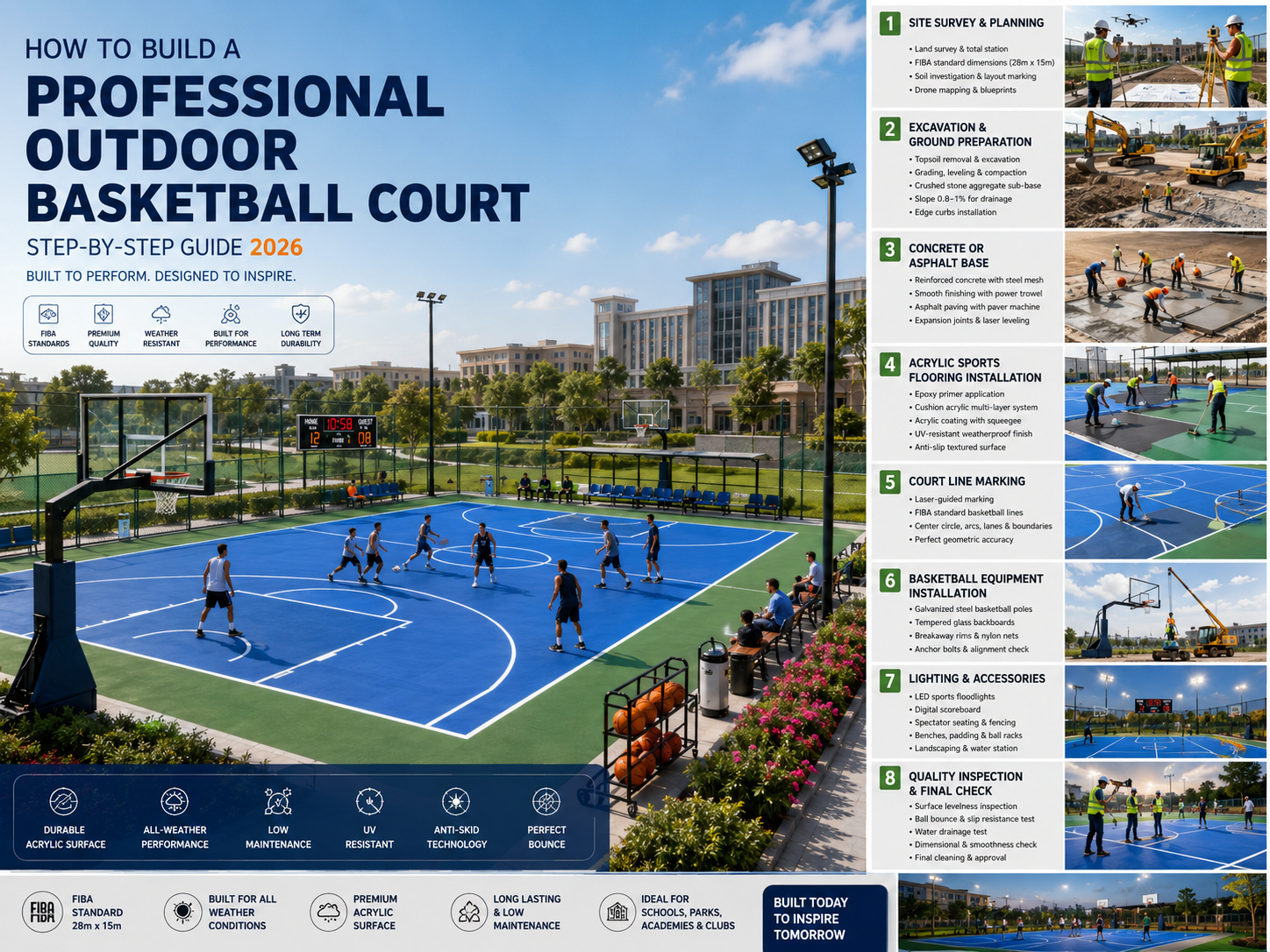
Outdoor basketball courts have become one of the most sought-after sports infrastructure projects across schools, colleges, universities, sports academies, residential societies, public parks, commercial developments, and government recreation facilities. As basketball continues to gain popularity worldwide, the demand for professionally designed and constructed outdoor courts has increased significantly. Communities are recognizing the importance of providing safe, durable, and high-performance sports facilities that encourage physical activity, social interaction, and athletic development.
The modern outdoor basketball court is much more than a simple concrete playing surface with two basketball hoops. Today’s professional courts are engineered using advanced construction techniques, premium acrylic sports flooring systems, high-quality concrete or asphalt bases, precision line markings, and weather-resistant materials that ensure exceptional durability and consistent playing performance throughout the year. Whether the court is intended for recreational use, competitive tournaments, school training sessions, or professional practice, every component must be carefully designed and installed to meet international quality standards.
Growing awareness of health and fitness has also contributed to the increasing demand for outdoor basketball courts. Governments, educational institutions, and private developers are investing heavily in sports infrastructure to encourage active lifestyles among children, teenagers, and adults. Basketball offers a full-body workout that improves cardiovascular fitness, agility, coordination, balance, teamwork, and mental focus, making it one of the most popular outdoor sports across all age groups.
Another major factor driving the popularity of outdoor basketball courts is the rapid development of residential townships, gated communities, sports complexes, and recreational parks. Homebuyers increasingly look for lifestyle amenities that promote wellness and community engagement. A professionally constructed basketball court enhances the overall value of residential and commercial properties while creating an attractive recreational space for residents and visitors.
Modern construction technologies have made it possible to build outdoor basketball courts that withstand heavy foot traffic and challenging weather conditions. High-performance acrylic sports flooring systems provide excellent slip resistance, UV stability, color retention, and impact absorption. Proper drainage systems, reinforced concrete or asphalt foundations, and specialized sports coatings minimize maintenance requirements while extending the service life of the court. These innovations ensure that athletes enjoy a safe and consistent playing surface regardless of seasonal temperature variations or rainfall.
Schools and universities are also investing in premium outdoor basketball courts as part of their sports education programs. A professionally designed court supports physical education classes, inter-school competitions, talent development programs, and extracurricular activities. Sports academies benefit from regulation-size courts that allow athletes to train under conditions similar to professional competitions, helping improve performance and skill development.
In addition to educational institutions, municipalities and urban planners recognize the role of basketball courts in building healthier communities. Public parks equipped with modern sports facilities encourage families, children, and fitness enthusiasts to participate in regular outdoor activities. These recreational spaces foster social interaction, reduce sedentary lifestyles, and contribute to overall community well-being.
From a construction perspective, building a professional outdoor basketball court requires careful planning, engineering expertise, and strict quality control. Every stage—from site selection and land surveying to base preparation, drainage design, acrylic sports flooring installation, basketball pole erection, and court marking—must be executed with precision. Even minor construction errors can affect player safety, ball bounce consistency, water drainage, and the long-term durability of the facility.
Selecting the appropriate construction materials is equally important. Premium-grade concrete, asphalt, acrylic resurfacing systems, reinforced basketball poles, tempered glass backboards, rust-resistant hardware, and high-quality sports coatings all contribute to creating a court that meets international performance standards while minimizing future maintenance costs.
Today, professional outdoor basketball court construction has become an essential investment for schools, universities, sports academies, residential communities, clubs, government organizations, hotels, corporate campuses, and commercial developers seeking to provide world-class sports facilities. A properly constructed court not only enhances athletic performance but also increases property value, promotes healthy living, and creates an engaging environment where players of all ages can enjoy the game safely.
In this comprehensive guide, you will learn every stage of professional outdoor basketball court construction—from planning and design to foundation work, acrylic sports flooring installation, basketball equipment setup, quality standards, maintenance practices, estimated costs, and expert recommendations. Whether you are planning a new sports facility or upgrading an existing court, understanding the complete construction process will help you build a durable, safe, and high-performance outdoor basketball court that delivers exceptional value for many years.
Benefits of a Professional Outdoor Basketball Court
A professionally constructed outdoor basketball court is far more than a recreational facility—it is a long-term investment that promotes health, community engagement, athletic development, and property value. Whether installed in schools, colleges, universities, sports academies, residential societies, public parks, commercial complexes, or government sports facilities, a high-quality basketball court provides lasting benefits for players, organizations, and communities alike. Modern construction techniques, premium acrylic sports flooring, and durable materials ensure that outdoor courts remain safe, attractive, and high-performing for many years with minimal maintenance.
1. Provides a Safe Playing Environment
Player safety is the most important advantage of a professionally designed basketball court. Unlike ordinary concrete surfaces, a professionally constructed court features a carefully engineered base, anti-slip acrylic sports coating, and precision leveling to reduce the risk of slips, falls, and injuries.
Premium acrylic sports flooring offers:
- Excellent slip resistance in both dry and slightly wet conditions.
- Consistent ball bounce across the entire court.
- Better player traction for quick movements.
- Reduced impact on knees and ankles.
- Improved shock absorption compared to untreated concrete.
A safe playing surface allows athletes of all ages to practice confidently while minimizing common sports injuries.
2. Exceptional Durability and Long Service Life
Outdoor basketball courts are constantly exposed to sunlight, rainfall, temperature fluctuations, dust, and heavy foot traffic. Professional construction ensures the court remains structurally sound under these challenging environmental conditions.
High-quality construction includes:
- Reinforced concrete or asphalt foundation.
- Proper drainage systems.
- UV-resistant acrylic coatings.
- Weather-resistant line markings.
- Crack-resistant surface preparation.
- Rust-proof basketball poles and hardware.
With routine maintenance, a professionally constructed basketball court can provide reliable performance for 15–25 years, making it a cost-effective investment.
3. Consistent Playing Performance
Professional basketball players expect predictable playing conditions during every game. A well-constructed outdoor basketball court delivers:
- Uniform surface texture.
- Accurate ball bounce.
- Proper court dimensions.
- Precision line markings.
- Smooth player movement.
- Excellent grip during fast directional changes.
Consistent performance enhances skill development, improves game quality, and creates a professional playing experience for recreational and competitive athletes alike.
4. Promotes Health and Physical Fitness
Basketball is one of the most effective full-body sports, engaging multiple muscle groups while improving cardiovascular endurance and coordination. A professionally built outdoor basketball court encourages regular physical activity among children, teenagers, adults, and senior citizens.
Regular basketball practice helps improve:
- Cardiovascular health.
- Muscle strength.
- Flexibility.
- Speed and agility.
- Hand-eye coordination.
- Balance and body control.
- Endurance.
- Mental concentration.
Accessible sports facilities encourage healthier lifestyles and reduce sedentary habits within communities.
5. Encourages Community Engagement
Outdoor basketball courts naturally become gathering spaces where people of all ages interact, compete, and build lasting relationships. Schools organize tournaments, residential communities host recreational events, and municipalities encourage public participation through sports programs.
Community benefits include:
- Increased social interaction.
- Youth engagement.
- Family recreation.
- Local sports competitions.
- Community wellness initiatives.
- Reduced screen time for children.
These shared recreational spaces strengthen community bonds while promoting teamwork and sportsmanship.
6. Supports Athlete Development
Professional-quality basketball courts are essential training facilities for aspiring athletes. Regulation-size courts with accurate markings and consistent playing surfaces allow players to practice under conditions similar to competitive tournaments.
Benefits for athletes include:
- Improved shooting accuracy.
- Better footwork training.
- Enhanced dribbling skills.
- Tactical practice sessions.
- Team coordination.
- Professional coaching environments.
Sports academies, schools, and universities rely on professionally constructed courts to nurture future basketball talent.
7. Enhances Educational Institutions
Educational institutions increasingly recognize the importance of sports infrastructure alongside academic excellence. A professionally designed basketball court enhances the reputation of schools, colleges, and universities while supporting comprehensive physical education programs.
Benefits include:
- Physical education classes.
- Inter-school competitions.
- Sports scholarships.
- Student fitness programs.
- Extracurricular activities.
- Talent identification.
Modern sports facilities also improve campus attractiveness for prospective students and parents.
8. Increases Property Value
Residential developers and commercial property owners understand that premium sports amenities significantly increase property appeal. A professionally constructed basketball court enhances the overall value of housing societies, townships, resorts, hotels, and mixed-use developments.
Potential buyers increasingly seek communities offering recreational amenities that encourage healthy lifestyles. A high-quality basketball court becomes a valuable selling point that differentiates a property from competing developments.
9. Low Maintenance Requirements
Professional basketball courts are designed for easy maintenance and long-term performance. High-quality acrylic sports flooring resists fading, peeling, cracking, and surface wear when installed correctly.
Routine maintenance typically includes:
- Sweeping debris.
- Washing the surface.
- Inspecting drainage systems.
- Repainting line markings when required.
- Checking basketball equipment.
- Repairing minor cracks promptly.
Preventive maintenance significantly extends the court’s lifespan while preserving its appearance and playing quality.
10. Excellent Weather Resistance
Outdoor courts must withstand harsh environmental conditions throughout the year. Modern acrylic sports flooring systems are specifically engineered to resist:
- UV radiation.
- Heavy rainfall.
- High temperatures.
- Humidity.
- Dust accumulation.
- Seasonal expansion and contraction.
Proper drainage systems prevent standing water, while weather-resistant coatings maintain vibrant colors and excellent traction even after years of outdoor exposure.
11. Multi-Purpose Sports Facility
A professionally designed basketball court can accommodate multiple recreational activities beyond basketball. Depending on the available space and layout, the same court may also support:
- Volleyball.
- Pickleball.
- Recreational fitness sessions.
- Physical education activities.
- Community events.
- Sports training programs.
This multi-purpose functionality maximizes the return on investment while serving a wider range of users.
12. Cost-Effective Long-Term Investment
Although professional basketball court construction requires an initial investment, the long-term financial benefits are substantial. Durable materials, proper engineering, and quality workmanship reduce maintenance expenses and costly repairs over time.
Organizations benefit from:
- Lower lifecycle maintenance costs.
- Extended service life.
- Reduced surface repairs.
- Improved user satisfaction.
- Higher facility utilization.
- Increased property value.
Investing in professional construction ensures dependable performance for decades.
Why Professional Construction Matters
Every component of an outdoor basketball court—from foundation preparation and drainage design to acrylic sports flooring installation and precision court markings—plays a critical role in its overall performance. Poor construction practices can result in uneven surfaces, water accumulation, surface cracking, faded markings, and increased maintenance costs.
By choosing experienced sports flooring specialists and high-quality construction materials, facility owners can create a basketball court that offers exceptional durability, player safety, professional performance, and long-term value. Whether the court is intended for schools, universities, residential communities, sports academies, parks, or commercial developments, a professionally built outdoor basketball court becomes a valuable asset that encourages active lifestyles, supports athletic excellence, and serves generations of players for years to come.
Planning, Site Selection & Design
Successful outdoor basketball court construction begins long before the first layer of concrete or acrylic sports flooring is installed. Careful planning, strategic site selection, and precise court design determine the overall performance, durability, safety, and maintenance requirements of the facility. Whether constructing a basketball court for a school, university, sports academy, residential society, public park, corporate campus, or commercial sports complex, every stage of planning should be completed with engineering precision to ensure a high-quality sports facility that meets professional standards.
Importance of Proper Planning
Planning is the foundation of every successful basketball court project. A professionally planned court minimizes future maintenance costs, prevents structural issues, and ensures optimal player safety. Before construction begins, project engineers, architects, and sports flooring specialists conduct a comprehensive site assessment to evaluate soil conditions, drainage patterns, available space, and environmental factors.
The planning phase typically includes:
- Site inspection and feasibility study
- Budget estimation
- Court size selection
- Soil testing
- Drainage analysis
- Utility mapping
- Material selection
- Construction scheduling
- Safety planning
- Future expansion possibilities
A well-planned project reduces construction delays and ensures that every stage is completed according to quality standards.
Choosing the Right Location
Selecting the appropriate location is one of the most important decisions in outdoor basketball court construction. The site should provide sufficient space for the court, safety clearance, player movement, and spectator areas.
An ideal basketball court location should have:
- Naturally level ground
- Good soil stability
- Easy accessibility
- Proper drainage
- Adequate sunlight
- Safe surroundings
- Space for seating and walkways
- Future maintenance access
Avoid locations that are prone to flooding, excessive tree cover, unstable soil, or frequent waterlogging, as these conditions can significantly reduce the lifespan of the playing surface.
Understanding Standard Basketball Court Dimensions
Court dimensions vary depending on the intended use, available space, and governing standards. Professional courts follow internationally recognized measurements to provide a consistent playing experience.
Full-Size Outdoor Basketball Court
Typical dimensions include:
- Court Length: 28 meters (91.9 feet)
- Court Width: 15 meters (49.2 feet)
Additional clearance is recommended around the playing area to improve player safety and accommodate movement outside the boundary lines.
Recommended free space:
- 2–3 meters on each side
- Additional space behind each basket
- Spectator zones
- Emergency access pathways
Smaller recreational courts and half-courts can also be designed based on available land while maintaining proportional dimensions.
Site Survey and Land Assessment
Before construction begins, engineers perform a detailed land survey to identify any issues that could affect court performance.
The survey evaluates:
- Existing ground levels
- Soil bearing capacity
- Underground utilities
- Drainage direction
- Elevation differences
- Surface water flow
- Existing vegetation
- Access roads
Modern surveying equipment such as total stations, GPS systems, and laser levels ensures accurate measurements and minimizes construction errors.
Soil Testing
Soil quality directly affects the structural stability of the basketball court. Weak or unstable soil can lead to settlement, surface cracks, and uneven playing conditions.
Professional soil testing examines:
- Soil density
- Moisture content
- Load-bearing capacity
- Compaction characteristics
- Drainage capability
- Organic material content
If the existing soil does not meet engineering requirements, additional stabilization methods such as granular filling, soil replacement, or mechanical compaction may be necessary.
Drainage Planning
Water is one of the biggest threats to outdoor sports infrastructure. Without an efficient drainage system, rainwater can accumulate on the playing surface, causing slippery conditions, structural damage, and premature deterioration.
Professional drainage design includes:
- Surface slope of approximately 0.8–1%
- Side drainage channels
- Stormwater outlets
- Underground drainage pipes
- Catch basins where required
Proper drainage ensures quick water removal, allowing the court to dry faster after rainfall and reducing maintenance costs.
Court Orientation
The orientation of the basketball court significantly impacts player comfort and visibility. Direct sunlight can interfere with shooting accuracy and player performance.
For outdoor installations, it is generally recommended to align the court so that the main playing direction minimizes glare from the rising and setting sun. Proper orientation improves visibility during morning and evening games while enhancing the overall playing experience.
Selecting the Right Base Construction
The structural base forms the foundation of the entire basketball court. Two common options are:
Reinforced Concrete Base
Advantages:
- Excellent strength
- Long lifespan
- Minimal movement
- Suitable for premium sports flooring
- Low maintenance
Asphalt Base
Advantages:
- Faster installation
- Lower initial cost
- Good shock characteristics
- Smooth playing surface
- Easier resurfacing
The choice depends on project budget, expected usage, local climate, and long-term maintenance goals.
Choosing the Sports Flooring System
Modern outdoor basketball courts commonly use acrylic sports flooring due to its excellent performance and durability.
Acrylic flooring provides:
- Anti-slip texture
- UV resistance
- Weather protection
- Consistent ball bounce
- Bright, fade-resistant colors
- Low maintenance
- Long service life
Professional acrylic systems consist of multiple layers, including primer, resurfacer, cushion coats (if specified), color coats, and precision line markings.
Basketball Equipment Planning
Equipment selection should meet professional quality standards to ensure safety and long-term reliability.
Essential components include:
- Heavy-duty galvanized basketball poles
- Tempered glass or high-quality acrylic backboards
- Breakaway or fixed rims
- Weather-resistant nets
- Protective pole padding
- Stainless steel fasteners
- Anchor systems
Correct positioning and installation ensure accurate gameplay and reduce maintenance needs.
Safety Considerations During Design
Player safety should be integrated into every stage of the design process. A well-designed court minimizes the risk of accidents and provides a comfortable environment for athletes.
Safety features include:
- Slip-resistant acrylic surface
- Rounded court edges
- Proper runoff areas
- Smooth surface transitions
- Securely anchored basketball systems
- Adequate lighting for evening play
- Protective fencing where necessary
- Clear spectator zones
These elements help create a safe environment for players of all skill levels.
Accessibility and User Experience
Modern basketball court design should also consider accessibility and convenience for all users.
Additional features may include:
- Wheelchair-accessible pathways
- Benches and seating areas
- Drinking water stations
- Shade structures
- LED sports lighting
- Bicycle parking
- Equipment storage
- Landscaping around the facility
These amenities improve the overall experience for players, coaches, spectators, and visitors.
Future Expansion Planning
When designing a new basketball court, it is wise to plan for future upgrades. Allocating extra space during the initial construction phase can simplify future improvements and reduce renovation costs.
Possible future additions include:
- Multi-purpose sports markings
- Additional practice hoops
- Spectator stands
- Scoreboards
- LED floodlighting
- CCTV security systems
- Covered player benches
- Fitness and warm-up zones
Planning for expansion ensures the facility remains adaptable to evolving community and sports requirements.
Effective planning, careful site selection, and thoughtful design are the cornerstones of a professional outdoor basketball court. By evaluating soil conditions, ensuring proper drainage, selecting high-quality construction materials, and incorporating safety-focused design principles, project owners can build a court that delivers exceptional performance, durability, and player satisfaction for years to come. Investing time in the planning stage not only prevents costly construction errors but also creates a world-class sports facility capable of supporting recreational play, competitive training, and community engagement.
Materials Required & Construction Equipment
The quality of an outdoor basketball court depends not only on skilled workmanship but also on the materials and equipment used during construction. Every layer—from the subgrade and base to the acrylic sports flooring and basketball equipment—must be selected carefully to ensure long-term durability, safety, and professional playing performance. Premium construction materials combined with modern construction equipment help create a court that can withstand heavy usage, harsh weather conditions, and years of outdoor exposure with minimal maintenance.
Importance of Using High-Quality Materials
Choosing superior construction materials is one of the most important decisions in a basketball court project. Inferior materials may reduce the initial construction cost, but they often lead to premature cracking, uneven surfaces, fading colors, drainage issues, and expensive repairs. Professional-grade materials provide better structural strength, weather resistance, and consistent playing conditions while extending the lifespan of the court.
High-quality materials offer several advantages, including:
- Improved structural stability
- Enhanced weather resistance
- Better slip resistance
- Longer service life
- Reduced maintenance costs
- Superior playing performance
- Consistent ball bounce
- Attractive appearance
Investing in premium materials ensures that the basketball court remains functional and visually appealing for many years.
Ground Preparation Materials
Ground preparation forms the foundation of a successful basketball court. Before installing the playing surface, the site must be stabilized using suitable earthwork and sub-base materials.
Soil Fill Material
If the existing ground is uneven or contains weak soil, engineered fill material is used to achieve the desired level and improve load-bearing capacity.
The fill material should be:
- Properly compacted
- Free from organic matter
- Well-graded
- Moisture controlled
- Suitable for heavy structural loads
Proper soil preparation minimizes future settlement and ensures a stable base.
Granular Sub-Base
A compacted granular sub-base distributes structural loads and improves drainage beneath the court.
Common materials include:
- Crushed stone
- Crushed aggregate
- Gravel
- Granular sub-base (GSB)
- Well-graded stone dust
The sub-base must be compacted in multiple layers to achieve maximum density and structural stability.
Base Construction Materials
The structural base provides the strength required to support the basketball court throughout its service life.
Reinforced Concrete
Concrete is one of the most commonly used base materials for professional basketball courts because of its exceptional strength and durability.
Advantages include:
- High load-bearing capacity
- Long lifespan
- Smooth finish
- Excellent structural integrity
- Minimal maintenance
- Crack resistance when properly reinforced
Steel reinforcement bars or welded wire mesh are often incorporated to improve tensile strength and minimize shrinkage cracks.
Asphalt Base
Asphalt is another popular choice for outdoor basketball courts, particularly for recreational facilities and community sports complexes.
Benefits include:
- Faster installation
- Flexible surface
- Lower construction cost
- Easy resurfacing
- Good shock characteristics
The asphalt layer must be properly compacted and finished to achieve a smooth, uniform playing surface.
Drainage Materials
Efficient drainage is essential for protecting the basketball court from water damage.
Typical drainage materials include:
- PVC drainage pipes
- Perforated drainage pipes
- Catch basins
- Surface drains
- Drainage channels
- Filter fabric
- Coarse gravel
These materials work together to remove rainwater quickly and prevent water accumulation beneath the playing surface.
Acrylic Sports Flooring Materials
Acrylic sports flooring is the preferred surface system for professional outdoor basketball courts due to its durability, slip resistance, and vibrant appearance.
A complete acrylic flooring system generally includes:
Acrylic Primer
The primer creates a strong bond between the concrete or asphalt base and subsequent acrylic layers.
Functions include:
- Improved adhesion
- Dust control
- Surface stabilization
- Enhanced durability
Acrylic Resurfacer
The resurfacer fills minor surface imperfections and creates a uniform foundation for the color coatings.
Benefits include:
- Surface leveling
- Improved texture
- Increased durability
- Better coating adhesion
Cushion Layers (Optional)
Premium basketball courts often include acrylic cushion systems that provide additional player comfort.
Advantages include:
- Shock absorption
- Reduced joint stress
- Enhanced player comfort
- Improved athletic performance
Acrylic Color Coatings
Multiple coats of UV-resistant acrylic color provide the court’s final appearance.
Features include:
- Fade resistance
- Weather resistance
- Anti-slip texture
- Bright professional colors
- Easy maintenance
- Long-lasting finish
Popular color combinations include:
- Blue with green borders
- Red with green surroundings
- Dark blue with light blue key area
- Green with red accents
- Custom branding colors
Court Line Marking Paint
Professional sports line marking paint provides crisp, highly visible court markings.
The paint should be:
- UV resistant
- Weather resistant
- Abrasion resistant
- High contrast
- Long lasting
Accurate line markings ensure compliance with international basketball standards.
Basketball Equipment Materials
Professional basketball equipment contributes significantly to the safety and functionality of the court.
Essential equipment includes:
Basketball Poles
High-quality poles are typically manufactured from:
- Galvanized steel
- Powder-coated steel
- Heavy-duty structural steel
These materials resist corrosion and provide long-term structural stability.
Backboards
Modern outdoor courts commonly use:
- Tempered glass
- Acrylic
- Polycarbonate
Tempered glass is preferred for professional courts because it offers excellent rebound characteristics and superior durability.
Basketball Rims
Professional rims should include:
- Heavy-duty steel construction
- Powder-coated finish
- Breakaway mechanism (for competitive courts)
- Corrosion resistance
High-quality rims maintain consistent performance even under frequent use.
Basketball Nets
Outdoor nets are typically manufactured from:
- Weather-resistant nylon
- Polypropylene
- Chain-link steel (high-vandalism areas)
These materials withstand prolonged outdoor exposure while maintaining durability.
Construction Equipment Required
Professional basketball court construction relies on specialized machinery to ensure accuracy, efficiency, and quality.
Survey Equipment
Engineers use advanced surveying instruments such as:
- Total Station
- Laser Level
- GPS Survey Equipment
- Measuring Wheels
- Digital Levels
These tools ensure precise layout and elevation control.
Earthwork Equipment
Ground preparation requires heavy machinery, including:
- Excavators
- Backhoe Loaders
- Bulldozers
- Motor Graders
- Skid Steer Loaders
These machines prepare the site quickly and efficiently.
Compaction Equipment
Proper compaction is essential for structural stability.
Common equipment includes:
- Vibratory Rollers
- Plate Compactors
- Rammer Compactors
- Tandem Rollers
Adequate compaction minimizes settlement and improves foundation strength.
Concrete Construction Equipment
Concrete installation typically requires:
- Concrete Mixers
- Transit Mixers
- Concrete Pumps
- Power Trowels
- Screeding Machines
- Vibrators
These machines help produce a dense, smooth, and durable concrete surface.
Asphalt Construction Equipment
For asphalt courts, contractors commonly use:
- Asphalt Pavers
- Road Rollers
- Asphalt Cutters
- Bitumen Sprayers
These machines ensure uniform thickness and smooth surface finishing.
Acrylic Flooring Installation Tools
Installing acrylic sports flooring requires precision equipment such as:
- Rubber Squeegees
- Notched Trowels
- Mixing Drills
- Roller Brushes
- Spray Equipment
- Measuring Containers
- Moisture Meters
These tools help achieve a consistent coating thickness and professional finish.
Court Marking Equipment
Accurate line marking is essential for professional gameplay.
Common tools include:
- Measuring Tapes
- Chalk Lines
- Laser Marking Devices
- Masking Tape
- Precision Rollers
- Line Striping Machines
These ensure sharp, regulation-compliant markings.
Safety Equipment
Construction personnel should always use appropriate personal protective equipment (PPE), including:
- Safety Helmets
- High-Visibility Jackets
- Protective Gloves
- Safety Goggles
- Steel-Toe Boots
- Dust Masks
- Hearing Protection
- Fall Protection Equipment (if required)
Using proper safety gear minimizes workplace accidents and ensures compliance with occupational safety standards.
Material Quality Inspection
Before installation, all materials should undergo quality checks to verify:
- Manufacturer specifications
- Strength and durability
- Surface finish
- Moisture content
- Dimensional accuracy
- Color consistency
- Compliance with project requirements
Only approved materials should be used to maintain construction quality and long-term performance
Selecting premium construction materials and using professional-grade equipment are essential for building a high-performance outdoor basketball court. From the compacted sub-base and reinforced concrete foundation to UV-resistant acrylic sports flooring, galvanized basketball poles, and precision installation tools, every component contributes to the court’s durability, safety, and playing quality. By combining quality materials with skilled workmanship and modern construction techniques, project owners can create a basketball facility that delivers reliable performance, low maintenance, and an exceptional playing experience for athletes and recreational users alike.
Ground Preparation & Base Construction
Ground preparation and base construction are the backbone of every professional outdoor basketball court. No matter how premium the acrylic sports flooring or basketball equipment may be, the court will fail prematurely if the foundation is not properly designed and constructed. Cracks, uneven surfaces, water stagnation, poor ball bounce, and expensive maintenance are often the direct result of inadequate ground preparation rather than defects in the surface coating itself.
A professionally engineered basketball court foundation provides structural stability, proper drainage, consistent playing performance, and long-term durability. Whether the court is being built for a school, university, sports academy, residential society, public park, commercial complex, or international sports facility, every stage of foundation construction must follow established engineering practices.
Why Ground Preparation is Important
Ground preparation creates a stable platform capable of supporting thousands of games throughout the life of the basketball court. A poorly prepared foundation may initially appear satisfactory but can develop serious structural problems within a few years.
Proper ground preparation helps achieve:
- Long-lasting structural stability
- Uniform ball bounce
- Smooth player movement
- Excellent drainage performance
- Crack prevention
- Reduced maintenance costs
- Increased surface lifespan
- Professional playing quality
The quality of the finished court is directly proportional to the quality of its foundation.
Site Clearing
The first stage of construction involves clearing the selected site completely before excavation begins.
This includes removing:
- Trees
- Bushes
- Grass
- Existing pavement
- Construction debris
- Organic material
- Large stones
- Roots
All unwanted materials should be transported away from the construction area to create a clean working surface.
Land Survey and Setting Out
After site clearing, engineers perform detailed surveying to establish the exact court position, levels, and dimensions.
Survey work includes:
- Boundary marking
- Centerline establishment
- Corner positioning
- Elevation measurements
- Slope verification
- Drainage direction
- Benchmark creation
Modern laser levels and total station equipment ensure millimeter-level accuracy throughout construction.
Excavation
Once the layout is finalized, excavation begins to achieve the required formation level.
Excavation depth depends on:
- Soil condition
- Foundation design
- Drainage requirements
- Concrete or asphalt thickness
- Local climate
- Load-bearing capacity
Typical excavation removes loose and unstable soil while creating a uniform platform for the sub-base.
During excavation, engineers continuously verify:
- Excavation depth
- Surface level
- Side slopes
- Soil quality
- Drainage alignment
Soil Compaction
Compaction is one of the most critical stages of basketball court construction.
Loose soil contains air pockets that eventually settle under repeated loading, causing cracks and uneven surfaces.
Professional compaction improves:
- Soil density
- Load-bearing capacity
- Structural strength
- Foundation stability
- Water resistance
Compaction is generally carried out using:
- Vibratory rollers
- Plate compactors
- Rammer compactors
Moisture content must also be carefully controlled during compaction to achieve maximum density.
Installing the Granular Sub-Base
After the natural ground has been compacted, a high-quality granular sub-base is installed.
Common materials include:
- Crushed stone
- Well-graded aggregates
- Stone dust
- Gravel
- Granular Sub Base (GSB)
The sub-base performs several essential functions:
- Distributes structural loads
- Prevents settlement
- Improves drainage
- Supports the concrete slab
- Reduces frost movement in colder regions
The granular material is placed in multiple layers and compacted thoroughly after each layer.
Fine Grading and Leveling
Before constructing the structural base, the sub-base must be accurately leveled.
Professional grading ensures:
- Uniform surface elevation
- Proper drainage slope
- Correct court dimensions
- Smooth foundation
Laser-guided grading equipment is commonly used to eliminate surface irregularities.
Even minor elevation differences can affect:
- Ball bounce
- Water flow
- Player safety
- Surface durability
Drainage System Installation
An efficient drainage system is essential for outdoor basketball courts.
Rainwater should leave the playing surface quickly without causing puddles or erosion.
A professionally designed drainage system may include:
- Surface drains
- Side drainage channels
- PVC drainage pipes
- Catch basins
- Underground stormwater pipelines
The court surface should be constructed with a gentle slope of approximately 0.8–1%, allowing water to drain naturally without affecting gameplay.
Proper drainage protects both the foundation and acrylic sports flooring from premature deterioration.
Installing Edge Restraints
Edge restraints maintain the structural integrity of the court by preventing movement of the foundation materials.
Typical edge construction includes:
- Reinforced concrete curbs
- Concrete edge beams
- Brick edging
- Precast concrete blocks
Strong edges also improve the appearance of the completed basketball court.
Reinforced Concrete Base Construction
For premium basketball courts, reinforced concrete provides the strongest and most durable foundation.
Concrete offers:
- High compressive strength
- Excellent dimensional stability
- Long service life
- Minimal maintenance
- Superior surface smoothness
The construction process includes:
Reinforcement Placement
Steel reinforcement bars or welded wire mesh are positioned according to structural design.
Benefits include:
- Crack control
- Increased tensile strength
- Better load distribution
- Longer structural life
Formwork Installation
Concrete formwork defines the exact dimensions of the court while maintaining proper thickness and alignment.
Well-installed formwork ensures:
- Straight edges
- Accurate levels
- Uniform thickness
- Professional finishing
Concrete Pouring
High-quality ready-mix concrete is poured continuously to avoid cold joints.
Professional contractors use:
- Concrete pumps
- Transit mixers
- Mechanical vibrators
- Screeding machines
The concrete is placed evenly across the entire court.
Surface Finishing
After placement, the concrete surface is finished using:
- Power trowels
- Magnesium floats
- Straight edges
- Finishing tools
The finished slab must be:
- Smooth
- Level
- Dense
- Crack-free
A smooth foundation is essential for successful acrylic sports flooring installation.
Alternative: Asphalt Base Construction
Many recreational basketball courts use asphalt instead of concrete.
The asphalt construction process generally includes:
- Bituminous base layer
- Asphalt paving
- Roller compaction
- Surface finishing
- Cooling period
Advantages include:
- Faster construction
- Lower initial cost
- Easier resurfacing
- Good flexibility
However, asphalt requires proper compaction and periodic maintenance to maintain a smooth playing surface.
Concrete Curing
Concrete curing is often overlooked but is essential for achieving maximum strength.
Proper curing:
- Prevents shrinkage cracks
- Increases durability
- Improves surface hardness
- Enhances long-term performance
Curing methods include:
- Water curing
- Curing compounds
- Wet coverings
Professional curing typically continues for at least 7–14 days, with the slab reaching full design strength after approximately 28 days.
Expansion and Control Joints
Concrete naturally expands and contracts due to temperature changes.
Expansion and control joints help prevent random cracking.
Benefits include:
- Crack control
- Stress relief
- Improved durability
- Longer service life
Joint locations are planned carefully to minimize their impact on gameplay.
Surface Inspection
Before applying acrylic sports flooring, the concrete or asphalt base undergoes a comprehensive quality inspection.
Engineers verify:
- Surface smoothness
- Flatness
- Level accuracy
- Moisture content
- Crack-free condition
- Drainage performance
- Concrete strength
- Joint integrity
Any defects are repaired before proceeding to the sports flooring installation stage.
Common Mistakes During Ground Preparation
Several construction errors can significantly reduce the lifespan of a basketball court.
Common mistakes include:
- Inadequate soil compaction
- Poor drainage design
- Uneven grading
- Low-quality aggregates
- Insufficient concrete thickness
- Improper curing
- Weak reinforcement placement
- Ignoring expansion joints
- Poor quality control
- Rushing construction
Avoiding these mistakes ensures a durable, professional-quality court.
Quality Control Checklist
Before moving to acrylic sports flooring installation, verify that:
- ✔ Site is fully cleared
- ✔ Soil is properly compacted
- ✔ Granular sub-base is dense and stable
- ✔ Drainage system is operational
- ✔ Surface levels are accurate
- ✔ Concrete has achieved required strength
- ✔ Expansion joints are correctly installed
- ✔ No cracks or surface defects are present
- ✔ Moisture levels are within acceptable limits
- ✔ Surface is clean and ready for coating
Ground preparation and base construction are the most critical stages in building a professional outdoor basketball court. A well-compacted subgrade, properly engineered drainage system, high-quality granular sub-base, and durable reinforced concrete or asphalt foundation provide the structural integrity required for long-term performance. When executed with precision and quality materials, the foundation supports the acrylic sports flooring system, delivers consistent ball bounce, enhances player safety, and minimizes maintenance costs. Investing in proper groundwork ensures that the basketball court remains durable, weather-resistant, and capable of providing an exceptional playing experience for decades.
Acrylic Sports Flooring Installation Process
Acrylic sports flooring is the preferred surface system for professional outdoor basketball courts because of its durability, weather resistance, excellent ball bounce, anti-slip performance, and vibrant appearance. Unlike ordinary concrete surfaces, acrylic sports flooring transforms a basic foundation into a high-performance playing surface that meets international sports standards. Proper installation is essential to maximize the lifespan of the court and provide athletes with a safe, comfortable, and consistent playing experience.
Professional acrylic sports flooring is a multi-layer coating system applied over a well-prepared concrete or asphalt base. Each layer serves a specific purpose, from improving adhesion and leveling the surface to enhancing durability, color retention, and player comfort. When installed correctly, an acrylic basketball court can deliver outstanding performance for 8 to 15 years with routine maintenance.
Why Choose Acrylic Sports Flooring?
Acrylic sports flooring has become the industry standard for outdoor basketball courts due to its exceptional performance characteristics and long-term value.
Key advantages include:
- Excellent slip resistance
- Consistent ball bounce
- UV-resistant colors
- Weather-resistant surface
- Low maintenance requirements
- Fast drying after rain
- Crack-resistant coating system
- Attractive professional appearance
- Long service life
- Environmentally friendly water-based coatings
These benefits make acrylic flooring ideal for schools, universities, sports academies, residential communities, parks, clubs, and professional sports facilities.
Components of an Acrylic Sports Flooring System
A professional acrylic basketball court consists of several carefully engineered layers, each contributing to the court’s durability and playing performance.
Typical system components include:
- Surface cleaning and preparation
- Acrylic primer
- Acrylic resurfacer
- Cushion layers (optional)
- Acrylic color coats
- Court line markings
- Final inspection and curing
Each layer must be applied according to the manufacturer’s specifications to ensure optimal performance.
Surface Inspection and Preparation
Before applying any acrylic coating, the concrete or asphalt base must be thoroughly inspected. The surface should be clean, smooth, dry, and structurally sound.
The inspection includes checking for:
- Surface cracks
- Dust and debris
- Oil or grease stains
- Uneven areas
- Moisture content
- Drainage performance
- Surface strength
- Expansion joints
Any defects are repaired before coating begins to prevent future failures.
Cleaning the Surface
A clean surface is essential for proper adhesion between the base and the acrylic coating.
Cleaning typically involves:
- Mechanical sweeping
- Pressure washing
- Vacuum cleaning
- Removing loose particles
- Eliminating oil and grease
- Drying the surface completely
Even small amounts of dust or contaminants can reduce the bond strength of the coating system.
Crack and Surface Repair
Minor cracks, holes, and surface imperfections should be repaired before installing the acrylic system.
Repair materials may include:
- Acrylic crack fillers
- Polymer repair mortars
- Epoxy repair compounds
- Cementitious patching materials
Repairs ensure a smooth and uniform surface while preventing cracks from reflecting through the finished flooring.
Application of Acrylic Primer
The primer acts as the bonding layer between the concrete or asphalt base and the acrylic coating system.
Functions of the primer include:
- Improving adhesion
- Stabilizing the surface
- Reducing dust
- Sealing porous areas
- Enhancing coating durability
The primer is applied evenly using rollers or rubber squeegees and allowed to dry completely before the next layer.
Applying the Acrylic Resurfacer
The acrylic resurfacer is designed to fill minor surface imperfections and create a uniform base for the color coatings.
Benefits of the resurfacer include:
- Smoother playing surface
- Better coating adhesion
- Improved durability
- Enhanced ball bounce
- Increased wear resistance
The resurfacer is mixed according to the manufacturer’s specifications and applied using professional rubber squeegees.
Depending on the project, one or more resurfacer coats may be required.
Installing Cushion Layers (Optional)
Premium basketball courts often include acrylic cushion systems that improve player comfort and reduce impact stress.
Cushion layers provide:
- Better shock absorption
- Reduced stress on joints
- Increased player comfort
- Improved athletic performance
- Enhanced safety
These layers are especially beneficial for schools, sports academies, and facilities with frequent use.
The number of cushion coats depends on the desired level of comfort and system specifications.
Applying Acrylic Color Coatings
Color coatings give the basketball court its distinctive appearance while providing the final playing texture.
Professional acrylic color coatings are:
- UV resistant
- Fade resistant
- Anti-slip
- Weather resistant
- Abrasion resistant
- Easy to maintain
The coating is applied in multiple thin layers using rubber squeegees to achieve a uniform finish.
Popular outdoor basketball court color combinations include:
- Blue court with green borders
- Red court with green surroundings
- Dark blue with light blue key area
- Green with red accents
- Custom colors to match school or club branding
Each coat is allowed to dry completely before the next application.
: Drying Between Coats
Proper drying time is essential to achieve maximum coating strength and durability.
Drying time depends on:
- Temperature
- Humidity
- Wind conditions
- Surface moisture
Applying additional coats before complete drying can lead to:
- Poor adhesion
- Surface blistering
- Uneven texture
- Reduced durability
Professional installers monitor weather conditions carefully throughout the installation process.
Court Layout and Line Marking
Once the color coats have cured, the basketball court layout is marked according to regulation dimensions.
The marking process includes:
- Measuring court dimensions
- Marking centerline
- Drawing sidelines
- Marking baselines
- Free throw circle
- Three-point line
- Key area
- Center circle
Masking tape is used to achieve clean, sharp edges before applying high-quality white acrylic line paint.
Accurate markings are essential for professional gameplay and compliance with international standards.
Final Surface Inspection
Before opening the court for use, a comprehensive quality inspection is conducted.
Inspectors evaluate:
- Surface smoothness
- Coating thickness
- Color consistency
- Adhesion quality
- Line accuracy
- Drainage performance
- Surface texture
- Overall appearance
Any defects identified during inspection are corrected before project completion.
Curing Period
After all coatings have been applied, the court must cure completely before use.
Typical curing recommendations include:
- Light foot traffic after 24–48 hours
- Basketball equipment installation after sufficient curing
- Full sports activity only after the manufacturer’s recommended curing period
Premature use can damage the fresh coating and reduce its service life.
Weather Conditions for Installation
Weather has a significant impact on acrylic flooring installation quality.
Ideal conditions include:
- Dry weather
- Moderate temperatures
- Low humidity
- No rainfall during application
- Calm wind conditions
Installation should be avoided during heavy rain, extreme heat, or freezing temperatures to ensure proper curing and adhesion.
Quality Control During Installation
Professional contractors perform continuous quality checks throughout the installation process.
These checks include:
- Surface moisture testing
- Coating thickness measurements
- Material mixing accuracy
- Drying time verification
- Color consistency inspection
- Adhesion testing
- Surface flatness evaluation
Strict quality control ensures a durable and visually appealing sports surface.
Common Installation Mistakes to Avoid
Several common errors can affect the performance and lifespan of acrylic sports flooring.
Avoid:
- Applying coatings on damp surfaces
- Skipping the primer
- Poor crack repairs
- Incorrect material mixing
- Uneven coating thickness
- Ignoring drying times
- Installing during unsuitable weather
- Using low-quality materials
- Inaccurate court markings
- Inadequate surface cleaning
Professional installation minimizes these risks and ensures a long-lasting finish.
Benefits of a Professionally Installed Acrylic Basketball Court
A professionally installed acrylic sports flooring system provides numerous long-term benefits:
- Safe, anti-slip playing surface
- Excellent ball bounce consistency
- Reduced maintenance costs
- Attractive appearance
- High UV and weather resistance
- Long-lasting color retention
- Comfortable playing experience
- Compliance with international sports standards
- Enhanced durability
- Increased property value
These advantages make acrylic flooring the preferred choice for outdoor basketball courts worldwide.
The acrylic sports flooring installation process is a critical stage in constructing a professional outdoor basketball court. From meticulous surface preparation and primer application to resurfacing, color coating, and precision line marking, every step must be executed with care and technical expertise. High-quality acrylic systems not only improve the visual appeal of the court but also enhance player safety, ball control, and overall performance. When combined with a properly prepared foundation and expert workmanship, acrylic sports flooring creates a durable, low-maintenance, and high-performance basketball court capable of delivering years of reliable service in all weather conditions.
Basketball Pole, Hoop & Court Marking Installation
The installation of basketball poles, hoops, backboards, and court markings is the final stage that transforms a completed sports surface into a fully functional outdoor basketball court. Even if the foundation and acrylic sports flooring are constructed perfectly, improper installation of basketball equipment or inaccurate court markings can negatively affect gameplay, player safety, and compliance with international standards. Professional installation ensures that every component is securely positioned, accurately measured, and built to withstand years of intensive use and outdoor weather conditions.
A high-quality basketball system consists of heavy-duty galvanized steel poles, durable backboards, professional rims, weather-resistant nets, and precision-painted court markings. Every element must be installed according to regulation specifications to deliver a safe, durable, and tournament-ready playing environment.
Importance of Professional Equipment Installation
Professional installation provides much more than an attractive appearance. Properly installed basketball equipment ensures:
- Safe gameplay
- Consistent shooting performance
- Structural stability
- Long equipment lifespan
- Reduced maintenance
- Professional playing experience
- Compliance with international basketball standards
Incorrect pole alignment or inaccurate court markings can significantly affect player performance and increase the risk of accidents.
Selecting the Right Basketball Pole System
Basketball poles are the primary structural support of the entire basketball system. Since outdoor courts are exposed to wind, rain, sunlight, and continuous impact, only premium-quality materials should be used.
Professional basketball poles are generally manufactured from:
- Heavy-duty galvanized steel
- Powder-coated structural steel
- Corrosion-resistant steel tubing
These materials provide:
- Excellent strength
- Rust resistance
- Long service life
- Minimal maintenance
- High impact resistance
For public facilities and sports academies, galvanized steel poles are the preferred option because they require very little maintenance and perform exceptionally well in outdoor environments.
Types of Basketball Pole Systems
Different projects require different pole configurations depending on the intended level of play.
In-Ground Basketball Systems
Advantages include:
- Maximum stability
- Professional appearance
- Excellent durability
- Permanent installation
- Reduced vibration
These systems are commonly used for schools, universities, sports academies, and tournament facilities.
Portable Basketball Systems
Suitable for:
- Community centers
- Temporary courts
- Multi-purpose sports facilities
- Recreational use
Although portable systems provide flexibility, permanent installations offer superior stability for professional gameplay.
Foundation for Basketball Poles
The basketball pole foundation must be designed to resist heavy loads and repeated impacts.
Construction typically includes:
- Excavation
- Reinforcement placement
- Anchor bolts
- High-strength concrete
- Accurate alignment
- Proper curing
The foundation dimensions depend on:
- Pole height
- Pole weight
- Wind loads
- Soil conditions
- Equipment manufacturer specifications
Proper curing is essential before mounting the basketball poles.
Pole Installation Process
Professional installation follows a systematic sequence.
Layout Marking
Engineers accurately mark the pole locations using laser measuring equipment.
Measurements verify:
- Court centerline
- Pole offset
- Basket projection
- Symmetry
- Alignment
Accurate positioning ensures proper gameplay.
Anchor Installation
Anchor bolts are embedded within reinforced concrete foundations.
Important considerations include:
- Correct spacing
- Vertical alignment
- Secure fixing
- Corrosion protection
The anchors provide long-term structural stability.
Pole Erection
After the concrete has achieved sufficient strength, the basketball poles are installed.
Professional installers use:
- Mobile cranes
- Chain hoists
- Torque wrenches
- Alignment tools
Each pole is checked for:
- Vertical alignment
- Structural stability
- Tightened connections
- Proper orientation
Installing the Backboard
The backboard directly affects shooting accuracy and rebound consistency.
Professional outdoor basketball courts generally use:
Tempered Glass Backboards
Benefits include:
- Professional rebound
- High durability
- Premium appearance
- Scratch resistance
- Excellent transparency
Acrylic Backboards
Advantages include:
- Lightweight
- Cost-effective
- Good durability
- Weather resistance
Tempered glass remains the preferred choice for competitive facilities.
Basketball Rim Installation
The rim must withstand repeated impacts while maintaining regulation dimensions.
Professional rims are manufactured using:
- Heavy-duty steel
- Powder-coated finish
- Corrosion-resistant hardware
Two common rim types include:
Breakaway Rims
Benefits:
- Player safety
- Reduced equipment damage
- Professional competition standard
- Better durability
Fixed Rims
Suitable for:
- Recreational courts
- Schools
- Community parks
- Training facilities
All mounting hardware should be tightened according to the manufacturer’s specifications.
Installing Basketball Nets
Outdoor basketball nets should withstand continuous exposure to weather.
Common materials include:
- Weather-resistant nylon
- Polypropylene
- Steel chain nets
Quality nets provide:
- Long lifespan
- Excellent visibility
- Consistent performance
- Minimal maintenance
Protective Pole Padding
Professional basketball courts often include impact-resistant pole padding.
Advantages include:
- Improved player safety
- Reduced injury risk
- Equipment protection
- Professional appearance
High-density foam covered with UV-resistant vinyl is commonly used.
Court Layout and Marking
Once the basketball equipment is installed, accurate court marking begins.
Every line must comply with official basketball dimensions.
The marking process includes:
- Court measurement
- Chalk layout
- Laser verification
- Masking tape application
- Acrylic line painting
- Final inspection
Professional layout ensures tournament-quality gameplay.
Standard Basketball Court Markings
The complete court includes:
- Sidelines
- Baselines
- Center line
- Center circle
- Free throw lane
- Free throw circle
- Three-point arc
- Restricted area
- Key area
- Coach’s box (where applicable)
Every measurement should be verified before painting.
Line Marking Materials
Professional court markings use premium acrylic sports paint because it offers:
- UV resistance
- Excellent visibility
- Long-lasting color
- Weather resistance
- Abrasion resistance
- Strong adhesion
White remains the most commonly used line color due to its excellent contrast.
Line Painting Procedure
Professional line marking follows these steps:
Surface Cleaning
Remove all dust and debris before marking.
Accurate Measurement
Laser measuring equipment ensures precise dimensions.
Masking
Professional masking tape creates sharp edges.
Paint Application
Acrylic line paint is applied using:
- Rollers
- Striping machines
- Fine brushes (for detail work)
Multiple thin coats provide better durability than a single thick coat.
Tape Removal
Masking tape is removed carefully before the paint fully hardens to produce clean, crisp lines.
Installing Court Accessories
Modern basketball courts often include additional facilities such as:
- Team benches
- Player shelters
- Scoreboards
- LED floodlights
- Ball storage units
- Referee chairs
- Drinking water stations
- Safety fencing
- Spectator seating
These features enhance functionality and improve the overall user experience.
Lighting Installation
For evening play, LED sports lighting is recommended.
Professional lighting systems provide:
- Uniform illumination
- Low energy consumption
- Reduced glare
- Long operational life
- Better visibility
Lighting poles should be positioned to avoid casting shadows on the playing area.
Safety Inspection
Before opening the court for use, engineers conduct a comprehensive inspection.
The inspection verifies:
- Pole stability
- Rim alignment
- Backboard strength
- Net installation
- Surface condition
- Court dimensions
- Line accuracy
- Fastener tightness
- Player safety clearances
Only after successful inspection should the court be handed over.
Common Installation Mistakes
Professional contractors avoid several common errors that reduce court quality.
These include:
- Incorrect pole positioning
- Weak foundations
- Uneven backboard height
- Poor-quality hardware
- Inaccurate court markings
- Crooked basketball rims
- Low-quality paint
- Missing safety padding
- Improper curing before use
- Ignoring manufacturer guidelines
Avoiding these mistakes significantly extends equipment life and improves player safety.
Maintenance of Basketball Equipment
Regular maintenance keeps the basketball court in excellent condition.
Maintenance should include:
- Tightening bolts
- Inspecting anchors
- Cleaning backboards
- Replacing worn nets
- Touching up line markings
- Checking pole alignment
- Inspecting protective padding
- Lubricating moving parts on breakaway rims
Preventive maintenance minimizes repair costs and extends equipment lifespan.
Benefits of Professional Installation
Professionally installed basketball systems offer numerous long-term advantages:
- Improved player safety
- Accurate gameplay
- Superior durability
- Better aesthetics
- Compliance with international standards
- Reduced maintenance
- Excellent weather resistance
- Higher property value
- Long service life
- Enhanced overall sports experience
Basketball pole, hoop, and court marking installation are the final and most visible stages of outdoor basketball court construction. Precision engineering, high-quality materials, and accurate measurements ensure that the court meets professional performance standards while providing a safe and enjoyable playing environment. From securely anchored galvanized steel poles and tempered glass backboards to regulation-size rims, weather-resistant nets, and precisely painted court markings, every component contributes to the overall quality of the facility. Proper installation and regular maintenance guarantee a durable, tournament-ready basketball court that delivers outstanding performance and reliability for years to come.
Quality Standards, Maintenance & Common Mistakes
Building a professional outdoor basketball court is only the first step toward creating a world-class sports facility. To ensure long-term performance, player safety, and durability, the court must meet recognized quality standards, follow a regular maintenance schedule, and avoid common construction and operational mistakes. A well-built and properly maintained basketball court can deliver consistent playing conditions for 15–25 years while minimizing repair costs and extending the life of the sports flooring system.
Whether the basketball court is installed in a school, university, sports academy, public park, residential society, commercial sports complex, or government facility, maintaining high construction standards is essential for achieving professional results and protecting the long-term investment.
Why Quality Standards Matter
Quality standards ensure that every stage of basketball court construction—from site preparation and foundation work to acrylic sports flooring and basketball equipment installation—meets strict engineering and sports performance requirements.
Following recognized construction standards provides:
- Enhanced player safety
- Consistent ball bounce
- Superior traction
- Improved drainage
- Greater structural stability
- Longer service life
- Lower maintenance costs
- Professional playing conditions
A court built according to quality standards performs better, lasts longer, and offers a safer experience for athletes of all skill levels.
Essential Quality Standards for Outdoor Basketball Courts
Professional basketball courts should comply with established sports infrastructure guidelines and construction best practices. Key quality considerations include:
Court Dimensions
The court should follow regulation measurements with clearly defined playing zones, safety clearances, and accurately painted boundary lines.
Surface Flatness
The playing surface must be:
- Smooth
- Even
- Free from depressions
- Crack-resistant
- Properly leveled
Uneven surfaces can affect ball bounce, player movement, and safety.
Drainage Performance
A professionally constructed court should allow rainwater to drain quickly without creating puddles or slippery areas.
The court should include:
- Proper surface slope
- Efficient drainage channels
- Well-designed stormwater outlets
- Clean drainage systems
Good drainage protects both the structural foundation and the acrylic sports flooring.
Surface Grip
Acrylic sports flooring should provide excellent traction without becoming excessively rough.
An ideal playing surface offers:
- Controlled grip
- Slip resistance
- Comfortable movement
- Safe pivoting
- Consistent performance in different weather conditions
Basketball Equipment Quality
All basketball equipment should be:
- Securely anchored
- Rust-resistant
- Structurally stable
- Correctly aligned
- Professionally installed
Regular inspection helps maintain equipment safety throughout its service life.
Importance of Routine Maintenance
Even the highest-quality basketball court requires periodic maintenance to preserve its appearance and playing performance.
Routine maintenance provides several benefits:
- Extends court lifespan
- Maintains surface color
- Improves player safety
- Prevents structural damage
- Reduces repair costs
- Enhances visual appeal
- Maintains ball bounce consistency
Preventive maintenance is significantly more economical than major repairs or complete resurfacing.
Daily Maintenance
Simple daily maintenance keeps the basketball court clean and safe for players.
Daily tasks include:
- Sweeping dust and leaves
- Removing litter
- Inspecting basketball nets
- Checking for standing water
- Cleaning benches and surrounding areas
Keeping the court free from debris reduces surface wear and improves player safety.
Weekly Maintenance
Weekly inspections help identify small problems before they become expensive repairs.
Recommended tasks include:
- Washing the court surface
- Cleaning drainage channels
- Inspecting basketball poles
- Checking rims and nets
- Removing algae or moss
- Examining surface cleanliness
Regular cleaning also preserves the appearance of the acrylic coating.
Monthly Maintenance
Monthly inspections should focus on structural components and sports equipment.
Inspect:
- Surface cracks
- Expansion joints
- Court markings
- Pole foundations
- Fasteners
- Protective padding
- Fence condition
- Lighting systems
Minor repairs performed early can prevent significant structural damage.
Annual Maintenance
Professional maintenance should be scheduled at least once every year.
Annual work may include:
- Pressure washing
- Repainting faded line markings
- Surface inspection by specialists
- Crack repairs
- Acrylic touch-up coatings
- Equipment servicing
- Drainage system maintenance
- Lighting inspection
Annual maintenance helps maintain tournament-quality playing conditions.
Acrylic Surface Maintenance
Acrylic sports flooring requires relatively little maintenance when installed correctly.
Recommended practices include:
- Using soft-bristle brooms
- Washing with clean water
- Using mild detergents
- Avoiding harsh chemicals
- Promptly removing oil or grease
- Repairing small cracks immediately
Heavy machinery and sharp metal objects should never be dragged across the court.
Basketball Equipment Maintenance
Basketball equipment should be inspected regularly for safety and performance.
Maintenance includes:
- Tightening bolts
- Checking anchor stability
- Inspecting welds
- Cleaning backboards
- Replacing damaged nets
- Lubricating breakaway rims
- Examining protective padding
Proper maintenance extends equipment life and minimizes safety risks.
Drainage Maintenance
Drainage systems play a critical role in protecting outdoor basketball courts.
Maintenance should include:
- Clearing leaves
- Removing sediment
- Cleaning catch basins
- Inspecting drainage pipes
- Checking outlet flow
- Repairing damaged channels
Blocked drainage systems can cause water accumulation and accelerate surface deterioration.
Common Construction Mistakes
Many basketball court failures result from avoidable construction errors.
Common mistakes include:
Poor Soil Compaction
Insufficient compaction causes settlement, cracking, and uneven playing surfaces.
Inadequate Drainage
Improper drainage leads to:
- Water pooling
- Surface deterioration
- Slippery conditions
- Foundation damage
Low-Quality Materials
Using inferior materials often results in:
- Surface cracking
- Color fading
- Equipment corrosion
- Frequent repairs
Incorrect Concrete Curing
Poor curing reduces concrete strength and increases the likelihood of cracking.
Improper Acrylic Application
Common coating mistakes include:
- Uneven thickness
- Poor surface preparation
- Incorrect mixing
- Inadequate drying time
These issues significantly reduce the lifespan of the flooring system.
Incorrect Court Measurements
Inaccurate dimensions affect gameplay and prevent the court from meeting professional standards.
Weak Basketball Pole Foundations
Improper foundation construction may cause:
- Pole movement
- Structural instability
- Increased maintenance
- Safety hazards
Common Maintenance Mistakes
Improper maintenance can shorten the life of even a professionally built basketball court.
Avoid:
- Ignoring small cracks
- Allowing water to accumulate
- Using strong chemical cleaners
- Delaying equipment repairs
- Neglecting drainage systems
- Dragging heavy equipment across the surface
- Repainting without surface preparation
- Skipping annual inspections
Early maintenance prevents major reconstruction costs.
Signs That a Basketball Court Needs Repair
Facility managers should monitor the court for early signs of wear.
Warning signs include:
- Surface cracks
- Standing water
- Faded line markings
- Color discoloration
- Peeling acrylic coating
- Loose basketball poles
- Damaged rims
- Uneven ball bounce
- Surface depressions
- Drainage problems
Addressing these issues promptly extends the court’s service life.
Best Practices for Long-Term Performance
To maximize durability and maintain professional playing conditions:
- Perform regular inspections
- Keep the surface clean
- Maintain proper drainage
- Repair cracks immediately
- Use only approved repair materials
- Schedule professional maintenance annually
- Replace worn basketball equipment when necessary
- Follow manufacturer recommendations for acrylic flooring
These practices help preserve the appearance and functionality of the basketball court for many years.
Benefits of Proper Maintenance
Routine maintenance offers significant long-term advantages:
- Longer court lifespan
- Lower repair expenses
- Improved player safety
- Better court appearance
- Consistent playing performance
- Enhanced property value
- Reduced downtime
- Greater return on investment
A proactive maintenance program protects the court while ensuring an exceptional playing experience.
Quality Inspection Checklist
Before opening the basketball court for regular use, verify the following:
- ✔ Court dimensions are accurate
- ✔ Surface is smooth and level
- ✔ Acrylic coating is fully cured
- ✔ Court markings are precise
- ✔ Basketball poles are securely anchored
- ✔ Backboards and rims are properly aligned
- ✔ Drainage system functions correctly
- ✔ Lighting operates efficiently
- ✔ Safety clearances are maintained
- ✔ No visible structural defects are present
Maintaining high-quality construction standards and implementing a structured maintenance program are essential for preserving the performance, safety, and durability of an outdoor basketball court. Regular inspections, timely repairs, proper cleaning, and the use of high-quality materials ensure that the court continues to provide excellent traction, consistent ball bounce, and a professional playing environment. By avoiding common construction and maintenance mistakes, facility owners can significantly extend the lifespan of the basketball court, reduce long-term operating costs, and deliver a safe, attractive, and high-performance sports facility that serves athletes and communities for decades.
Cost, Timeline, FAQs & Expert Tips
Constructing a professional outdoor basketball court is a valuable long-term investment for schools, colleges, universities, sports academies, residential societies, public parks, commercial sports complexes, corporate campuses, hotels, and government recreation facilities. However, before starting the project, it is important to understand the estimated construction cost, project timeline, key cost-influencing factors, and best practices that ensure maximum return on investment.
A properly planned basketball court not only delivers excellent playing performance but also minimizes maintenance costs and provides reliable service for decades. By selecting quality materials, experienced contractors, and professional sports flooring systems, owners can build a facility that combines durability, safety, and visual appeal.
Factors Affecting Basketball Court Construction Cost
The overall cost of constructing an outdoor basketball court depends on several technical and project-specific factors. No two projects have exactly the same cost because site conditions, materials, equipment, and design requirements vary.
Major factors include:
- Court size
- Site location
- Soil condition
- Ground preparation requirements
- Drainage system
- Concrete or asphalt base
- Acrylic sports flooring system
- Number of cushion layers
- Basketball equipment quality
- Lighting installation
- Fencing and landscaping
- Seating arrangements
- Local labor costs
- Transportation of materials
- Project complexity
Understanding these variables helps project owners prepare an accurate construction budget.
Typical Cost Components
A professional outdoor basketball court consists of multiple construction stages, each contributing to the total project cost.
Major cost components include:
1. Site Survey and Design
This includes:
- Land survey
- Soil testing
- Engineering drawings
- Court layout
- Project planning
Proper planning helps prevent expensive construction errors later.
2. Earthwork and Ground Preparation
Ground preparation includes:
- Site clearing
- Excavation
- Soil compaction
- Filling
- Granular sub-base construction
A strong foundation reduces future repair costs.
3. Concrete or Asphalt Base
The structural base generally represents one of the largest portions of the project budget.
Costs include:
- Reinforcement steel
- Concrete or asphalt
- Formwork
- Labor
- Equipment
A durable base significantly extends the life of the basketball court.
4. Acrylic Sports Flooring
This stage includes:
- Primer
- Resurfacer
- Cushion layers (if required)
- Color coatings
- Court markings
Premium acrylic systems provide excellent durability and professional playing performance.
5. Basketball Equipment
Equipment costs typically include:
- Basketball poles
- Backboards
- Professional rims
- Weather-resistant nets
- Pole padding
- Anchor systems
Higher-quality equipment usually requires less maintenance over time.
6. Additional Infrastructure
Optional facilities may include:
- LED sports lighting
- Spectator seating
- Safety fencing
- Walkways
- Landscaping
- Scoreboards
- Benches
- Water stations
These features improve the overall functionality of the sports facility.
Estimated Construction Timeline
The construction schedule depends on project size, weather conditions, labor availability, and site complexity.
A typical professional outdoor basketball court follows this approximate timeline:
| Construction Stage | Estimated Duration |
|---|---|
| Site Survey & Planning | 2–5 Days |
| Site Clearing | 2–4 Days |
| Excavation & Earthwork | 3–7 Days |
| Soil Compaction | 2–3 Days |
| Sub-base Installation | 3–5 Days |
| Concrete/Asphalt Base | 5–10 Days |
| Concrete Curing | 14–28 Days |
| Acrylic Flooring Installation | 5–8 Days |
| Basketball Equipment Installation | 2–3 Days |
| Court Marking | 1–2 Days |
| Final Inspection & Handover | 1–2 Days |
Total Estimated Timeline: Approximately 5 to 8 weeks, depending on weather, site conditions, and the complexity of the project.
Tips to Reduce Construction Costs
Reducing costs should never come at the expense of quality. Instead, focus on efficient planning and resource management.
Cost-saving strategies include:
- Conduct detailed site investigations before construction.
- Choose experienced sports flooring contractors.
- Use high-quality materials to reduce future maintenance.
- Schedule construction during favorable weather.
- Purchase materials in bulk where possible.
- Select durable galvanized basketball equipment.
- Maintain the court regularly to avoid major repairs.
These practices help optimize the budget while maintaining high construction standards.
Return on Investment (ROI)
A professionally constructed basketball court offers long-term financial and social benefits.
Key returns include:
- Increased property value
- Higher community engagement
- Improved sports participation
- Reduced maintenance expenses
- Long operational lifespan
- Better institutional reputation
- Increased usage of sports facilities
- Enhanced recreational opportunities
For schools, residential societies, and commercial developments, a basketball court is a valuable amenity that enhances the overall appeal of the property.
Expert Tips for a Successful Basketball Court Project
Sports flooring professionals recommend following these best practices:
Choose Experienced Contractors
Work with specialists who have proven experience in sports infrastructure construction.
Invest in Quality Materials
Premium acrylic flooring and galvanized equipment provide better durability and lower maintenance costs.
Never Skip Soil Testing
Understanding soil conditions helps prevent structural failures.
Prioritize Drainage
An efficient drainage system protects the court from water damage and extends its lifespan.
Follow International Standards
Proper court dimensions and equipment installation ensure a professional playing experience.
Perform Routine Maintenance
Regular inspections and cleaning help preserve the appearance and performance of the court.
Plan for Future Expansion
If space permits, design the facility to accommodate additional sports amenities, lighting, or spectator seating in the future.
(FAQs)
1. How long does it take to build a professional outdoor basketball court?
Most professional projects are completed within 5 to 8 weeks, depending on weather conditions, site preparation, concrete curing time, and project complexity.
2. Which flooring is best for an outdoor basketball court?
Acrylic sports flooring is widely considered the best choice because it offers excellent slip resistance, UV stability, weather resistance, consistent ball bounce, and low maintenance.
3. How long does an acrylic basketball court last?
With proper installation and routine maintenance, a high-quality acrylic sports flooring system can last 8 to 15 years, while the concrete foundation can last 20 years or more.
4. Does an outdoor basketball court require regular maintenance?
Yes. Routine cleaning, drainage maintenance, equipment inspections, and periodic repainting of court markings help maximize the lifespan and safety of the facility.
5. Can a basketball court be used for multiple sports?
Yes. A professionally designed court can be marked for additional activities such as volleyball, pickleball, badminton, or recreational fitness programs, depending on available space and layout.
6. What is the ideal base for an outdoor basketball court?
A reinforced concrete base is generally preferred for its strength, durability, and long-term stability. Asphalt is also a suitable option for many recreational facilities.
7. Why is proper drainage important?
Proper drainage prevents standing water, reduces surface deterioration, minimizes maintenance costs, and keeps the court safe for play after rainfall.
8. What lighting is recommended for outdoor basketball courts?
Energy-efficient LED sports lighting is recommended because it provides uniform illumination, low energy consumption, long service life, and excellent visibility for evening games.
9. How can the lifespan of a basketball court be increased?
The lifespan can be extended by:
- Using premium construction materials
- Performing regular inspections
- Cleaning the surface routinely
- Maintaining drainage systems
- Repairing cracks promptly
- Following a scheduled maintenance plan
10. Why should I hire a professional sports flooring contractor?
Experienced contractors ensure accurate site preparation, proper drainage, high-quality acrylic flooring installation, precise court markings, and compliance with sports construction standards, resulting in a durable and safe basketball court.
Recommendations
Before beginning construction, prepare a detailed project plan that includes site analysis, engineering design, budget estimation, material selection, construction scheduling, and maintenance planning. Investing in premium materials, experienced contractors, and regular upkeep will provide a basketball court that delivers excellent performance, long service life, and maximum value for years to come.
The next section will conclude this guide with a comprehensive summary, SEO-friendly call-to-action, and additional FAQ content to help readers make informed decisions about building a professional outdoor basketball court.
Conclution
Constructing a professional outdoor basketball court is more than simply installing a playing surface and basketball hoops. It is a comprehensive engineering project that combines careful planning, quality materials, advanced construction techniques, precision installation, and ongoing maintenance to create a durable, safe, and high-performance sports facility. Whether the court is designed for a school, college, university, sports academy, residential society, public park, corporate campus, commercial sports complex, or government recreation center, every stage of construction contributes to its long-term success.
Throughout this guide, we explored every critical phase of outdoor basketball court construction—from site selection, land surveying, ground preparation, and reinforced concrete or asphalt base construction to acrylic sports flooring installation, basketball equipment setup, regulation court markings, quality standards, maintenance practices, and project cost considerations. Each step plays an essential role in ensuring that the finished court provides consistent ball bounce, excellent traction, superior player safety, and reliable performance in all weather conditions.
One of the most important factors in the success of any basketball court is the quality of the foundation. A properly compacted subgrade, engineered drainage system, and reinforced structural base provide the stability required to support years of intensive use without significant deterioration. When combined with premium acrylic sports flooring, the result is a surface that resists UV rays, heavy rainfall, temperature fluctuations, and continuous foot traffic while maintaining its appearance and playing characteristics.
Investing in high-quality construction materials is equally important. Galvanized steel basketball poles, tempered glass backboards, professional rims, weather-resistant nets, UV-stable acrylic coatings, and precision line markings all contribute to the durability and professional appearance of the facility. Although premium materials may require a higher initial investment, they significantly reduce long-term maintenance costs and improve the overall return on investment.
Routine maintenance is another key to preserving the quality of an outdoor basketball court. Regular cleaning, drainage inspections, equipment servicing, crack repairs, and periodic resurfacing help extend the lifespan of the court while maintaining optimal playing conditions. Preventive maintenance is far more economical than major repairs and ensures that athletes continue to enjoy a safe and visually appealing sports environment.
A professionally constructed basketball court also delivers benefits that extend beyond sports. It encourages healthier lifestyles, supports youth development, strengthens community engagement, increases property value, and provides a welcoming space for recreation, competition, and social interaction. Educational institutions can enhance their sports programs, residential communities can offer premium recreational amenities, and public authorities can promote active living by investing in quality basketball infrastructure.
Choosing an experienced sports flooring contractor is one of the most important decisions in the construction process. Skilled professionals understand the technical requirements of sports infrastructure, follow international construction standards, use certified materials, and implement strict quality control measures. Their expertise helps avoid costly construction errors and ensures that the completed facility meets the highest standards of safety, durability, and performance.
As the popularity of basketball continues to grow, the demand for modern, professionally built outdoor courts is expected to increase across schools, universities, residential developments, sports academies, parks, and commercial projects. Investing in a well-designed basketball court today creates a valuable community asset that will serve athletes, students, and families for many years while promoting fitness, teamwork, and sporting excellence.
If you are planning to build a new outdoor basketball court or renovate an existing one, begin with a detailed project plan, select premium materials, prioritize proper drainage and foundation construction, and partner with experienced sports flooring professionals. By following the step-by-step construction process outlined in this guide, you can develop a world-class basketball court that combines outstanding durability, professional playing performance, and long-term value.
Frequently Asked Questions
1. What is the best surface for an outdoor basketball court?
Acrylic sports flooring installed over a reinforced concrete or asphalt base is considered the best option. It provides excellent slip resistance, consistent ball bounce, UV protection, weather resistance, and low maintenance, making it ideal for long-term outdoor use.
2. How much space is required to build a professional outdoor basketball court?
A full-size basketball court measures approximately 28 meters × 15 meters (91.9 ft × 49.2 ft). Additional clearance of 2–3 meters around the court is recommended for player safety, movement, and maintenance access.
3. How long does it take to construct an outdoor basketball court?
A professionally built basketball court generally takes 5–8 weeks, depending on site conditions, weather, concrete curing time, and project complexity.
4. How long does an acrylic basketball court last?
A professionally installed acrylic sports flooring system typically lasts 8–15 years with proper maintenance, while the reinforced concrete foundation can remain serviceable for 20 years or more.
5. What maintenance does an outdoor basketball court require?
Routine maintenance includes:
- Sweeping and washing the surface
- Cleaning drainage channels
- Inspecting basketball poles, rims, and nets
- Repairing minor cracks promptly
- Repainting faded court markings when needed
- Conducting annual professional inspections
6. Can one basketball court support multiple sports?
Yes. A professionally designed court can also be marked for activities such as volleyball, pickleball, badminton, or recreational fitness sessions, depending on the available space and intended use.
7. Why is drainage important for an outdoor basketball court?
Proper drainage prevents standing water, protects the foundation, extends the life of the acrylic flooring, reduces maintenance costs, and allows the court to return to play more quickly after rain.
8. Which is better for a basketball court: concrete or asphalt?
Both are suitable. Reinforced concrete offers greater strength, durability, and long-term stability, while asphalt is more economical and faster to install. The choice depends on budget, usage, and local climate.
9. What features should a professional basketball court include?
A high-quality outdoor basketball court should include:
- Reinforced concrete or asphalt base
- Acrylic sports flooring
- Accurate court markings
- Heavy-duty galvanized basketball poles
- Tempered glass backboards
- Professional rims and weather-resistant nets
- Efficient drainage system
- LED sports lighting (optional)
- Safety fencing and seating (optional)
10. Why should I hire a professional basketball court contractor?
Professional contractors ensure accurate engineering, quality workmanship, compliance with sports standards, efficient drainage, durable flooring installation, and proper equipment setup. Their expertise reduces construction risks and helps deliver a safe, long-lasting, and high-performance basketball court.
Call to Action
Ready to Build a World-Class Outdoor Basketball Court?
Whether you’re planning a basketball court for a school, college, university, sports academy, residential society, public park, club, hotel, corporate campus, or government sports facility, partnering with an experienced sports flooring contractor is the key to long-term success.
Choose high-quality materials, follow proven construction practices, and invest in professional installation to create a basketball court that delivers exceptional performance, safety, and durability for years to come.
Get in touch with a trusted basketball court construction company today to discuss your project requirements, receive a customized site assessment, and obtain a detailed quotation. With expert planning and execution, you can build a premium outdoor basketball court that inspires athletes, strengthens communities, and provides lasting value for generations.