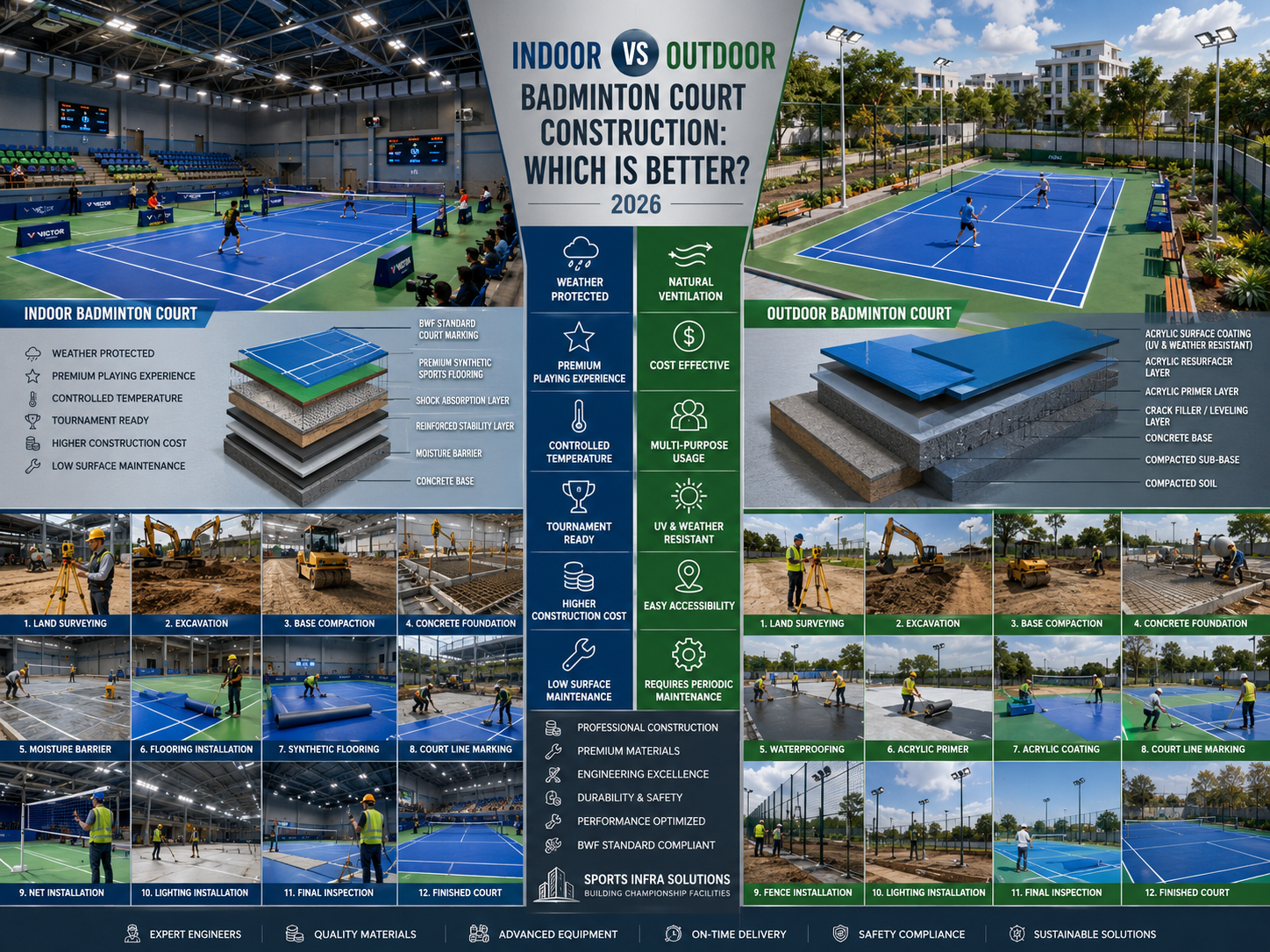
Indoor vs Outdoor Badminton Court Construction: Which Is Better?

Indoor vs Outdoor Badminton Court Construction

Introduction

Badminton has become one of the fastest-growing sports across the world, attracting players of all age groups and skill levels. From schools and universities to sports academies, fitness clubs, residential societies, community parks, and professional sports complexes, the demand for well-designed badminton courts has increased significantly over the past few years. As sports infrastructure continues to improve, organizations and investors are looking for high-quality badminton court construction solutions that deliver exceptional playing performance, durability, and long-term value.

One of the most common questions during the planning stage is whether to build an indoor badminton court or an outdoor badminton court. Both options have unique advantages, construction requirements, maintenance needs, and budget considerations. Selecting the right type of badminton court depends on several factors, including available space, climate conditions, expected usage, project budget, maintenance capabilities, and the level of competition the facility intends to support.

Indoor badminton courts are widely preferred for professional tournaments, training centers, and competitive sports because they provide controlled playing conditions throughout the year. Outdoor badminton courts, on the other hand, offer a cost-effective solution for recreational play in schools, parks, resorts, residential communities, and public sports facilities where accessibility and affordability are key priorities.

Understanding the differences between indoor and outdoor badminton court construction helps project owners make informed decisions that maximize investment returns while providing athletes with a safe and enjoyable playing environment.

This comprehensive guide explores every aspect of indoor and outdoor badminton court construction, including design considerations, flooring systems, structural requirements, installation methods, maintenance practices, cost factors, and long-term benefits. Whether you are planning a new sports complex or upgrading an existing facility, this guide will help you determine which type of badminton court best suits your requirements.


Why Professional Badminton Court Construction Matters

Constructing a badminton court involves much more than installing a playing surface. A professionally built court combines engineering precision, premium materials, accurate dimensions, and advanced flooring technology to create a facility that enhances player performance while minimizing the risk of injuries.

A professionally designed badminton court offers several important advantages:

  • Excellent shock absorption that reduces stress on players’ knees and ankles.
  • Consistent ball and shuttlecock performance for competitive gameplay.
  • Slip-resistant flooring that improves player safety.
  • Superior durability capable of withstanding intensive daily use.
  • Reduced maintenance costs through high-quality construction materials.
  • Compliance with international badminton standards.
  • Enhanced visual appeal for schools, sports clubs, and commercial facilities.
  • Long-term return on investment through extended service life.

Whether the court is built indoors or outdoors, professional planning and execution ensure that the playing surface performs reliably under varying conditions while maintaining its appearance and functionality for many years.


Understanding Indoor Badminton Court Construction

Indoor badminton courts are specially designed sports facilities enclosed within a building or dedicated sports hall. They are considered the preferred choice for professional competitions, sports academies, training centers, and multi-purpose indoor arenas because they provide a controlled environment that minimizes external disturbances.

Unlike outdoor courts, indoor facilities eliminate challenges such as wind, rain, direct sunlight, dust, and temperature fluctuations. This controlled atmosphere allows players to focus entirely on their game, making indoor courts ideal for high-level practice sessions and official tournaments.

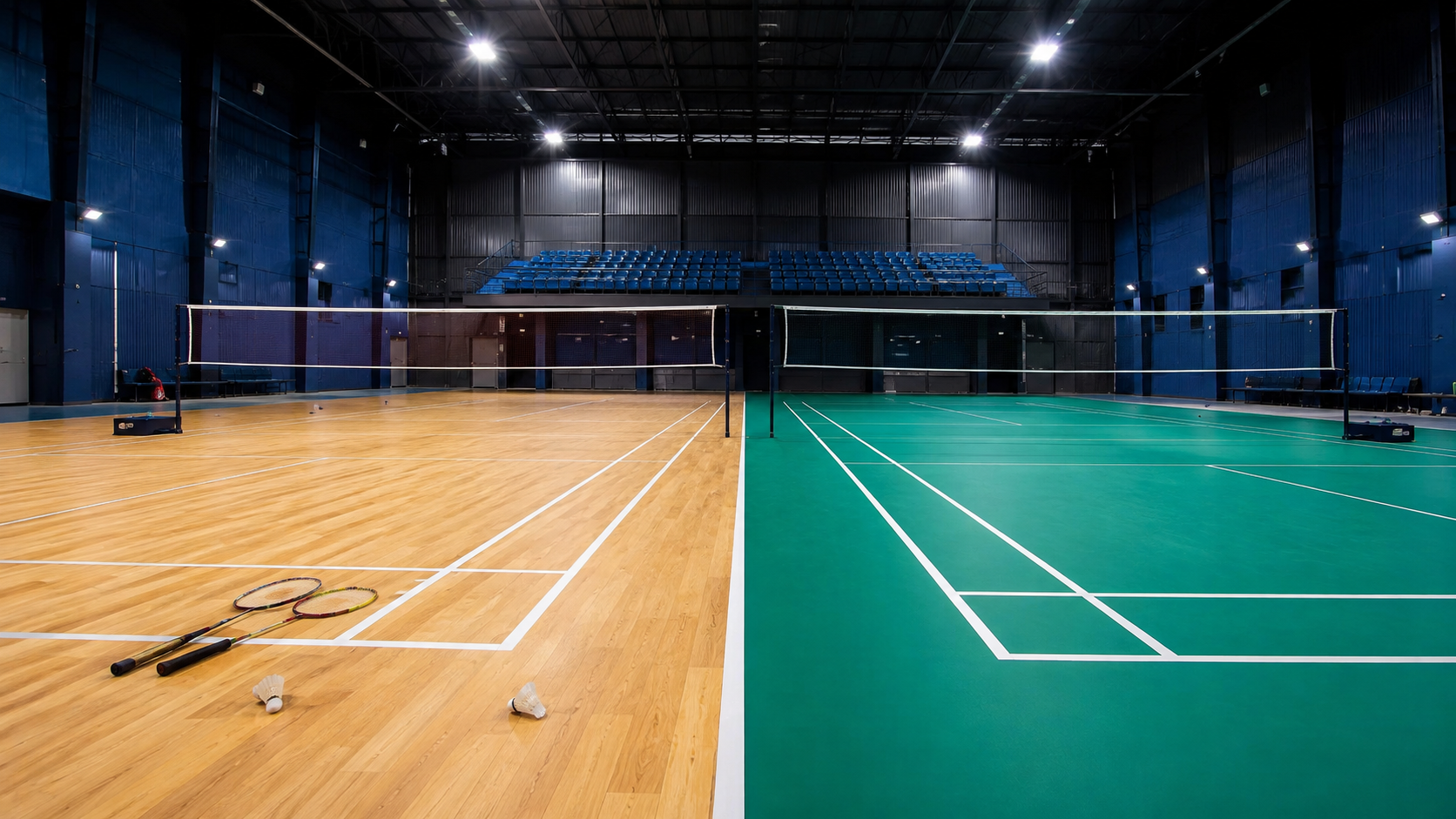
Professional indoor badminton courts typically feature advanced sports flooring systems such as PVC vinyl, polyurethane (PU), or engineered wooden flooring installed over shock-absorbing substructures. These surfaces are specifically designed to provide optimal grip, cushioning, and energy return, helping players perform at their best while reducing fatigue and the risk of injury.

In addition to the playing surface, indoor badminton court construction includes carefully planned lighting systems, ceiling heights, ventilation, acoustic treatment, and structural engineering to create a world-class sporting environment.


Key Features of Indoor Badminton Courts

Indoor badminton courts are engineered with several specialized features that enhance performance and player comfort.

Controlled Playing Environment

The enclosed structure protects players from unpredictable weather conditions, allowing games and training sessions to continue throughout the year without interruption.

Professional Sports Flooring

Indoor courts commonly use premium flooring systems that provide:

  • High shock absorption
  • Excellent slip resistance
  • Comfortable foot movement
  • Consistent shuttle response
  • Reduced player fatigue

Advanced Lighting Systems

Proper LED sports lighting eliminates shadows and glare while providing uniform illumination across the entire playing area, ensuring excellent visibility during practice and competitions.

Temperature and Ventilation Control

Modern indoor sports halls incorporate ventilation and climate control systems that maintain comfortable playing conditions regardless of external weather.

Longer Playing Hours

Because lighting and environmental conditions are controlled, indoor courts can be used from early morning until late at night, maximizing facility utilization.

Professional Tournament Standards

Indoor badminton courts can be designed to meet national and international standards, making them suitable for competitive events and official championships.


Understanding Badminton Court Construction

Outdoor badminton courts are constructed in open spaces where natural surroundings become part of the playing experience. These courts are commonly found in schools, colleges, public parks, residential societies, recreational clubs, hotels, resorts, community centers, and fitness parks.

Outdoor badminton courts are significantly more economical than indoor facilities because they do not require enclosed buildings, roofing systems, or extensive climate-control infrastructure. As a result, they are an attractive option for organizations seeking affordable sports facilities that encourage community participation and recreational activities.

To withstand exposure to sunlight, rainfall, temperature changes, and continuous use, outdoor courts are typically built using weather-resistant acrylic sports flooring applied over reinforced concrete or asphalt bases. These surfaces provide excellent durability, anti-slip performance, UV resistance, and vibrant color retention while requiring relatively low maintenance.

Proper site preparation, drainage planning, and base construction are essential components of outdoor badminton court construction. Effective water management helps prevent surface damage and extends the lifespan of the playing area.


Key Features of Outdoor Badminton Courts

Outdoor badminton courts offer several practical advantages for recreational and community sports development.

Cost-Effective Construction

Outdoor courts require fewer structural components, making them significantly less expensive to construct compared to indoor facilities.

Weather-Resistant Flooring

High-quality acrylic sports flooring systems are designed to resist:

  • UV radiation
  • Rainfall
  • Moisture
  • Temperature fluctuations
  • Surface abrasion

Multi-Purpose Usage

Outdoor badminton courts can often accommodate additional recreational activities, making them suitable for schools, community centers, and residential developments.

Faster Construction Time

Without the need for building construction, roofing, or HVAC systems, outdoor badminton courts can usually be completed in a much shorter timeframe.

Low Maintenance Requirements

Routine cleaning, occasional repainting, and periodic inspections are generally sufficient to maintain outdoor acrylic courts in excellent condition.

Greater Accessibility

Outdoor courts encourage public participation by providing open, accessible spaces for sports, fitness, and recreational activities.


Indoor or Outdoor: Which One Is Right for You?

Choosing between an indoor and outdoor badminton court depends on your project’s goals, budget, available land, expected player volume, and long-term maintenance capabilities.

If your objective is to create a professional training facility or host competitive tournaments, an indoor badminton court provides unmatched playing conditions and year-round usability. Conversely, if your focus is on community recreation, school sports, or budget-friendly infrastructure, an outdoor badminton court offers an excellent balance of affordability, durability, and accessibility.

In the next part of this guide, we will explore the complete construction process for both indoor and outdoor badminton courts, including site preparation, flooring materials, sub-base construction, lighting systems, drainage, equipment installation, and essential design considerations.
Indoor Badminton Court Construction Process

Constructing a professional indoor badminton court requires careful planning, engineering expertise, and premium-quality materials. Every stage of the project contributes to the court’s overall safety, durability, and playing performance. Unlike outdoor courts, indoor facilities demand greater attention to structural design, ventilation, lighting, and flooring installation to meet professional standards.

Below is the complete step-by-step construction process.


1. Site Planning and Facility Design

Every successful badminton court project begins with detailed planning. Engineers and architects evaluate the available space to determine the most efficient court layout while ensuring compliance with international badminton standards.

During the planning stage, professionals consider:

  • Number of badminton courts
  • Future expansion possibilities
  • Spectator seating
  • Player circulation areas
  • Emergency exits
  • Equipment storage rooms
  • Reception and waiting areas
  • Washrooms and changing rooms
  • Parking facilities
  • Accessibility for differently-abled players

Proper planning minimizes construction delays while ensuring efficient use of available land.


2. Ground Preparation and Foundation

The foundation is one of the most important elements of badminton court construction.

For indoor facilities, the ground is excavated and compacted before laying a reinforced concrete slab. Laser-guided leveling equipment is used to achieve an extremely flat surface because even minor unevenness can negatively affect flooring installation.

The foundation generally includes:

  • Soil compaction
  • Gravel filling
  • Moisture barrier installation
  • Reinforced concrete slab
  • Precision leveling
  • Surface curing

A properly prepared base prevents future settlement, cracking, and uneven flooring.


3. Structural Steel Building Construction

Unlike outdoor courts, indoor badminton courts require a fully enclosed building.

The steel structure generally consists of:

  • Steel columns
  • Roof trusses
  • Purlins
  • Wall cladding
  • Roof insulation
  • Ventilation systems
  • Rainwater drainage system

The roof height is carefully designed to allow high shuttle trajectories without obstruction.

Modern badminton halls also include insulated roofing to maintain comfortable indoor temperatures while reducing energy consumption.


4. Flooring System Installation

The flooring system has the greatest impact on player comfort and performance.

Professional indoor badminton courts commonly use:

PVC Vinyl Sports Flooring

PVC flooring is one of the most popular choices because it provides:

  • Excellent shock absorption
  • Anti-slip surface
  • Comfortable foot movement
  • Easy maintenance
  • Long service life

It is widely used in schools, academies, and indoor sports complexes.


Polyurethane (PU) Sports Flooring

PU flooring delivers:

  • Superior cushioning
  • High elasticity
  • Seamless finish
  • Excellent durability
  • Reduced joint stress

It is commonly installed in professional training centers and premium sports facilities.


Wooden Sports Flooring

Engineered maple or hardwood flooring remains the preferred choice for elite badminton tournaments.

Advantages include:

  • Natural playing feel
  • Outstanding shock absorption
  • Excellent energy return
  • Premium appearance
  • Long lifespan

Professional wooden courts usually incorporate resilient understructures that absorb impact during jumping and rapid movement.


5. Sports Lighting Installation

Lighting significantly influences playing quality.

Professional badminton lighting systems are designed to eliminate glare while providing uniform illumination throughout the court.

Modern indoor facilities use:

  • High-efficiency LED sports lights
  • Anti-glare fixtures
  • Uniform lux distribution
  • Energy-efficient controls
  • Emergency lighting systems

Proper lighting improves player visibility while reducing eye fatigue during long matches.


6. Ventilation and Climate Control

Indoor badminton facilities require proper airflow to maintain comfortable playing conditions.

Modern systems include:

  • Fresh air ventilation
  • Exhaust systems
  • Air conditioning
  • Humidity control
  • Temperature regulation

Good ventilation prevents condensation and protects sports flooring from moisture damage.


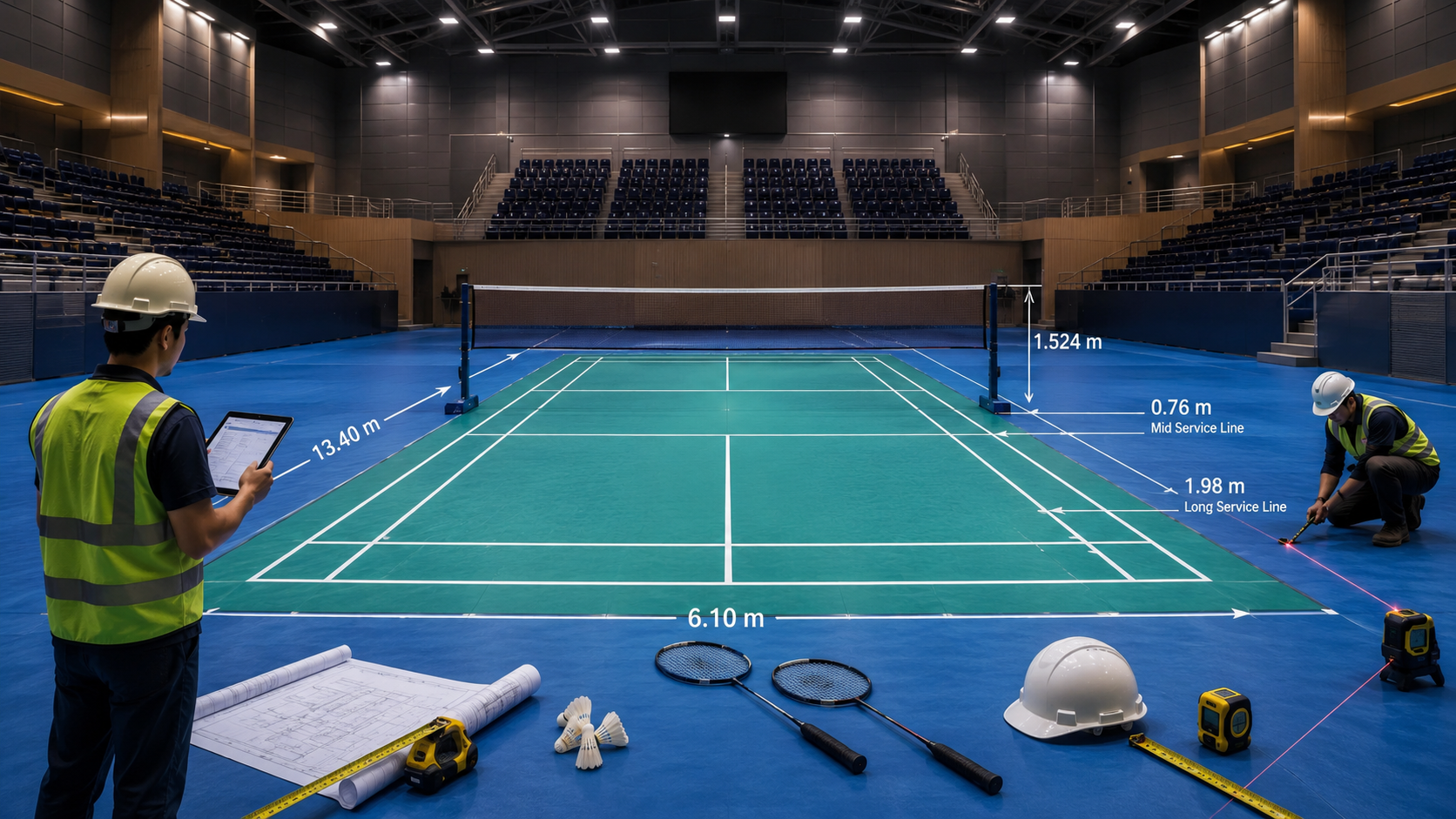
7. Court Marking

Once the flooring is installed, accurate court markings are applied.

Professional line marking involves:

  • Laser measurements
  • Standard court dimensions
  • High-visibility white lines
  • Wear-resistant paint
  • Precision alignment

Accurate markings ensure fair gameplay during competitive matches.


Badminton Court Construction Process

Outdoor badminton courts follow a different construction methodology because they must withstand changing weather conditions throughout the year.

Every stage focuses on durability, drainage, and long-term performance.


1. Site Selection

The first step is selecting a suitable location.

Professionals evaluate:

  • Soil condition
  • Available area
  • Sunlight direction
  • Wind exposure
  • Drainage availability
  • Accessibility
  • Future expansion

An ideal site minimizes water accumulation after rainfall.


2. Excavation and Earthwork

The construction area is excavated to the required depth before compacting the soil.

This stage includes:

  • Vegetation removal
  • Earth excavation
  • Soil stabilization
  • Mechanical compaction
  • Level correction

A stable base ensures long-lasting performance.


3. Granular Sub-base Construction

A compacted granular sub-base distributes structural loads evenly.

Typical layers include:

  • Crushed stone
  • Gravel
  • Aggregate
  • Compacted filling

Each layer is compacted using heavy rollers to maximize stability.


4. Concrete or Asphalt Base

The playing surface is supported by either:

Reinforced Concrete Base

Benefits include:

  • High structural strength
  • Long service life
  • Crack resistance
  • Stable surface

Asphalt Base

Advantages include:

  • Faster installation
  • Smooth finish
  • Better flexibility
  • Cost-effectiveness

The base must cure properly before flooring installation begins.


5. Acrylic Sports Flooring Installation

Acrylic flooring is the most widely used outdoor badminton court surface.

Installation typically includes:

  • Primer coat
  • Acrylic resurfacer
  • Cushion layers (optional)
  • Color coats
  • Anti-slip finish
  • UV-resistant topcoat

The result is a vibrant, weather-resistant playing surface suitable for year-round use.


6. Drainage System Installation

Drainage is critical for outdoor courts.

Professional drainage systems include:

  • Surface slopes
  • Side drains
  • Underground drainage pipes
  • Rainwater channels
  • Water outlets

Efficient drainage protects the court from water damage and extends its lifespan.


7. Net Pole Installation

Badminton poles are installed using reinforced concrete foundations.

Professional installations ensure:

  • Perfect alignment
  • Stable anchoring
  • Correct net height
  • Long-term durability

8. Court Line Marking

After the acrylic coating cures completely, court lines are painted using weather-resistant sports coatings.

Professional markings provide:

  • Excellent visibility
  • Fade resistance
  • Accurate dimensions
  • Long-lasting performance

Materials Used in Indoor /Outdoor

The quality of construction materials directly affects the lifespan, safety, and playing experience of a badminton court. Choosing premium-grade materials ensures better durability, lower maintenance costs, and consistent performance over the years.

Indoor Court Materials

Indoor badminton courts commonly use:

  • Reinforced concrete foundation
  • Structural steel framework
  • Insulated roofing panels
  • PVC vinyl sports flooring
  • Polyurethane (PU) flooring systems
  • Engineered wooden flooring
  • Moisture barrier membranes
  • Adhesives for sports flooring
  • Shock-absorbing underlay systems
  • LED sports lighting
  • Acoustic wall panels
  • Ventilation and HVAC equipment
  • Professional badminton poles and nets
  • High-performance sports-grade line marking paint

Outdoor Court Materials

Outdoor badminton courts generally require:

  • Compacted soil foundation
  • Crushed stone and granular sub-base
  • Reinforced concrete or asphalt base
  • Acrylic sports flooring system
  • Cushion acrylic layers (optional)
  • UV-resistant acrylic color coatings
  • Anti-slip surface finish
  • Weather-resistant primers
  • Outdoor badminton poles
  • Galvanized steel hardware
  • Drainage pipes and channels
  • Expansion joints
  • Waterproof sealants
  • UV-stable line marking coatings

Using certified, weather-resistant materials not only enhances the court’s appearance but also minimizes repair costs and extends the facility’s operational life.


 Comparison

Choosing between an indoor and outdoor badminton court is one of the most important decisions in any sports infrastructure project. While both court types are designed to provide a safe and enjoyable playing experience, they differ significantly in terms of construction cost, playing conditions, durability, maintenance, and long-term return on investment.

The right choice depends on your budget, available space, local climate, intended users, and the overall goals of your facility. This section compares indoor and outdoor badminton courts across all the key factors to help you make an informed decision.


Indoor /Outdoor

Feature Indoor Badminton Court Outdoor Badminton Court
Construction Cost Higher More affordable
Playing Experience Professional and consistent Suitable for recreational play
Weather Impact No effect Affected by wind, rain, and sunlight
Flooring Options PVC, PU, Wooden Flooring Acrylic Sports Flooring
Maintenance Moderate Low to moderate
Durability Very high with proper maintenance High with weather-resistant materials
Year-Round Usage Yes Weather dependent
Tournament Suitability Excellent Limited
Installation Time Longer Faster
Player Comfort Excellent Good
Return on Investment High for commercial facilities High for community projects

Playing Performance

Playing performance is often the deciding factor for sports academies, professional clubs, and tournament organizers.

Indoor Court Performance

Indoor badminton courts offer a controlled environment where external conditions do not interfere with gameplay. Players enjoy:

  • Consistent shuttle flight
  • Uniform lighting
  • Stable temperature
  • Better grip and traction
  • Reduced fatigue due to cushioned flooring
  • Higher accuracy during competitive matches

These advantages make indoor courts the preferred choice for professional coaching, national competitions, and international events.

Outdoor Court Performance

Outdoor courts are ideal for recreational use but are influenced by environmental conditions.

Factors affecting gameplay include:

  • Wind direction
  • Rainfall
  • High temperatures
  • Dust accumulation
  • Sunlight glare

Despite these challenges, modern acrylic flooring systems provide excellent traction and durability, making outdoor courts a practical solution for schools, parks, and residential communities.


Construction Cost Comparison

Budget is a critical consideration when planning a badminton court project.

Indoor Court Construction Cost

Indoor facilities involve significant investment due to the additional structural and mechanical components required.

Major cost factors include:

  • Land development
  • Structural steel building
  • Roofing and insulation
  • HVAC systems
  • LED sports lighting
  • Premium sports flooring
  • Electrical systems
  • Ventilation
  • Fire safety systems
  • Interior finishing
  • Seating and spectator areas

Although the initial investment is higher, indoor courts generally offer greater revenue potential through memberships, coaching programs, tournaments, and year-round bookings.

Outdoor Court Construction Cost

Outdoor courts require fewer structural elements, resulting in a lower overall project cost.

Typical expenses include:

  • Site preparation
  • Earthwork
  • Concrete or asphalt base
  • Acrylic sports flooring
  • Net posts
  • Court markings
  • Drainage systems
  • Perimeter fencing (if required)

For schools, housing societies, public parks, and community sports centers, outdoor badminton courts provide an economical way to promote sports participation.


Maintenance Requirements

Proper maintenance extends the lifespan of any badminton court while ensuring player safety and consistent performance.

Indoor Court Maintenance

Indoor courts require regular maintenance to preserve the flooring and indoor environment.

Routine tasks include:

  • Daily cleaning of dust and debris
  • Periodic inspection of flooring joints
  • Cleaning ventilation systems
  • LED lighting maintenance
  • Humidity monitoring
  • Net and pole inspection
  • Surface polishing (for wooden courts)
  • Replacement of worn sports flooring when necessary

Since indoor courts are protected from weather, the playing surface generally experiences slower wear.

Outdoor Court Maintenance

Outdoor courts are exposed to environmental conditions throughout the year.

Maintenance typically involves:

  • Sweeping leaves and dirt
  • Pressure washing the surface
  • Removing algae or moss
  • Repairing minor cracks
  • Repainting faded court lines
  • Inspecting drainage systems
  • Cleaning rainwater channels
  • Recoating acrylic surfaces when needed

Regular upkeep helps maintain surface grip and prevents premature deterioration.


Durability and Lifespan

The durability of a badminton court depends on construction quality, materials used, and ongoing maintenance.

Indoor Courts

Indoor courts are protected from rain, UV rays, and temperature fluctuations, which significantly increases the lifespan of the flooring and structural components.

With proper care:

  • PVC flooring can last for many years.
  • PU flooring retains its performance over long periods.
  • Wooden sports floors can serve for decades with periodic refinishing.
  • Steel structures remain durable with proper corrosion protection.

Outdoor Courts

Outdoor courts are designed to withstand changing weather conditions.

High-quality acrylic systems provide:

  • UV resistance
  • Water resistance
  • Fade resistance
  • Abrasion resistance
  • Crack resistance when installed on a stable base

Periodic resurfacing helps maintain performance and appearance over the long term.


Safety and Player Comfort

A safe playing environment is essential for reducing injuries and improving player confidence.

Indoor Courts

Indoor sports flooring systems are specifically engineered to absorb impact during running, jumping, and rapid directional changes.

Benefits include:

  • Lower stress on joints
  • Better shock absorption
  • Reduced muscle fatigue
  • Excellent traction
  • Enhanced balance
  • Comfortable playing experience

These features are especially important for competitive athletes and frequent training sessions.

Outdoor Courts

Modern acrylic sports flooring also provides reliable safety features.

Advantages include:

  • Slip-resistant textured surfaces
  • Stable footing in dry conditions
  • Durable surface finish
  • Comfortable recreational play

However, outdoor courts should not be used when wet, as moisture can reduce traction.


Weather Resistance

Weather conditions play a major role in determining the suitability of a badminton court.

Indoor Courts

Indoor facilities are unaffected by:

  • Rain
  • Strong winds
  • Direct sunlight
  • Dust storms
  • Extreme temperatures

This allows uninterrupted training and competitions throughout the year.

Outdoor Courts

Outdoor courts are built using weather-resistant materials, but gameplay may be interrupted during adverse weather.

Challenges include:

  • Rainwater accumulation
  • Wind affecting shuttle movement
  • Surface heating during summer
  • Leaf and dust accumulation

Proper drainage, regular cleaning, and UV-resistant coatings help minimize these effects.


ROI

A badminton court is not only a sports facility but also a long-term investment.

Indoor Court ROI

Indoor badminton courts can generate revenue through:

  • Coaching academies
  • Hourly court rentals
  • Membership programs
  • Professional tournaments
  • Corporate sports events
  • Fitness and recreational programs

Because they can operate throughout the year, indoor facilities often achieve higher occupancy rates and greater earning potential.

Outdoor Court ROI

Outdoor courts offer excellent value by:

  • Encouraging community sports participation
  • Enhancing school and campus infrastructure
  • Increasing the appeal of residential projects
  • Supporting public fitness initiatives
  • Requiring lower initial investment

While revenue opportunities may be more limited than indoor facilities, the lower construction cost often results in an attractive long-term return for educational institutions and community developments.


Which Option Is Best

The ideal badminton court depends on the specific needs of the organization.

Indoor Courts Are Best For

  • Professional badminton academies
  • National and international sports complexes
  • Indoor stadiums
  • Universities
  • Multi-sport training centers
  • Commercial sports clubs
  • Tournament venues
  • High-performance coaching facilities

Outdoor Courts Are Best For

  • Government schools
  • Private schools
  • Public parks
  • Residential societies
  • Hotels and resorts
  • Community recreation centers
  • Corporate campuses
  • Recreational sports facilities

Selecting the right option ensures that the court aligns with user expectations, budget, and long-term operational goals

Expert Tips for Successful Badminton Court Construction

Building a badminton court is a long-term investment that requires careful planning, quality materials, and professional execution. Whether you’re developing a single court for a school or a multi-court sports complex, following industry best practices will improve the court’s durability, safety, and overall playing experience.

1. Define the Purpose Before Construction

Before selecting an indoor or outdoor court, identify how the facility will be used.

For example:

  • Professional tournaments
  • Sports academies
  • School physical education
  • Residential societies
  • Community recreation
  • Commercial sports clubs
  • Corporate wellness programs

The intended use will influence the flooring system, lighting, drainage, and structural requirements.


2. Invest in High-Quality Sports Flooring

The flooring system directly affects player comfort and safety.

Choose premium-quality sports flooring that provides:

  • Shock absorption
  • Slip resistance
  • UV resistance (for outdoor courts)
  • High durability
  • Easy maintenance
  • Long service life

Avoid low-cost flooring materials that deteriorate quickly and increase maintenance expenses.


3. Ensure Proper Base Construction

Even the highest-quality flooring cannot perform well if installed on a weak foundation.

A professionally constructed base should provide:

  • Excellent load-bearing capacity
  • Accurate leveling
  • Proper compaction
  • Moisture protection
  • Long-term structural stability

A stable foundation significantly extends the life of the court.


4. Install an Efficient Drainage System

For outdoor badminton courts, drainage is essential.

Proper drainage helps prevent:

  • Waterlogging
  • Surface cracks
  • Acrylic coating damage
  • Algae growth
  • Premature flooring failure

A slight surface slope combined with well-designed drainage channels ensures quick water runoff after rainfall.


5. Use Professional Sports Lighting

Lighting plays a vital role in player performance.

Modern LED sports lighting provides:

  • Uniform brightness
  • Reduced glare
  • Energy efficiency
  • Longer operating life
  • Better visibility

Professional lighting improves the playing experience for both athletes and spectators.


6. Follow Standard Court Dimensions

Accurate court dimensions are essential for fair play and future tournament eligibility.

Professional surveying equipment and laser measurements ensure precise court markings and proper equipment placement.


7. Hire Experienced Sports Flooring Contractors

Professional contractors understand:

  • Surface preparation
  • Material compatibility
  • Installation techniques
  • Industry standards
  • Quality control procedures

Experienced installation teams reduce construction errors and improve the overall lifespan of the court.


Common Mistakes to Avoid

Many badminton court projects encounter avoidable problems due to poor planning or the use of inferior materials.

Avoid these common mistakes:

Poor Site Selection

Selecting a location with weak soil, poor drainage, or insufficient space can lead to structural problems and higher maintenance costs.


Inadequate Foundation Preparation

Skipping proper soil compaction or concrete curing often results in:

  • Surface settlement
  • Cracking
  • Uneven flooring
  • Water accumulation

Choosing Low-Quality Flooring

Cheap sports flooring may initially reduce costs but often leads to:

  • Faster wear
  • Reduced grip
  • Higher injury risk
  • Frequent repairs
  • Shorter service life

Ignoring Drainage

Water is one of the biggest threats to outdoor sports flooring.

Poor drainage can cause:

  • Surface damage
  • Acrylic peeling
  • Structural deterioration
  • Moss and algae growth

Incorrect Lighting Design

Improper lighting creates:

  • Player discomfort
  • Shadows
  • Poor visibility
  • Reduced match quality

Professional sports lighting should provide even illumination across the entire court.


Improper Court Markings

Incorrect line markings can affect gameplay and make the facility unsuitable for official competitions.

Always use accurate measurements and sports-grade line-marking materials.


Delaying Maintenance

Neglecting routine inspections can shorten the life of the court.

Regular cleaning and timely repairs help preserve both performance and appearance.


 (FAQs)

1. Which is better: an indoor or outdoor badminton court?

Indoor badminton courts are ideal for professional training and tournaments because they offer consistent playing conditions throughout the year. Outdoor badminton courts are more affordable and well suited for schools, parks, residential communities, and recreational use.


2. Which flooring is best for an indoor badminton court?

Popular indoor flooring options include:

  • PVC vinyl sports flooring
  • Polyurethane (PU) sports flooring
  • Engineered wooden sports flooring

The best choice depends on the budget, expected usage, and performance requirements.


3. What is the best surface for an outdoor badminton court?

Acrylic sports flooring is the preferred option for outdoor badminton courts because it offers:

  • UV resistance
  • Anti-slip performance
  • Weather resistance
  • Easy maintenance
  • Long-lasting durability

4. How long does badminton court construction take?

The construction timeline depends on project size and complexity.

Generally:

  • Outdoor badminton courts can be completed within a few weeks under favorable site conditions.
  • Indoor badminton courts typically require a longer schedule because of structural work, roofing, utilities, and interior finishing.

5. How often should a badminton court be maintained?

Routine cleaning should be performed regularly, with periodic inspections of the flooring, court markings, lighting, drainage, and equipment. Preventive maintenance helps extend the court’s lifespan and maintain player safety.


6. Can outdoor badminton courts be converted into indoor courts later?

Yes. If the site has sufficient space and structural feasibility, an outdoor court can later be enclosed with a steel building and upgraded with lighting, ventilation, and other indoor facility components.


7. Which badminton court offers a better long-term return on investment?

Indoor courts generally provide higher revenue potential through coaching, memberships, and year-round rentals. Outdoor courts deliver excellent value for schools, parks, and community projects due to their lower construction and operating costs.


Conclusion

Indoor and outdoor badminton courts each offer unique advantages, and the right choice depends on the goals of your project. Indoor badminton courts provide a controlled environment, premium playing conditions, and year-round usability, making them the preferred option for professional tournaments, sports academies, commercial clubs, and high-performance training centers. Although they require a larger initial investment, they can generate consistent revenue through memberships, coaching programs, and court bookings.

Outdoor badminton courts, on the other hand, are a practical and cost-effective solution for schools, residential societies, parks, universities, and community recreation facilities. Modern acrylic sports flooring systems deliver excellent durability, weather resistance, and low maintenance, making them well suited for recreational sports and public use.

Regardless of the option you choose, the success of any badminton court depends on professional planning, a well-engineered foundation, premium-quality sports flooring, accurate court markings, efficient drainage, and regular maintenance. Investing in experienced sports flooring contractors and high-grade materials ensures a safe, attractive, and long-lasting facility that serves players for many years.

Whether your objective is to build a world-class indoor badminton arena or a durable outdoor community court, careful design and quality construction will maximize player satisfaction, enhance safety, and provide excellent long-term value.

Awesome
Be the first to write a review

Leave a Reply

We’re sorry you’ve had a bad experience. Before you post your review, feel free to contact us, so we can help resolve your issue.

Post Review

Your email address will not be published. Required fields are marked *