Introduction
Pickleball has quickly become one of the most popular recreational and competitive paddle sports, attracting players across residential communities, sports clubs, schools, colleges, fitness centres, hotels, resorts, and professional sports facilities. As participation continues to grow, the demand for professionally designed and properly engineered pickleball court construction is increasing across India.
Building a pickleball court may appear straightforward because the playing area is relatively compact. However, a professional-quality court requires much more than installing a net and painting court lines. Site selection, ground preparation, drainage, base construction, surface selection, accurate dimensions, fencing, lighting, and finishing all influence the safety, playing experience, durability, and maintenance requirements of the finished court.
This complete guide explains the important aspects of pickleball court construction, from initial planning and site evaluation to flooring installation, court marking, lighting, fencing, and maintenance.
What Is Pickleball Court Construction?
Pickleball court construction is the complete process of designing and developing a dedicated playing facility according to accepted court dimensions, surface-performance requirements, safety considerations, and site conditions.
A professional construction project normally includes:
- Site inspection and measurement
- Soil and ground-condition assessment
- Court layout planning
- Excavation and levelling
- Sub-base preparation
- Concrete or asphalt base construction
- Drainage development
- Acrylic or other sports flooring installation
- Court line marking
- Net and post installation
- Perimeter fencing
- Sports lighting
- Gates and safety accessories
- Final quality inspection
The objective is to create a smooth, level, durable, slip-resistant and well-drained playing environment that can withstand regular recreational or commercial use.
Standard Pickleball Court Dimensions
One of the most important parts of pickleball court construction is getting the dimensions and markings correct.
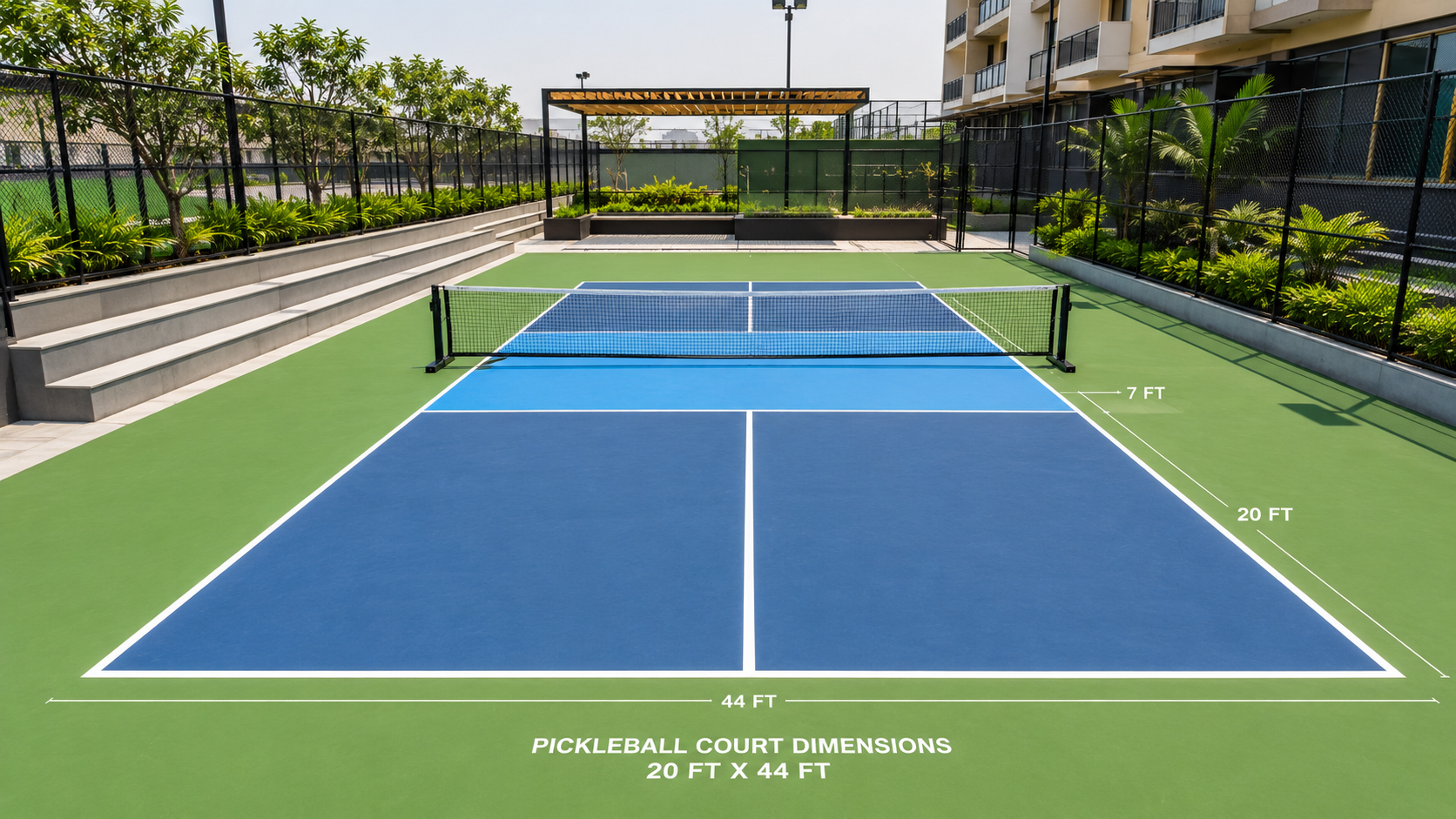
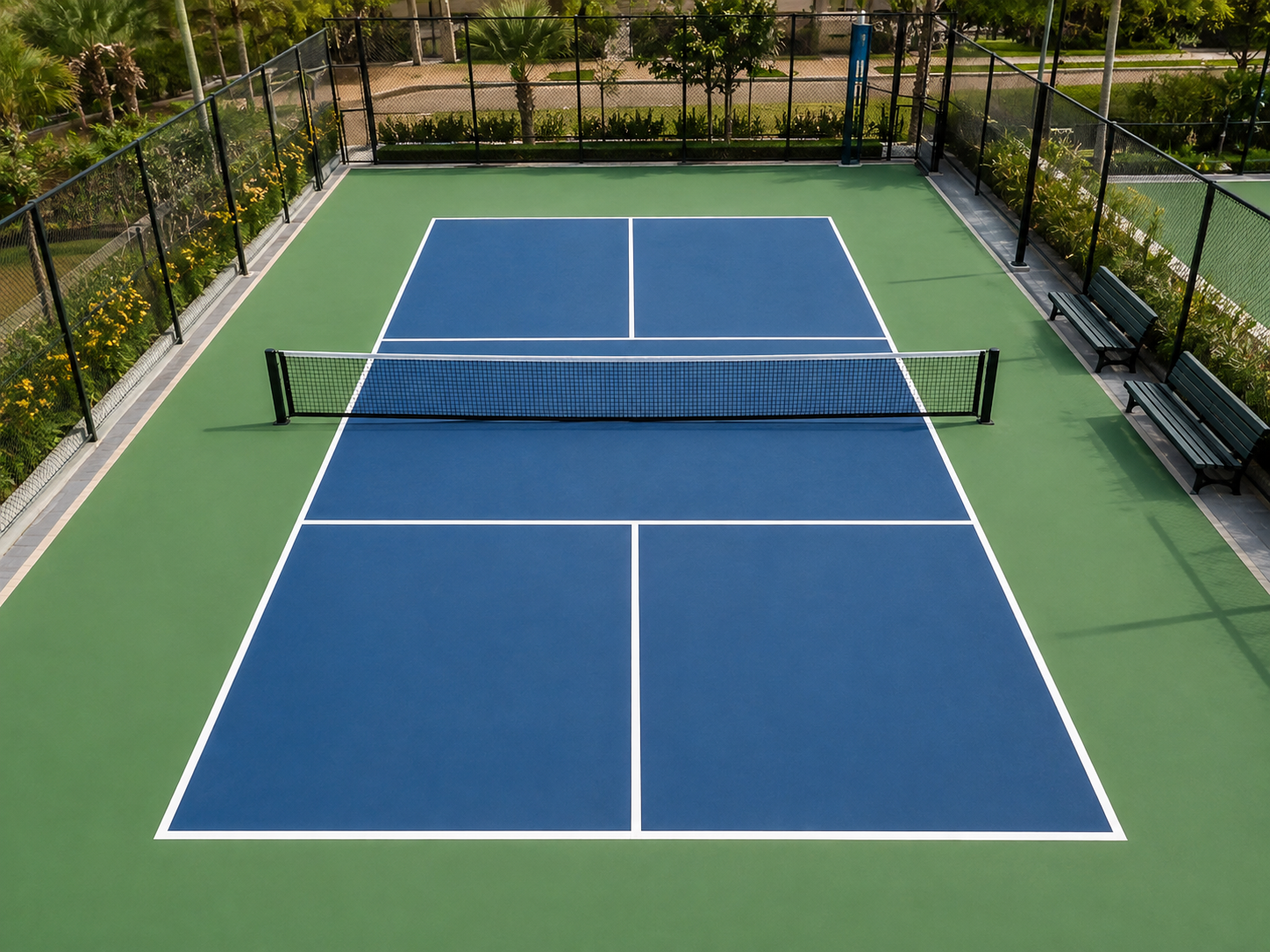
According to the 2025 USA Pickleball Official Rulebook, the standard pickleball playing court measures 20 feet wide by 44 feet long, or approximately 6.10 metres by 13.41 metres. These dimensions apply to both singles and doubles play. The official rulebook also specifies 2-inch-wide court lines.
However, the playing lines are not the same as the total construction footprint.
For comfortable movement and player safety, additional run-off space should be provided around the court. A commonly used minimum playing-surface area is approximately 30 feet × 60 feet, while larger spaces can provide greater comfort for competitive play.
Key Pickleball Court Measurements
| Court Feature | Standard Measurement |
|---|---|
| Court length | 44 feet / 13.41 m |
| Court width | 20 feet / 6.10 m |
| Non-volley zone | 7 feet from each side of the net |
| Net height at centre | 34 inches |
| Net height at posts | 36 inches |
| Minimum recommended playing area | Approximately 30 × 60 feet |
| Court line width | 2 inches |
Accurate measurement is essential because even small layout errors can affect gameplay and create an unprofessional appearance.
Choosing the Right Location for a Pickleball Court
The first practical decision is selecting an appropriate location.
A good site should have sufficient space for the court, safety run-off areas, access pathways, fencing, drainage and, where required, spectator or seating areas.
Before construction begins, the site should be checked for:
- Soil stability
- Existing slopes
- Water accumulation
- Underground utilities
- Existing concrete or asphalt
- Tree roots
- Nearby structures
- Overhead obstructions
- Vehicle and pedestrian access
- Electrical availability
- Drainage outlets
A site that appears level from the surface may still have underlying drainage or soil problems. Professional site evaluation can therefore prevent expensive repairs later.
Site Survey and Planning
Every professional pickleball court project should begin with a detailed site survey.
The contractor should measure the available land and determine how the court can be positioned most efficiently. The survey should also identify existing levels and establish the proposed finished floor level.
For outdoor facilities, orientation should be considered carefully because players should not regularly face direct sunlight during normal playing periods.
A detailed plan can include:
- Court orientation
- Court dimensions
- Safety zones
- Entry gates
- Fencing layout
- Drainage channels
- Lighting positions
- Electrical routes
- Spectator areas
- Seating
- Landscaping
- Future expansion possibilities
Planning multiple courts at the beginning can also be more economical than adding courts later because shared infrastructure can reduce construction duplication.
Ground Preparation and Excavation
Once the layout has been approved, the construction area is prepared.
Loose soil, vegetation, debris and unsuitable material are removed. The ground is then excavated to the required depth and graded according to the engineering design.
Proper compaction is particularly important. If the underlying soil settles unevenly after construction, cracks, depressions and surface failures can develop.
The preparation process may include:
- Clearing the site
- Excavating unsuitable soil
- Levelling the formation
- Moisture conditioning where necessary
- Mechanical compaction
- Installing the sub-base
- Checking levels and slopes
The exact construction method should be determined according to soil conditions, existing ground levels and the selected base system.
Constructing the Court Base
The playing surface is only as good as the base beneath it.
A professional pickleball court can be constructed over an appropriately engineered concrete or asphalt base. In many Indian projects, reinforced concrete is selected because it provides a rigid and stable foundation when correctly designed and installed.
The base construction process generally involves:
- Compacted subgrade
- Granular sub-base
- Formwork
- Reinforcement where specified
- Concrete placement
- Levelling
- Finishing
- Curing
- Surface preparation
The finished base should be smooth and sufficiently uniform for the selected sports surface system.
Cracks, uneven areas and poor drainage should be addressed before acrylic or other sports flooring is applied.
Drainage Design for Outdoor Pickleball Courts
Drainage is one of the most frequently underestimated elements of outdoor sports court construction.
Rainwater should leave the court quickly without creating puddles or damaging the foundation. A suitable surface gradient and perimeter drainage system can help move water away from the playing area.
Depending on the site, drainage may include:
- Surface slope
- Perimeter drains
- Linear channels
- Catch pits
- Stormwater connections
- Properly designed discharge points
Water should not be allowed to remain on the playing surface for extended periods. Persistent moisture can contribute to staining, algae growth, surface deterioration and damage to the underlying structure.
Choosing the Best Pickleball Court Flooring
The playing surface has a major influence on player comfort, ball response, traction and long-term performance.
Acrylic Sports Flooring
Acrylic flooring is one of the most commonly selected solutions for outdoor pickleball courts.
A properly installed acrylic system can provide:
- Consistent playing characteristics
- Good traction
- UV resistance
- Weather resistance
- Attractive colour options
- Easy cleaning
- Relatively low maintenance
- Professional appearance
Modern acrylic sports surfaces are normally installed as a multi-layer system rather than simply applying ordinary paint over concrete.
A typical system can include a primer, resurfacer, cushion layers where required, colour coats and line marking.
Cushioned Acrylic Flooring
For facilities where player comfort is a priority, a cushioned acrylic system can be considered.
The additional resilient layers help reduce the hardness of the playing surface and can provide a more comfortable playing experience during extended sessions.
Cushioned systems are particularly attractive for:
- Sports clubs
- Academies
- Premium residential communities
- Commercial pickleball facilities
- Training centres
Modular Sports Tiles
Interlocking polypropylene sports tiles are another option, particularly for certain indoor facilities, recreational spaces and existing hard surfaces.
Their advantages can include relatively fast installation, replaceability and modular construction.
However, the playing characteristics differ from acrylic surfaces, so the choice should be based on the intended level of play, site conditions and maintenance requirements.
Concrete Surface
Bare concrete may provide a strong structural base, but it is generally not the preferred finished playing surface for a professional pickleball facility.
A dedicated sports surface can provide improved traction, appearance and playing characteristics compared with an untreated concrete surface.
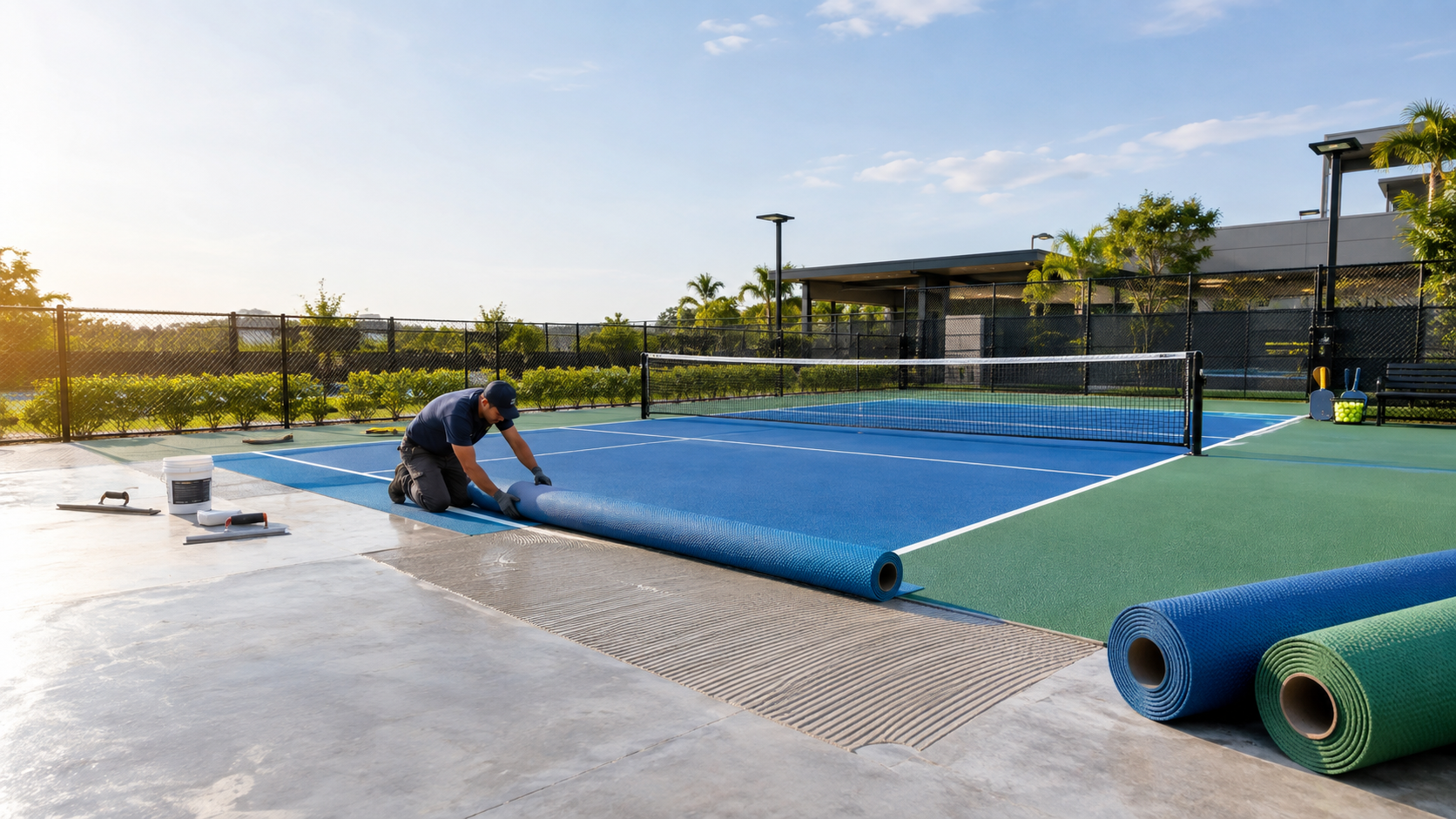
Acrylic Surface Installation Process
A professional acrylic sports flooring system requires careful preparation and application.
A typical installation sequence includes:
- Cleaning and preparing the base
- Repairing minor surface imperfections
- Applying primer where specified
- Applying resurfacer
- Installing cushion layers if required
- Applying acrylic colour coats
- Allowing appropriate curing between coats
- Applying accurate court markings
- Inspecting the completed surface
The exact number of layers depends on the product system and performance specification.
Outdoor courts should use a suitable UV-stabilised sports coating designed for the expected climatic conditions. Material quality and correct application are just as important as the product itself.
Pickleball Court Line Marking
Court markings must be accurate, straight and clearly visible.
According to USA Pickleball specifications, court lines should be 2 inches wide and clearly contrast with the playing surface.
The line-marking process should be performed only after the underlying surface has been properly completed and cured.
Professional contractors use accurate measurements and marking equipment to ensure:
- Straight sidelines
- Correct baselines
- Accurate non-volley zone
- Correct centreline
- Consistent line width
- Strong colour contrast
Poorly measured markings can affect both recreational and competitive gameplay.
Pickleball Net and Posts
The net is a central component of the court and should be installed at the correct height.
A professional installation normally includes durable posts, appropriate anchoring and a regulation-style net system.
Posts should be securely fixed so that the net remains stable during regular use. Portable net systems can also be considered for temporary or multipurpose facilities.
The net should be properly tensioned without creating excessive stress on the supporting structure.
Perimeter Fencing and Safety
Fencing helps contain balls and separates the playing area from surrounding spaces.
A typical outdoor pickleball facility may use chain-link, welded mesh or other suitable sports fencing.
Fencing considerations include:
- Appropriate height
- Strong posts
- Secure foundations
- Proper gate access
- Smooth finishes
- Protection against sharp edges
- Adequate ball containment
The exact fencing design should be adapted to the surrounding property and intended usage.
For residential communities and commercial facilities, controlled entry gates can also improve safety and access management.
LED Sports Lighting
Lighting allows players to use the court during evening hours and can significantly increase the utilisation of the facility.
A professional LED lighting system should provide even illumination while minimising glare and dark areas.
Lighting design should consider:
- Pole positions
- Mounting height
- LED output
- Beam angle
- Glare control
- Electrical safety
- Cabling
- Maintenance access
Poorly positioned lights can create uncomfortable glare and shadows, affecting visibility during fast rallies.
For commercial or tournament facilities, lighting should be designed according to the expected playing standard rather than simply installing the maximum available wattage.
Indoor Pickleball Court Construction
Indoor pickleball facilities offer protection from rain, extreme heat and other outdoor weather conditions.
When developing an indoor facility, the construction plan should consider:
- Available floor area
- Ceiling height
- Ventilation
- Lighting
- Indoor sports flooring
- Temperature control
- Acoustic treatment
- Player circulation
- Emergency exits
- Spectator areas
An existing warehouse, sports hall or multipurpose building can sometimes be converted into a pickleball facility if the floor, ceiling clearance and structural conditions are suitable.
Indoor construction costs can be substantially higher when a new building, roofing system, HVAC installation or major structural modifications are required. Current Indian market estimates vary significantly depending on whether an existing building is being adapted or a complete facility is being constructed.
Outdoor Pickleball Court Construction
Outdoor courts are generally simpler than fully enclosed facilities but must be designed for weather exposure.
Important considerations include:
- UV-resistant flooring
- Rainwater drainage
- Surface slope
- Waterproofing where appropriate
- Durable fencing
- Weather-resistant equipment
- LED lighting
- Expansion and movement considerations
- Regular surface maintenance
India’s combination of strong sunlight, seasonal monsoon conditions and temperature fluctuations makes correct material selection particularly important.
How Much Does Pickleball Court Construction Cost in India?
The total pickleball court construction cost in India depends on the location, ground condition, base type, flooring system, fencing, lighting and other project requirements.
Current 2026 market guides place standard outdoor court projects broadly in the range of approximately ₹4.5 lakh to ₹9 lakh, while premium installations with enhanced flooring, fencing and lighting can reach ₹8 lakh to ₹12 lakh or more. These figures are indicative rather than fixed prices because actual construction costs vary significantly by site and specification.
Major Cost Factors
The overall budget can include:
- Site survey
- Excavation and levelling
- Sub-base
- Concrete or asphalt foundation
- Acrylic sports flooring
- Court markings
- Net and posts
- Drainage
- Fencing
- Gates
- LED lighting
- Electrical work
- Labour
- Transportation
- Taxes
- Site-specific civil work
One important point when comparing contractor quotations is to check whether the quoted price covers the complete construction footprint or only the 20 × 44 ft playing area. Some estimates exclude run-off space, fencing, drainage and lighting, which can make an apparently inexpensive quotation misleading.
The most reliable approach is to request a detailed BOQ covering every component of the project.
Factors That Affect Pickleball Court Construction Cost
Several variables can change the final project price.
1. Site Condition
A flat, prepared site requires less civil work than an uneven or poorly drained property.
2. Base Construction
The cost varies depending on whether the project uses a new concrete base, asphalt base or an existing suitable slab.
3. Flooring System
Standard acrylic flooring generally costs less than premium cushioned acrylic systems.
4. Number of Courts
Building several courts together can improve project efficiency because certain infrastructure elements can be shared.
5. Fencing
Fencing height, material, coating, gates and structural requirements affect the budget.
6. Lighting
Lighting can create a significant difference between a basic daytime court and a fully equipped evening-play facility.
7. Location
Labour, transportation and material costs vary between cities and regions.
8. Existing Infrastructure
An existing sports slab or suitable building can reduce civil construction costs, provided it passes technical inspection.
Professional Pickleball Court Construction Process
A reliable construction company should follow a structured workflow.
Consultation
The project begins with understanding the client’s requirements, available space, budget and intended use.
Site Inspection
The construction team evaluates soil, levels, drainage, access and existing infrastructure.
Design and Layout
The court dimensions, run-off areas, orientation, fencing and equipment positions are finalised.
BOQ and Cost Estimation
A detailed bill of quantities is prepared so that the client can understand the scope and cost.
Ground Preparation
Excavation, grading, compaction and sub-base work are completed.
Base Construction
The concrete or asphalt foundation is installed and allowed to achieve the required condition before surface application.
Drainage Installation
Drainage channels and water-discharge arrangements are completed.
Sports Flooring
The selected acrylic, cushioned acrylic or modular sports flooring system is installed.
Court Marking
Accurate lines are measured and applied.
Equipment Installation
Net posts, net, fencing, gates and other accessories are installed.
Lighting
LED sports lighting and electrical systems are installed where required.
Quality Inspection
The completed facility is inspected for dimensions, surface quality, drainage, equipment stability and finishing.
Handover
The client receives the completed court along with recommendations for cleaning and ongoing maintenance.
Common Mistakes to Avoid During Pickleball Court Construction
Building Only the Playing Area
A 20 × 44 ft court does not mean that the entire project can be restricted to those dimensions. Players need additional movement and safety space.
Ignoring Drainage
Water accumulation can damage both the playing surface and underlying structure.
Choosing Flooring Based Only on Price
The cheapest surface is not necessarily the most economical over its complete lifecycle.
Applying Acrylic on a Poor Base
Sports coating cannot compensate for major structural defects beneath the surface.
Using Ordinary Paint for Court Lines
Professional sports line-marking materials provide better visibility and durability.
Poor Lighting Position
Incorrect light placement can create glare and shadows.
Skipping Site Testing
Unstable soil and poor compaction can cause expensive structural problems after construction.
Accepting an Incomplete Quotation
Always verify whether the quoted amount includes civil work, drainage, fencing, net, lighting, taxes and finishing.
Pickleball Court Maintenance
Regular maintenance helps preserve playing quality and extend the life of the court.
Routine maintenance may include:
- Sweeping and cleaning
- Removing leaves and debris
- Checking drainage
- Inspecting cracks
- Monitoring surface wear
- Checking fencing
- Tightening net components
- Inspecting lighting
- Repairing damaged areas promptly
The court should be kept free from standing water, mud, oil and other contaminants.
Cleaning schedules depend on the location and usage level. A busy commercial facility generally requires more frequent inspection than a private residential court.
Pickleball Court Applications
Professional pickleball courts can be developed for a wide range of facilities.
Residential Communities
Pickleball courts can add recreational value to gated communities, apartment complexes and housing societies.
Schools and Colleges
Educational institutions can use courts for physical education, recreational activities and sports programmes.
Sports Academies
Dedicated courts provide controlled environments for coaching and player development.
Fitness Clubs
Fitness centres can add pickleball as an additional recreational and social activity.
Hotels and Resorts
Resorts can use pickleball facilities as an outdoor guest amenity.
Corporate Campuses
Companies can incorporate pickleball into employee wellness and recreational programmes.
Commercial Sports Clubs
Multi-court facilities can support memberships, coaching, leagues and tournaments.
Why Professional Pickleball Court Construction Matters
A professionally constructed court provides benefits that go beyond appearance.
A properly engineered facility can deliver:
- Better player safety
- Consistent ball response
- Reliable traction
- Improved drainage
- Better surface durability
- Reduced maintenance
- Professional appearance
- Longer service life
- Better user experience
- Greater facility value
Construction quality is particularly important because resurfacing a defective court does not always solve problems originating in the foundation.
How to Choose a Pickleball Court Construction Company
Before selecting a contractor, ask for details about previous projects and construction specifications.
Important questions include:
- Do you provide complete turnkey construction?
- What base system do you recommend for my site?
- Which sports flooring system will be used?
- Is the acrylic system UV-resistant?
- What drainage design is included?
- What is the total construction footprint?
- Is fencing included?
- Is lighting included?
- What type of net and posts will be installed?
- What warranty is provided?
- What maintenance services are available?
- Can you provide a detailed BOQ?
- What is the expected project schedule?
A professional contractor should be able to explain the complete construction process rather than offering only a price per square foot.
Frequently Asked Questions
What is the standard size of a pickleball court?
The standard playing court is 20 feet × 44 feet for both singles and doubles. Additional space should be provided around the court for player movement and safety.
What is the best flooring for an outdoor pickleball court?
A properly engineered acrylic sports flooring system is a popular choice for outdoor courts because it can provide good traction, consistent playing characteristics and weather resistance.
How much space is required to build one pickleball court?
Although the playing lines occupy 20 × 44 feet, a larger overall footprint is required. A minimum playing-surface area of approximately 30 × 60 feet is commonly referenced, with larger areas offering greater player comfort.
How much does a pickleball court cost in India?
A standard outdoor court can broadly fall within the ₹4.5 lakh–₹9 lakh range in current market estimates, while premium specifications can cost considerably more. The final price depends on site conditions, civil work, flooring, fencing, drainage and lighting.
Can an existing concrete surface be converted into a pickleball court?
Yes, provided the existing slab is structurally sound, sufficiently level, properly drained and suitable for the selected sports surface system. A technical inspection should be completed before installation.
Is fencing necessary?
Fencing is not always mandatory for a private court, but it is highly useful for outdoor facilities because it helps contain balls and separates the playing area from surrounding spaces.
Can pickleball courts be built indoors?
Yes. Indoor courts can be developed in sports halls, warehouses and other suitable structures, provided there is adequate floor area, ceiling clearance, lighting and ventilation.
How long does pickleball court construction take?
The timeline depends on site preparation, weather, base construction, curing requirements, flooring system and the scope of additional infrastructure. A contractor should provide a project-specific schedule after inspecting the site.
Conclusion
Professional pickleball court construction requires careful planning from the foundation upward. Court dimensions are only one part of the project. The quality of the sub-base, concrete or asphalt foundation, drainage, acrylic sports flooring, court markings, fencing, lighting and equipment all contribute to the finished facility.
For an outdoor court in India, particular attention should be given to drainage, UV-resistant surface materials, foundation stability and protection against seasonal weather conditions. A properly designed court can provide a safe, attractive and durable playing environment for residential, educational, commercial and professional use.
Whether you are planning a single pickleball court, a residential community facility, a sports academy, a school court or a multi-court commercial pickleball centre, professional design and construction can help ensure that the investment delivers reliable performance for years to come.
If you are planning a new pickleball facility, begin with a site assessment and a detailed BOQ rather than choosing a contractor solely on the lowest quoted price. The right foundation, surface and drainage system can make a substantial difference to the court’s long-term performance, maintenance cost and player experience.