Introduction
Futsal is one of the fastest-growing indoor and outdoor football formats in India. Its compact playing area, quick gameplay, low space requirement, and strong demand from schools, sports academies, clubs, gyms, residential communities, and commercial sports facilities have made futsal court construction an attractive investment.
However, building a professional futsal court is not simply a matter of installing artificial turf or painting lines on a concrete surface. A quality facility requires proper site planning, drainage, base preparation, flooring selection, dimensions, fencing, lighting, goal installation, safety features, and regular maintenance.
This complete guide explains futsal court construction cost, standard futsal court dimensions, flooring options, construction process, material requirements, lighting, drainage, maintenance, and important factors to consider before starting your project.
What Is Futsal Court Construction?
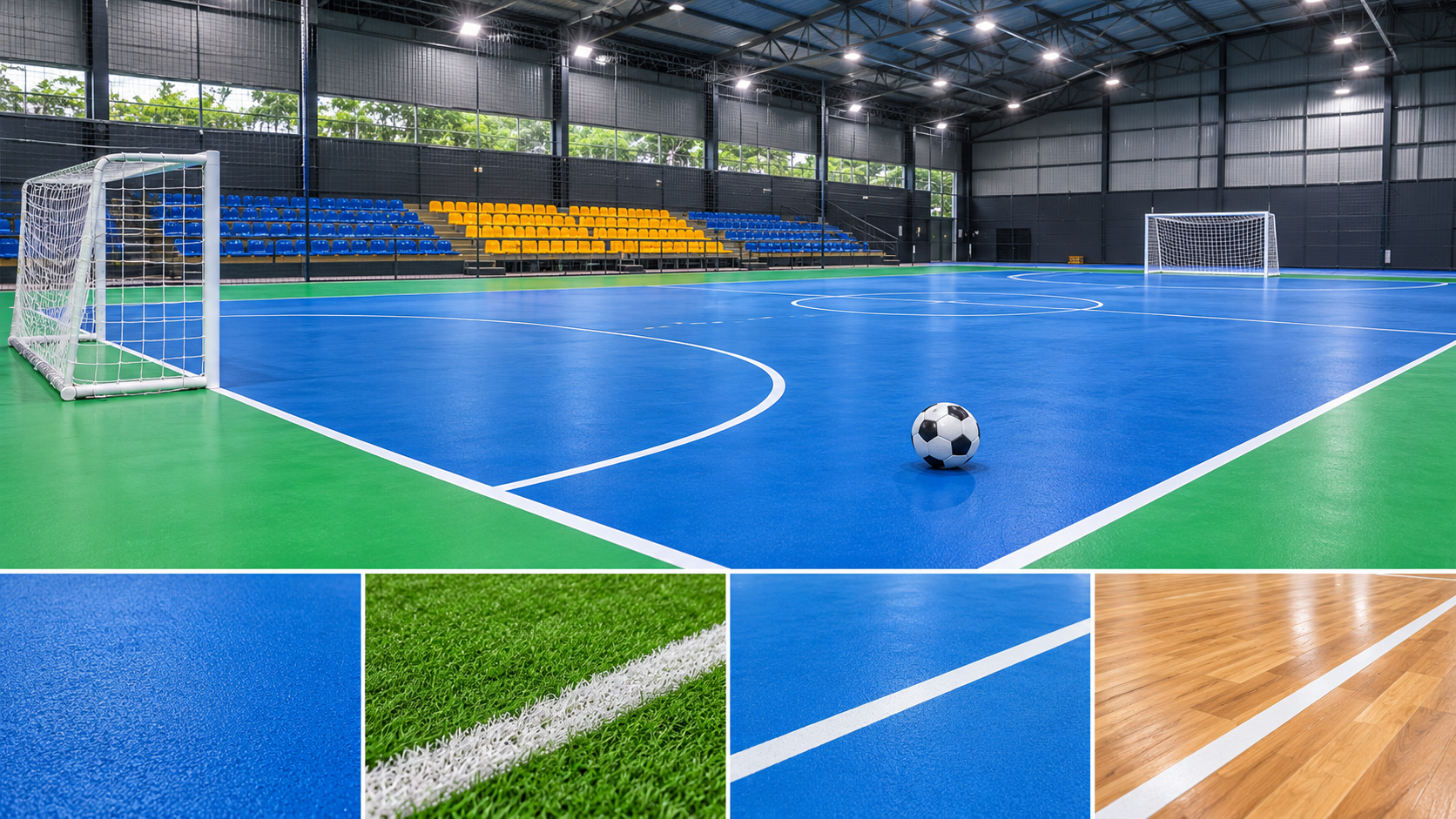
Futsal court construction involves developing a specially designed playing surface suitable for five-a-side football. Unlike conventional football grounds, futsal is generally played on a hard, smooth, and level surface rather than natural grass.
Depending on the project, a futsal facility can be constructed indoors or outdoors. Common flooring solutions include acrylic sports surfaces, polyurethane systems, PVC sports flooring, wooden sports flooring, and specialized synthetic surfaces.
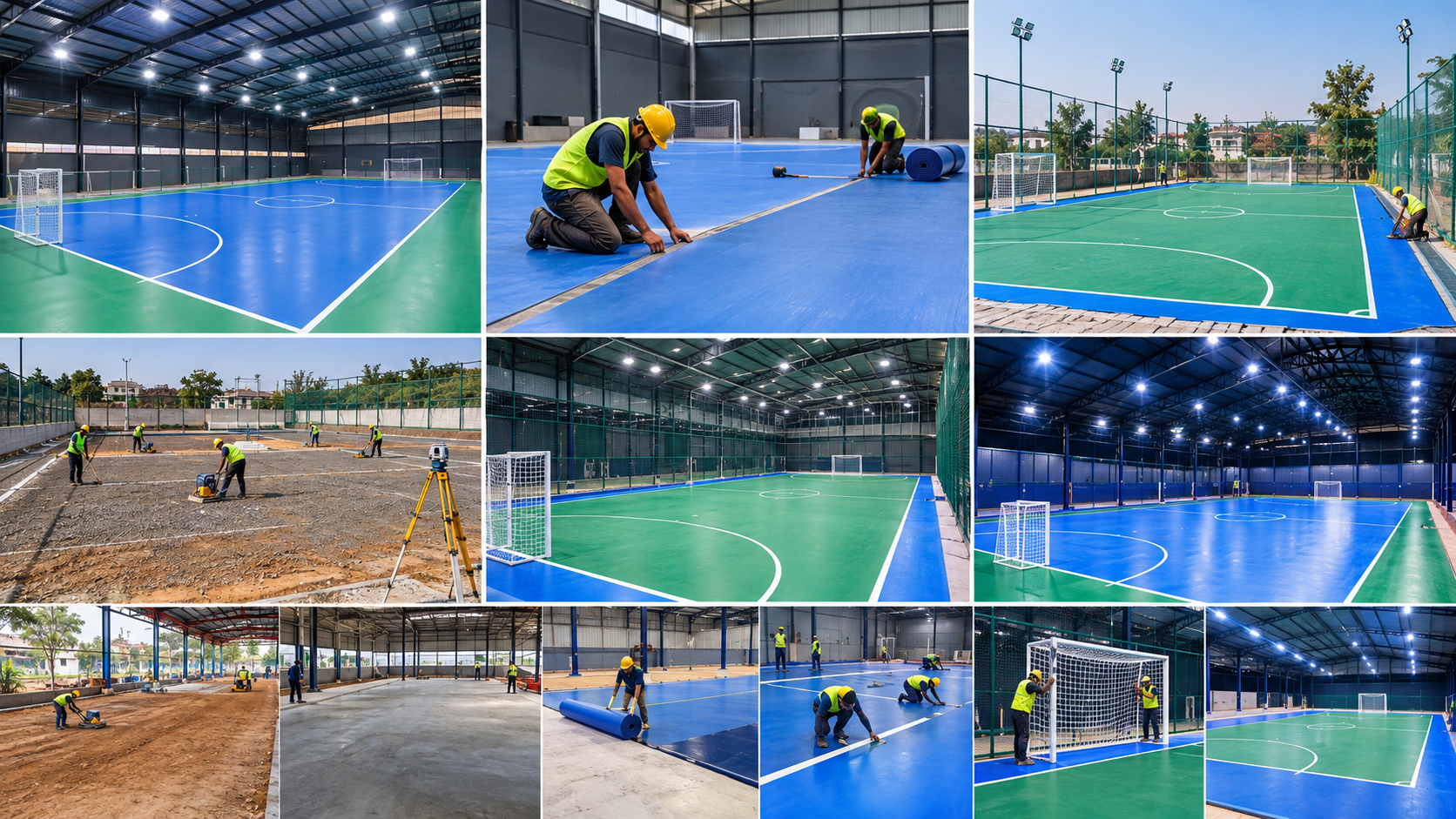
The construction system normally includes:
- Site surveying and measurement
- Ground preparation
- Sub-base development
- Concrete or asphalt base construction
- Surface leveling
- Waterproofing and drainage
- Sports flooring installation
- Court marking
- Goalpost installation
- Perimeter fencing
- Sports lighting
- Safety and spectator facilities
A professionally engineered court provides better ball response, player traction, shock absorption, durability, and long-term playing performance.
Standard Futsal Court Dimensions
One of the first decisions in a futsal construction project is determining the available playing area.
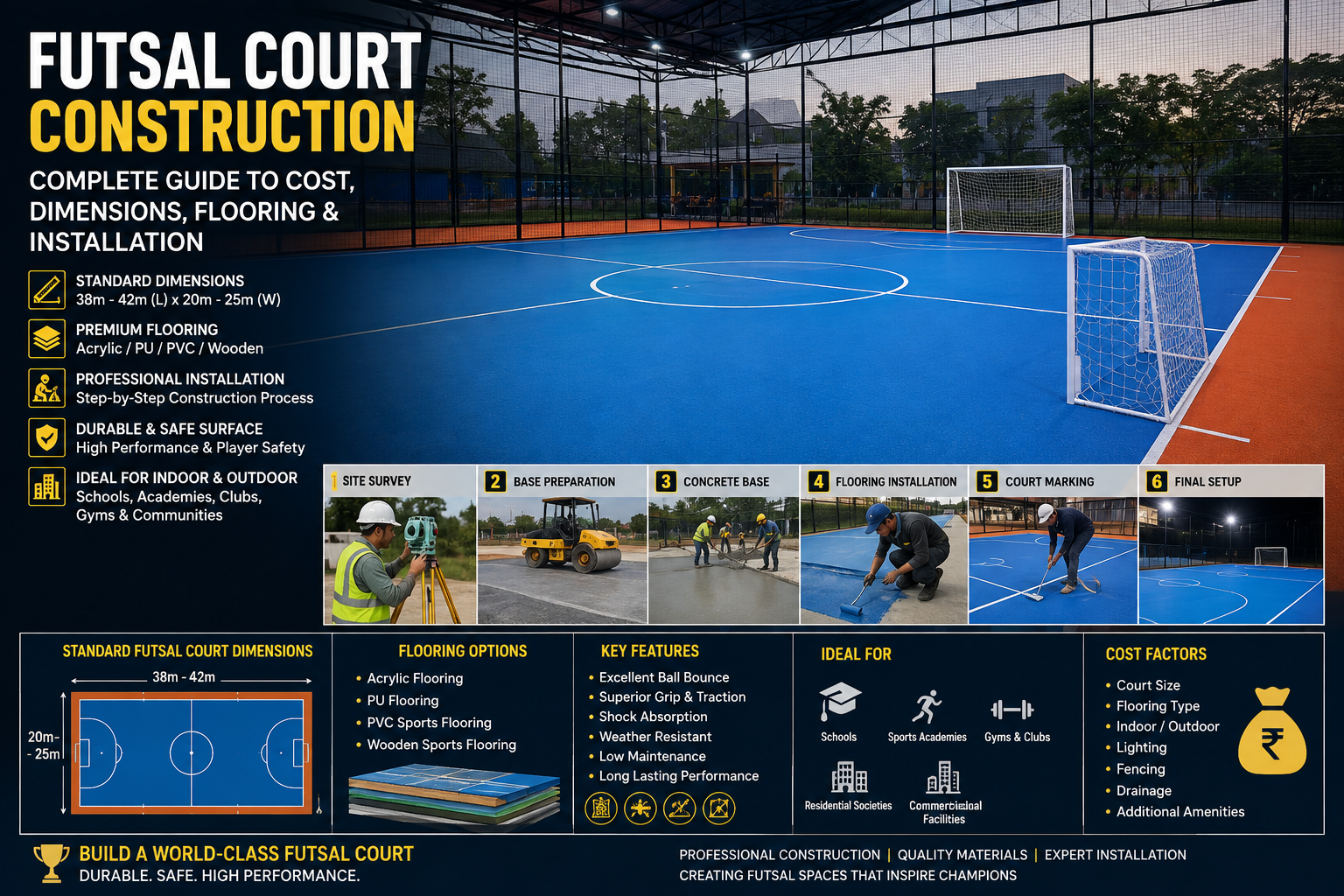
For international-level futsal, the playing court is generally designed within the following range:
Length: approximately 38–42 metres
Width: approximately 20–25 metres
For non-international competitions, smaller dimensions may be permitted, generally within:
Length: approximately 25–42 metres
Width: approximately 16–25 metres
The exact dimensions should be selected according to the intended use, available land, governing competition requirements, and applicable regulations.
Futsal Goal Dimensions
A standard futsal goal measures:
Width: 3 metres
Height: 2 metres
The goal should be securely anchored and positioned accurately to maintain player safety and match standards.
Futsal Court Markings
Court markings are normally clearly visible and consistent across the entire playing area. The penalty area, centre circle, touchlines, goal lines, penalty marks, and other required markings must be accurately measured before final painting.
For professional facilities, markings should be applied using durable sports-grade coating rather than ordinary exterior paint.
How Much Does Futsal Court Construction Cost?
The futsal court construction cost in India depends heavily on the project specifications. There is no single price applicable to every court because the final investment changes according to flooring, land condition, court size, roofing, lighting, fencing, drainage, civil work, and supporting facilities.
As an indicative planning range, a basic outdoor futsal court may require an investment of roughly ₹15 lakh to ₹30 lakh, while a premium facility with advanced flooring, professional lighting, fencing, roofing, changing rooms, spectator areas, and supporting infrastructure can cost considerably more.
Typical cost components include:
| Construction Component | Cost Impact |
|---|---|
| Site development | Low to high |
| RCC/concrete base | Medium to high |
| Sports flooring | Medium to very high |
| Fencing | Medium |
| Floodlighting | Medium to high |
| Drainage | Medium |
| Goalposts and equipment | Low to medium |
| Roofing/structure | High |
| Changing rooms | High |
| Seating and amenities | Project dependent |
These figures are only indicative because local material prices, labour rates, site conditions, transportation, structural requirements, and specifications can significantly change the final quotation.
The best approach is to obtain a detailed site-based estimate instead of relying on a generic per-square-foot price.
Major Factors Affecting Futsal Court Cost
1. Court Size
A larger playing area requires more excavation, base material, flooring, fencing, lighting, and drainage. Therefore, court dimensions directly influence construction costs.
2. Indoor or Outdoor Construction
An outdoor futsal court generally has a lower initial construction cost if roofing is not required. An indoor facility, however, may require a steel structure, roofing system, ventilation, electrical work, lighting, wall protection, and additional civil infrastructure.
3. Flooring System
Flooring is one of the most important cost factors. Basic acrylic systems can be more economical, while premium polyurethane, PVC, or specialized sports flooring systems can require a higher investment.
4. Existing Ground Condition
A level, stable site may require less preparation. Poor soil, uneven terrain, waterlogging, weak subgrade, or inadequate drainage can substantially increase civil construction costs.
5. Lighting
Commercial facilities often require high-quality LED floodlighting for evening games. The number, wattage, mounting height, pole design, electrical distribution, and illumination requirements affect the overall budget.
6. Fencing
Perimeter fencing protects the court and keeps the ball inside the playing area. The height, mesh quality, support posts, gates, and protective padding influence the price.
Best Flooring for a Futsal Court
Choosing the right futsal court flooring is critical because the surface directly affects player movement, ball control, traction, comfort, and injury risk.
Acrylic Sports Flooring
Acrylic sports flooring is widely used for multi-purpose sports courts.
Advantages include:
- Durable surface
- Attractive appearance
- Good traction
- Easy cleaning
- Suitable for outdoor applications when properly specified
- Multiple colour options
- Relatively economical
Acrylic systems are especially suitable for facilities that may also be used for basketball, volleyball, or other recreational activities.
PU Sports Flooring
Polyurethane flooring is a premium sports flooring option. It can provide excellent resilience, consistent playing characteristics, and improved comfort when installed as a multi-layer system.
PU flooring can be considered for professional indoor sports facilities where performance and durability are important.
PVC Sports Flooring
PVC sports flooring is commonly considered for indoor facilities. It provides a controlled, smooth playing surface and can be designed with cushioning layers.
It is particularly useful when the facility is intended for multiple indoor sports.
Wooden Sports Flooring
Professional indoor sports facilities may use engineered wooden sports floors. A properly designed sprung wooden system can offer excellent playing characteristics and controlled shock absorption.
However, wooden flooring requires careful moisture management, installation expertise, and maintenance.
Step-by-Step Futsal Court Construction Process
Site Survey
Construction begins with a detailed site inspection.
Engineers evaluate:
- Available land area
- Soil condition
- Existing levels
- Access for construction equipment
- Water drainage
- Electrical requirements
- Surrounding structures
- Flooding risk
- Orientation
- Future expansion possibilities
Accurate surveying at the beginning prevents expensive modifications later.
Site Preparation
The site is cleared of unwanted vegetation, debris, loose soil, and unsuitable material.
The ground is then graded according to the planned levels. Proper compaction is essential because settlement beneath the playing surface can eventually create cracks, depressions, and uneven areas.
Sub-Base Construction
A strong sub-base provides the foundation for the complete court.
Depending on the design, the contractor may use properly graded aggregate layers followed by compaction. The objective is to create a stable and uniform foundation capable of supporting the finished sports surface.
Concrete or Asphalt Base
The playing surface is constructed over an appropriately engineered base.
For many professional facilities, a reinforced concrete base is selected because it provides strength and dimensional stability. Expansion and construction joints must be planned carefully.
The base must be accurately leveled because sports flooring cannot compensate for major structural unevenness.
Drainage Installation
Outdoor futsal courts require effective rainwater management.
Drainage planning may include:
- Surface slopes
- Perimeter drains
- Channel drains
- Catch pits
- Stormwater connections
- Proper discharge routes
Water should never remain standing on the playing surface. Poor drainage can damage the flooring and reduce the usable life of the facility.
Surface Preparation
Before sports flooring installation, the base is inspected for cracks, moisture, dust, contamination, and uneven areas.
Grinding, cleaning, patching, priming, or leveling may be required depending on the flooring system.
This stage is often underestimated, but it has a major influence on the final appearance and performance of the court.
Sports Flooring Installation
The selected flooring system is installed according to the manufacturer’s technical specifications.
A multi-layer system may include:
- Primer
- Base or elastic layer
- Cushion layer where required
- Intermediate coating
- Wearing layer
- Protective finish
- Court markings
Each layer needs sufficient curing time. Rushing the installation can cause adhesion problems, bubbling, peeling, premature wear, or inconsistent surface performance.
Court Line Marking
After the playing surface has properly cured, professional sports line markings are applied.
The lines should be:
- Straight
- Clearly visible
- Uniform in width
- Accurately positioned
- Resistant to abrasion
Laser measurement and professional marking equipment can help improve accuracy on premium projects.
Goalpost Installation
Futsal goals are positioned according to the required dimensions. They must be stable and safely secured.
Portable goals should also be designed to prevent accidental movement during play.
Perimeter Fencing
Fencing is particularly important for commercial and outdoor courts.
A suitable fencing system helps:
- Keep the ball within the facility
- Protect surrounding property
- Improve player safety
- Control access
- Reduce interruptions during games
Protective padding may be added around selected structural posts in high-use facilities.
Futsal Court Lighting
Good lighting is essential for evening games and commercial operations.
LED floodlights are generally preferred because they provide efficient illumination and long service life.
The lighting design should consider:
- Pole height
- Number of fixtures
- Beam angle
- Glare control
- Uniform illumination
- Electrical load
- Maintenance access
Simply installing powerful lights does not guarantee a good playing environment. Uneven lighting and excessive glare can negatively affect players.
A professional lighting design should distribute illumination consistently across the complete playing surface.
Indoor vs Outdoor Futsal Court
Outdoor Futsal Court
Outdoor construction can be more economical and easier to develop where land and weather conditions permit.
Important considerations include:
- UV-resistant flooring
- Rainwater drainage
- Weather-resistant fencing
- Outdoor LED lighting
- Surface durability
- Expansion joints
Indoor Futsal Court
Indoor facilities provide greater year-round usability and protection from weather.
However, construction normally involves additional costs for:
- Steel structure
- Roofing
- Wall systems
- Ventilation
- Indoor lighting
- Electrical infrastructure
- Acoustic treatment
- Changing rooms
- Fire and safety systems
For commercial sports centres, an indoor futsal facility can provide better scheduling flexibility and greater utilization throughout the year.
Important Safety Features
Player safety should be considered during every stage of construction.
Recommended features include:
- Non-abrasive sports flooring
- Appropriate traction
- Proper shock absorption where required
- Secure goalposts
- Safe fencing
- Rounded or protected structural edges
- Adequate lighting
- Clear emergency access
- Proper drainage
- Regular surface inspection
The playing surface should not become excessively slippery when exposed to moisture or contaminants.
Common Mistakes in Futsal Court Construction
Many problems occur because owners focus only on the visible surface and overlook the foundation.
Common mistakes include:
Using an Unstable Base
A premium coating cannot correct a poorly constructed foundation.
Ignoring Drainage
Standing water is one of the biggest threats to outdoor sports surfaces.
Choosing Flooring Only on Price
The cheapest flooring option may have a shorter service life or provide unsuitable playing characteristics.
Poor Line Measurement
Incorrect markings can make a facility unsuitable for organized competitions.
Insufficient Lighting
Poorly distributed lighting creates shadows and glare.
Hiring an Inexperienced Contractor
Sports flooring requires different technical knowledge from ordinary civil flooring. Contractors should understand sports surface preparation, coating systems, curing requirements, and court markings.
Maintenance of a Futsal Court
Regular maintenance protects the investment and preserves playing quality.
A maintenance program should include:
- Routine sweeping and cleaning
- Removal of leaves and debris
- Inspection for cracks
- Checking drainage channels
- Inspection of goal anchors
- Fence inspection
- Lighting checks
- Repair of damaged coating
- Repainting worn markings when necessary
Outdoor courts should receive additional inspection after heavy rainfall and extreme weather.
Indoor surfaces should be protected from unnecessary moisture, dust accumulation, and chemical contamination.
How to Choose a Futsal Court Construction Company
Selecting the right contractor is as important as choosing the flooring.
Before awarding a project, evaluate:
- Previous sports court projects
- Technical knowledge of sports flooring
- Quality of construction materials
- Base preparation methodology
- Drainage planning
- Flooring system specifications
- Warranty terms
- Maintenance support
- Project timeline
- Detailed quotation
Ask the contractor to explain the complete flooring build-up instead of accepting a quotation that simply says “synthetic flooring.”
A professional quotation should clearly identify the construction layers, material specifications, thickness where applicable, surface preparation, court dimensions, drainage, fencing, lighting, and installation scope.
Frequently Asked Questions
How much land is required for a futsal court?
The playing court can vary in size depending on the intended use and applicable regulations. For a standard full-size project, the playing area may be around 40 × 20 metres, but additional land is required for safety zones, fencing, circulation, changing rooms, spectator areas, and other facilities.
What is the standard futsal goal size?
A standard futsal goal is 3 metres wide and 2 metres high.
Which flooring is best for futsal?
There is no single flooring solution for every project. Acrylic, PU, PVC, and wooden sports flooring can all be suitable depending on whether the court is indoor or outdoor, the required performance, budget, maintenance expectations, and intended level of play.
Can a futsal court be built outdoors?
Yes. Outdoor futsal courts can be constructed successfully with an appropriately engineered base, weather-resistant flooring, effective drainage, fencing, and suitable lighting.
How long does futsal court construction take?
The timeline depends on court size, site conditions, civil work, flooring system, weather, and supporting infrastructure. A basic project may take several weeks, while a complete indoor sports facility can require substantially longer.
Is artificial grass suitable for futsal?
Artificial turf can be used for certain small-sided football facilities, but traditional futsal is generally associated with hard court surfaces. The appropriate surface should therefore be selected according to the intended game format and applicable playing requirements.
Final Thoughts
A successful futsal court construction project begins with proper planning rather than simply selecting an attractive flooring colour. The foundation, drainage, dimensions, flooring system, lighting, fencing, safety features, and installation quality all contribute to the final performance of the facility.
For schools, sports academies, colleges, residential communities, gyms, clubs, and commercial sports centres, a professionally designed futsal court can become a valuable recreational and sporting asset.
The most important principle is simple: build the foundation correctly, choose flooring according to actual playing requirements, and work with professionals who understand sports infrastructure rather than treating the project like ordinary civil flooring.
Before construction begins, prepare a detailed project specification covering the court dimensions, total site area, base construction, drainage, flooring layers, fencing, lighting, goals, safety requirements, and maintenance plan. This approach makes the budget more predictable and helps ensure a durable, attractive, and high-performance futsal facility.