Intruduction
Padel has quickly become one of the most talked-about emerging sports in India. Sports clubs, hotels, residential communities, schools, fitness centres and commercial sports operators are increasingly considering padel courts as a new recreational and revenue-generating facility.
One of the first questions investors ask is: How much does it cost to build a padel court in India in 2026?
The answer depends heavily on the court specification, site condition, flooring system, glass quality, structural steel, lighting, drainage and whether the project is outdoor, rooftop or covered. Current 2026 industry estimates show a substantial difference between a basic court package and a fully engineered turnkey installation. Some published estimates place standard installed courts around ₹9–14 lakh, while more comprehensive FIP-oriented turnkey projects are commonly quoted around ₹25–45 lakh. The difference is largely explained by what is included in the quotation.
This guide explains the padel court construction cost in India for 2026, including material costs, civil work, artificial turf, glass walls, steel structure, LED lighting, drainage, installation, additional expenses and factors that can increase the total investment.
What Is a Padel Court?
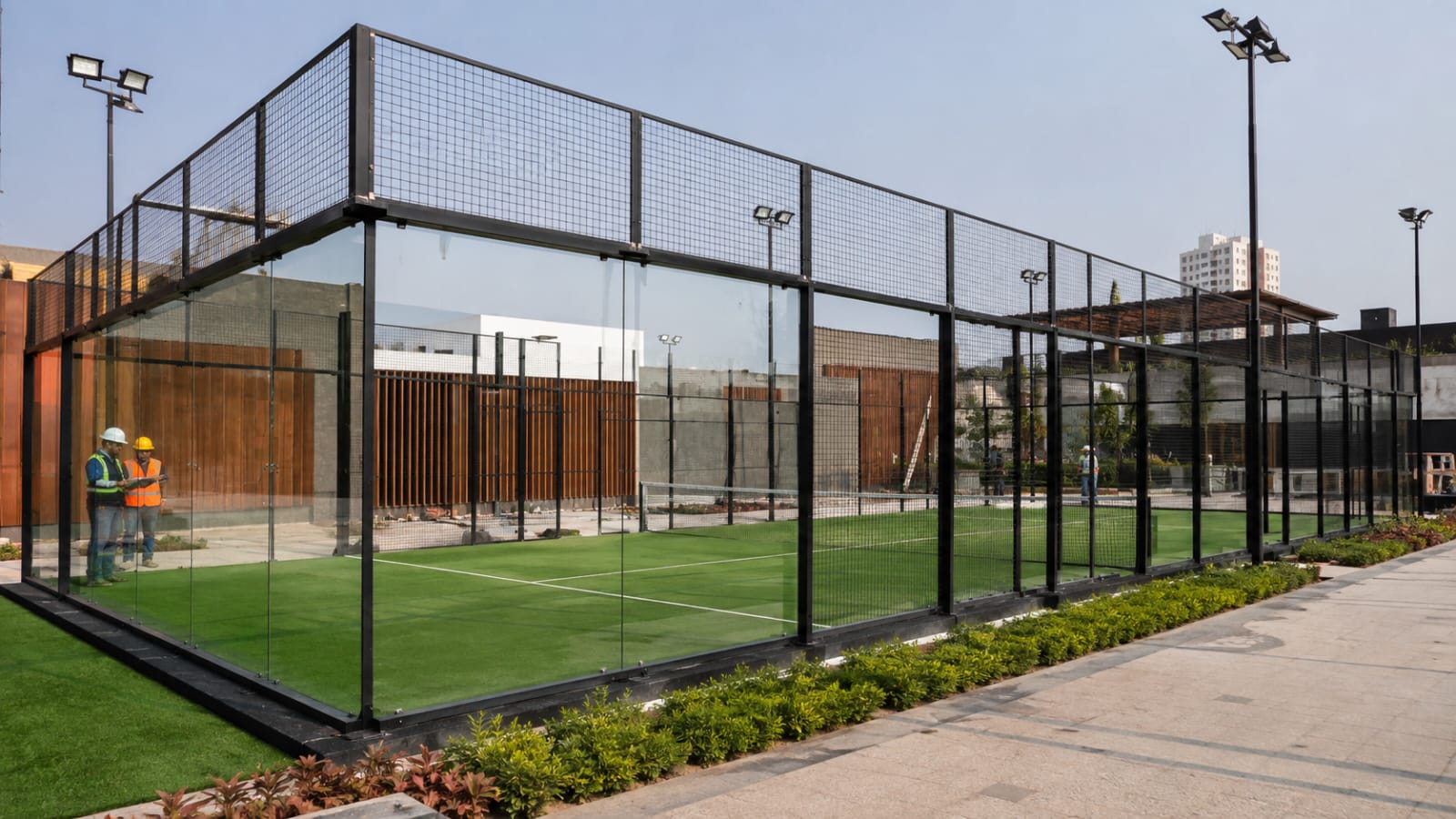
A padel court is an enclosed racket-sport facility designed for doubles play. A standard court measures 20 metres long by 10 metres wide, creating approximately 200 square metres of enclosed playing area. The court combines artificial turf, transparent glass walls, metal mesh, a structural frame, netting and sports lighting.
Unlike a conventional tennis court, padel relies heavily on the surrounding walls during play. This means the quality and engineering of the glass, steel frame, anchoring system and foundation are particularly important.
For commercial facilities, the court should not be viewed simply as a turf-and-glass product. A reliable installation requires proper civil engineering, water drainage, structural stability, surface preparation, lighting and professional assembly.
Padel Court Construction Cost in India in 2026
For budgeting purposes, a standard outdoor turnkey padel court in India can be planned at approximately ₹25 lakh to ₹32 lakh, while premium outdoor installations can move towards ₹30 lakh–₹40 lakh or more. Covered or indoor facilities can reach ₹38 lakh–₹45 lakh+ depending on the building and roofing requirements.
A useful planning range is:
| Padel Court Type | Approx. 2026 Investment |
|---|---|
| Basic / limited-scope installation | ₹9–14 lakh* |
| Standard outdoor turnkey court | ₹25–32 lakh |
| Premium outdoor court | ₹30–40 lakh+ |
| Indoor / covered commercial court | ₹38–45 lakh+ |
| Rooftop or structurally complex project | Site-specific |
*Some lower published estimates represent different scopes, specifications or partial packages rather than the same fully engineered turnkey specification.
Therefore, anyone comparing quotations should first check what is actually included before deciding that one contractor is cheaper than another.
Padel Court Cost Breakdown
The easiest way to understand the investment is to divide the construction into individual components.
1. Civil Foundation and Base Work
The foundation is one of the most important parts of a padel court. The playing surface and steel enclosure depend on a stable, accurately levelled base.
Civil work can include:
- Site clearing
- Excavation and levelling
- Soil preparation
- Granular sub-base
- PCC or reinforced concrete slab
- Surface finishing
- Required slope
- Drainage provisions
- Anchoring points
- Waterproofing where necessary
A published 2026 turnkey specification lists a 200-square-metre PCC base as one of the principal cost components, while broader market estimates place foundation and drainage together around ₹4–7 lakh depending on site conditions.
If the existing surface is already suitable, the civil requirement may be lower. However, saving money by installing a court over an inadequate or uneven base can lead to cracking, water accumulation and alignment problems later.
Estimated planning range: ₹3–7 lakh
2. Structural Steel Frame
The steel frame forms the skeleton of the padel court. It supports the glass panels, mesh sections and other structural elements while transferring loads to the foundation.
Quality specifications may include:
- Structural steel columns
- Horizontal support members
- Bracing
- Galvanised components
- Powder-coated finish
- Corrosion protection
- Heavy-duty anchor systems
- Gates and access components
For outdoor installations in India, corrosion resistance is especially important because courts are exposed to rain, humidity, dust and temperature fluctuations.
Depending on the design and finish, steel structure costs can represent a major portion of the overall budget. Current 2026 published estimates place a standard steel structure in the several-lakh range, with premium galvanised systems costing substantially more.
Estimated planning range: ₹6–12 lakh
3. Tempered Glass Walls
Glass is another major investment in a padel court.
The walls need to provide:
- Player visibility
- Consistent ball rebound
- Safety
- Structural strength
- Long-term weather resistance
- A premium appearance
Depending on the court design, manufacturers may offer different tempered-glass configurations, including standard framed systems and panoramic designs.
Published 2026 specifications commonly show 10 mm or 12 mm tempered glass for FIP-oriented installations. Premium panoramic designs can significantly increase the price.
The glass cost depends on:
- Thickness
- Tempering quality
- Panel dimensions
- Framing system
- Hardware
- Panoramic configuration
- Transportation
- Installation complexity
Estimated planning range: ₹6–11 lakh
4. Artificial Padel Turf
Padel requires a purpose-designed synthetic playing surface. A good-quality artificial turf system provides predictable ball behaviour, player traction and an appropriate playing feel.
The turf specification can influence both initial cost and long-term maintenance.
Important factors include:
- Fibre type
- Pile height
- Fibre density
- UV stability
- Backing quality
- Drainage performance
- Silica sand infill
- Installation method
One current FIP-oriented commercial specification lists approximately 12 mm artificial padel turf with silica infill.
Low-cost turf may reduce the initial quotation but can wear faster under intensive commercial use. A better approach is to select the surface according to expected playing hours rather than choosing purely on price.
Estimated planning range: ₹3.5–5 lakh including turf and associated surface materials
5. Padel Net and Accessories
Although relatively small compared with the structural components, the net and accessories are essential to completing the court.
Typical items include:
- Professional padel net
- Net posts
- Anchoring hardware
- Access gates
- Protective components
- Court markings
- Fasteners
- Safety fittings
A published 2026 commercial specification places the net and posts in the tens of thousands of rupees, depending on the selected system.
Estimated planning range: ₹25,000–₹60,000+
6. LED Lighting Cost
Lighting is particularly important for commercial padel courts because evening sessions can represent a significant portion of operating hours.
A professional lighting system should provide:
- Adequate illumination
- Good uniformity
- Low glare
- Reliable performance
- Efficient electricity consumption
- Appropriate mounting height
Current 2026 court specifications commonly use LED floodlighting, with published examples around ₹1.5–2.5 lakh for a court-specific lighting installation.
The final cost depends on the number and wattage of fixtures, poles or mounting arrangements, electrical cabling, control panels and site infrastructure.
Estimated planning range: ₹1.5–4 lakh
7. Drainage System
Drainage is often overlooked during the initial budgeting stage.
This can become a major problem in India because heavy monsoon rainfall can quickly expose weaknesses in the court foundation.
A proper drainage strategy may include:
- Surface slope
- Perimeter drainage
- Channel drains
- Stormwater connections
- Collection points
- Sub-surface drainage where required
The correct design depends on the existing site and local rainfall conditions.
A court with excellent turf but poor drainage can still become unusable after heavy rain. Therefore, drainage should be considered part of the court construction rather than an optional accessory.
Estimated planning range: ₹50,000–₹2 lakh+, depending on the site.
What Factors Affect Padel Court Construction Cost?
Not every padel court costs the same. Several variables can move the final quotation considerably.
1. Location
Construction prices vary between cities because of:
- Labour rates
- Transportation
- Material availability
- Local fabrication
- Freight
- Site accessibility
- Contractor mobilisation
A court in a major metropolitan area may have different installation costs from one in a Tier-2 city.
2. Existing Ground Condition
A prepared concrete area can reduce civil expenditure. A vacant plot requiring excavation, filling, compaction, drainage and a new foundation will require a larger budget.
3. Standard vs Panoramic Glass
Panoramic courts have a more open and premium appearance. They are particularly attractive for commercial clubs and facilities where visual presentation is important.
However, specialised glass configurations and structural arrangements can add several lakh rupees to the project.
4. Outdoor vs Indoor Padel Court
An outdoor court generally requires the court enclosure, foundation, surface, lighting and associated infrastructure.
An indoor court adds the cost of the building or roof structure.
If an existing suitable sports hall is available, the additional expense can be lower. Constructing a completely new covered facility is substantially more expensive.
Current industry estimates indicate that roofing or indoor construction can add several lakh rupees, depending on the span, height, structural design and finishing.
Rooftop Padel Court Cost
Rooftop padel courts are becoming an interesting option for hotels, commercial buildings and urban sports facilities where ground space is limited.
However, a rooftop project should never be treated as a normal ground-level installation.
Before construction, the building should be evaluated for:
- Structural load capacity
- Wind loads
- Waterproofing
- Existing slab condition
- Access for materials
- Equipment movement
- Drainage
- Safety barriers
- Electrical supply
Structural reinforcement or waterproofing can substantially increase the project budget. Published 2026 estimates suggest rooftop installations can add roughly 20–30% or more depending on the building and engineering requirements.
A structural engineer should therefore assess the building before a final quotation is accepted.
How Much Land Is Needed for a Padel Court?
The playing enclosure itself is approximately 20 m × 10 m, or 200 square metres.
However, the plot should not be planned at exactly 200 square metres.
Additional space may be needed for:
- Player circulation
- Entrance access
- Maintenance
- Electrical equipment
- Spectator movement
- Seating
- Reception
- Toilets
- Changing rooms
- Café or refreshments
- Multiple courts
For a commercial padel facility, the total land requirement should therefore be calculated as part of the complete business and site layout rather than based solely on the court dimensions.
Cost of Building Two or More Padel Courts
If the project is commercial, constructing multiple courts can improve the economics.
A two-court project can share certain expenses such as:
- Site mobilisation
- Transportation
- Engineering
- Labour setup
- Electrical infrastructure
- Drainage planning
- Equipment handling
Current industry estimates indicate that two-court projects can reduce the per-court cost compared with constructing a single isolated court. One published specification estimates approximately ₹22–23 lakh per court for a two-court installation versus ₹25 lakh for a single court under its stated specification.
The actual saving depends on the project design and site.
Padel Court Construction Timeline
A typical installation timeline depends on how much civil work is required.
A simplified sequence is:
- Site inspection
- Layout and design
- Soil and ground assessment
- Site preparation
- Foundation and concrete work
- Drainage installation
- Steel structure installation
- Glass and mesh installation
- Artificial turf installation
- Net and accessories installation
- LED lighting installation
- Testing and finishing
- Final inspection and handover
For a prepared site, the enclosure and court installation itself can be completed relatively quickly. However, civil work, material procurement and weather conditions can extend the overall schedule.
How to Choose a Padel Court Construction Company
Selecting the cheapest quotation is not always the best way to control project cost.
Before signing a contract, ask the contractor for a detailed specification covering:
Structural System
Confirm the steel section, corrosion protection, coating and anchoring method.
Glass
Ask for the glass thickness, tempering specification and warranty.
Artificial Turf
Check pile height, density, UV resistance, backing and expected maintenance requirements.
Foundation
Confirm slab thickness, concrete grade, reinforcement, slope and sub-base.
Drainage
Ask exactly where rainwater will go and whether perimeter drainage is included.
Lighting
Check fixture quantity, wattage, mounting height and electrical controls.
Warranty
Get separate warranty information for structure, glass, turf and electrical equipment.
Installation
Clarify whether erection, transportation, labour and commissioning are included.
A quotation that looks cheaper on paper may become considerably more expensive if these items are excluded.
Common Mistakes That Increase Padel Court Costs
Choosing Only on Initial Price
A very low quotation may exclude important components. Always compare specifications rather than only the final number.
Ignoring Drainage
Water accumulation can damage the base and shorten the useful life of the surface.
Using Unsuitable Turf
Commercial courts experience substantially more wear than private installations. Surface quality should match expected usage.
Poor Foundation Preparation
The court enclosure can be high quality, but an inadequate base can create expensive problems later.
Forgetting Electrical Infrastructure
The lighting quotation may not include electrical cabling, distribution panels or site connections. These should be clearly identified.
Not Planning Maintenance
A padel facility should be budgeted as a long-term asset. Turf maintenance, cleaning, sand management, glass cleaning, structural inspections and lighting replacement should be included in the operating plan.
Is Padel Court Construction a Good Investment in India?
For commercial operators, the investment potential depends on location, pricing, occupancy and operating costs.
A successful facility can generate income through:
- Hourly court bookings
- Memberships
- Coaching
- Tournaments
- Corporate events
- Academy programmes
- Sponsorships
- Food and beverage
- Sports merchandise
The business case becomes stronger when multiple courts are operated together because players can participate at different times and the facility can support leagues, coaching and tournaments.
However, construction cost alone does not determine profitability. Investors should also calculate land rent or acquisition cost, staff salaries, electricity, maintenance, marketing, taxes, insurance and other operating expenses.
2026 Padel Court Budget: Quick Example
Suppose you are planning a standard outdoor commercial court.
A preliminary investment model might look like:
| Component | Indicative Budget |
|---|---|
| Civil foundation & drainage | ₹4–7 lakh |
| Galvanised steel structure | ₹7–10 lakh |
| Tempered glass & mesh | ₹6–9 lakh |
| Artificial turf & infill | ₹3.5–5 lakh |
| LED lighting | ₹1.5–2.5 lakh |
| Net, gates & accessories | ₹0.5–1 lakh |
| Installation & commissioning | ₹2–3.5 lakh |
| Indicative Total | ₹24.5–38 lakh |
This is a planning model rather than a fixed market quotation. Site conditions, design, material origin, glass configuration and project volume can move the final figure significantly. Published 2026 turnkey estimates similarly show a broad range based on specification.
Frequently Asked Questions About Padel Court Cost in India
How much does a padel court cost in India in 2026?
For a properly specified outdoor turnkey installation, a practical planning range is approximately ₹25 lakh to ₹32 lakh for a standard court, with premium installations reaching ₹40 lakh or more. Indoor or covered facilities can exceed ₹38–45 lakh depending on the building structure.
Can I build a padel court for ₹10 lakh?
Some published estimates show ₹9–14 lakh installations, but the scope must be checked carefully. Such figures may represent different specifications or packages. A full turnkey commercial court with engineered civil work, quality glass, structure, turf, drainage and lighting can cost considerably more.
What is the standard padel court size?
A standard padel court measures 20 metres × 10 metres, or approximately 200 square metres of enclosed playing area.
Is a covered padel court more expensive?
Yes. If a new roof or building structure must be constructed, it becomes a significant additional investment. An existing suitable indoor hall can reduce the additional construction requirement.
How long does a padel court last?
The service life depends on structural quality, climate, maintenance and usage. A current commercial specification cites a 10+ year lifespan, with turf top-up or renewal typically required periodically under regular use.
Can padel courts be installed in India outdoors?
Yes. Outdoor padel courts are suitable for many Indian locations, provided the foundation, drainage, structural protection, turf and electrical systems are designed for local environmental conditions.
Does building multiple courts reduce the cost?
Usually, yes. Shared logistics, labour mobilisation, civil planning and installation can reduce the per-court cost in a multi-court development.
Final Thoughts: Planning Your Padel Court Investment
The padel court construction cost in India in 2026 should be evaluated as a complete infrastructure investment rather than simply the price of a steel-and-glass court kit.
For budgeting, a standard outdoor turnkey project can reasonably be planned in the ₹25–32 lakh range, while premium, panoramic, complex-site and covered installations can move towards ₹40–45 lakh or beyond. Lower advertised prices should be examined carefully to determine whether they include the foundation, drainage, lighting, installation and other essential components.
The most important factors are foundation quality, structural steel, tempered glass, artificial turf, drainage, lighting and professional installation. Choosing the right specification at the beginning can prevent expensive repairs and upgrades later.
If you are planning a padel facility for a sports club, school, hotel, residential community, fitness centre or commercial sports business, the best approach is to begin with a site assessment and an itemised project estimate. This allows the construction team to evaluate the land, access, drainage, electrical requirements and intended court specification before providing a final cost.
In short: don’t compare padel courts by price alone. Compare the complete specification, engineering, materials, warranty, installation and long-term maintenance value.