Introduction
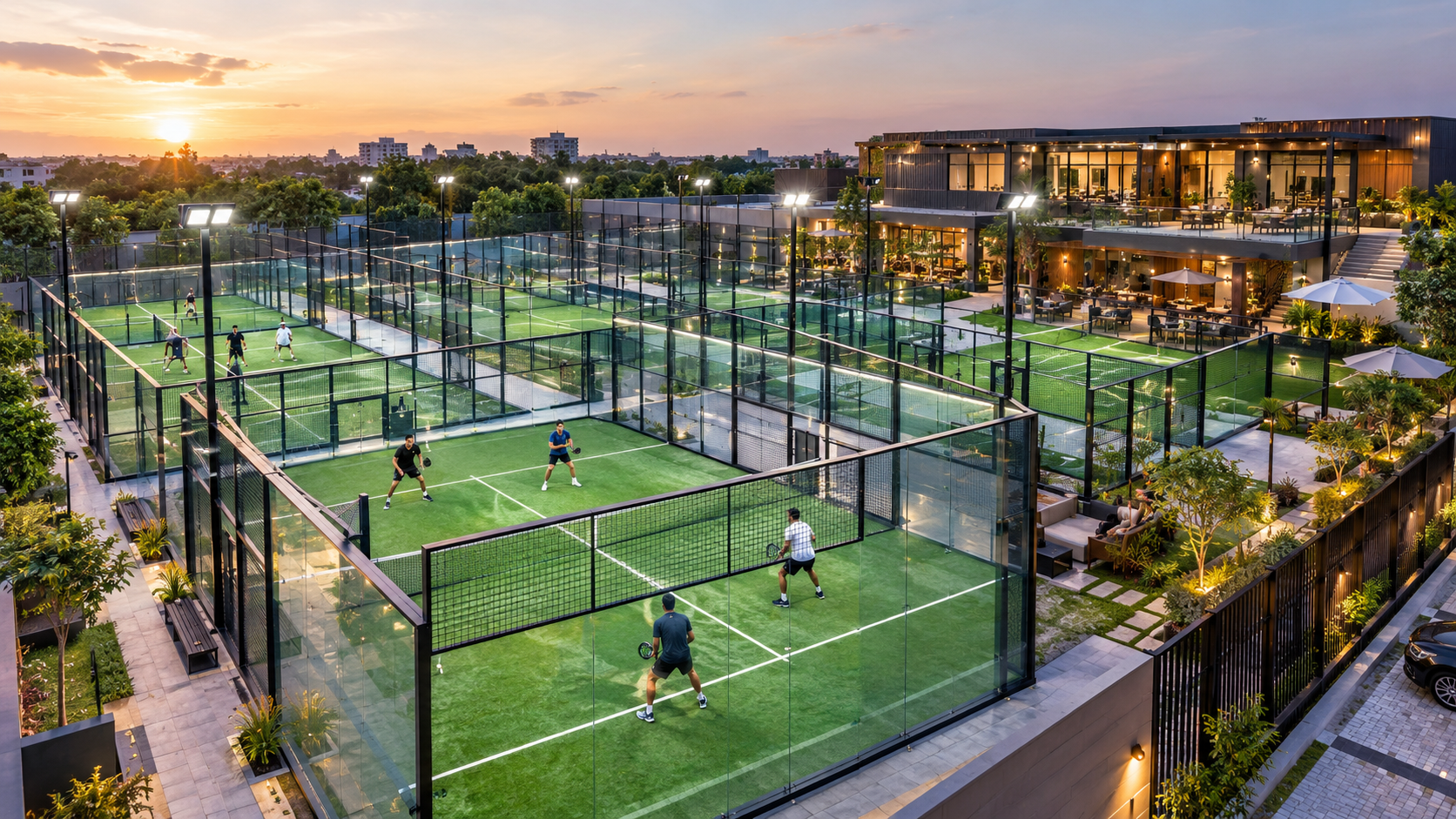
Padel is rapidly becoming one of the most attractive sports facility investments for clubs, hotels, schools, residential communities, fitness centers, and commercial sports venues. Its compact court size, social playing format, and relatively efficient land usage make it suitable for both dedicated sports facilities and mixed-use developments.
However, one of the most important decisions before starting a padel court construction project is choosing between an indoor padel court and an outdoor padel court.
Both options can deliver an excellent playing experience, but they differ considerably in terms of site planning, civil construction, weather protection, lighting, drainage, maintenance, operating costs, and long-term investment.
An outdoor padel court can provide a more open and economical installation where land and weather conditions are suitable. An indoor padel facility, on the other hand, offers greater environmental control and can potentially support more consistent year-round operations.
The right choice ultimately depends on your location, available space, business model, climate, budget, expected utilization, and future expansion plans.
This guide explains the major considerations involved in indoor and outdoor padel court construction, from dimensions and foundations to artificial turf, glass walls, lighting, drainage, equipment, costs, maintenance, and contractor selection.
What Is a Padel Court?
A padel court is a specialized enclosed sports court designed for the game of padel, a racket sport played primarily in doubles. Unlike a conventional tennis court, padel uses surrounding walls as part of gameplay.
A professionally constructed padel court generally incorporates:
- Reinforced concrete or engineered foundation
- Structural steel framework
- Tempered glass panels
- Perimeter fencing
- Artificial sports turf
- Padel net and court markings
- LED sports lighting
- Drainage provisions for outdoor installations
- Access doors and safety systems
- Professional court accessories
The enclosure is not simply decorative. The glass and mesh elements form an essential part of the playing environment and must be properly engineered to provide stability, visibility, durability, and player safety.
For commercial facilities, the construction quality of these components can directly influence playing comfort, maintenance requirements, customer experience, and the useful life of the court.
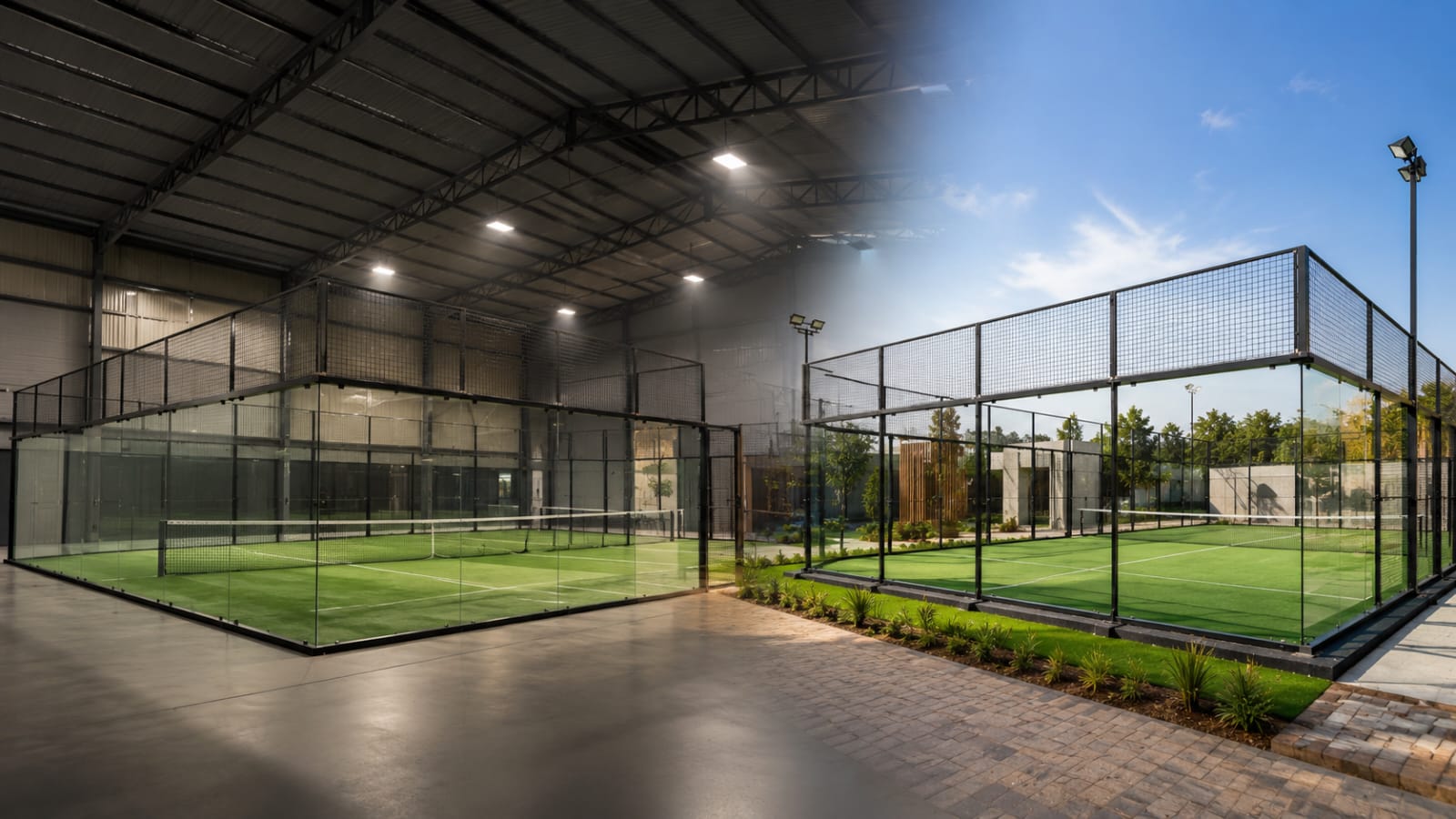
Indoor vs Outdoor Padel Court: The Basic Difference
The fundamental difference is environmental exposure.
An outdoor padel court is directly exposed to sunlight, rain, humidity, wind, dust, and seasonal temperature changes. Its design therefore needs appropriate weather-resistant materials, surface drainage, corrosion protection, and suitable lighting.
An indoor padel court is installed inside an existing or purpose-built building. The building envelope provides protection from rain and direct sunlight, but the project introduces additional requirements such as adequate clear height, ventilation, structural capacity, electrical planning, flooring protection, and interior lighting.
Outdoor Padel Court
Outdoor courts are often suitable for:
- Sports clubs
- Resorts and hotels
- Residential communities
- Schools and colleges
- Open recreational facilities
- Rooftop or terrace projects where structurally suitable
- Dedicated commercial padel venues
Indoor Padel Court
Indoor courts can be particularly useful for:
- Premium sports clubs
- Large commercial padel centers
- Fitness and recreation facilities
- Warehouses converted into sports venues
- Multi-sport indoor arenas
- Facilities operating throughout changing weather conditions
Neither option is universally better. The better solution is the one that matches the project’s operating conditions.
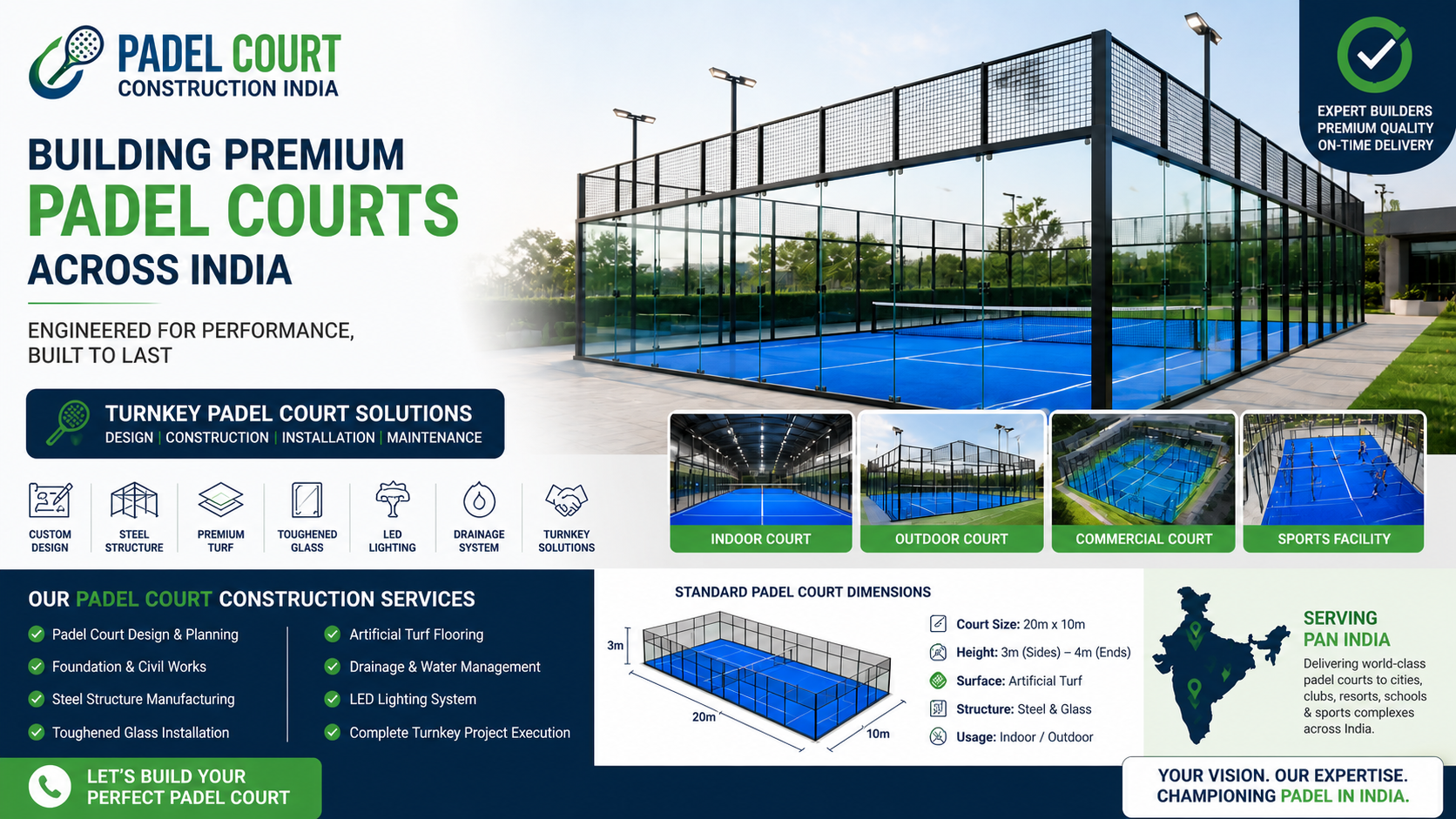
Standard Padel Court Dimensions
A standard padel court is commonly designed around a 10-metre width and 20-metre length, creating a playing area of approximately 200 square metres.
The court is enclosed by walls and fencing, with glass and mesh forming the surrounding playing enclosure.
However, the actual land requirement is greater than the playing area alone.
A construction plan should also consider:
- Structural columns
- External circulation
- Player access
- Safety clearances
- Lighting positions
- Drainage
- Maintenance access
- Reception and waiting areas
- Seating
- Changing rooms
- Toilets
- Storage
- Parking
- Fire and emergency access
For commercial developments, it is therefore a mistake to purchase or lease land based solely on the 200-square-metre playing area.
A professional contractor should prepare the complete site layout before civil work begins.
Site Requirements for Padel Court Construction
Site selection has a major influence on construction cost and long-term performance.
Before finalizing the location, evaluate:
1. Available Land
Check whether the site can accommodate the court along with circulation and supporting facilities.
2. Ground Condition
Soil bearing capacity, existing pavement, groundwater conditions, and site settlement should be assessed before foundation design.
3. Site Level
A significantly uneven site can increase excavation, filling, retaining, and drainage costs.
4. Accessibility
Construction materials such as steel sections, glass panels, artificial turf, and sports equipment require suitable access for transportation and installation.
5. Water Drainage
Outdoor facilities require a carefully planned system for removing rainwater from the playing surface and surrounding areas.
6. Electrical Supply
Lighting, access systems, security cameras, signage, and other facility equipment require adequate electrical capacity.
7. Surrounding Environment
Nearby buildings, trees, roads, dust-producing activities, and neighboring structures can affect wind movement, maintenance, privacy, and player comfort.
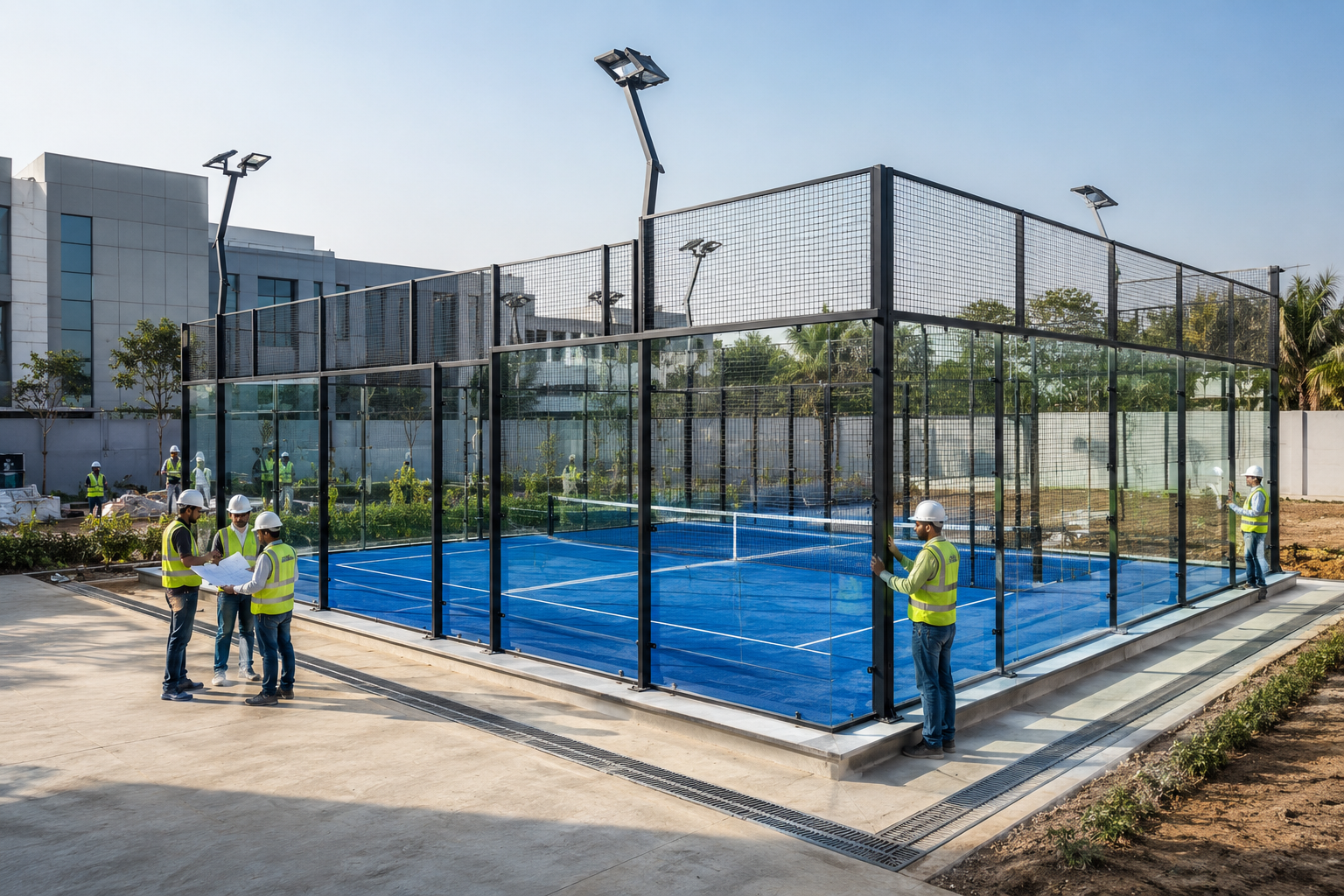
Construction Process of a Padel Court
A professional padel court construction project normally follows several interconnected stages.
1. Consultation and Requirement Analysis
The project begins by understanding:
- Court quantity
- Indoor or outdoor requirement
- Site dimensions
- Expected usage
- Flooring preference
- Lighting requirements
- Budget
- Branding requirements
- Supporting amenities
This information helps establish the preliminary project scope.
2. Site Survey
The contractor evaluates the physical location, ground conditions, levels, access, drainage, and available utilities.
For indoor projects, the building itself must also be assessed.
3. Layout and Engineering
The court position, orientation, foundation requirements, access points, lighting arrangement, drainage strategy, and supporting infrastructure are developed.
4. Foundation Work
The foundation is prepared according to the engineering requirements of the selected court structure and site.
5. Steel Structure Installation
The structural frame is fabricated and installed with appropriate alignment and anchoring.
6. Glass and Fencing Installation
Tempered glass panels and mesh fencing are installed to create the court enclosure.
7. Artificial Turf Installation
The sports surface is installed after the underlying base has been prepared and verified.
8. Lighting and Electrical Work
LED sports lights, cabling, control systems, and related electrical components are installed.
9. Court Equipment
The net, doors, posts, accessories, signage, and other required equipment are fitted.
10. Inspection and Handover
The finished court is inspected for alignment, surface quality, structural stability, lighting, safety, and finishing.
Padel Court Foundation
The foundation is one of the most important parts of the project because the complete court structure depends on a stable and properly prepared base.
For outdoor courts, foundation planning should account for:
- Soil conditions
- Rainwater movement
- Ground settlement
- Concrete strength
- Structural anchor positions
- Surface levels
- Local climate
- Long-term loading
Depending on the site, the construction may involve excavation, soil compaction, granular layers, reinforced concrete, edge beams, anchor systems, and drainage infrastructure.
A poorly prepared foundation can lead to settlement, uneven surfaces, structural misalignment, water accumulation, and premature repairs.
Indoor courts may have an existing concrete floor, but that does not automatically mean it is suitable.
The floor should be checked for:
- Flatness
- Cracks
- Moisture
- Load-bearing capacity
- Level differences
- Existing damage
- Structural limitations
Steel Structure for Padel Courts
The steel framework supports major components of the enclosure and must be designed for durability and stability.
A quality structure should provide:
- Accurate dimensional alignment
- Proper anchoring
- Corrosion protection
- Strong connections
- Appropriate structural sections
- Consistent finishing
- Compatibility with glass and fencing systems
For outdoor applications, corrosion resistance becomes especially important because the structure is exposed to rain and humidity.
Galvanized or appropriately protected steel components can help reduce corrosion-related maintenance when correctly specified and installed.
Structural design should also consider local wind conditions, especially for exposed outdoor courts.
Glass Walls and Perimeter Fencing
Glass is one of the defining features of a modern padel court.
The enclosure generally combines transparent safety glass with metallic fencing.
Tempered Glass
High-quality tempered glass provides:
- Clear visibility
- Strong impact resistance
- Professional appearance
- Good spectator visibility
- Low visual obstruction
Glass thickness and installation specifications should be selected according to the applicable engineering and safety requirements.
Perimeter Fencing
Mesh fencing completes the enclosure and supports the playing environment.
The fencing should be:
- Securely fixed
- Properly aligned
- Corrosion resistant
- Free from hazardous protrusions
- Suitable for repeated ball impact
The glass and fencing should work as an integrated system rather than being treated as separate decorative components.
Artificial Turf for Padel Courts
The playing surface has a direct effect on player movement, traction, comfort, and ball behavior.
Professional padel courts generally use specialized artificial sports turf rather than ordinary landscaping grass.
A suitable surface should provide:
- Consistent ball response
- Controlled player traction
- Good dimensional stability
- Resistance to repeated use
- Suitable drainage characteristics
- Comfortable movement
Different turf systems can vary in pile characteristics, fiber construction, infill requirements, and maintenance needs.
For outdoor courts, the surface should also work effectively with the site’s drainage design.
For indoor courts, drainage requirements are generally less demanding because the court is protected from rainfall, although cleaning and moisture management remain important.
Lighting for Indoor and Outdoor Padel Courts
Lighting is essential if the facility will operate during evening hours.
A professional sports lighting system should provide consistent illumination across the entire playing area without creating excessive glare.
Important considerations include:
- LED sports lighting
- Pole or structural mounting
- Light distribution
- Glare control
- Electrical safety
- Switching and control systems
- Energy efficiency
- Maintenance access
Outdoor Lighting
Outdoor courts require fixtures and electrical components suitable for external conditions.
Indoor Lighting
Indoor facilities require careful positioning to avoid glare from the roof, glass, or surrounding surfaces.
Poorly positioned lights can create distracting reflections on glass walls and make it difficult for players to track the ball.
Drainage for Outdoor Padel Courts
Drainage is one of the most important differences between indoor and outdoor padel court construction.
Outdoor courts must be designed to handle rainfall efficiently.
The drainage strategy can include:
- Proper court slope
- Surface water collection
- Perimeter drainage
- Channel drains
- Stormwater connections
- Subsurface drainage where necessary
Water should not remain on the playing surface after rainfall.
A court that looks excellent when newly installed can quickly develop operational problems if drainage is ignored during construction.
Indoor courts generally have much lower rainwater exposure, but drainage and moisture protection may still be relevant where the building has washdown areas, condensation, plumbing risks, or existing moisture problems.
Padel Court Equipment
A complete court requires more than turf and glass.
Typical equipment includes:
- Padel net
- Net posts
- Court access doors
- Safety hardware
- Court markings
- Lighting
- Protective components
- Player benches
- Scoreboards where required
- Signage
- Ball and racket storage
- Spectator seating
Commercial facilities may additionally require reception systems, lockers, CCTV, access control, vending areas, changing rooms, showers, and waiting zones.
These requirements should be considered during the initial design rather than added after construction.
Construction Cost Factors
The cost of constructing a padel court varies significantly from one project to another.
There is no single fixed price because the final investment depends on the site and specification.
Major cost factors include:
Court Type
Indoor and outdoor installations have different construction requirements.
Number of Courts
Multiple courts can change the overall project economics because site preparation, lighting, electrical infrastructure, and supporting facilities may be shared.
Foundation
Poor ground conditions can increase civil construction costs.
Structural System
Steel quality, corrosion protection, engineering requirements, and finishing influence the overall budget.
Glass and Fencing
The specification and quantity of glass and fencing have a substantial effect on the project cost.
Artificial Turf
Different turf technologies and performance levels are available at different price points.
Lighting
The number, type, efficiency, and mounting arrangement of LED fixtures affect the electrical budget.
Drainage
Outdoor courts may require additional stormwater and drainage infrastructure.
Indoor Building
For an indoor facility, the existing building condition can be one of the largest cost variables.
Potential expenses may include:
- Building modifications
- Roofing
- Flooring preparation
- Ventilation
- Electrical upgrades
- Fire safety
- Interior lighting
- Insulation or climate-control systems
For this reason, a contractor should inspect the site before preparing a final quotation.
Indoor vs Outdoor Padel Court Cost Considerations
An outdoor court can be financially attractive when a suitable prepared site is already available.
An indoor court may require a higher initial investment if a new building or major structural conversion is necessary.
However, comparing only the initial construction price can be misleading.
The more useful comparison is:
Initial investment + operating costs + maintenance + expected utilization + revenue potential.
An indoor facility may provide greater operational consistency in areas affected by extreme weather, while an outdoor facility can offer lower building-related expenses.
The best business decision depends on the specific location and business model.
Padel Court Construction Timeline
Construction duration depends on the site condition, court quantity, design complexity, material availability, civil work, and approvals.
A typical project can involve:
- Site inspection
- Design and engineering
- Ground preparation
- Foundation work
- Structural installation
- Glass and fencing
- Turf installation
- Lighting
- Equipment installation
- Testing and handover
A straightforward installation on a prepared site can progress considerably faster than a project requiring extensive excavation, new foundations, drainage, building modifications, or multiple courts.
Weather can also influence outdoor construction schedules.
For a commercial project, it is advisable to establish a realistic project schedule before ordering major materials.
Maintenance of Padel Courts
Regular maintenance protects the playing quality and appearance of the court.
Artificial Turf Maintenance
Routine brushing, cleaning, debris removal, and inspection help maintain the surface.
Glass Maintenance
Glass should be cleaned periodically to preserve visibility and professional presentation.
Steel Structure
Outdoor structures should be inspected for corrosion, coating damage, loose connections, and other signs of deterioration.
Fencing
Check fencing regularly for damage, loose sections, or sharp points.
Lighting
LED fixtures, electrical connections, mounting brackets, and controls should be inspected periodically.
Drainage
Outdoor drainage channels and collection points should remain free from leaves, dirt, and other debris.
Net and Accessories
Nets, posts, doors, handles, and other frequently used components should be checked and replaced when necessary.
A preventive maintenance program is generally more economical than waiting for major failures.
Common Padel Court Construction Mistakes
1. Choosing the Site Based Only on Available Space
A plot may appear large enough but still lack adequate room for circulation, maintenance, access, and supporting facilities.
2. Ignoring Soil Conditions
Foundation design should be based on actual site conditions rather than assumptions.
3. Treating Drainage as an Afterthought
Outdoor water management should be incorporated into the original civil design.
4. Using Low-Quality Turf
Ordinary artificial grass is not necessarily appropriate for professional sports use.
5. Selecting Poor-Quality Glass
The enclosure is a safety-critical component and should be sourced and installed according to appropriate specifications.
6. Inadequate Lighting Design
Simply adding powerful lights does not guarantee good visibility.
7. Forgetting Maintenance Access
Equipment should remain accessible for cleaning, repairs, and inspections.
8. Focusing Only on Construction Price
The cheapest quotation may not represent the lowest long-term cost.
9. Not Planning Supporting Facilities
Commercial facilities should consider reception, seating, toilets, changing areas, storage, parking, and customer circulation.
10. Hiring a Contractor Without Sports Construction Experience
A general civil contractor may not understand the technical requirements of a complete padel court system.
How to Choose the Right Padel Court Contractor
Selecting the right construction partner is one of the most important project decisions.
Before appointing a contractor, consider:
Experience
Ask about previous padel court construction projects and the type of facilities completed.
Technical Capability
The contractor should understand civil foundations, steel structures, glass systems, turf installation, drainage, and sports lighting.
Material Quality
Ask what specifications and brands or grades of materials are proposed.
Engineering
Structural and foundation requirements should be properly evaluated rather than estimated casually.
Project Scope
Make sure the quotation clearly identifies what is included and excluded.
Warranty and Support
Understand the warranty terms and whether post-installation maintenance assistance is available.
Site Supervision
Professional installation requires proper alignment, anchoring, surface preparation, and quality checks.
References
Where possible, review completed facilities or speak with previous clients.
Which Is Better: Indoor or Outdoor Padel Court?
There is no universal winner.
Choose an Outdoor Padel Court When:
- You have suitable open land.
- The local climate allows regular outdoor play.
- You want to avoid major building construction.
- Natural surroundings are part of the facility experience.
- You can provide effective drainage.
- The business model benefits from outdoor recreation.
Choose an Indoor Padel Court When:
- Consistent year-round operation is important.
- Weather could frequently interrupt bookings.
- You have a suitable warehouse or sports building.
- You want greater environmental control.
- The facility targets premium or high-frequency users.
- You plan to create a larger multi-court sports center.
A Hybrid Approach
Some projects may benefit from a covered or semi-enclosed arrangement. This can provide additional protection from sun and rain while avoiding the full cost and complexity of a conventional enclosed building.
The feasibility of such a solution depends on local regulations, structural design, climate, ventilation, and the available site.
Frequently Asked Questions
What is the standard size of a padel court?
A standard padel court is generally approximately 10 metres wide by 20 metres long, with the court enclosed by glass and fencing.
Is an indoor padel court better than an outdoor court?
Not necessarily. Indoor courts provide greater protection from weather, while outdoor courts can be simpler and more economical when suitable land and climate conditions are available.
Can a padel court be installed outdoors in India?
Yes. Outdoor padel courts can be developed in suitable locations across India, provided that the foundation, drainage, structural system, turf, lighting, and materials are selected appropriately for the local environment.
Does an outdoor padel court require drainage?
Yes. Proper rainwater management is essential for outdoor courts to prevent water accumulation and protect the playing surface and foundation.
What type of turf is used for padel courts?
Specialized artificial sports turf designed for racket-sport applications is commonly used. The appropriate turf specification depends on the intended use, climate, drainage system, and project requirements.
How long does it take to build a padel court?
The construction period varies according to site readiness, civil requirements, material availability, weather, court quantity, and project complexity. A prepared site can generally be completed faster than a project requiring extensive civil or building work.
How much does a padel court cost?
There is no universal construction price. Cost depends on the court structure, foundation, glass, fencing, turf, lighting, drainage, site conditions, transportation, and additional facility requirements.
Can an existing warehouse be converted into an indoor padel facility?
Potentially, yes. The building should first be assessed for clear height, structural capacity, floor condition, ventilation, lighting, fire safety, access, and other applicable requirements.
What should I consider before building multiple padel courts?
Consider land utilization, player circulation, reception and waiting areas, changing rooms, toilets, parking, lighting, drainage, spectator facilities, maintenance access, electrical capacity, and future expansion.
Why Professional Padel Court Construction Matters
A padel court is an integrated sports facility rather than a collection of individual components.
The foundation affects the structure. The structure supports the glass and fencing. The surface affects player movement. Drainage protects the outdoor installation. Lighting affects visibility. Equipment affects usability.
When these elements are designed and installed together, the result is a safer, more durable, visually attractive, and commercially useful sports facility.
Professional padel court construction services can help project owners move from initial site assessment and design to civil work, structural installation, sports surfacing, lighting, equipment, testing, and handover through a coordinated process.
Conclusion
Choosing between an indoor and outdoor padel court should begin with the project’s location, climate, available land, investment capacity, expected usage, and long-term business objectives.
An outdoor padel court can be an excellent option where suitable land, weather conditions, drainage, and operating plans align. An indoor facility can offer greater protection from environmental conditions and potentially more predictable year-round utilization, but it may require additional building and infrastructure investment.
Before construction begins, evaluate the complete project rather than comparing court prices alone.
A well-planned padel facility should combine a stable foundation, engineered steel structure, quality glass and fencing, professional artificial turf, suitable LED lighting, effective drainage where required, reliable equipment, and a practical maintenance strategy.
With proper planning and an experienced construction team, your padel court can become a durable and attractive facility designed for regular recreational, commercial, institutional, or professional use.
Build Your Padel Court Project With the Right Plan
Planning a new padel court, indoor padel facility, outdoor padel court, or multi-court sports complex?
Start with a professional site evaluation and project consultation.
A detailed assessment can help determine:
- Indoor or outdoor suitability
- Required site area
- Foundation requirements
- Court orientation
- Structural specifications
- Turf selection
- Glass and fencing requirements
- LED lighting design
- Drainage requirements
- Construction timeline
- Estimated project investment
- Future expansion possibilities
Contact a professional padel court construction team today to discuss your site, requirements, and project goals.
Ready to Build Your Padel Court?
Get in touch for a site assessment and customized padel court construction solution.