Introduction
Basketball court flooring is one of the most important investments when developing an indoor sports facility. A professionally designed floor does much more than improve the appearance of a court. It influences player safety, ball response, traction, comfort, durability, maintenance requirements, and the overall quality of the playing experience.
For schools, colleges, sports academies, fitness clubs, residential communities, corporate campuses, indoor stadiums, and professional training facilities, choosing the right basketball flooring requires careful consideration. The ideal surface depends on the level of play, expected foot traffic, available budget, building conditions, maintenance capacity, and whether the court will be used exclusively for basketball or multiple sports.
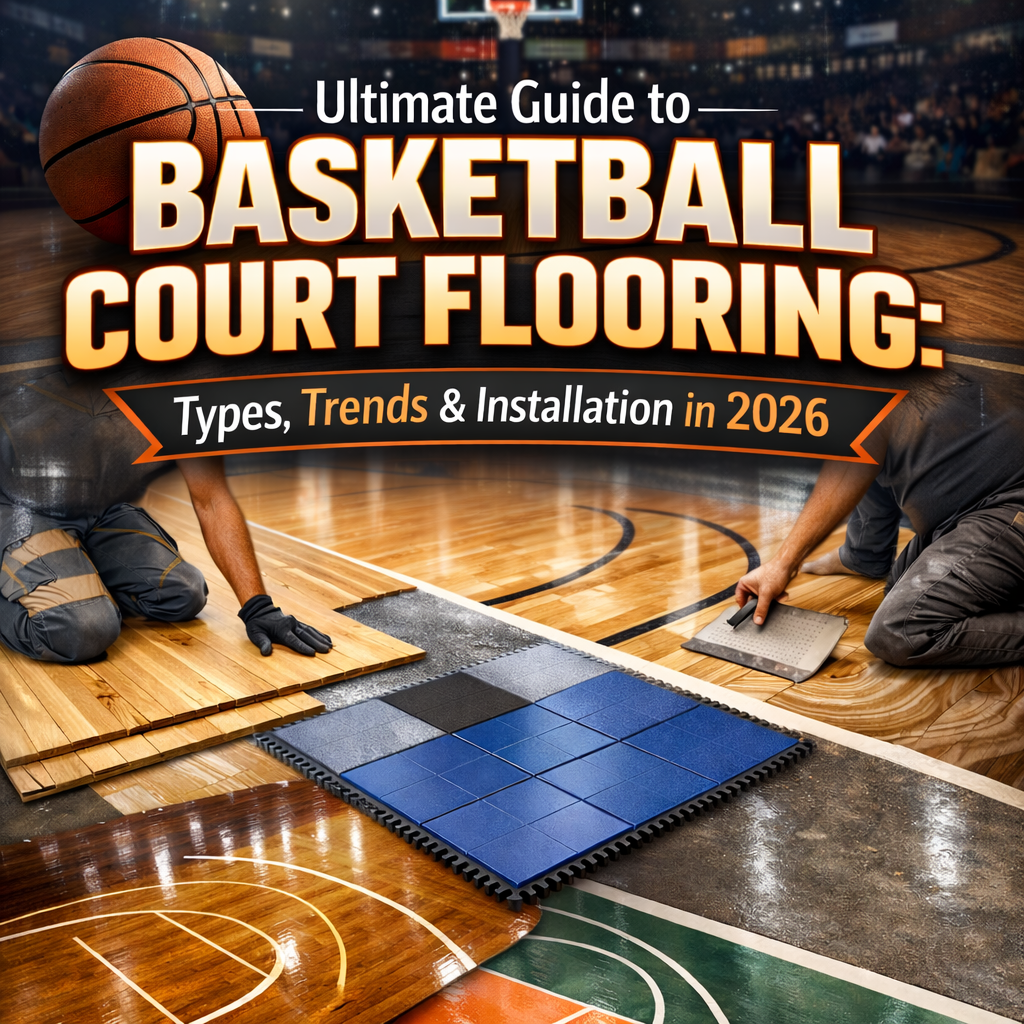
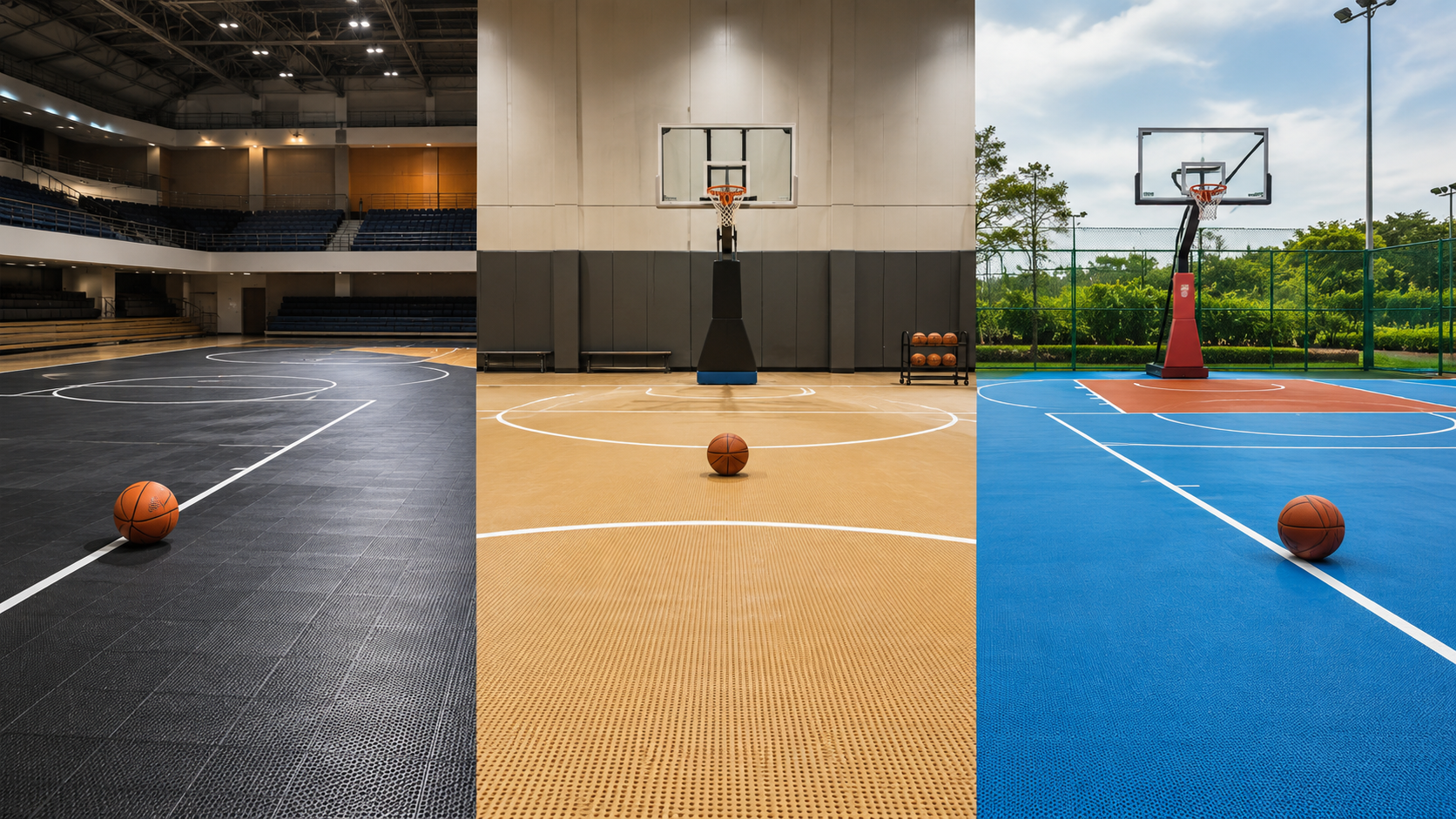
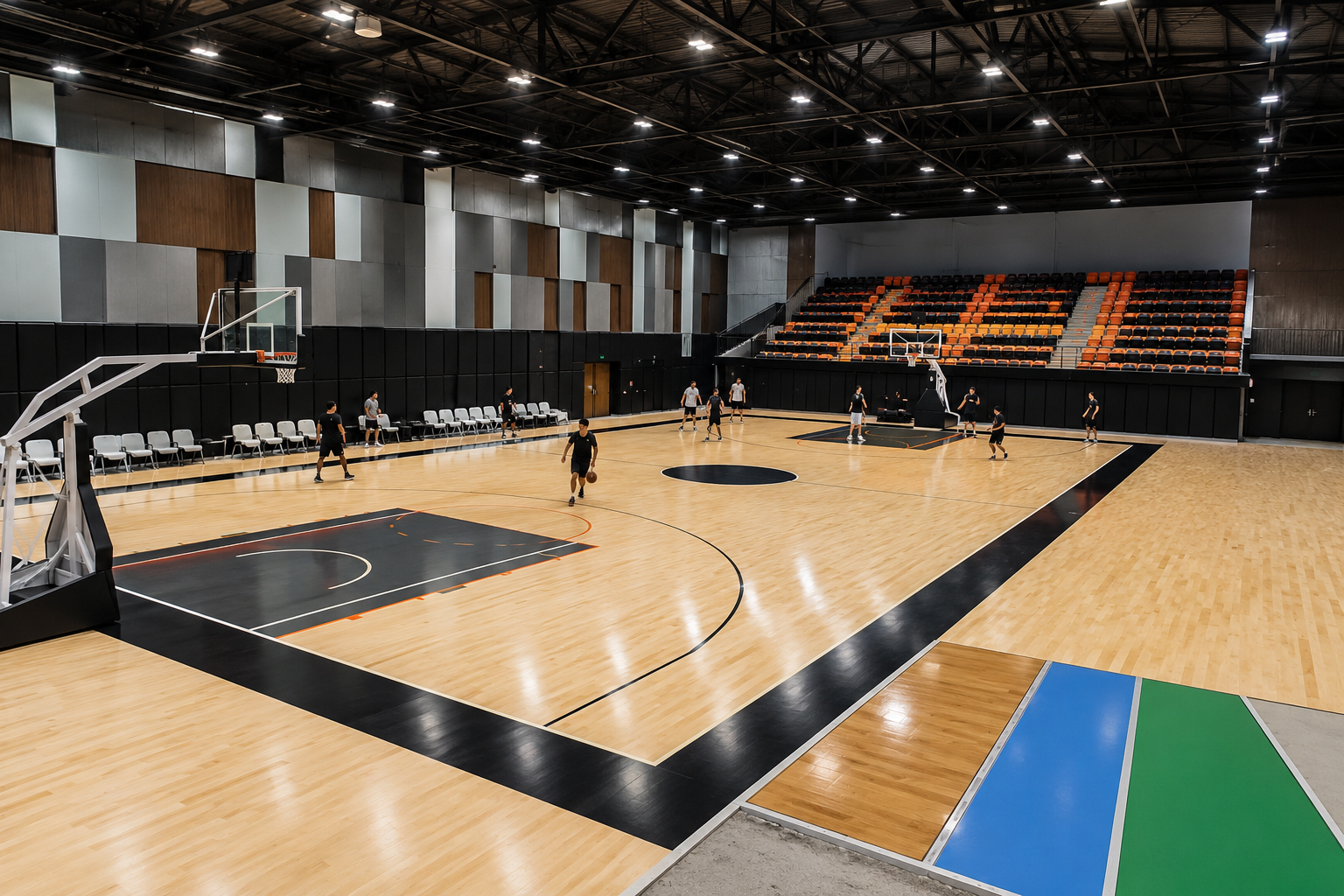
Modern indoor basketball facilities commonly use sprung hardwood, polyurethane (PU), PVC/vinyl sports flooring, and other engineered sports surfaces. Each option has different performance characteristics and installation requirements. For example, maple hardwood remains a premium choice for high-level basketball, while cushioned PU flooring provides a practical combination of comfort, performance, and versatility for many indoor facilities.
This guide explains the major factors you should evaluate before selecting basketball court flooring for an indoor sports facility.
Why Basketball Court Flooring Matters
Basketball involves constant running, jumping, sudden stops, rapid changes of direction, and repeated landings. Players place significant loads on their feet, ankles, knees, and other joints throughout a training session or match.
A suitable sports floor should therefore provide a controlled combination of:
- Shock absorption
- Stable foot traction
- Consistent ball bounce
- Appropriate surface elasticity
- Comfortable movement
- Resistance to wear
- Easy maintenance
- Long-term dimensional stability
A sports floor should not be selected simply because it looks attractive. The construction beneath the visible playing surface is equally important. A high-quality basketball floor is a complete system consisting of the substrate, cushioning or support layer, playing surface, protective finish, and court markings.
For this reason, flooring specifications should be considered during the initial planning stage rather than after the building is completed.
1. Start With the Type of Indoor Facility
The first question is: Who will use the basketball court and how frequently?
An elite basketball academy may require a completely different floor from a school gymnasium or residential sports hall.
Professional and Competitive Facilities
Professional academies, tournament venues, universities, and high-performance training centers should prioritize performance, shock absorption, consistent ball response, and compliance with applicable competition requirements.
A properly engineered sprung hardwood system can provide excellent athletic performance and is widely associated with high-level indoor basketball venues. Hardwood can also be refinished periodically, allowing the playing surface to remain functional for many years when correctly maintained.
Schools and Colleges
Educational institutions usually require a combination of durability, safety, versatility, and manageable maintenance costs.
If the hall will host basketball alongside volleyball, badminton, indoor training, or other activities, a cushioned synthetic sports flooring system can be an attractive option.
Commercial Sports Academies
Sports academies generally need flooring capable of handling intensive daily training. Players may use the court for several hours every day, which makes wear resistance and consistent performance especially important.
PU sports flooring is often considered for these environments because it can combine cushioning, seamless construction, and multi-sport versatility.
Community and Multipurpose Halls
If the facility is intended for recreational basketball and multiple indoor activities, the most expensive flooring may not necessarily be the best investment.
Instead, choose a system that offers appropriate shock absorption, reliable grip, easy cleaning, and sufficient durability for the expected usage.
2. Understand the Main Basketball Flooring Options
Before making a decision, understand what each flooring system offers.
Sprung Maple Hardwood Flooring
Maple hardwood is one of the most recognized indoor basketball surfaces. A professional system normally consists of a hardwood playing layer installed over a specially engineered subfloor.
The subfloor is critical because it contributes to the floor’s cushioning and area elasticity.
Advantages include:
- Excellent basketball playing characteristics
- Consistent ball response
- Premium appearance
- Excellent traction when correctly finished
- Can be sanded and refinished
- Suitable for high-level competition
However, hardwood requires greater attention to environmental conditions than many synthetic systems. Excessive moisture and humidity fluctuations can affect timber flooring, so appropriate building management and climate control should be considered.
Hardwood is therefore best suited to facilities where premium performance justifies higher installation and maintenance requirements.
Polyurethane Sports Flooring
Polyurethane, commonly called PU flooring, is a popular synthetic option for indoor sports facilities.
A typical system may include a prepared concrete substrate, cushioning layer, self-leveling components, pigmented surface layers, and protective finishing. The exact construction depends on the manufacturer’s system and the required performance characteristics.
PU flooring can provide:
- Good shock absorption
- Seamless appearance
- Consistent playing characteristics
- Easy cleaning
- Resistance to heavy usage
- Suitability for multipurpose indoor halls
Modern indoor sports flooring guides identify PU as a major option for basketball and other indoor court sports because it can provide a useful balance between performance and versatility.
For many commercial sports facilities, PU is worth considering when the goal is to achieve a professional-quality synthetic floor without moving to a premium hardwood installation.
PVC or Vinyl Sports Flooring
PVC sports flooring is supplied in engineered rolls or sheets. Depending on the product, the flooring may contain a wear layer, reinforcement structure, and cushioned backing.
This type of flooring is frequently used in indoor sports halls and multipurpose facilities. It can be particularly useful when a facility hosts several sports rather than basketball alone.
Potential benefits include:
- Factory-controlled manufacturing
- Cushioned construction
- Relatively quick installation
- Easy cleaning
- Availability in multiple colors and designs
- Suitable for multipurpose halls
The quality of the product and installation method matters significantly. Seams should be professionally joined, and the substrate must be properly prepared before installation.
Modular PP Sports Tiles
Interlocking polypropylene tiles are another option for some indoor basketball facilities, particularly where fast installation, easy replacement, or flexibility is important.
Individual damaged sections can generally be replaced without removing the entire playing surface. This can be useful for community facilities, temporary installations, or multipurpose areas.
However, buyers should evaluate the actual sports performance of the selected tile system rather than choosing it solely because it is inexpensive or easy to install.
3. Compare Shock Absorption and Player Comfort
Basketball players repeatedly jump and land during practice and competition. A hard surface with inadequate cushioning can create an uncomfortable playing environment.
When comparing floors, ask the installer:
- What type of cushioning system is included?
- What is the total flooring thickness?
- How is impact absorption achieved?
- Is the floor point-elastic or area-elastic?
- What performance documentation is available?
- Is the system designed specifically for basketball?
Do not judge cushioning simply by pressing your hand against a sample.
A technically engineered sports floor can behave very differently from ordinary commercial flooring. The interaction between the surface, cushioning layer, substrate, and subfloor determines the final performance.
4. Evaluate Traction and Slip Resistance
Basketball requires fast movement. Players need enough grip to accelerate, stop, pivot, and change direction without uncontrolled slipping.
At the same time, an excessively aggressive surface can interfere with natural movement.
The ideal floor should provide controlled traction rather than simply maximum grip.
Ask for technical information regarding:
- Slip resistance
- Surface texture
- Finish type
- Cleaning requirements
- Performance under dry conditions
- Compatibility with recommended basketball footwear
Avoid choosing flooring based only on color or visual texture.
5. Check Ball Bounce Consistency
Consistent ball response is an essential characteristic of a quality basketball court.
If one section of the court produces a noticeably different bounce from another, players can experience unpredictable game conditions.
This is why substrate preparation is so important.
Before installing the final sports surface, the contractor should verify that the base is:
- Level
- Stable
- Clean
- Dry
- Properly cured
- Free from major cracks and contamination
A premium flooring material cannot compensate for a poorly prepared foundation.
6. Examine the Indoor Building Conditions
Indoor does not automatically mean that every flooring system can be installed without environmental preparation.
Temperature and humidity can affect flooring materials, adhesives, coatings, and wooden components.
Hardwood systems are particularly sensitive to moisture and humidity fluctuations. Therefore, facilities considering timber flooring should assess ventilation, HVAC performance, humidity management, and moisture control before installation.
For synthetic flooring systems, the concrete substrate must also be sufficiently dry before installation. Moisture trapped below a flooring system can contribute to adhesion problems or other installation failures.
A professional site inspection should therefore happen before the flooring material is finalized.
7. Inspect the Concrete Subfloor
The subfloor is the foundation of the basketball flooring system.
Before installation, the contractor should evaluate:
- Surface levelness
- Moisture condition
- Concrete strength
- Cracks
- Expansion joints
- Surface contamination
- Uneven areas
- Drainage or water-related issues
- Existing coating or flooring
If the concrete requires grinding, leveling, crack repair, moisture treatment, or self-leveling preparation, these activities should be included in the project scope.
One of the biggest mistakes facility owners make is comparing flooring prices without comparing substrate preparation.
A low-cost flooring quote can become expensive if major preparation work is excluded.
8. Consider Court Usage and Traffic
Think about how many people will use the facility.
A basketball academy may conduct multiple training sessions every day. A school may have classes during weekdays and competitions on weekends. A commercial sports center may operate from morning until late evening.
Heavy traffic requires a flooring system designed for repeated use.
When evaluating products, consider:
- Expected playing hours per day
- Number of users
- Type of footwear
- Frequency of cleaning
- Equipment movement
- Furniture movement
- Possibility of other sports
- Expected service life
A slightly higher initial investment may be worthwhile if it reduces frequent repairs and replacement.
9. Decide Whether the Court Will Be Multipurpose
Many indoor sports facilities do not host basketball exclusively.
The same hall may be used for:
- Basketball
- Volleyball
- Badminton
- Futsal training
- Fitness activities
- School events
- Indoor competitions
- Community programs
If your hall has multiple functions, choose a flooring system that accommodates the complete activity schedule.
PU and engineered vinyl sports flooring can be particularly attractive for multipurpose facilities because they are available as synthetic sports systems designed for different athletic applications.
However, the exact specification should be matched to the sports that will receive the greatest amount of use.
10. Check Maintenance Requirements
Every basketball floor requires maintenance.
The maintenance schedule depends on the material, traffic, environmental conditions, and cleaning procedures.
Hardwood Maintenance
Hardwood generally requires:
- Regular dust removal
- Appropriate cleaning products
- Periodic inspection
- Finish maintenance
- Professional refinishing when required
- Moisture and humidity control
PU Maintenance
PU floors normally require:
- Regular sweeping
- Damp cleaning using approved products
- Prompt removal of spills
- Periodic inspection
- Recoating or refurbishment when required
PVC Sports Flooring Maintenance
PVC flooring generally benefits from:
- Routine dust removal
- Appropriate sports-floor cleaning products
- Immediate spill management
- Inspection of seams
- Avoidance of harsh chemicals
Always follow the flooring manufacturer’s maintenance recommendations.
11. Consider Court Markings and Finish
Court markings are not simply decorative elements.
Basketball lines must be clearly visible and accurately positioned for the intended ruleset. If the facility will host organized competition, the court should be designed according to the relevant governing body’s current specifications.
The finish should also minimize unwanted glare from indoor lighting.
A professional basketball court typically uses contrasting colors between the main playing area, key areas, boundary zones, and court lines. Good color planning improves visibility and gives the facility a polished professional appearance.
12. Evaluate Lighting Along With Flooring
Flooring and lighting should be considered together.
Glossy surfaces can reflect light and create visual distractions if lighting is poorly positioned. A suitable sports floor should therefore be coordinated with the facility’s LED lighting system.
Consider:
- Light distribution
- Glare
- Reflections
- Ceiling height
- Fixture positioning
- Camera requirements
- Spectator visibility
For facilities that plan to record games or livestream competitions, glare control becomes even more important.
13. Compare Initial Cost With Lifetime Value
The cheapest flooring option is not automatically the most economical.
Instead of asking only:
“How much does the flooring cost?”
ask:
“What will this flooring cost over its complete service life?”
Your calculation should consider:
- Material cost
- Subfloor preparation
- Installation
- Court markings
- Protective finishes
- Cleaning
- Periodic recoating
- Repairs
- Refinishing
- Replacement
- Downtime
Current Indian market guides show a wide spread between synthetic and premium hardwood systems, with actual prices depending heavily on specification, installation scope, location, and project requirements.
Therefore, request a detailed quotation rather than comparing a single per-square-foot number.
14. Ask for Technical Specifications
Before signing a contract, ask the flooring contractor for a written specification.
The document should identify:
- Flooring type
- Manufacturer or system name
- Total thickness
- Cushioning layer
- Substrate preparation
- Adhesive or bonding system where applicable
- Surface finish
- Court marking system
- Installation procedure
- Expected maintenance
- Warranty terms
A quotation that simply says “premium sports flooring” is difficult to evaluate.
The more clearly the system is specified, the easier it becomes to compare different contractors.
15. Select an Experienced Basketball Court Flooring Contractor
The quality of installation can be just as important as the quality of the flooring material.
Look for a contractor with experience in indoor sports construction rather than a general flooring installer.
Ask to see:
- Completed basketball courts
- Indoor sports facility projects
- Flooring samples
- Technical documentation
- Installation methodology
- Warranty information
- Maintenance recommendations
- Previous client references
An experienced sports flooring contractor should understand the relationship between the civil foundation, sports flooring, court dimensions, equipment, lighting, and overall facility design.
Recommended Flooring by Facility Type
A simple starting point is:
| Facility | Flooring to Consider |
|---|---|
| Professional basketball arena | Sprung hardwood |
| High-performance basketball academy | Sprung hardwood or premium PU |
| School indoor basketball court | PU or suitable synthetic sports flooring |
| College sports hall | PU, hardwood, or multipurpose synthetic flooring |
| Commercial sports academy | PU or high-performance synthetic flooring |
| Multipurpose indoor hall | PU or engineered PVC sports flooring |
| Budget recreational facility | Suitable synthetic or modular system |
This table should be treated as a starting point rather than a universal specification. The final selection should be based on the building, usage pattern, required performance, and available budget.
Common Mistakes to Avoid
Choosing Based Only on Price
A cheaper quotation may exclude substrate preparation, cushioning, markings, or finishing.
Installing on an Unprepared Base
Uneven or damp concrete can undermine an otherwise high-quality flooring system.
Ignoring Humidity
This is especially important for timber basketball flooring.
Selecting Ordinary Flooring
Commercial tiles, gym flooring, or generic vinyl are not automatically suitable for basketball.
Ignoring Maintenance
Every sports floor needs an appropriate cleaning and inspection routine.
Using an Inexperienced Installer
Poor installation can reduce the performance and service life of premium flooring.
Forgetting Multipurpose Usage
If the hall will host several sports, choose flooring based on the complete usage profile rather than basketball alone.
Final Checklist Before Choosing Basketball Court Flooring
Before approving the project, confirm:
- The flooring is designed for indoor sports use.
- The system provides appropriate shock absorption.
- Surface traction is suitable for basketball.
- Ball response is consistent.
- The concrete substrate has been professionally inspected.
- Moisture conditions have been checked.
- The facility’s humidity and ventilation have been considered.
- The flooring specification is provided in writing.
- Court markings are included.
- Maintenance requirements are understood.
- Warranty terms are documented.
- The contractor has relevant basketball flooring experience.
- Total lifecycle cost has been evaluated.
- The flooring is appropriate for the expected traffic.
- Any multipurpose requirements have been considered.
Conclusion
Choosing the best basketball court flooring for an indoor sports facility requires more than selecting a surface color or comparing installation prices. The right flooring must work as part of a complete sports-flooring system that combines performance, player comfort, durability, safety, and long-term maintenance.
For premium competitive venues, properly engineered sprung hardwood remains a leading choice. For many indoor academies, schools, clubs, and multipurpose sports halls, PU flooring can offer an effective balance between cushioning, durability, seamless construction, and versatility. PVC sports flooring and modular systems can also be considered where multipurpose use, installation flexibility, or budget plays a major role.
The most important step is to assess the facility before selecting the material. Consider the players, usage intensity, building environment, subfloor condition, maintenance capacity, competition requirements, and long-term budget.
A professionally planned basketball floor does more than make the court look impressive. It creates a reliable playing environment where athletes can train, compete, and improve with confidence for years to come.
The best basketball court flooring is ultimately the one that matches the facility’s performance requirements, building conditions, usage pattern, and long-term investment goals.