Introduction
Basketball is a fast-paced sport that demands quick movements, sudden stops, jumping, turning, and continuous changes in direction. While players, coaching, and equipment are important, the playing surface is equally significant. A properly designed basketball court flooring system can influence player comfort, traction, ball response, durability, maintenance, and the overall playing experience.
Choosing the right basketball court flooring is not simply about selecting an attractive color or finish. The flooring must match the location, level of play, expected usage, climate, maintenance requirements, and available budget. A school basketball court may have different requirements from a professional training academy, while an outdoor community court needs a flooring system capable of handling sunlight and changing weather conditions.
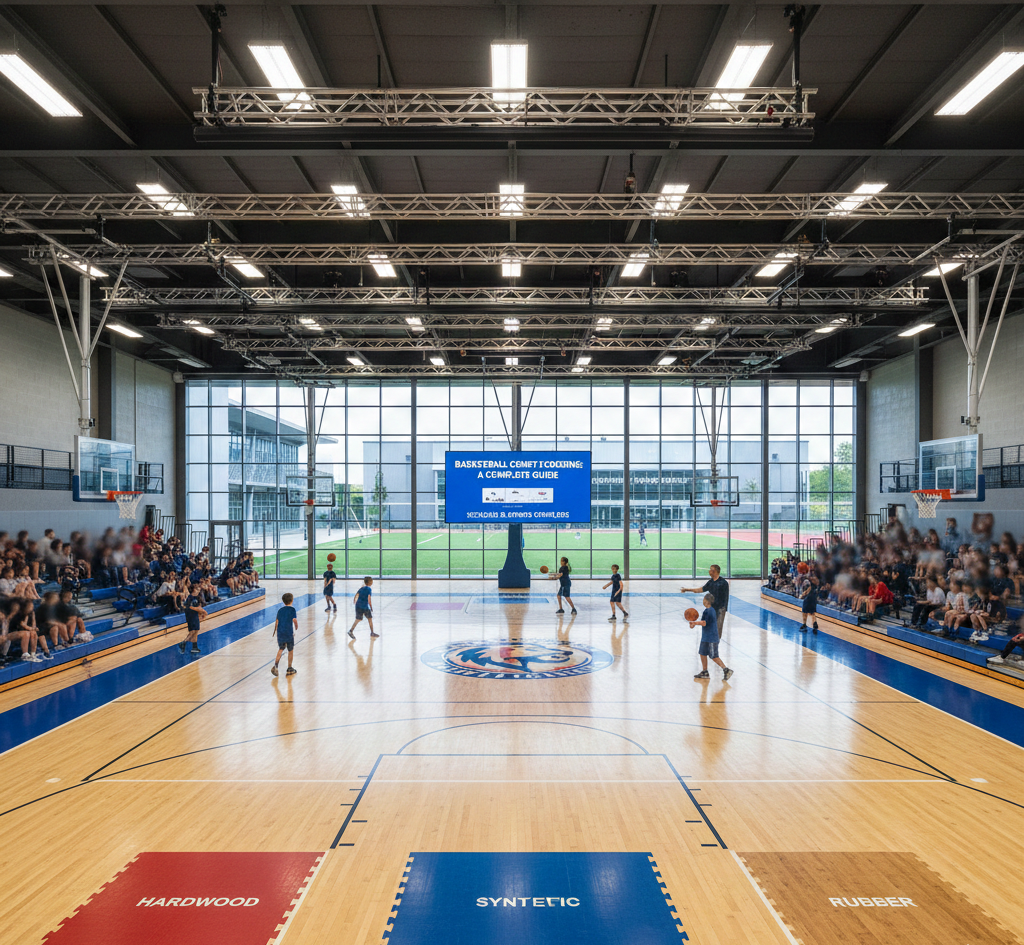
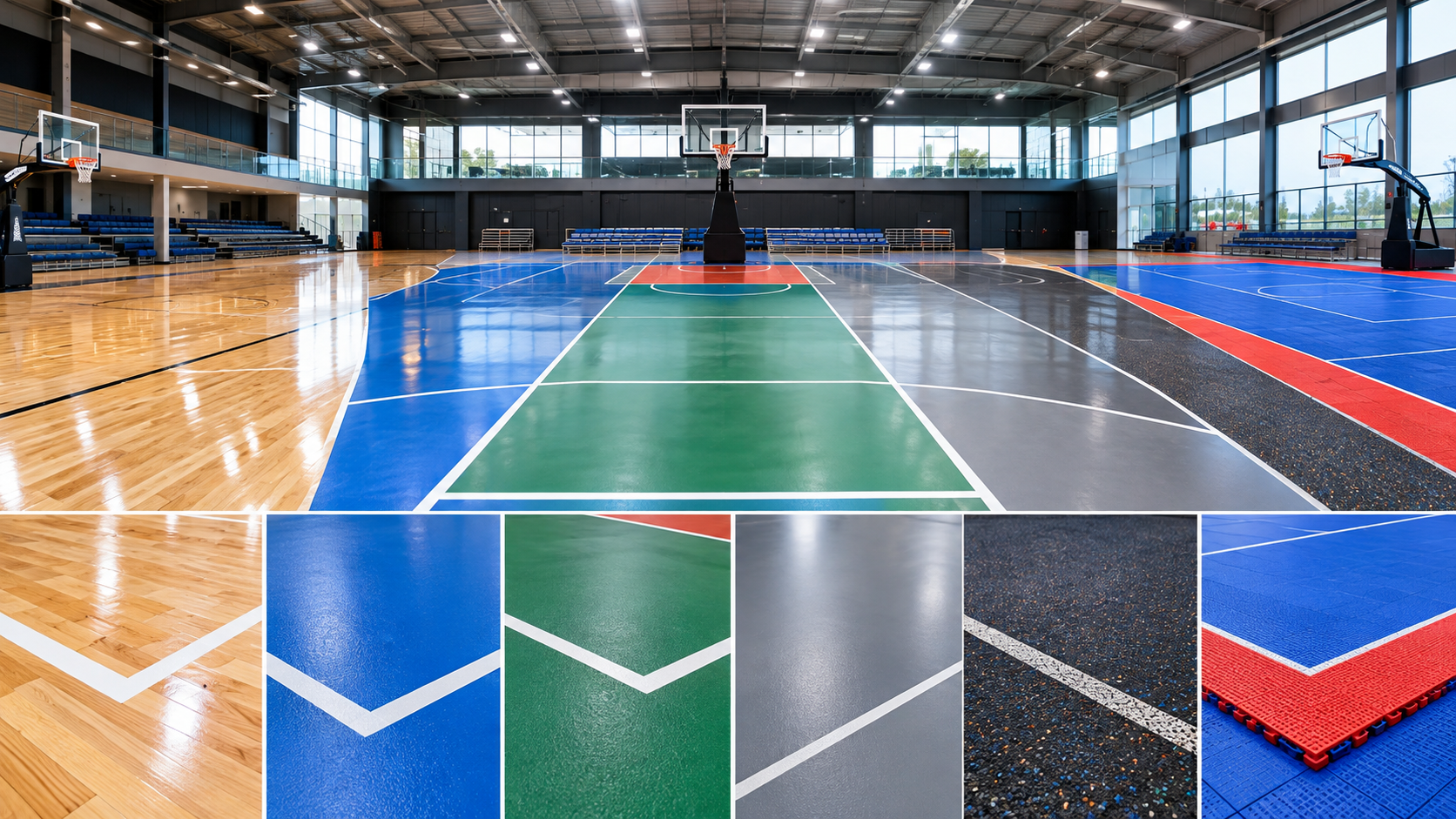
Modern basketball courts are available with several flooring options, including wooden sports flooring, PVC or vinyl sports flooring, acrylic flooring, polyurethane flooring, rubber flooring, and modular sports tiles. Each system has its own characteristics and practical advantages.
This guide explains the major types of basketball court flooring, their benefits, applications, and important factors to consider before installation.
Why Basketball Court Flooring Matters
Basketball involves repeated impact from running and jumping. Players also need reliable traction when accelerating, defending, shooting, or changing direction. A poorly selected or improperly installed surface can affect comfort and playing consistency.
Professional basketball flooring is generally designed around several important performance requirements:
- Consistent traction
- Controlled shock absorption
- Player comfort
- Ball response
- Surface durability
- Resistance to regular wear
- Easy cleaning and maintenance
- Proper court marking visibility
- Suitable performance for the intended environment
The subfloor is also important. Even premium flooring may perform poorly if the underlying concrete or base is uneven, damp, cracked, or inadequately prepared. For this reason, professional basketball court construction normally involves surface inspection, leveling, moisture assessment, installation, line marking, and quality checks.
Major Types of Basketball Court Flooring
1. Wooden Basketball Court Flooring
Hardwood flooring is one of the most recognized options for indoor basketball courts. It is widely associated with professional arenas, competitive facilities, colleges, sports academies, and high-quality indoor courts.
Maple hardwood is commonly used for high-performance basketball environments because it provides a firm and responsive playing surface. The floor is constructed over a suitable subfloor and may incorporate a sports-grade cushioning or shock-absorption system.
Benefits of Wooden Basketball Flooring
Excellent ball response: Hardwood provides a predictable surface for basketball movement and ball interaction.
Professional appearance: Natural wood creates a premium visual appearance and is commonly used in major indoor sporting facilities.
Good traction: A properly finished sports hardwood surface can provide controlled grip for quick movements.
Long service potential: With correct maintenance and periodic refinishing, quality hardwood flooring can remain usable for many years.
Suitable for competitive play: Hardwood is frequently selected for professional and institutional basketball facilities where consistent performance is important.
Where Is Wooden Flooring Suitable?
Wooden basketball flooring is particularly suitable for:
- Indoor stadiums
- Professional basketball facilities
- Sports academies
- Colleges and universities
- Training centers
- Multi-purpose indoor arenas
- High-level competition venues
The main consideration is maintenance. Wood requires protection from excessive moisture, unsuitable cleaning chemicals, scratches, and environmental fluctuations.
2. PVC or Vinyl Basketball Court Flooring
PVC sports flooring is another popular choice for indoor basketball courts. It is manufactured as sports-grade rolls or tiles and can incorporate cushioning layers designed to improve comfort and impact management.
PVC flooring is often selected for schools, sports clubs, academies, community centers, indoor gyms, and multi-purpose sports halls.
Benefits of PVC Basketball Flooring
Shock absorption: Cushioned PVC systems can help reduce the impact transmitted through the playing surface during repeated movements.
Comfort: The layered construction can provide a more comfortable surface for regular training and recreational use.
Slip resistance: Textured sports surfaces can provide controlled traction when properly selected and maintained.
Low maintenance: Routine sweeping and damp cleaning can generally keep the surface in good condition.
Moisture resistance: PVC can be a practical option for indoor facilities where moisture management is an important consideration.
Design flexibility: PVC flooring is available in different colors, patterns, and surface finishes.
Applications
PVC basketball flooring can be used in:
- Schools
- Indoor basketball courts
- Sports academies
- Fitness facilities
- Clubs
- Community sports centers
- Corporate recreation facilities
- Multi-purpose sports halls
For heavy-use facilities, the thickness, wear layer, cushioning construction, and installation quality should be selected according to expected traffic.
3. Acrylic Basketball Court Flooring
Acrylic flooring is commonly associated with outdoor sports courts. It is applied over a properly prepared concrete or asphalt base and built through multiple coating layers.
Acrylic basketball surfaces can be customized with different colors and court-marking layouts, making them suitable for outdoor recreational and institutional facilities.
Benefits of Acrylic Flooring
Weather suitability: Outdoor acrylic systems can be designed for exposure to sunlight and changing weather conditions.
Strong surface finish: Properly installed acrylic coatings provide a durable sports surface.
Good traction: The texture can be adjusted according to the required playing characteristics.
Color options: Court owners can select different color combinations for playing and surrounding areas.
Easy maintenance: Routine cleaning and periodic inspection help preserve the playing surface.
Cost efficiency: Acrylic can be a practical choice for many outdoor basketball projects when compared with some specialized indoor flooring systems.
Where Can Acrylic Basketball Flooring Be Used?
It is commonly considered for:
- Outdoor basketball courts
- Schools
- Residential communities
- Parks
- Sports clubs
- Colleges
- Public recreation areas
- Training facilities
Acrylic flooring is highly dependent on the quality of the underlying base. Cracks, drainage problems, or improper surface preparation can eventually affect the coating system.
4. Polyurethane Basketball Court Flooring
Polyurethane, commonly called PU flooring, is another sports flooring solution used in indoor and multi-purpose facilities. PU systems are constructed through carefully controlled coating layers and can provide a seamless finished surface.
Depending on the specification, PU flooring can be designed with different levels of elasticity, cushioning, and wear resistance.
Benefits of PU Basketball Flooring
Seamless finish: Unlike roll materials, a properly installed PU system creates a continuous surface.
Shock management: Sports PU systems can be engineered to provide cushioning suitable for athletic activities.
Durability: Quality PU systems can withstand substantial levels of regular sports traffic.
Comfort: The surface can offer a balanced combination of grip and cushioning.
Custom appearance: Different colors and court-marking combinations are available.
Multi-purpose use: PU flooring can work well in sports halls where basketball is played alongside other indoor activities.
Suitable Applications
PU flooring may be considered for:
- Indoor basketball courts
- Sports complexes
- School gymnasiums
- Training centers
- Multi-purpose sports halls
- Institutional facilities
Professional installation is particularly important because the surface needs proper substrate preparation, controlled application, curing, and finishing.
5. Rubber Basketball Court Flooring
Rubber flooring is designed to provide durability and impact management. It is available in different formats, including rolls and tiles.
Rubber surfaces can be useful in facilities where resilience, comfort, and heavy-duty performance are important considerations.
Benefits of Rubber Flooring
Impact absorption: Rubber naturally provides a degree of cushioning and can be designed for sports applications.
Durability: It can withstand repeated foot traffic and demanding usage.
Noise reduction: Some rubber systems can help reduce impact noise compared with harder surfaces.
Comfort: The resilient nature of rubber can make it comfortable for training environments.
Maintenance: Routine cleaning is generally straightforward when the correct cleaning procedure is followed.
Where Is Rubber Flooring Used?
Rubber flooring may be suitable for:
- Training areas
- Sports gyms
- Recreational basketball facilities
- Fitness centers
- Indoor sports halls
- Athletic training spaces
However, the specific rubber product should be selected carefully because not every rubber floor is designed for basketball. Sports-specific traction and ball-response characteristics should be considered.
6. Modular Basketball Court Tiles
Modular sports tiles are another option, particularly for outdoor basketball courts and recreational facilities. These systems consist of interlocking or mechanically connected individual tiles installed over a suitable base.
Their modular construction can simplify installation and, depending on the product, allow individual damaged sections to be replaced.
Benefits of Modular Tiles
Fast installation: Interlocking systems can be installed comparatively quickly when the base is ready.
Replaceable sections: Damaged tiles may be replaceable without removing the entire court surface.
Outdoor applications: Certain modular systems are designed specifically for outdoor sports use.
Drainage capability: Some tile designs incorporate drainage pathways beneath or through the surface.
Design flexibility: Different colors and patterns can be combined to create customized court designs.
Common Applications
Modular basketball tiles can be considered for:
- Outdoor basketball courts
- Schools
- Community centers
- Residential societies
- Parks
- Recreational areas
- Temporary or semi-permanent sports installations
The base must still be properly prepared. Modular tiles do not eliminate the need for a stable, level, and suitable foundation.
Indoor vs Outdoor Basketball Court Flooring
One of the first decisions in a basketball court project is determining whether the court will be indoor or outdoor.
Indoor Basketball Flooring
Indoor facilities generally provide greater control over temperature, humidity, sunlight, and moisture. Common flooring choices include:
- Hardwood
- PVC sports flooring
- PU flooring
- Rubber sports flooring
The selection should depend on the intended level of play, usage frequency, maintenance capacity, and performance requirements.
Outdoor Basketball Flooring
Outdoor courts face more demanding environmental conditions. Direct sunlight, rain, temperature changes, dust, and moisture can affect the surface.
Common options include:
- Acrylic systems
- Outdoor PU systems
- Modular sports tiles
- Specialized outdoor sports coatings
Outdoor flooring should also be planned with proper drainage and expansion considerations.
Basketball Court Flooring Comparison
| Flooring Type | Typical Environment | Main Benefits | Maintenance |
|---|---|---|---|
| Hardwood | Indoor | Professional feel, ball response, premium appearance | Moderate |
| PVC/Vinyl | Indoor | Cushioning, comfort, easy cleaning | Low to moderate |
| Acrylic | Outdoor | Weather-oriented coating, color flexibility | Moderate |
| PU | Indoor | Seamless finish, durability, cushioning options | Low to moderate |
| Rubber | Indoor | Resilience, impact management, durability | Low to moderate |
| Modular Tiles | Mainly outdoor | Quick installation, replaceable sections | Low to moderate |
The table provides a general comparison. Actual performance depends on the product specification, substrate, installation method, climate, and maintenance program.
How to Choose the Right Basketball Court Flooring
Selecting a basketball floor should begin with the requirements of the facility rather than the appearance of the material.
1. Consider the Location
Determine whether the court is indoors or outdoors. Outdoor courts require flooring designed for exposure to environmental conditions, while indoor courts provide more flexibility.
2. Identify the Level of Play
A professional training facility may require different performance characteristics from a school recreational court.
Consider whether the court will be used for:
- Recreation
- School sports
- Academy training
- Competitive matches
- Professional-level training
- Multi-purpose activities
3. Evaluate Player Comfort
Basketball involves repeated jumping, running, and directional changes. Flooring with an appropriate sports cushioning system can contribute to overall playing comfort.
4. Check Traction Requirements
Too little grip can make movement difficult, while excessive friction may also be undesirable. The surface should provide controlled traction suitable for basketball activity.
5. Inspect the Subfloor
A high-quality flooring system cannot compensate for a defective foundation. Before installation, check:
- Levelness
- Cracks
- Moisture
- Surface strength
- Cleanliness
- Drainage for outdoor courts
Subfloor preparation is one of the most important stages of basketball court construction.
6. Consider Maintenance
Every flooring type has different maintenance requirements. Hardwood may need specialized care and periodic refinishing, while PVC, PU, and acrylic surfaces generally rely more on routine cleaning and periodic inspections.
7. Calculate the Long-Term Cost
The cheapest initial option is not always the lowest-cost solution over its entire service life.
Consider:
- Material price
- Surface preparation
- Installation
- Court marking
- Maintenance
- Repairs
- Replacement requirements
- Expected usage
A lifecycle approach can help facility owners make a more informed investment.
Basketball Court Flooring Installation Process
Professional installation normally begins with a detailed site assessment.
: Site Inspection
The installation team evaluates the existing floor or proposed court area.
Step 2: Base Preparation
The surface is cleaned, repaired, leveled, and prepared according to the selected flooring system.
Step 3: Moisture Assessment
For indoor installations, moisture conditions should be checked before installing flooring materials that may be affected by excessive moisture.
Step 4: Flooring Installation
The selected system is installed according to the manufacturer’s technical requirements. This may involve laying rolls, applying coating layers, installing hardwood components, or connecting modular tiles.
Step 5: Court Marking
Basketball lines are measured and marked accurately according to the intended court specification.
Step 6: Quality Inspection
The finished surface is inspected for adhesion, appearance, levelness, joints, markings, and overall finish.
Step 7: Final Handover
After the appropriate curing or installation period, the court can be handed over with maintenance recommendations.
Common Basketball Court Flooring Problems
Even good-quality flooring can develop problems if the installation or maintenance process is neglected.
Common issues include:
- Surface cracking
- Peeling coatings
- Uneven areas
- Poor adhesion
- Excessive slipperiness
- Worn-out markings
- Moisture damage
- Damaged tiles
- Scratches
- Joint separation
Many of these problems can be reduced through proper substrate preparation, correct product selection, professional installation, and regular maintenance.
Basketball Court Flooring Maintenance Tips
Regular maintenance helps preserve appearance and performance.
Keep the surface clean
Remove dust, dirt, and debris regularly. Fine particles can affect traction and surface wear.
Use suitable cleaning products
Avoid aggressive chemicals unless specifically approved for the flooring system.
Prevent unnecessary damage
Heavy equipment, sharp objects, and unsuitable footwear can damage sports flooring.
Inspect the court regularly
Look for cracks, loose sections, worn markings, surface deterioration, or moisture-related problems.
Maintain outdoor drainage
For outdoor courts, water should drain efficiently instead of remaining on the playing surface.
Final Thoughts
Basketball court flooring plays an important role in creating a functional, safe, comfortable, and durable sports environment. There is no single flooring material suitable for every basketball court. Hardwood can provide a traditional professional indoor playing environment, while PVC offers cushioning and practical maintenance advantages. Acrylic is widely considered for outdoor courts, PU provides seamless sports surfaces, rubber offers resilience, and modular tiles provide flexible installation options for suitable applications.
The right decision depends on the court location, usage intensity, playing requirements, budget, maintenance expectations, and quality of the underlying base.
For schools, academies, clubs, stadiums, residential communities, and commercial sports facilities, investing in professionally planned basketball court flooring can help create a surface that remains functional and visually appealing for years.
Before beginning a basketball court flooring project, evaluate the site carefully and compare flooring specifications rather than choosing solely on appearance or initial price. A properly selected and professionally installed flooring system can make a significant difference to the overall quality of the basketball facility.
Frequently Asked Questions
1. What are the main types of basketball court flooring?
The main types include hardwood, PVC, acrylic, PU, rubber, and modular sports tiles.
2. Which flooring is best for an indoor basketball court?
Hardwood, PVC, PU, and rubber sports flooring are commonly used for indoor basketball courts.
3. Which basketball flooring is suitable for outdoor courts?
Acrylic, outdoor PU, and modular sports tiles are commonly considered for outdoor basketball courts.
4. Is PVC flooring good for basketball courts?
Yes, sports-grade PVC flooring can provide cushioning, traction, comfort, and easy maintenance.
5. How long does basketball court flooring last?
Its lifespan depends on the flooring type, installation quality, usage, climate, and maintenance.
6. How much does basketball court flooring cost?
Cost depends on flooring material, court size, subfloor condition, installation, and project requirements.
7. Why is proper subfloor preparation important?
A level, clean, and properly prepared base helps improve flooring performance and durability.
8. Can basketball court flooring be customized?
Yes, many flooring systems offer different colors, finishes, court markings, and design options