Introduction
Badminton is a fast-paced sport that demands explosive movement, rapid changes of direction, jumping, lunging, and repeated stopping. While players often focus on rackets, shoes, shuttlecocks, and training techniques, one of the most important factors affecting their safety is the playing surface beneath their feet.
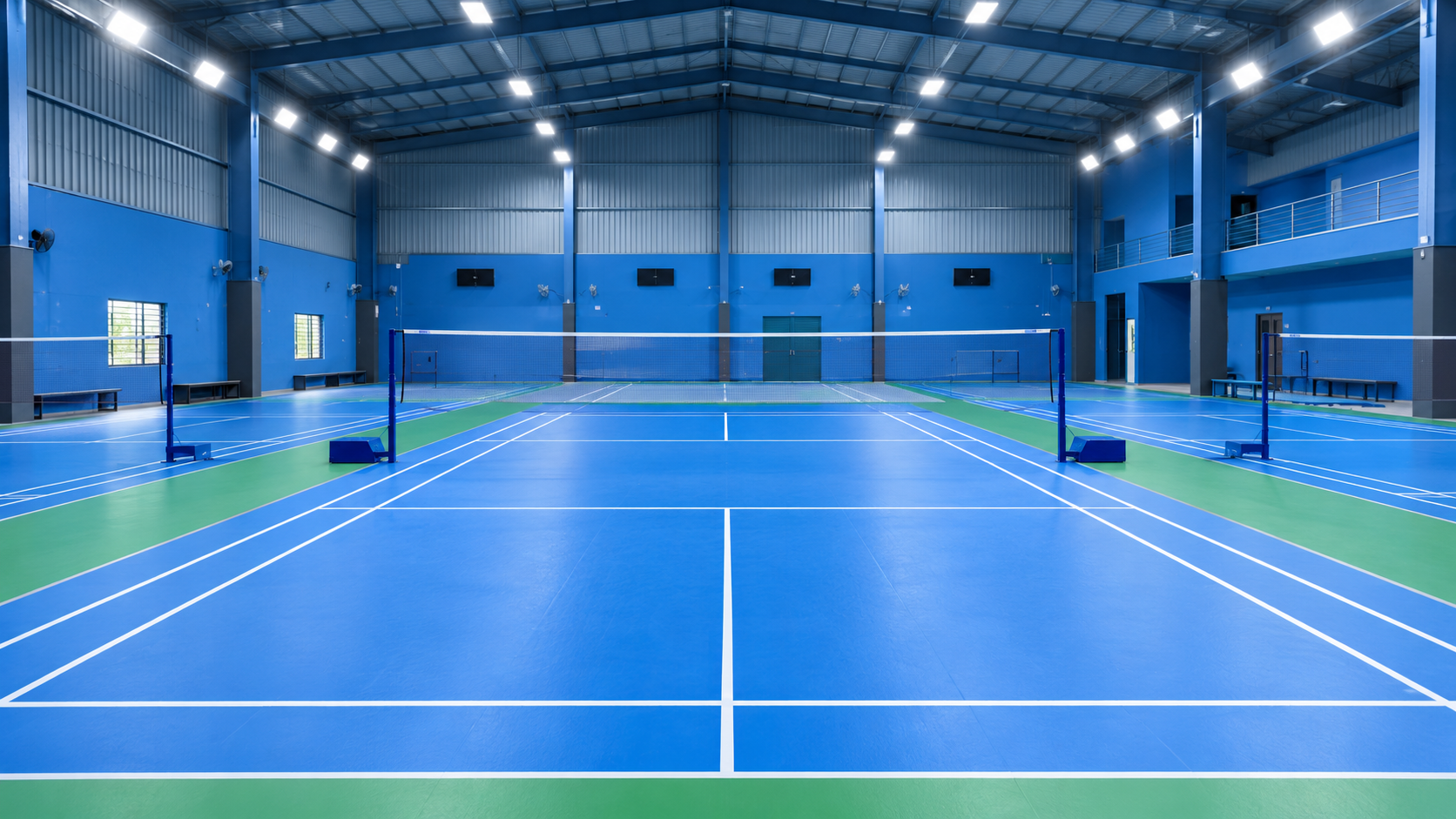
A professionally installed badminton court flooring system does much more than create an attractive court. It provides the right combination of shock absorption, traction, stability, cushioning, and surface consistency required for safe and effective play. When flooring is poorly designed or incorrectly installed, players may experience slipping, excessive impact, unstable foot placement, or unnecessary stress on the ankles, knees, hips, and lower back.
For schools, sports academies, clubs, indoor stadiums, fitness facilities, universities, and professional training centres, investing in professional badminton court flooring installation is therefore an important part of creating a safe sporting environment.
This guide explains why professional installation matters, how quality flooring protects players, what problems can occur with improper installation, and how to choose the right flooring system for a badminton facility.
Understanding the Importance of Badminton Court Flooring
Badminton involves significantly more movement than simply running from one point to another. Players constantly accelerate, decelerate, pivot, jump, land, and stretch into different positions to reach the shuttlecock.
These movements place considerable demands on the feet and lower body. Every landing and sudden directional change transfers force through the flooring system.
A suitable badminton court floor helps manage these forces while providing enough grip for controlled movement.
The objective is not to create a surface that is simply soft or highly cushioned. Excessive softness can reduce stability, while an overly hard surface can increase impact. The flooring needs to provide a carefully balanced performance response.
A professional installation ensures that the entire flooring system—from the underlying base to the visible playing surface—is prepared and installed according to the requirements of the facility.
1. Reduces the Risk of Slips and Falls
Traction is one of the most important safety characteristics of badminton flooring.
Players frequently perform quick lateral movements and sudden stops. If the floor is excessively slippery, their shoes may lose contact with the surface. This can result in uncontrolled movement, falls, twisted ankles, or other injuries.
On the other hand, a surface with excessive friction can restrict natural movement and place additional stress on the legs and joints.
Professional badminton flooring installation focuses on creating an appropriate balance between grip and movement. The surface is prepared properly, seams are managed carefully, and the final flooring is installed without loose sections, raised edges, or unwanted irregularities.
Regular cleaning and maintenance also play a major role in maintaining traction. Dust, moisture, sweat, and unsuitable cleaning products can change the surface characteristics over time.
2. Provides Better Shock Absorption
Badminton players repeatedly jump and land during rallies. These movements can create significant impact forces, particularly during aggressive play and extended training sessions.
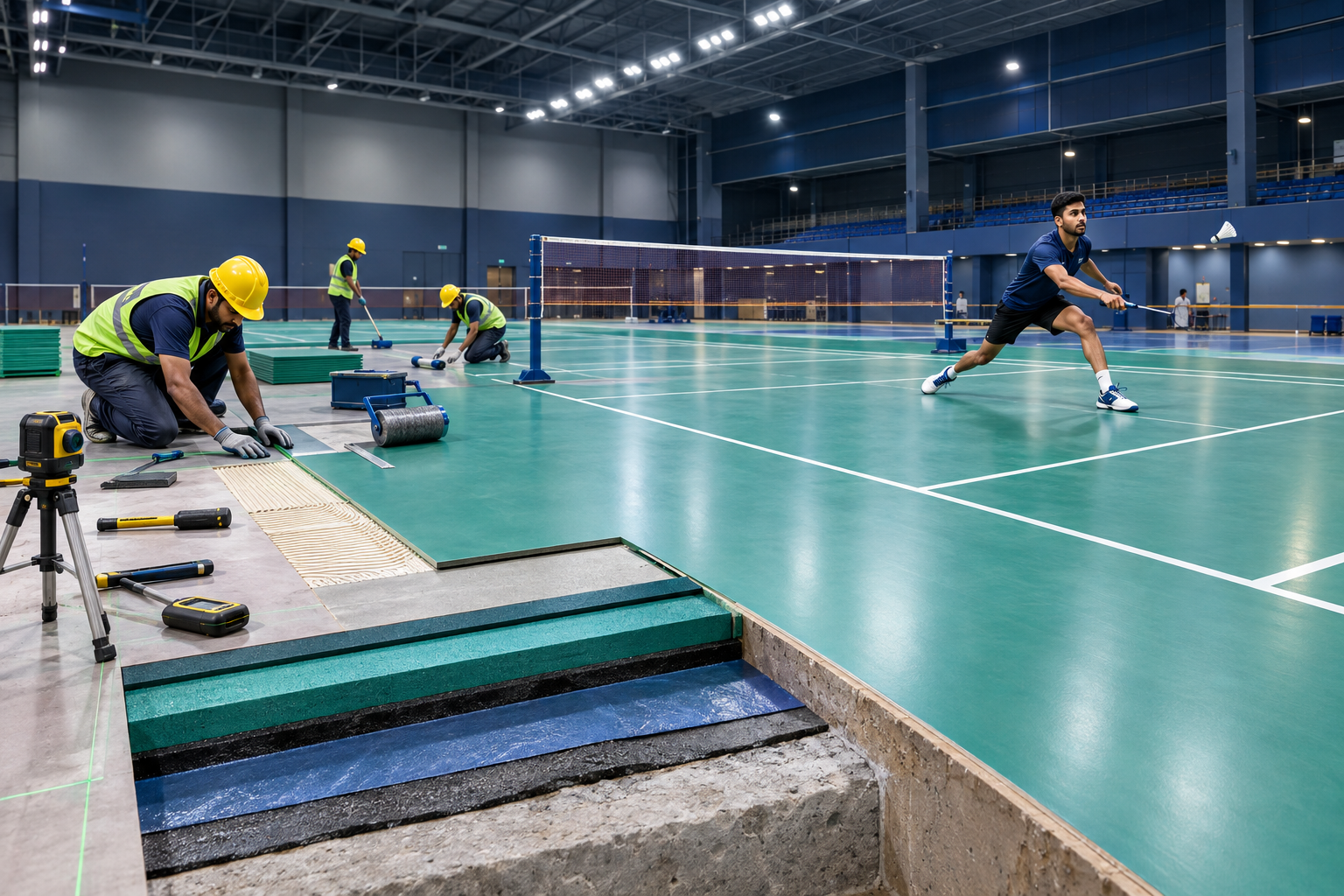
A professionally designed sports flooring system can incorporate cushioning or resilient layers that help absorb and distribute impact.
Depending on the flooring specification, this may include resilient underlayers, cushioned sports surfaces, sprung subfloors, or specialized multi-layer systems.
Effective shock absorption can help create a more comfortable playing environment and reduce excessive impact transmission through the lower body.
This is especially important in facilities where athletes train for several hours each day.
3. Protects Ankles, Knees, and Other Joints
Badminton requires frequent lunges and rapid directional changes. The ankle and knee joints are particularly involved in these movements.
If the floor is too hard, uneven, slippery, or inconsistent, players may have difficulty maintaining proper balance and movement control.
A correctly installed flooring system provides a stable and predictable surface beneath the player. This helps athletes move with greater confidence while performing demanding footwork.
Professional installation cannot eliminate sports injuries entirely, because injuries can have many causes. However, an appropriately designed playing surface can contribute to a safer environment when combined with proper footwear, training, warm-ups, technique, and maintenance.
4. Creates a Consistent Playing Surface
Consistency is essential in badminton.
Players need to know how their feet will respond when they move across the court. If one area has different levels of grip, cushioning, or firmness from another, movement can become unpredictable.
Professional installation helps ensure that the flooring is level and securely fixed across the playing area.
For modular, PVC, vinyl, synthetic, or wooden sports flooring systems, installation methods vary. However, the underlying principle remains the same: the finished court should provide a uniform playing experience.
Uneven surfaces, poorly joined sections, loose tiles, bubbles, wrinkles, or improperly installed seams can create hazards and affect player confidence.
5. Helps Improve Movement and Footwork
Good badminton flooring does not simply protect players; it also supports performance.
The sport requires precise footwork. Players must move forward, backward, sideways, and diagonally while maintaining balance and preparing for the next shot.
A suitable floor allows players to push off, stop, and change direction without excessive slipping or unwanted resistance.
This makes flooring an important part of overall court performance.
A professionally installed surface provides consistent traction throughout the playing area, allowing athletes to develop reliable movement patterns during practice and competition.
6. Professional Installation Starts with the Subfloor
One of the most common mistakes in sports flooring projects is focusing only on the visible top surface.
The performance of a badminton floor depends heavily on what lies underneath it.
Before installation begins, professionals should assess the existing base for factors such as:
- Surface level and flatness
- Moisture conditions
- Cracks and structural defects
- Surface contamination
- Concrete strength and condition
- Drainage or water-related concerns
- Existing flooring condition
- Required expansion provisions
If the base is not properly prepared, problems can eventually appear on the finished floor.
For example, an uneven subfloor can cause visible irregularities in the flooring surface. Excess moisture may affect certain flooring materials or adhesives. Cracks can potentially transfer into the finished system if they are not appropriately addressed.
Proper subfloor preparation is therefore one of the foundations of a safe badminton court.
7. Prevents Flooring Movement and Surface Defects
Badminton players need a stable surface beneath their shoes.
Loose flooring sections, poorly bonded materials, lifting edges, bubbles, gaps, or damaged joints can create unexpected obstacles.
Even a relatively small defect can become a problem when players are moving at high speed.
Professional installers use appropriate installation techniques, materials, adhesives, joining methods, and finishing procedures according to the selected flooring system.
The objective is to create a secure, continuous playing surface that remains stable during repeated athletic use.
8. Wooden Badminton Flooring Requires Specialized Installation
Wooden badminton courts are widely used for premium indoor sports facilities because they can provide a high-quality playing environment when properly designed.
However, wood is a natural material and requires careful consideration during installation.
The installation process may involve:
- Moisture assessment
- Subfloor preparation
- Resilient supports or pads
- Structural wooden components
- Plywood or supporting layers
- Expansion provisions
- Hardwood installation
- Sanding
- Surface finishing
- Court line marking
A professional installer must account for environmental conditions such as temperature and humidity because wood can respond to changes in moisture.
Poor installation can lead to gaps, movement, deformation, surface irregularities, or premature deterioration.
A professionally engineered wooden sports floor can instead provide a stable and responsive surface suitable for intensive badminton use.
9. PVC and Synthetic Badminton Flooring Also Requires Precision
PVC and other synthetic sports flooring systems are popular for indoor badminton courts because they can provide durability, consistent performance, and relatively straightforward maintenance.
However, the material itself does not guarantee safety.
The installation surface must be properly prepared before the flooring is installed. Depending on the system, installers may need to control moisture, correct uneven areas, prepare joints, apply appropriate adhesive, and carefully manage seams.
Poor installation can cause bubbles, lifting, open joints, or uneven transitions.
Professional installation helps ensure that the synthetic surface functions as part of a complete sports flooring system rather than simply being placed over an unsuitable base.
10. Correct Court Markings Improve Player Awareness
Accurate court markings are another important part of professional installation.
Badminton players depend on clearly visible boundaries during both practice and competitive matches.
Incorrectly positioned or poorly applied lines can create confusion and affect the usability of the court.
Professional court marking involves accurate measurement, appropriate line materials, proper alignment, and careful application.
The final markings should be clearly visible without creating unwanted surface irregularities.
11. Professional Installation Improves Long-Term Durability
A badminton court can experience thousands of hours of repeated movement.
Players constantly run, stop, pivot, jump, and land. Sports shoes create repeated friction against the surface.
A professionally installed flooring system is better positioned to withstand this demanding environment.
Proper installation reduces the likelihood of premature problems caused by inadequate bonding, poor subfloor preparation, incorrect joints, or unsuitable installation techniques.
This can help facility owners reduce repair requirements and maintain a better-quality playing environment over the long term.
12. Reduces Maintenance Problems
Correct installation can also make ongoing maintenance easier.
When flooring is installed properly, the surface is less likely to develop avoidable problems such as loose edges, open seams, uneven sections, or premature surface deterioration.
However, even the best flooring requires routine care.
Facility managers should establish a maintenance program that includes:
- Regular dust and dirt removal
- Appropriate damp cleaning
- Prompt removal of spills
- Inspection of damaged areas
- Periodic professional inspection
- Use of manufacturer-recommended cleaning products
- Avoidance of unsuitable chemicals and abrasive equipment
Maintenance is particularly important because dust and moisture can affect traction.
13. Professional Installation Supports Different Facility Requirements
Not every badminton court has the same purpose.
A school may need a durable and easy-to-maintain system for frequent recreational use. A sports academy may prioritize cushioning and performance because athletes train for many hours each week.
A professional competition facility may have more demanding specifications regarding surface consistency, dimensions, lighting, court layout, and playing conditions.
Residential and community facilities may prioritize durability, safety, cost efficiency, and maintenance.
Professional flooring specialists can evaluate the facility’s intended use and recommend a system based on traffic levels, available subfloor, environmental conditions, budget, and performance requirements.
14. Why DIY or Poor Installation Can Become Expensive
Choosing the cheapest installation approach can appear economical initially, but flooring problems can become expensive later.
If the base is inadequately prepared, the facility may eventually face repairs, replacement work, or court downtime.
Potential issues include:
- Uneven flooring
- Loose sections
- Poorly bonded surfaces
- Visible seams
- Surface bubbles
- Cracking
- Moisture-related damage
- Inconsistent cushioning
- Premature wear
- Poor traction
- Damaged court markings
Correcting these problems after installation can require removing sections of flooring and repeating preparation work.
Professional installation therefore represents an investment in the complete performance and lifespan of the court rather than simply an installation charge.
15. Safety Is More Than Flooring Alone
Although flooring plays an important role, player safety depends on the entire sports environment.
A safe badminton facility should also consider:
- Appropriate sports footwear
- Adequate lighting
- Correct court dimensions
- Safe clearance around the playing area
- Proper ventilation
- Regular floor cleaning
- Equipment maintenance
- Player warm-up and conditioning
- Coaching and movement technique
- Prompt repair of damaged flooring
The flooring should be considered one part of a broader safety strategy.
How to Choose a Professional Badminton Flooring Installer
Before hiring an installation company, facility owners should evaluate several factors.
Experience with Sports Flooring
Sports flooring is different from ordinary residential or commercial flooring. Look for installers with experience working on badminton courts and similar athletic facilities.
Knowledge of Different Flooring Systems
A reliable contractor should understand the differences between wooden, PVC, vinyl, polyurethane, rubber, and other sports flooring systems.
Subfloor Assessment
Ask whether the installer will inspect the existing base before providing the final recommendation.
Installation Method
The contractor should clearly explain how the selected flooring will be installed and what preparation is required.
Safety and Performance
Discuss shock absorption, traction, surface consistency, durability, and maintenance requirements rather than focusing only on appearance.
Maintenance Support
A professional provider should be able to explain how the flooring should be cleaned, maintained, inspected, and repaired.
Professional Badminton Court Flooring Installation: A Step-by-Step Overview
Although installation procedures differ depending on the flooring type, a typical professional project may follow these stages:
Step 1: Site Inspection
The installer examines the court area, dimensions, ventilation, environmental conditions, and existing floor.
Step 2: Subfloor Preparation
Uneven sections, cracks, contamination, and other defects are addressed before installation.
Step 3: Moisture Assessment
Moisture conditions are checked where required by the flooring system.
Step 4: Installation of the Flooring System
The selected sports flooring, underlayer, resilient system, or wooden structure is installed according to its specifications.
Step 5: Surface Finishing
Wooden systems may require sanding and protective finishing, while synthetic systems may require specific seam or surface treatments.
Step 6: Court Marking
Badminton lines are measured and applied accurately.
Step 7: Quality Inspection
The finished court is inspected for surface consistency, joints, markings, defects, and overall installation quality.
Step 8: Maintenance Guidance
The facility owner receives recommendations for cleaning, routine inspections, and long-term care.
Conclusion
Professional badminton court flooring installation matters because the playing surface directly influences movement, stability, comfort, and the overall safety of athletes.
A high-quality floor is not simply a decorative finish placed inside a sports hall. It is an engineered part of the playing environment that must work together with the subfloor, cushioning system, surface material, court markings, footwear, and maintenance program.
Proper installation helps create a stable and consistent surface, supports controlled traction, manages impact, reduces avoidable surface hazards, and contributes to a better playing experience.
Whether the facility is a school, badminton academy, sports club, university, indoor stadium, residential community, or professional training centre, selecting the right flooring system and installing it correctly can make a significant difference.
Ultimately, the goal of professional badminton court flooring is simple: create a reliable playing surface where athletes can move confidently, train effectively, and play safely.