Introduction
Kabaddi is one of India’s most popular traditional sports, and its growing presence in schools, colleges, sports academies, clubs, residential communities, and professional training centres has increased the demand for properly constructed kabaddi courts. A professionally developed court is more than a marked playing area. It requires the right dimensions, a stable base, suitable flooring, proper drainage where applicable, accurate line marking, and adequate space around the playing surface.
One of the first questions asked before starting a project is: What is the kabaddi court construction cost in India?
There is no single fixed price because the total investment depends on several project-specific factors. Court size, construction type, flooring material, soil condition, location, drainage requirements, lighting, fencing, site preparation, and the level of finish can all influence the final budget.
This guide explains the major cost factors, commonly used materials, construction stages, and budgeting considerations so that schools, academies, sports clubs, institutions, and private developers can plan a kabaddi court project more effectively.
What Is the Cost of Constructing a Kabaddi Court in India?
The cost of a kabaddi court varies according to whether you are developing a basic outdoor mud court, synthetic outdoor court, or a more advanced indoor sports facility.
As a broad planning reference, a basic outdoor kabaddi court may require a relatively modest investment, while a professional synthetic court with a prepared base, drainage, lighting, fencing, spectator areas, and other infrastructure can cost considerably more.
The playing surface itself is only one component of the project. Before requesting quotations, it is useful to separate the budget into:
- Site preparation
- Earthwork and leveling
- Base construction
- Flooring or playing surface
- Court marking
- Drainage
- Fencing or boundary protection
- Lighting
- Equipment
- Walkways and surrounding areas
- Labour and transportation
- Additional civil works
For this reason, a contractor should ideally inspect the site before providing a final project quotation.
Standard Kabaddi Court Dimensions
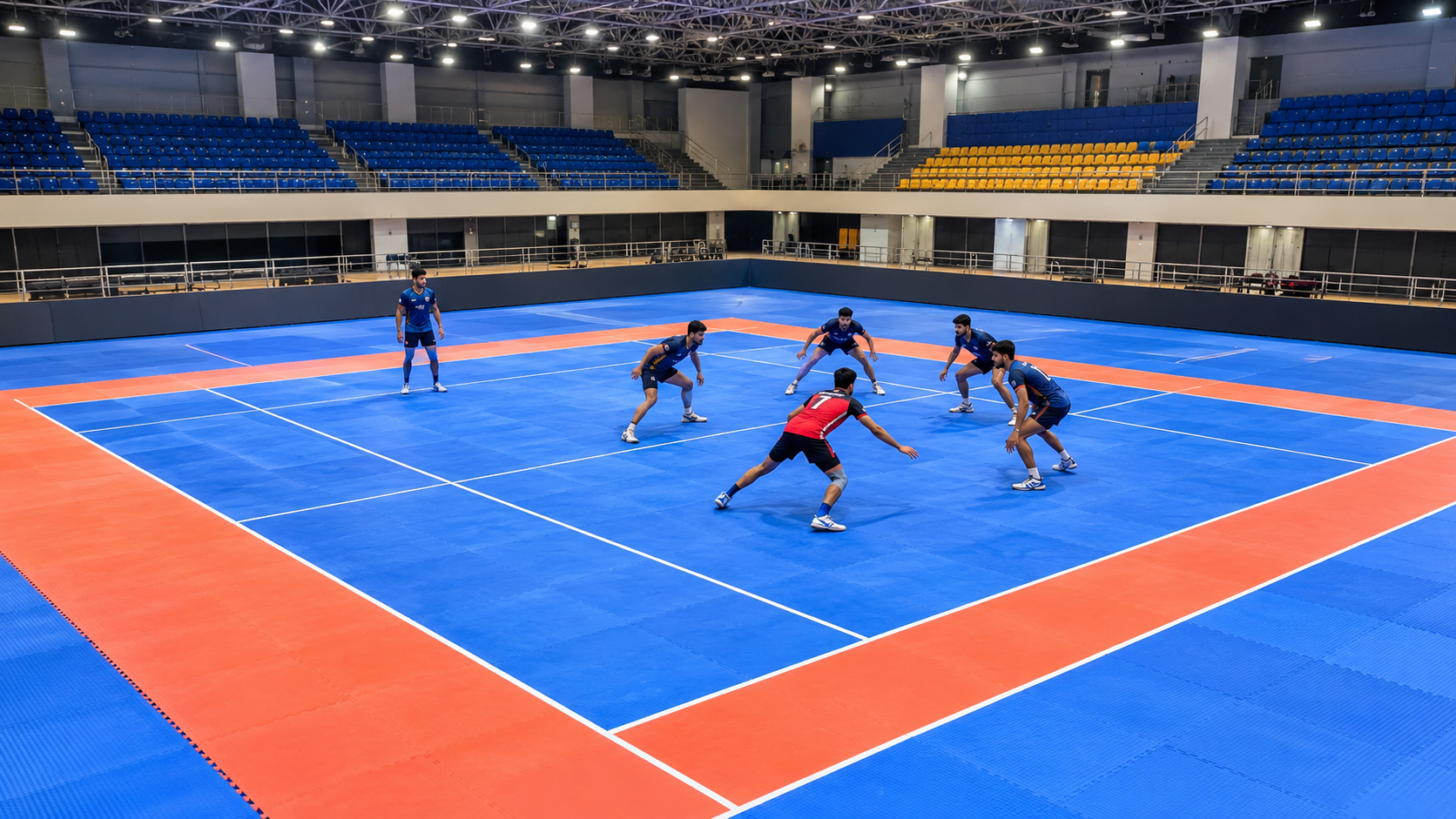
Correct dimensions are essential for creating a functional kabaddi playing area. For a standard senior men’s kabaddi court, the playing court is generally 13 metres long and 10 metres wide. For women’s and junior categories, dimensions can differ according to the applicable competition rules.
The court includes important zones and markings such as:
- Boundary lines
- Midline
- Baulk lines
- Bonus lines
- Lobby areas
- End lines
- Playing zones
The surrounding clearance should also be considered during planning. Building only the exact playing dimensions without sufficient space around the court can create safety and maintenance problems.
For institutional or professional projects, the dimensions should be finalized according to the rules applicable to the intended level of play and the requirements of the relevant sporting authority.
Major Factors That Affect Kabaddi Court Construction Cost
1. Type of Kabaddi Court
The biggest factor affecting the budget is the type of court being constructed.
A traditional mud or earthen court generally requires basic leveling, soil preparation, compaction, and marking. It is suitable for recreational use and some training environments.
A synthetic court requires a more engineered base and specialized sports surfacing. The initial cost is generally higher, but the surface can offer more consistent playing characteristics and easier maintenance when properly installed.
An indoor kabaddi facility requires an entirely different level of investment. The project may include a steel structure, roofing, flooring system, lighting, ventilation, electrical work, spectator areas, changing rooms, and other amenities.
Therefore, it is important to define the intended use before setting the budget.
2. Site Condition
The existing condition of the land can significantly affect construction expenses.
A flat, compact, and properly accessible site normally requires less preparation. However, uneven land may require excavation, filling, soil replacement, grading, and compaction.
Other site conditions that can increase costs include:
- Soft or unstable soil
- Waterlogging
- Existing concrete or damaged pavement
- Sloping terrain
- Poor drainage
- Difficult material access
- Vegetation or debris
- Requirement for retaining structures
A professional site assessment helps identify these issues before construction begins rather than after work has started.
3. Foundation and Base Preparation
A sports surface performs only as well as the base beneath it.
For outdoor synthetic courts, the base may involve layers of compacted subgrade, granular material, and a suitable rigid or semi-rigid pavement system depending on the selected surface.
The construction team needs to achieve:
- Proper levels
- Adequate compaction
- Appropriate slope for water management
- Surface stability
- Smoothness
- Proper curing where concrete is used
Reducing the budget by compromising on base preparation can create expensive problems later, including cracks, depressions, unevenness, water accumulation, and premature surface deterioration.
4. Choice of Flooring Material
The playing surface is another major component of the overall cost.
Common options include:
Mud or Earthen Surface
A traditional mud court can be economical to construct. The soil needs to be properly selected, leveled, compacted, and maintained.
Its main advantages are comparatively low initial cost and a familiar playing feel. However, it can require regular maintenance and may be affected by rain and moisture.
Synthetic Acrylic Surface
Acrylic sports surfacing can be installed over a properly prepared base. It provides a finished appearance and can be designed with different surface characteristics.
It is suitable for outdoor sports environments where durability, appearance, and relatively straightforward maintenance are priorities.
PVC or Sports Vinyl Flooring
PVC sports flooring is more commonly associated with indoor facilities. It can provide cushioning, controlled traction, and a consistent surface.
The cost depends on thickness, construction, performance characteristics, brand, installation method, and subfloor preparation.
Rubber Flooring
Certain indoor sports facilities may consider rubber-based flooring systems. These surfaces can provide impact absorption and resilience, although suitability depends on the exact sports application and product specification.
The right material should be selected based on playing requirements rather than choosing a surface simply because it has a lower price.
5. Drainage Requirements
For outdoor kabaddi courts, drainage should not be treated as an optional feature.
Rainwater can damage the playing surface, weaken the base, and create puddles if the court does not have an appropriate drainage strategy.
Depending on the location, a project may require:
- Surface slope
- Peripheral drains
- Stormwater channels
- Catch pits
- Drainage pipes
- Proper discharge arrangements
Areas with heavy monsoon rainfall may require more detailed water-management planning than relatively dry regions.
A slightly higher initial investment in drainage can help protect the playing surface and reduce recurring maintenance.
6. Court Marking
Accurate markings are essential for proper gameplay.
Court lines should be straight, clearly visible, and positioned according to the dimensions required for the intended category of competition.
The cost of marking depends on:
- Type of paint or marking material
- Number of coats
- Surface type
- Court size
- Preparation requirements
- Complexity of the marking layout
Using unsuitable paint can result in fading, peeling, or poor visibility, particularly on outdoor surfaces exposed to sunlight and rain.
7. Fencing and Safety Features
A kabaddi court located in a school, sports complex, club, or public facility may benefit from boundary fencing.
Fencing helps separate the court from surrounding activities and can improve overall site organization.
The price depends on:
- Fence height
- Post material
- Mesh type
- Gate design
- Coating
- Foundation requirements
- Total perimeter
Additional safety features may include protective padding, access gates, non-slip walkways, and adequate clearance around the court.
8. Lighting Installation
Lighting becomes important when the facility will be used during evenings or for extended training schedules.
A professional sports lighting system needs more than simply installing high-wattage lights. Light positioning, uniformity, glare control, mounting height, electrical infrastructure, and maintenance access should all be considered.
LED sports lights are commonly considered for modern facilities because they can provide efficient illumination and controlled beam distribution when appropriately designed.
For tournament-level or professional facilities, lighting should be designed according to the expected playing and viewing requirements.
9. Location and Transportation
Construction costs vary between cities and regions because labour, transportation, material availability, taxes, logistics, and local market conditions differ.
A project located in a major metropolitan area may have higher labour or site costs, while a remote location may incur additional transportation expenses.
If specialized flooring or construction materials need to be transported over long distances, freight can become a noticeable part of the project budget.
10. Indoor vs Outdoor Construction
The difference between indoor and outdoor construction can be substantial.
An outdoor court may require:
Land preparation → base construction → surface installation → marking → drainage → fencing → lighting
An indoor facility can additionally require:
Structural framework → roofing → wall cladding → ventilation → electrical systems → indoor sports flooring → lighting → changing rooms → spectator facilities
If an existing indoor sports hall is available, the project may be limited mainly to subfloor preparation, flooring, markings, lighting improvements, and associated works.
Constructing a new sports building from the ground up is a much larger investment and should therefore be budgeted separately from the cost of the playing court itself.
Kabaddi Court Construction Materials
Selecting appropriate materials is important for both performance and longevity.
Typical materials may include:
Earth and Granular Materials
Used for subgrade preparation, filling, leveling, and traditional mud courts.
Concrete
Used where a rigid base or structural pavement is required.
Aggregate
Different grades of aggregate may be used for sub-base and base construction depending on the engineering design.
Synthetic Sports Coatings
Acrylic and other sports surfacing systems can provide a finished outdoor playing surface.
PVC Sports Flooring
Suitable for certain indoor applications where cushioning, traction, and surface consistency are required.
Line Marking Paint
Specialized sports marking products provide better visibility and adhesion than ordinary decorative paints.
Drainage Components
Pipes, channels, grates, catch pits, and other components may be required for outdoor water management.
Fencing Materials
Steel posts, mesh panels, gates, and protective coatings are commonly used around outdoor sports facilities.
The final material specification should be selected according to the court’s usage, climate, expected traffic, maintenance capacity, and available budget.
Kabaddi Court Construction Process
A professional construction project normally follows several stages.
Site Inspection
The site is assessed for dimensions, soil conditions, accessibility, drainage, existing levels, and available utilities.
Layout Planning
The court orientation, playing dimensions, safety clearance, entrances, drainage, fencing, and other requirements are finalized.
Ground Preparation
The area is cleared, excavated or filled where required, leveled, and compacted.
Base Construction
The appropriate sub-base and base layers are installed according to the selected surface system.
Surface Installation
The selected mud, acrylic, PVC, rubber, or other sports surface is installed according to the manufacturer’s and project specifications.
Court Marking
All required playing lines are measured and marked accurately.
Accessories and Infrastructure
Fencing, lighting, gates, drainage components, walkways, and other facilities are installed where included in the project.
Quality Inspection
The finished court should be inspected for levels, surface consistency, line accuracy, drainage performance, finishing quality, and general safety.
Handover
After final cleaning and inspection, the facility can be handed over for use along with relevant maintenance recommendations.
How to Prepare a Kabaddi Court Budget
Before approaching a construction company, prepare a basic project brief containing:
- Available land dimensions
- Location of the project
- Indoor or outdoor requirement
- Number of courts
- Intended users
- Recreational or professional use
- Preferred flooring
- Lighting requirement
- Fencing requirement
- Drainage requirement
- Spectator requirements
- Changing-room requirements
- Expected project timeline
Having this information allows contractors to prepare more meaningful quotations.
Instead of asking only for the kabaddi court construction price, ask for a detailed cost breakup covering civil work, flooring, marking, drainage, lighting, fencing, transportation, installation, and taxes where applicable.
Ways to Control Kabaddi Court Construction Cost
A controlled budget does not necessarily mean selecting the cheapest materials.
Plan the Complete Project First
Changes made during construction can increase labour and material costs. Finalize the layout and specifications before beginning major work.
Choose Flooring According to Usage
A school recreation court may not require the same specification as a professional training facility.
Avoid Compromising on the Base
A high-quality top surface cannot compensate for a poorly prepared foundation.
Consider Future Maintenance
A cheaper surface that requires frequent repairs may become more expensive over its useful life.
Compare Complete Quotations
When comparing contractors, check whether quotations include transportation, installation, court marking, drainage, taxes, and other necessary components.
Plan Multiple Courts Together
For academies or institutions developing multiple courts, bulk procurement and coordinated construction may provide logistical advantages.
Kabaddi Court for Schools, Academies and Sports Facilities
Different users have different requirements.
Schools and colleges may prioritize durability, safety, easy maintenance, and controlled construction costs.
Kabaddi academies may require better surface consistency, training infrastructure, lighting, equipment areas, and multiple courts.
Sports clubs may focus on appearance, durability, player comfort, and facility management.
Professional training centres may require more detailed specifications, specialized flooring, high-quality lighting, spectator facilities, changing rooms, and other supporting infrastructure.
Therefore, the ideal court specification should be developed around the actual purpose of the facility.
Frequently Asked Questions
What is the average kabaddi court construction cost in India?
There is no universal average price because the cost depends on court type, land preparation, flooring, drainage, lighting, fencing, location, and other requirements. A basic outdoor court will generally require a smaller investment than a complete synthetic or indoor sports facility.
What is the standard size of a kabaddi court?
A standard senior men’s kabaddi playing court is generally 13 metres long and 10 metres wide. Dimensions can vary for women, juniors, and different competition categories, so the applicable rules should be confirmed before construction.
Which flooring is best for a kabaddi court?
The appropriate flooring depends on whether the court is indoor or outdoor, the expected level of play, climate, budget, and maintenance requirements. Mud, acrylic, PVC, and other sports surfaces can serve different purposes.
Is drainage necessary for an outdoor kabaddi court?
Yes. Proper drainage is particularly important in areas that receive significant rainfall. Effective water management helps prevent water accumulation and protects the playing surface and underlying base.
How long does kabaddi court construction take?
The construction timeline depends on site conditions, court type, weather, material availability, curing requirements, and the scope of additional facilities. A basic court can be completed much faster than a fully equipped indoor sports complex.
Can a kabaddi court be constructed indoors?
Yes. Indoor kabaddi courts can be developed in existing sports halls or as part of a newly constructed sports building. Indoor facilities provide greater control over weather conditions but generally involve additional infrastructure costs.
How can I reduce kabaddi court construction costs?
Start with a clear project scope, choose materials according to actual usage, prepare the base correctly, compare detailed quotations, and avoid unnecessary features. Long-term maintenance should also be considered when selecting materials.
Final Thoughts
The kabaddi court construction cost in India depends on much more than the price of the playing surface. Site condition, court type, foundation, flooring, drainage, marking, lighting, fencing, labour, transportation, and additional infrastructure all contribute to the final investment.
For a durable and safe facility, the focus should be on creating the right combination of engineering, material quality, accurate dimensions, surface performance, drainage, and workmanship.
Whether the project is for a school, college, sports academy, club, residential community, corporate facility, or professional training centre, the best approach is to define the intended use first and then select the construction system accordingly.
A detailed site inspection and itemized quotation can help avoid unexpected expenses and make the project easier to manage from planning through completion. Rather than choosing a contractor solely on the lowest initial quotation, compare the complete scope of work, material specifications, installation method, warranty or support terms, and expected maintenance requirements.
With proper planning and professional execution, a kabaddi court can become a reliable sports facility that supports regular training, competitions, and community participation for years to come.