



Introduction
Volleyball is one of the most popular sports played in schools, colleges, sports academies, residential communities, clubs, and professional sports facilities across India. As interest in fitness and competitive sports continues to grow, the demand for durable, safe, and high-performance volleyball courts is also increasing. Choosing the right synthetic volleyball court flooring service in India is an important step in developing a sports facility that delivers consistent playing performance, long-term durability, and a better experience for athletes.
Synthetic volleyball court flooring offers several advantages over conventional concrete surfaces, including improved grip, cushioning, uniform ball response, and enhanced playing comfort. However, the quality of the final court depends on more than the flooring material alone. Proper site preparation, drainage, subfloor leveling, professional installation, and regular maintenance all contribute to the performance and lifespan of the playing surface.
At Sports Facility India, sports flooring projects can be planned around the requirements of schools, colleges, indoor stadiums, sports academies, private clubs, and multipurpose sports facilities. Whether you are developing a new volleyball court or upgrading an existing playing area, selecting the appropriate flooring system helps create a functional and reliable sports environment.
In this complete guide, we explain synthetic volleyball court flooring types, benefits, installation procedures, court dimensions, cost factors, maintenance requirements, and important considerations for choosing a professional flooring contractor in India.
What Is Synthetic Volleyball Court Flooring?
Synthetic volleyball court flooring is a specially designed sports surface manufactured using materials such as polyurethane, acrylic-based systems, PVC sports flooring, or other synthetic compounds. These surfaces are selected according to the court’s location, expected usage, performance requirements, and available budget.
Unlike ordinary concrete flooring, a suitable sports flooring system can provide more consistent traction and a playing surface designed for repeated jumping, landing, quick direction changes, and lateral movement.
Synthetic flooring can be installed in different environments, depending on the product specifications and site conditions.
Common applications include:
- Indoor volleyball courts in schools and colleges
- Professional training courts and sports academies
- Indoor stadiums and sports complexes
- Outdoor volleyball courts in clubs and communities
- Residential sports facilities
- Multipurpose courts used for different sporting activities
The right flooring solution should be selected according to the intended application. For example, an indoor PVC sports floor may be suitable for a covered volleyball facility, while an outdoor acrylic system may be more appropriate for an exposed court requiring weather resistance.
Benefits of Synthetic Volleyball Court Flooring
Investing in quality synthetic volleyball court flooring can improve playing comfort, simplify maintenance, and support the long-term use of a sports facility.
1. Improved Player Comfort
Volleyball involves frequent jumping, blocking, spiking, and landing. A suitable cushioned flooring system can help reduce impact forces compared with a hard, untreated concrete surface.
The amount of cushioning depends on the flooring construction, thickness, and product design. Facilities should choose a system that provides an appropriate balance between comfort, stability, and athletic performance.
2. Reliable Grip and Traction
Players need dependable traction when moving quickly across the court. Synthetic sports flooring is designed to provide a consistent surface for acceleration, stopping, jumping, and changing direction.
The surface texture and friction characteristics should be appropriate for volleyball. Excessively slippery or overly abrasive flooring can affect movement and playing comfort.
3. Durable Playing Surface
High-quality synthetic flooring can withstand regular sports activity when it is correctly specified, installed, and maintained. The expected service life depends on the material, installation quality, environmental exposure, usage intensity, and maintenance practices.
For schools, academies, and commercial sports facilities, selecting a suitable flooring system can help reduce the frequency of major repairs.
4. Consistent Playing Conditions
A properly prepared and installed sports floor provides a uniform playing area with clearly marked boundaries. This supports predictable movement and helps create a professional environment for practice sessions, competitions, and recreational games.
5. Attractive Court Appearance
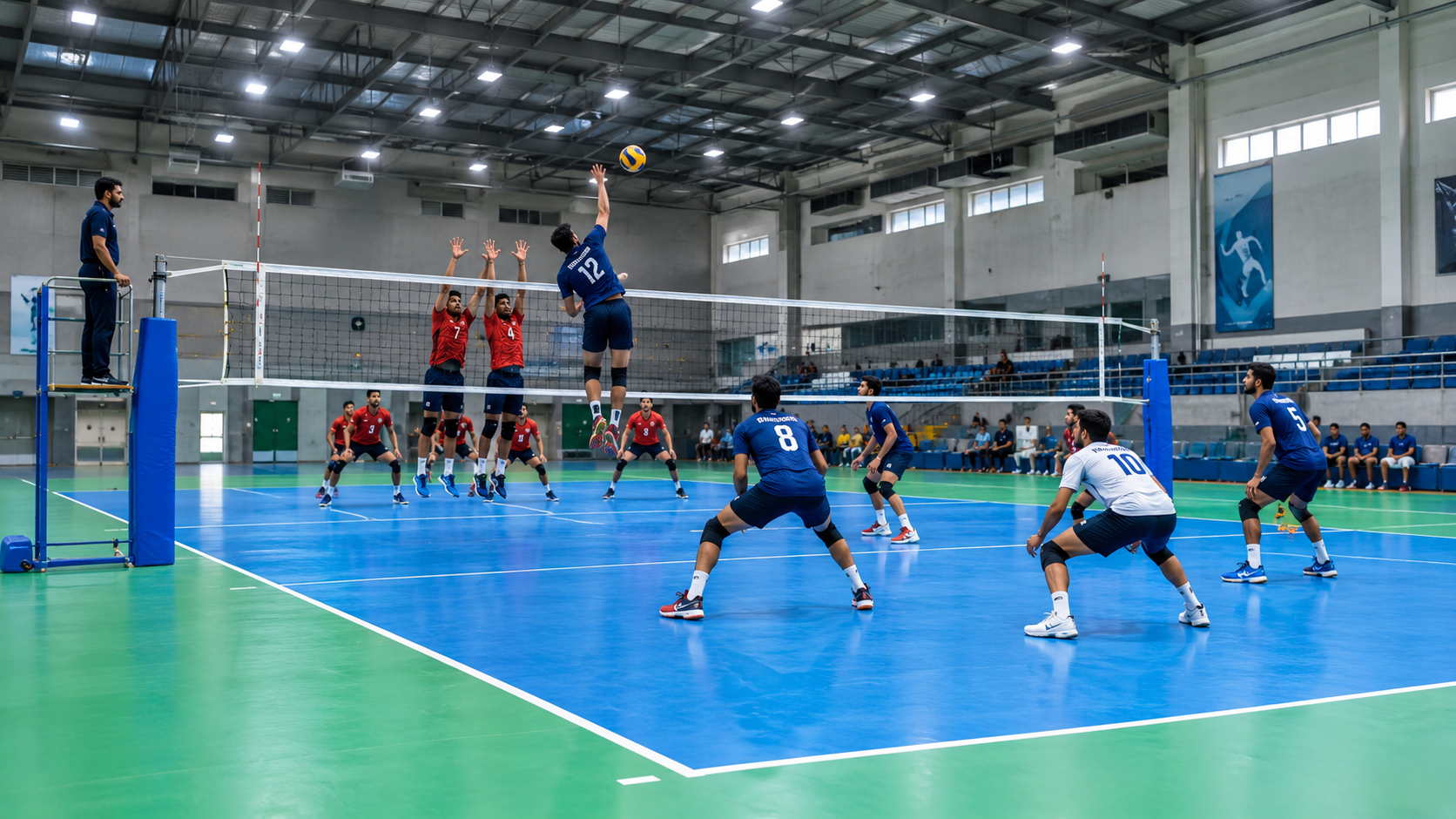
Synthetic volleyball court flooring is available in a variety of colours and finishes. Popular colour combinations include blue, green, red, and contrasting shades for the playing area and surrounding zones.
Clear line markings and a well-finished surface improve visibility and give the facility a clean, organised appearance.
6. Easier Cleaning and Maintenance
Many synthetic flooring systems can be maintained through regular dust removal, damp mopping, and the use of manufacturer-approved cleaning products.
Compared with untreated concrete, certain synthetic systems may also offer a more consistent surface finish. However, cleaning methods must match the selected material, especially for indoor PVC and polyurethane floors.
Types of Synthetic Volleyball Court Flooring in India
Choosing the right sports flooring material is one of the most important decisions when planning a volleyball court. Each system has different installation requirements, performance characteristics, and environmental limitations.
1. PVC Volleyball Court Flooring
PVC volleyball court flooring is commonly used for indoor sports facilities, multipurpose halls, training centres, and indoor stadiums.
It is generally supplied in rolls or specialised sports flooring formats, with product constructions designed for different levels of cushioning and durability.
Key features:
- Available in different thicknesses and surface finishes
- Options with cushioned backing
- Suitable for many indoor sports environments
- Easy routine cleaning when maintained correctly
- Available in different colours and designs
PVC sports flooring should be installed on a suitable, smooth, dry, and stable subfloor. It is generally not the default choice for an exposed outdoor court unless the particular product is specifically designed and approved for that application.
2. Acrylic Volleyball Court Flooring
Acrylic sports flooring is a popular option for outdoor volleyball courts and other outdoor sports surfaces. It is usually applied over a properly prepared concrete or asphalt base as part of a specified coating system.
Key features:
- Available in multiple colours
- Suitable for outdoor sports applications when correctly specified
- Provides a defined playing surface and court markings
- Offers relatively straightforward routine maintenance
- Can be designed for recreational or more demanding sports use
The system must be selected according to the base condition, local climate, drainage requirements, and manufacturer’s recommendations.
3. Polyurethane Sports Flooring
Polyurethane flooring systems are used in certain indoor sports facilities where performance, resilience, and surface consistency are important.
Depending on the system design, polyurethane flooring may include resilient layers intended to provide cushioning and support athletic movement.
Key features:
- Available in different performance specifications
- Can provide resilient playing characteristics
- Suitable for selected indoor sports applications
- Offers a seamless finish in many system designs
- Requires professional installation and appropriate curing conditions
The exact performance of a polyurethane system depends on its construction. Buyers should review the technical specifications rather than relying on the material name alone.
4. Synthetic Flooring for Multipurpose Sports Courts
Some schools, universities, residential developments, and sports complexes require courts that accommodate several activities. A multipurpose sports flooring system may be considered where volleyball is played alongside other sports.
However, a surface designed for one sport may not automatically be ideal for another. The contractor should assess the expected activities, movement patterns, traction requirements, and line-marking needs before recommending a system.
Indoor vs Outdoor Volleyball Court Flooring
Indoor and outdoor volleyball courts face different environmental and performance requirements. Understanding these differences helps facility owners choose an appropriate solution.
| Feature | Indoor Volleyball Court | Outdoor Volleyball Court |
|---|---|---|
| Common flooring options | PVC, polyurethane, selected synthetic systems | Acrylic and suitable outdoor-rated systems |
| Weather exposure | Usually protected | Exposed to sun, rain, and temperature changes |
| Base preparation | Smooth, dry, stable subfloor | Stable base with appropriate drainage |
| Cushioning | Can be prioritised according to the system | Depends on the selected outdoor system |
| Maintenance | Dust removal and suitable damp cleaning | Surface cleaning and periodic condition checks |
| Main consideration | Playing comfort and indoor performance | Weather resistance and drainage |
For indoor courts, moisture control and subfloor preparation are particularly important before installing roll-based flooring. Outdoor courts require suitable drainage and a surface system designed for environmental exposure.
Standard Volleyball Court Dimensions
Court dimensions should be established during the planning stage to ensure the playing area and boundary markings are correctly positioned.
For standard indoor volleyball, the playing court measures 18 metres long and 9 metres wide. It is divided into two equal halves by the centre line and net.
Important measurements include:
- Court length: 18 metres
- Court width: 9 metres
- Each team’s court area: 9 metres × 9 metres
- Attack line: 3 metres from the axis of the centre line on each side
- Net height for senior men’s volleyball: 2.43 metres
- Net height for senior women’s volleyball: 2.24 metres
Net heights differ for some age groups and competition categories. Competition facilities should confirm the applicable rules before installation.
The overall space required is larger than the playing court because players need a free zone around the boundaries. The required free zone and overhead clearance depend on the competition level and applicable rules. A professional contractor should confirm these requirements during site planning.
Synthetic Volleyball Court Flooring Installation Process
Professional installation is essential for achieving a uniform playing surface. Even high-quality flooring can underperform when installed over an uneven base or without following the manufacturer’s specifications.
At Sports Facility India, a well-planned flooring project should account for site conditions, the selected flooring material, and the intended use of the court.
Site Inspection and Planning
The first step is to evaluate the available area, proposed court layout, access conditions, and existing surface.
The inspection should identify cracks, uneven areas, moisture issues, drainage concerns, and any other conditions that could affect installation.
Flooring Material Selection
After assessing the site, the contractor should recommend a suitable flooring system based on whether the court is indoor or outdoor, the expected playing frequency, the performance requirements, and the available budget.
Product specifications should be reviewed before finalising the material.
Base Preparation
The subfloor must be prepared according to the selected system. This may involve grinding high spots, repairing cracks, filling low areas, removing dust, and ensuring the base is sufficiently dry and stable.
For outdoor installations, the base and drainage arrangement should be checked to reduce the risk of water accumulation.
Moisture and Level Checks
Moisture testing is particularly important for flooring systems installed over concrete. Excess moisture can affect adhesion and contribute to installation failures.
The base should meet the flooring manufacturer’s requirements for moisture, flatness, and surface condition before work proceeds.
Flooring Installation
The installation technique depends on the material. PVC flooring may require careful sheet positioning, adhesive application, seam treatment, and rolling. Acrylic systems involve the application of specified coating layers over a suitable base.
Polyurethane systems may require several application stages and controlled curing conditions.
Court Line Marking
After the playing surface is ready, court markings are applied according to the intended rules and approved layout. The lines should be visible, accurately positioned, and compatible with the flooring system.
For multipurpose courts, additional markings should be planned to avoid confusion between sports.
Quality Inspection and Handover
The completed court should be checked for surface uniformity, visible defects, line accuracy, and installation finish. The contractor should also explain cleaning procedures, usage restrictions during curing, and recommended maintenance.
The facility should not be used until the flooring system has reached the manufacturer’s specified readiness conditions.
Synthetic Volleyball Court Flooring Cost in India
One of the most common questions buyers ask is: What is the cost of synthetic volleyball court flooring in India?
There is no single price that applies to every project. The total cost depends on the flooring material, the condition of the base, the court dimensions, and the scope of work.
The main factors influencing the overall project budget include:
1. Flooring material: PVC, acrylic, and polyurethane systems have different material and installation costs.
2. Flooring thickness and construction: Cushioned systems and specialised performance products may cost more than basic surface systems.
3. Base preparation: Existing concrete or asphalt may require repairs, grinding, levelling, or other preparatory work.
4. Court size: Larger courts generally require more materials and labour.
5. Indoor or outdoor installation: Environmental requirements, drainage, and the type of sports flooring system affect the project cost.
6. Line marking: Standard volleyball markings and additional lines for multipurpose courts may influence the final quotation.
7. Transportation and location: Delivery, labour availability, and project accessibility can affect installation expenses.
8. Additional facilities: Lighting, fencing, net posts, nets, drainage work, and other sports infrastructure may be priced separately.
For an accurate quotation, request a site-specific estimate that clearly separates flooring material, surface preparation, installation, markings, and additional construction work. This makes it easier to compare quotations from different sports flooring companies.
How to Choose the Best Synthetic Volleyball Court Flooring Contractor in India
Selecting the right contractor is just as important as choosing the right flooring material. A reliable service provider should understand sports surface requirements and be able to explain the complete installation process.
Consider the following points before making a decision:
- Relevant experience: Check whether the company has experience with volleyball courts and similar sports flooring projects.
- Material specifications: Ask for details about the flooring system, thickness, cushioning, surface texture, and intended application.
- Site assessment: Prefer a contractor who evaluates the base and site conditions before recommending a solution.
- Installation quality: Confirm the preparation method, installation procedure, curing requirements, and quality checks.
- Warranty information: Review the written warranty and understand which conditions or types of damage are excluded.
- Maintenance support: Ask about cleaning instructions, repairs, and long-term maintenance requirements.
- Transparent pricing: Ensure the quotation identifies the material, labour, preparation work, line marking, and other charges.
Avoid choosing a contractor solely because of the lowest quotation. An unsuitable flooring system or poor installation can result in additional repair costs and unnecessary disruption.
Why Choose Sports Facility India for Volleyball Court Flooring?
Sports Facility India provides a sports-infrastructure-focused approach to planning and developing playing surfaces. When evaluating a volleyball flooring project, the key objective is to match the selected system with the facility’s requirements rather than recommending the same product for every site.
A project-specific approach can help address:
- Flooring selection for indoor and outdoor applications
- Site assessment and subfloor preparation requirements
- Court layout and line-marking planning
- Material and installation coordination
- Sports facility development for schools, colleges, academies, and clubs
- Maintenance guidance for the selected flooring system
Whether you are planning a new volleyball court or upgrading an existing sports area, discuss the intended use, available space, site condition, and budget with your flooring contractor before finalising the project.
For the most suitable recommendation, request a consultation and a detailed quotation based on your specific site requirements.
Maintenance Tips for Synthetic Volleyball Court Flooring
Regular maintenance helps preserve the appearance and performance of a synthetic sports surface.
Clean the surface regularly: Remove dust, sand, leaves, and other debris using suitable cleaning equipment.
Use approved cleaning products: Follow the flooring manufacturer’s recommendations. Avoid harsh chemicals or abrasive tools that could damage the surface.
Inspect the playing area: Check for loose seams, cracks, peeling coatings, damaged markings, or uneven sections.
Prevent unnecessary damage: Avoid dragging heavy equipment across the court and use appropriate protective measures when moving sports equipment.
Manage moisture: For indoor courts, investigate moisture or condensation problems promptly. For outdoor courts, keep drainage channels clear and prevent standing water wherever possible.
Schedule periodic inspections: A professional assessment can help identify minor problems before they require more extensive repairs.
Maintenance procedures should be tailored to the selected flooring system because PVC, acrylic, and polyurethane surfaces do not all require identical care.
Frequently Asked Questions (FAQs)
1. What is the best flooring for a volleyball court in India?
The best option depends on whether the court is indoor or outdoor. PVC and suitable polyurethane systems are common considerations for indoor facilities, while outdoor-rated acrylic systems are often considered for outdoor courts.
2. How much does synthetic volleyball court flooring cost in India?
The cost varies according to material, flooring thickness, court dimensions, base preparation, installation requirements, and location. A site-specific quotation provides a more reliable estimate than a general price per square foot.
3. Can synthetic volleyball flooring be installed on concrete?
Yes, many synthetic flooring systems can be installed over a properly prepared concrete base. The concrete must meet the product’s requirements for stability, moisture, flatness, and surface condition.
4. Is synthetic volleyball court flooring suitable for outdoor use?
Yes, provided the selected system is specifically designed for outdoor conditions. Outdoor installations also require suitable base preparation, drainage, and consideration of local weather conditions.
5. What is the standard size of a volleyball court?
A standard indoor volleyball playing court measures 18 metres in length and 9 metres in width. Additional surrounding space is required for player movement and safety.
6. How long does synthetic volleyball court flooring last?
Its lifespan depends on material quality, installation, usage, weather exposure, and maintenance. Ask the supplier for product-specific durability information and written warranty terms.
7. How long does volleyball court flooring installation take?
The timeline depends on site preparation, the selected flooring system, weather conditions, court size, and curing requirements. The contractor should provide a project schedule before installation begins.
8. Can one court be used for multiple sports?
Yes, some facilities can accommodate multiple sports with additional line markings. However, the flooring material should be suitable for the activities planned, and the markings must remain clear and distinguishable.
9. Why is professional flooring installation important?
Professional installation helps ensure correct base preparation, suitable material application, accurate court markings, and compliance with the flooring manufacturer’s instructions.
10. How can I get a quotation for synthetic volleyball court flooring in India?
Contact a sports flooring service provider with your project location, court dimensions, indoor or outdoor requirements, existing base condition, and preferred flooring type. These details help the contractor prepare a more accurate quotation.
Conclusion
Synthetic volleyball court flooring is an important investment for schools, colleges, sports academies, clubs, indoor stadiums, and recreational facilities. The right system can provide a more consistent playing surface, appropriate traction, improved comfort, and a professional appearance.
However, the success of a volleyball court depends on selecting the correct material, preparing the base properly, installing the flooring according to the manufacturer’s specifications, and maintaining the surface over time.
Before choosing a synthetic volleyball court flooring service in India, compare flooring systems, evaluate the contractor’s experience, review product specifications, and request a transparent project quotation.
Sports Facility India can be considered for discussions about sports flooring and court development requirements. Whether your project involves a new indoor volleyball court, an outdoor sports area, or a larger sports complex, careful planning is the foundation of a durable and functional facility.
