Introduction
Tennis is becoming an increasingly popular sport across India, creating new opportunities for sports academies, educational institutions, residential communities, private clubs, hotels, and professional training centres. As interest in tennis grows, the demand for well-designed, durable, and performance-oriented tennis courts is also increasing. A properly constructed court provides a consistent playing surface, supports player movement, and helps reduce maintenance problems over time.
involves much more than preparing a flat area and applying a sports surface. It requires careful planning, site evaluation, suitable surface selection, drainage arrangements, base construction, accurate court marking, lighting, fencing, and professional installation. Every stage influences the quality, safety, and long-term performance of the finished court.
Whether you are planning a tennis court for a school, sports academy, private property, resort, or commercial sports complex, understanding the complete construction process can help you make informed decisions and manage your project efficiently.
This guide explains the major stages of court construction, different flooring options, standard dimensions, cost considerations, and maintenance requirements for projects across
What Is Tennis Court Construction?
Tennis court construction is the process of designing and developing a dedicated playing area according to recognised tennis court dimensions and suitable surface-performance requirements. It includes site preparation, civil work, foundation development, surface installation, line marking, and the addition of supporting facilities.
A professional tennis court project should consider the intended level of play, local weather conditions, available space, soil stability, drainage, expected usage, and maintenance budget.
For example, a school tennis court may prioritise durability and straightforward maintenance, while a professional training academy may require a surface that delivers consistent ball bounce, reliable traction, and suitable player comfort.
Choosing the right construction method at the beginning can help prevent surface damage, water accumulation, uneven playing conditions, and expensive repairs.
Why Is Construction in India in Demand?
The growth of organised sports, fitness activities, and professional coaching has increased interest in tennis infrastructure throughout the country. Schools and colleges are developing sports facilities to encourage physical activity, while residential societies and private clubs are adding courts to improve their recreational amenities.
Several factors contribute to this demand:
- Sports academies: Dedicated courts help coaches deliver structured tennis training.
- Schools and colleges: Tennis facilities expand opportunities for students to participate in organised sports.
- Residential communities: A tennis court provides an active recreational space for residents.
- Hotels and resorts: Sports facilities can improve guest experiences and leisure offerings.
- Sports clubs: Well-maintained courts support coaching sessions, recreational matches, and tournaments.
- Private properties: Individual owners can create dedicated spaces for practice and recreation.
Because India experiences varied climates, from humid coastal regions to hot and dry inland areas, every project should be designed around its location rather than following a single construction method.
Site Selection and Project Planning
The first stage of tennis court construction is identifying a suitable location and establishing the project requirements. Proper planning helps determine the court layout, construction method, surface material, and overall investment.
Evaluate the Available Space
A standard tennis court measures 23.77 metres in length. Its width is 8.23 metres for singles matches and 10.97 metres for doubles matches. However, the total construction area must be larger than the marked playing court to accommodate run-off space, fencing, access routes, and other facilities.
Before beginning construction, assess the available land and determine whether it can accommodate the playing area and the required surrounding clearance.
Check Soil and Ground Conditions
Soil stability directly affects the performance of the court foundation. Weak, expansive, or poorly compacted soil may lead to settlement, cracking, and uneven surfaces.
A site assessment should identify ground conditions, existing slopes, waterlogging risks, and any need for excavation, filling, or additional ground stabilisation.
Plan the Court Orientation
Court orientation should account for the movement of the sun and the surrounding environment. A north–south orientation is commonly preferred for outdoor tennis courts because it can reduce direct sunlight shining into players’ eyes during many playing conditions. Actual orientation should be evaluated against the site’s constraints.
Also consider nearby buildings, trees, overhead obstructions, wind exposure, and access for construction equipment.
Choose the Right Tennis Court Surface
Selecting the appropriate tennis court flooring is one of the most important decisions in the construction process. Different surfaces influence ball speed, bounce, player movement, installation requirements, and maintenance costs.
Acrylic Tennis Court Flooring
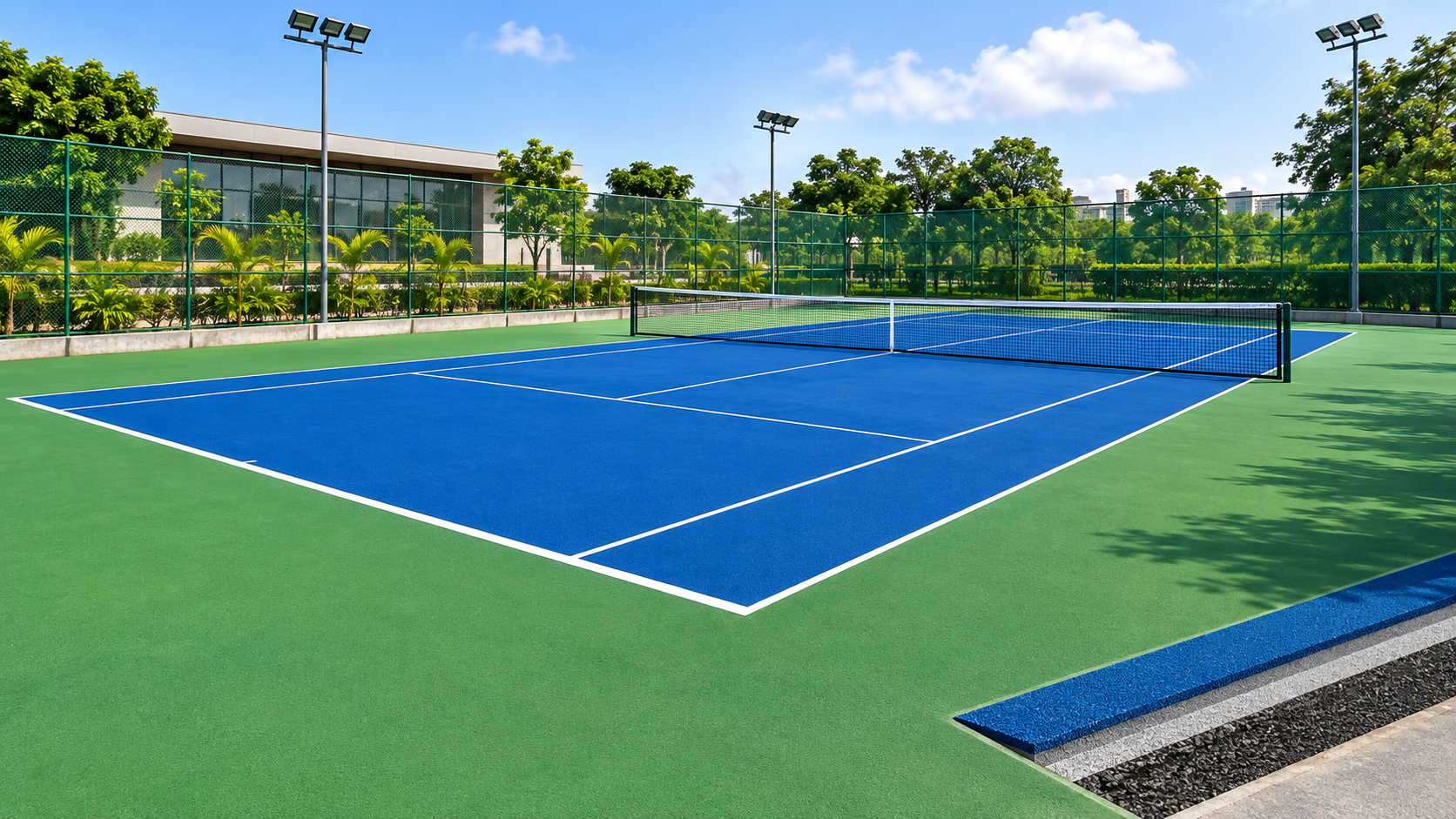
Acrylic tennis court flooring is widely used for outdoor courts because it can provide a durable, textured playing surface when installed over a properly prepared base. The system generally consists of compatible coatings applied over asphalt or concrete, with texture and cushioning options available depending on the specification.
Key advantages:
- Available in different colours and playing-surface finishes.
- Suitable for many outdoor sports facilities.
- Relatively straightforward routine cleaning.
- Can be specified with cushioned layers.
- Offers flexibility in surface texture and playing characteristics.
Acrylic systems are often considered for schools, clubs, residential projects, and sports academies. Their performance depends on correct base preparation, drainage, product selection, and installation quality.
Synthetic Tennis Court Flooring
Synthetic sports surfaces are designed to deliver specific playing characteristics and may be considered for selected indoor or outdoor tennis applications. The term covers different products and constructions, so the exact material and performance specification should be confirmed before purchase.
The surface should be selected according to the expected playing level, local climate, maintenance capability, and compatibility with the proposed foundation.
Clay Tennis Courts
Clay courts use a specialised layered construction that provides a distinctive playing experience. The surface typically supports slower ball speed and a higher bounce than many hard courts, although performance depends on the clay system and its maintenance.
Clay courts require regular attention, including watering where appropriate, surface levelling, line maintenance, and seasonal preparation. They may be suitable for clubs and facilities prepared to maintain the playing surface consistently.
Grass Tennis Courts
Grass tennis courts offer a traditional playing experience, with ball behaviour influenced by grass variety, soil conditions, and surface upkeep. They generally require more specialised maintenance than many hard-court systems, including mowing, irrigation, rolling where specified, and turf management.
Grass courts are best suited to projects with appropriate land, maintenance resources, and the ability to manage seasonal growing conditions.
How to Select the Best Flooring
There is no single surface that is ideal for every tennis court. Compare initial construction expenses, expected maintenance, local weather, intended playing level, surface lifespan, and player preferences before making a decision.
Tennis Court Dimensions and Layout
Correct dimensions are essential for a functional tennis court. Markings must follow the relevant tennis rules, and the surrounding area should provide adequate clearance for player movement.
The principal playing dimensions are:
| Measurement | Standard dimension |
|---|---|
| Court length | 23.77 metres |
| Singles court width | 8.23 metres |
| Doubles court width | 10.97 metres |
| Net height at centre | 0.914 metres |
| Net height at posts | 1.07 metres |
These dimensions describe the marked playing court, not the entire construction footprint. Additional space is required behind the baselines and beside the sidelines for safe movement.
During layout planning, the construction team should confirm the baseline positions, service lines, centre service line, singles sidelines, doubles sidelines, net location, and post positions.
For facilities intended for competitions, the applicable governing-body requirements and event specifications should be checked before construction begins.
Earthwork and Base Preparation
A stable foundation is critical to the long-term performance of any tennis court. Surface coatings cannot compensate for an unstable or poorly prepared base.
The civil construction stage may include clearing vegetation, removing unsuitable soil, excavation, filling, compaction, and formation of the required levels.
Ground Levelling and Compaction
The site should be prepared to the approved design levels. Suitable fill material must be placed and compacted correctly to minimise settlement.
The construction team should verify levels and compaction before proceeding to the next stage. Where ground conditions require it, additional geotechnical advice or ground-improvement work may be necessary.
Concrete or Asphalt Base
Depending on the design and selected surface system, the court may use a concrete or asphalt foundation. Both options require appropriate engineering, construction quality, and surface preparation.
The base should provide the required stability, smoothness, and drainage performance. Cracks, depressions, loose material, and uneven areas should be addressed before the sports surface is installed.
Base design should follow the requirements of the selected flooring system and the local site conditions.
Drainage System and Water Management
Drainage is particularly important for outdoor court construction in where heavy monsoon rainfall can affect playing conditions and damage poorly designed surfaces.
Water should not remain standing on the playing area. The court’s surface levels, surrounding ground, and drainage arrangements must work together to move water away efficiently.
Depending on the location and site design, drainage provisions may include carefully controlled surface gradients, perimeter drains, collection channels, and suitable discharge arrangements.
The slope should be engineered to provide effective drainage without compromising the intended playing characteristics. The correct design varies by surface system and project specification, so an arbitrary slope should not be used for every court.
Before the final flooring is installed, inspect the drainage arrangement and resolve any areas where water may collect. Proper water management can help reduce algae growth, premature surface deterioration, and weather-related maintenance issues.
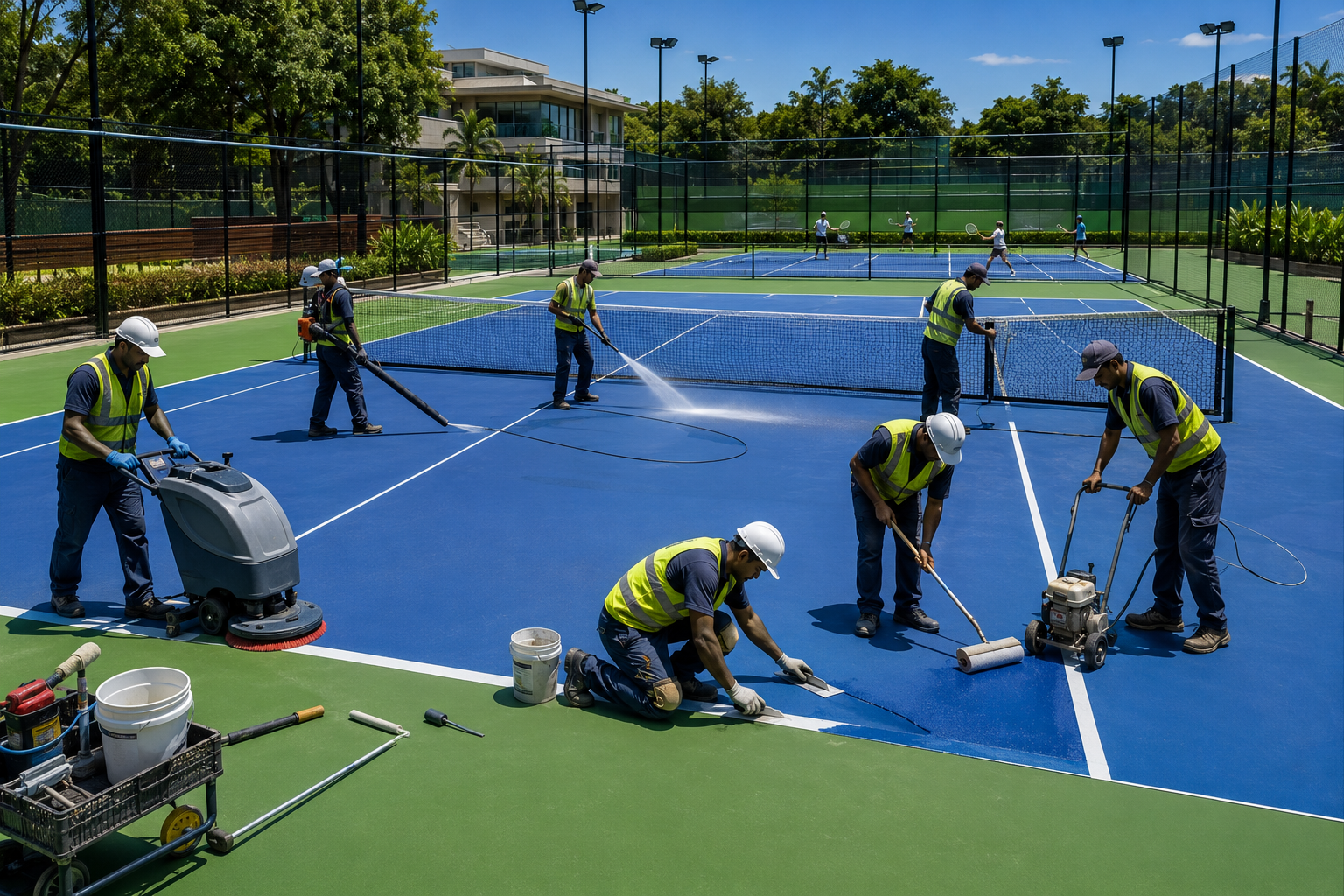
Court Flooring Installation
Once the base has been completed and approved, the sports surface can be installed according to the selected system.
For an acrylic hard court, the process may include:
- Base inspection: Check the foundation for level, cleanliness, cracks, and surface defects.
- Surface preparation: Repair imperfections and prepare the substrate as required by the product manufacturer.
- Primer application: Apply a compatible primer when specified by the system.
- Resurfacing or levelling layers: Use suitable materials to create the required surface finish.
- Acrylic coating application: Apply the specified coating layers in accordance with product instructions.
- Texture development: Establish the intended surface texture and playing characteristics.
- Colour coating: Apply the selected playing-area and surrounding-area colours.
- Curing and drying: Allow each layer to dry or cure under suitable environmental conditions.
- Line marking: Measure and apply the court lines accurately.
- Final inspection: Review the finished surface, line accuracy, and any visible defects.
Other surfaces, including clay, grass, and specialised synthetic systems, require different installation procedures. The work should be carried out by a team experienced with the chosen surface rather than following a generic process.
Temperature, humidity, rainfall, substrate moisture, and manufacturer recommendations should all be considered when scheduling installation.
Install Fencing, Net Posts, and Accessories
A complete tennis court project also requires appropriate accessories and supporting infrastructure. These elements help create a functional, secure, and convenient playing environment.
Common installations include:
- Tennis net and net-post system.
- Perimeter fencing and gates.
- Outdoor court lighting, where required.
- Player seating and rest areas.
- Benches and equipment storage.
- Court signage and access pathways.
- Optional spectator areas and landscaping.
Fencing height and design should suit the facility’s intended use and local requirements. Net posts must be positioned correctly, and the net should be installed at the prescribed heights.
Lighting should provide suitable visibility across the playing area while controlling glare and unnecessary light spill. For competitive or high-use facilities, a lighting design should be prepared according to the expected playing standard.
Construction Cost in India
The cost of court construction in varies from project to project. There is no reliable single price for every court because the total investment depends on land conditions, surface selection, foundation requirements, drainage, accessories, and location.
Main Factors Affecting Construction Cost
1. Flooring material: Acrylic, clay, grass, and specialised synthetic surfaces have different material and installation requirements.
2. Site condition: Excavation, soil improvement, filling, and compaction can increase costs when the land needs substantial preparation.
3. Base construction: Concrete or asphalt work, reinforcement where required, and surface finishing contribute to the project budget.
4. Drainage arrangements: Perimeter drains, channels, and water-discharge systems vary according to site conditions and rainfall exposure.
5. Court dimensions and surrounding space: The total developed area is larger than the marked playing court, so fencing, earthwork, and surfacing quantities must be calculated using the actual project layout.
6. Lighting and accessories: Poles, luminaires, fencing, gates, seating, and other facilities can affect the final quotation.
7. Project location: Material transportation, labour availability, site access, and local construction conditions may influence the cost.
8. Maintenance expectations: Some surfaces need more regular care, specialised equipment, or periodic refurbishment.
How to Prepare an Accurate Budget
Request an itemised quotation covering site preparation, base construction, drainage, flooring materials, installation, court marking, fencing, lighting, taxes, and any optional accessories. Confirm the specifications, exclusions, warranty terms, and expected maintenance requirements before approving the project.
A detailed quotation makes it easier to compare suppliers on quality and scope instead of selecting a contractor solely on the lowest initial price.
Quality Inspection and Final Handover
Before opening a new tennis court, carry out a structured inspection to confirm that the completed facility meets the approved specifications.
The inspection should cover:
- Playing-court dimensions and line placement.
- Surface uniformity and visible defects.
- Base condition and drainage performance.
- Net and post installation.
- Fencing stability and gate operation.
- Lighting functionality, where installed.
- Surface curing and readiness for use.
- Completion of agreed project items.
Where appropriate, the contractor should provide product information, maintenance instructions, warranty documentation, and guidance on when the court can be used.
The facility owner should avoid heavy use before the flooring system has fully cured or reached the manufacturer’s stated readiness conditions.
Court Maintenance for Long-Term Performance
Regular maintenance protects the investment in a tennis court and helps preserve its appearance and playing quality.
Routine Cleaning
Remove leaves, dust, sand, and other debris using cleaning methods suitable for the installed surface. Use approved cleaning products and avoid chemicals or tools that could damage the finish.
Drainage Checks
Inspect drainage outlets and surrounding channels, particularly before and during the monsoon season. Remove debris that could obstruct water flow.
Surface Inspection
Look for cracks, peeling coatings, worn areas, unevenness, or signs of water damage. Address developing problems promptly to reduce the risk of larger repairs.
Net and Fence Maintenance
Check net tension, posts, gates, fencing connections, and lighting equipment at suitable intervals. Repair loose components and damaged fixtures as required.
Professional Refurbishment
Acrylic courts may need periodic repairs or recoating depending on usage, weather exposure, product specifications, and the condition of the base. Clay and grass courts have their own specialised maintenance schedules.
A documented maintenance plan helps owners manage costs, maintain safety, and extend the useful life of the facility.
Common Mistakes to Avoid During Court Construction
Even a high-quality flooring material can perform poorly when the construction process is not properly managed. Avoid these common mistakes:
- Selecting a surface without considering the local climate and intended use.
- Starting construction without assessing soil and ground conditions.
- Using an inadequately prepared or unstable foundation.
- Ignoring drainage requirements and monsoon rainfall.
- Choosing a contractor without checking relevant project experience.
- Installing incorrect court dimensions or poorly measured lines.
- Applying coatings in unsuitable weather conditions.
- Failing to allow adequate curing time before opening the court.
- Overlooking fencing, lighting, and safe access.
- Ignoring routine inspection and maintenance after handover.
Careful planning, clear specifications, and regular quality checks can prevent many of these problems.
How to Choose the Right Company
Selecting an experienced contractor is an important part of a successful project. A suitable construction company should understand sports-surface systems, civil foundations, drainage, court geometry, and installation requirements.
Before making a decision, consider the following points:
Experience and project portfolio: Review completed tennis court projects and ask whether the company has experience with the surface you intend to install.
Material specifications: Request details about the flooring products, installation system, expected performance, and maintenance requirements.
Technical planning: Confirm that the contractor evaluates the site, prepares a clear scope of work, and explains the proposed construction method.
Transparent pricing: Obtain a detailed quotation with material specifications, quantities, exclusions, and payment milestones.
Quality control: Ask how the company checks base preparation, court dimensions, surface application, and final workmanship.
After-sales support: Clarify warranty coverage, maintenance guidance, repair availability, and the process for addressing installation-related concerns.
Sports Facility can be considered for discussing court construction and sports flooring requirements. Project owners should request a site-specific assessment, relevant product details, and a written quotation before proceeding.
Conclusion
requires a coordinated approach that combines site planning, civil engineering, drainage, surface selection, professional installation, and ongoing maintenance. Every decision, from evaluating the soil to choosing the final flooring material, can affect the playing experience and the long-term value of the facility.
A well-planned tennis court should meet the intended playing requirements, suit the local climate, provide effective water management, and remain practical to maintain. By comparing surface options, establishing a realistic budget, checking contractor experience, and following appropriate construction standards, property owners can develop a reliable facility for recreation, coaching, and competitive play.
Whether the project is for a school, academy, residential community, sports club, resort, or private property, investing in proper planning and workmanship is the foundation of a successful tennis court.
Frequently Asked Questions (FAQs)
1. How much does cost
The cost depends on the flooring material, site preparation, foundation, drainage, court dimensions, fencing, lighting, and project location. An accurate estimate requires a site assessment and a detailed bill of quantities.
2. What is the standard size of a tennis court?
The marked court is 23.77 metres long. It is 8.23 metres wide for singles and 10.97 metres wide for doubles. Additional space is needed around the playing area for safe movement.
3. Which flooring is best for an outdoor court in India?
Acrylic hard-court systems are a common option for outdoor tennis courts. The best choice depends on local weather, base construction, playing requirements, maintenance resources, and the selected product specification.
4. How long does it take to build a tennis court?
The project duration depends on site preparation, foundation work, drainage, surface type, weather, material availability, and curing requirements. A contractor should provide a project schedule after assessing the site.
5. Can a tennis court be constructed on an existing concrete surface?
Yes, in some cases. The existing concrete must be inspected for structural stability, cracking, moisture, levels, and drainage. Repairs or other preparation may be necessary before applying a compatible sports-surface system.
6. Is drainage necessary for outdoor tennis courts?
Yes. Proper drainage helps prevent standing water, protects the surface, and supports faster recovery after rainfall. The design should suit the site, soil conditions, rainfall, and selected court system.
7. Which surface is suitable for a tennis academy?
Acrylic hard courts are often considered for academies because of their versatility and maintenance characteristics. The final selection should reflect the coaching programme, playing level, budget, and expected court usage.
8. How can I maintain a tennis court?
Remove debris regularly, use approved cleaning methods, inspect the surface and court lines, keep drainage outlets clear, and maintain the net, fencing, and lighting. Arrange repairs or resurfacing when the surface condition requires it.
9. What facilities are required for a complete tennis court project?
A complete project may include the playing surface, prepared foundation, drainage, net and posts, court marking, fencing, gates, lighting, and access areas. The final scope depends on the intended use and budget.
10. How do I choose a reliable company in India?
Compare relevant experience, completed projects, surface-material specifications, installation methods, itemised quotations, quality checks, warranty conditions, and after-sales support before selecting a contractor.