Introduction
Building an outdoor sports court is more than creating a flat surface where people can play. It requires careful planning, quality construction materials, proper drainage, and a flooring system that can withstand continuous physical activity and changing weather conditions.
Whether you are developing a basketball court, volleyball court, tennis court, badminton court, school playground, or multi-purpose sports facility, choosing the right flooring material plays a significant role in the court’s performance and lifespan.
One material that has gained considerable attention in modern sports infrastructure is EPDM (Ethylene Propylene Diene Monomer) rubber flooring. Known for its flexibility, weather resistance, vibrant colour options, and shock-absorbing properties, EPDM flooring is a practical solution for many outdoor recreational and sports applications.
However, even the highest-quality EPDM rubber flooring cannot deliver its full benefits without proper installation and a well-designed foundation.
In this comprehensive guide, we will explain how to build a durable outdoor sports court using EPDM flooring, from initial site preparation and base construction to rubber surface installation, line marking, and long-term maintenance.
1. Understand the Requirements of Your Outdoor Sports Court
Before starting construction, the first step is to understand how the sports court will be used.
Different sports require different surface characteristics. A basketball court needs reliable grip and consistent ball response, while a volleyball court benefits from controlled surface cushioning. A multi-purpose recreational court requires a balance between traction, comfort, durability, and versatility.
Start by identifying the intended activities.
Important factors to consider include:
-
Type of sport: Determine whether the facility will be used for basketball, volleyball, tennis, badminton, skating, children’s activities, or multiple sports.
-
Expected foot traffic: Schools, sports academies, residential communities, and public parks may experience different levels of daily usage.
-
Weather exposure: Consider direct sunlight, heavy rainfall, humidity, temperature fluctuations, and seasonal changes.
-
Safety requirements: Evaluate slip resistance, shock absorption, surface consistency, and suitable cushioning.
-
Available space: Determine the court dimensions, safety clearance, spectator areas, and surrounding access routes.
An important consideration is that EPDM flooring is not automatically suitable for every competitive sport simply because it is a sports-grade rubber surface. The complete flooring system must be selected and tested for the intended sporting activity.
For example, a recreational multi-purpose court may use a different EPDM system from a professional tennis or basketball facility.
Planning these requirements at the beginning helps avoid expensive modifications after construction.
2. Select the Right EPDM Flooring System
EPDM rubber flooring is manufactured using synthetic rubber granules that are combined with suitable polyurethane binders to create an elastic surface.
These granules are available in different colours, particle sizes, and grades, allowing designers to create attractive sports surfaces with functional performance characteristics.
For outdoor sports courts, two common construction approaches are worth considering.
A. Wet-Pour EPDM Flooring
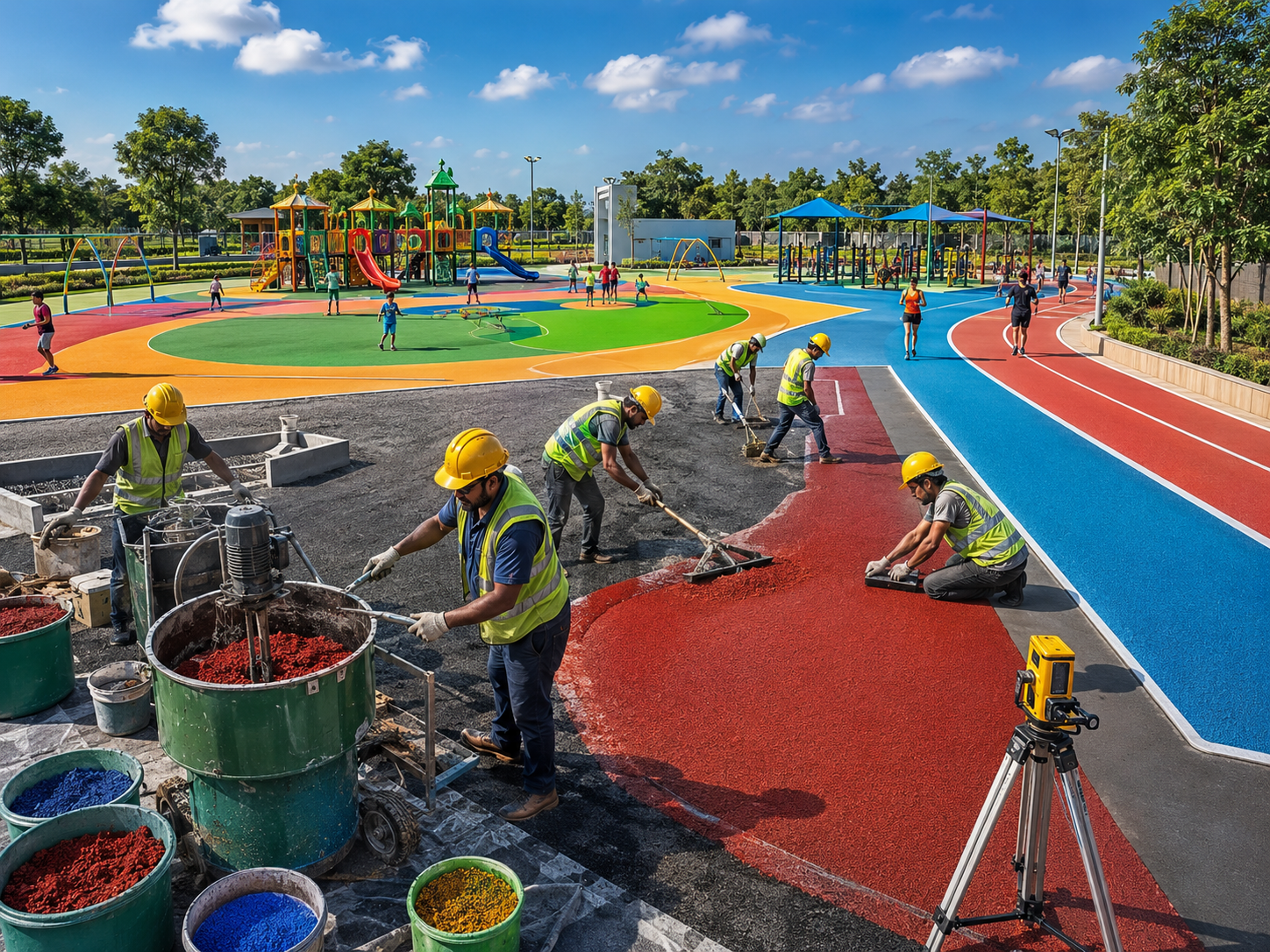
Wet-pour EPDM flooring is created by mixing EPDM rubber granules with a polyurethane binder and installing the mixture directly onto a prepared base.
The material is spread, levelled, and compacted to achieve a seamless finish.
Advantages include:
-
Seamless and uniform surface appearance.
-
Flexible design and colour combinations.
-
Good outdoor weather resistance when a suitable system is specified.
-
Comfortable surface cushioning.
-
Fewer joints compared with modular flooring.
Wet-pour systems are particularly useful for recreational courts, school play areas, and multi-purpose sports facilities where a continuous rubber surface is preferred.
B. EPDM Top Layer with a SBR Rubber Base
Another commonly used construction method combines a lower layer of SBR (Styrene Butadiene Rubber) granules with an upper layer of coloured EPDM granules.
The SBR layer provides cushioning and contributes to the overall thickness of the flooring system. The EPDM layer creates the finished wearing surface.
Key benefits include:
-
Customisable shock absorption.
-
Efficient use of rubber materials.
-
Multiple thickness configurations.
-
Attractive coloured finishes.
-
Suitable system options for different recreational applications.
The overall thickness should be determined by the intended sport, impact requirements, substrate, and manufacturer’s tested system specifications.
Expert tip: Never select EPDM flooring based only on the price per square foot. Evaluate granule quality, UV resistance, binder compatibility, installed thickness, adhesion, and independently tested performance.
3. Conduct Proper Site Inspection and Plannin
Once the flooring system is selected, the next step is to inspect and prepare the construction site.
A poor foundation can lead to surface cracks, water accumulation, uneven flooring, and premature deterioration.
During site inspection, assess the following:
Soil condition: Determine whether the existing soil is stable enough to support the proposed court. Weak, loose, or expansive soil may require additional ground improvement.
Site levels: Check the existing elevation and identify low-lying areas where rainwater could collect.
Drainage conditions: Understand the natural direction of water movement and identify suitable drainage discharge points.
Existing utilities: Locate underground electrical lines, water pipelines, and other services before excavation.
Environmental exposure: Consider nearby trees, roots, dust sources, and structures that may affect the court.
After inspection, prepare a detailed construction layout showing the court dimensions, levels, drainage arrangements, edging, and flooring thickness.
For projects in regions experiencing intense summer heat and monsoon rainfall, drainage and UV-resistant materials deserve particular attention.
4. Prepare a Strong and Stable Base Foundation
The foundation is one of the most important elements of a durable outdoor EPDM sports court.
A rubber surface can only perform properly when it is installed over a stable, properly prepared substrate.
The base construction process generally involves the following stages.
Step 1: Excavation
Remove grass, vegetation, organic material, loose soil, and unsuitable existing layers from the construction area.
Excavation depth depends on soil conditions, expected loading, drainage design, and the selected pavement structure.
Do not use a fixed excavation depth for every project.
Step 2: Subgrade Preparation
After excavation, level the exposed ground and compact it using appropriate mechanical equipment.
The objective is to create a stable and uniform subgrade that can support the layers above it without excessive settlement.
Where soil conditions require it, geotextile separation or engineered soil stabilisation may be considered.
Step 3: Aggregate Sub-Base
Install suitable graded aggregates in properly designed layers.
Each layer should be spread evenly and compacted to achieve the specified density.
The aggregate layer provides structural support and helps distribute loads across the ground.
Step 4: Install the Base Surface
Depending on the selected EPDM system, the base may consist of:
-
Properly designed concrete.
-
Asphalt.
-
An engineered permeable aggregate system.
-
Another manufacturer-approved structural substrate.
Concrete and asphalt bases are common choices for outdoor sports courts because they can provide a stable and consistent surface.
Before proceeding, check surface levels, smoothness, curing requirements, and moisture conditions.
Important: The base should not contain loose particles, oil contamination, standing water, or significant surface irregularities. Any defects should be corrected before EPDM installation.
5. Design an Effective Drainage System
Poor drainage can cause water accumulation, weaken supporting layers, affect adhesion, and increase maintenance requirements.
A properly designed drainage system should manage both surface runoff and water movement through or around the court structure.
Important drainage considerations include:
Court slope: Design an appropriate gradient to direct surface water towards designated drainage points. The slope must remain compatible with the selected sport’s playing requirements.
Perimeter drains: Install suitable drainage channels around the court where required.
Surface drainage: Ensure that the installed flooring system and underlying base work together to manage water effectively.
Discharge arrangements: Direct collected rainwater towards an approved stormwater outlet or suitable drainage facility.
It is important to understand that not every EPDM floor is permeable.
Some EPDM systems are installed over impermeable concrete or asphalt, where water drains across the surface towards the perimeter. Other specially designed permeable systems allow water to pass through the surface into a drainage-compatible base.
These systems should not be confused or combined without proper technical design.
6. Install the EPDM Rubber Flooring
Once the foundation is ready, the EPDM flooring installation can begin.
This stage requires skilled applicators, appropriate equipment, accurate material measurement, and strict control of environmental conditions.
A typical wet-pour installation involves the following process.
Clean and Inspect the Substrate
Remove dust, loose material, grease, and other contaminants.
Check that the substrate is structurally sound, sufficiently cured, and within the moisture limits specified by the flooring system manufacturer.
Where required, apply a compatible primer to improve bonding between the substrate and rubber flooring.
Prepare the Rubber Granules
Select the specified EPDM granules according to the approved project design.
Check that the granules have consistent quality, particle size, colour, and cleanliness.
Store materials in dry conditions and protect them from contamination.
Mix EPDM Granules with PU Binder
Mix the EPDM granules with the recommended polyurethane binder in the specified proportions.
The mixing process should ensure that the binder is distributed evenly throughout the granules.
Insufficient binder can cause loose granules and weak surface cohesion, while excessive binder may affect the intended flexibility and texture.
Follow the binder manufacturer’s recommended mixing time, dosage, and working time.
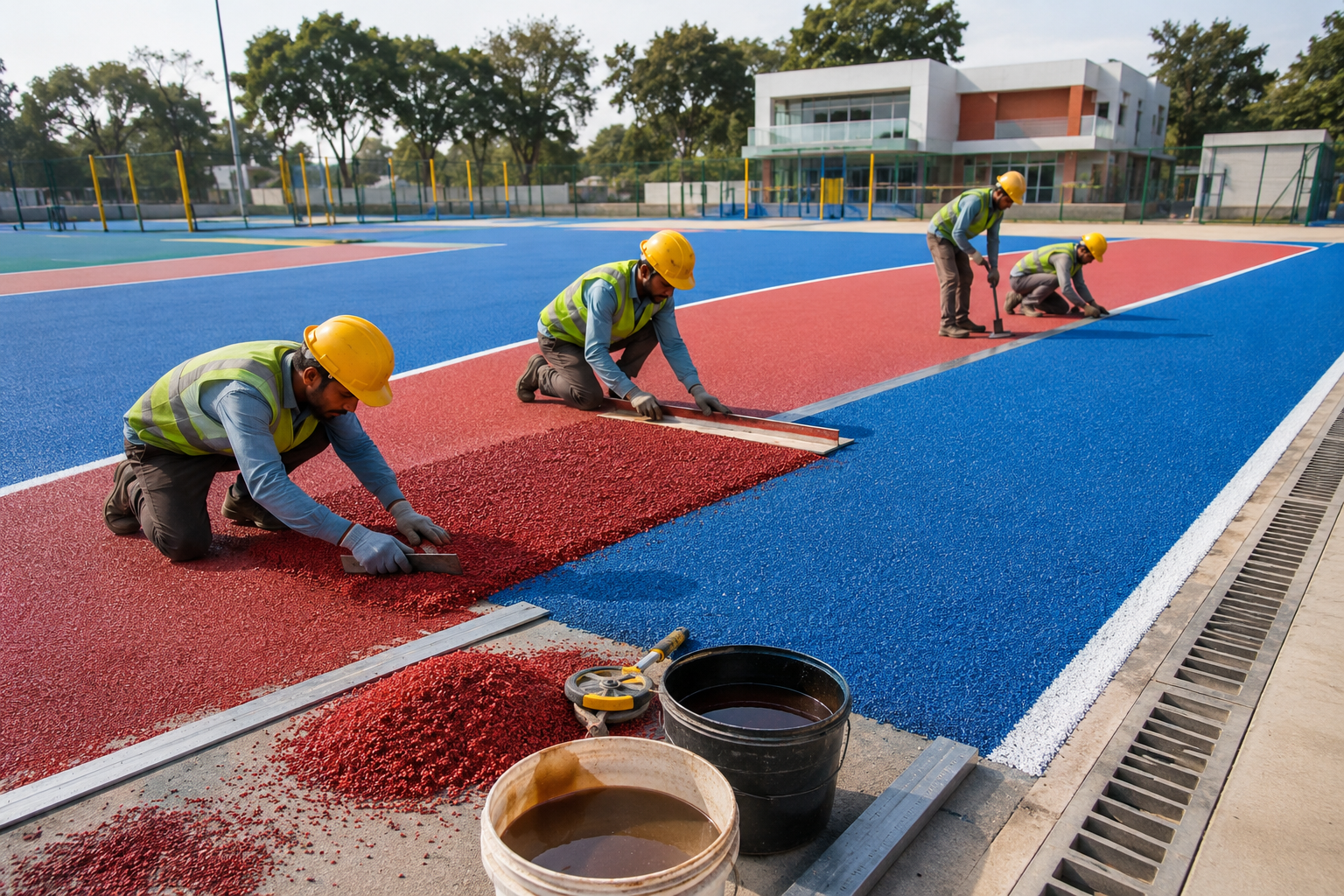
Spread and Level the Material
Transfer the prepared mixture to the installation area.
Spread it evenly using suitable hand tools and levelling equipment.
Maintain consistent thickness throughout the court.
Particular attention should be given to edges, corners, joints, and transitions around surrounding structures.
Compact and Finish the Surface
Use suitable trowels and finishing equipment to achieve a consistent surface texture.
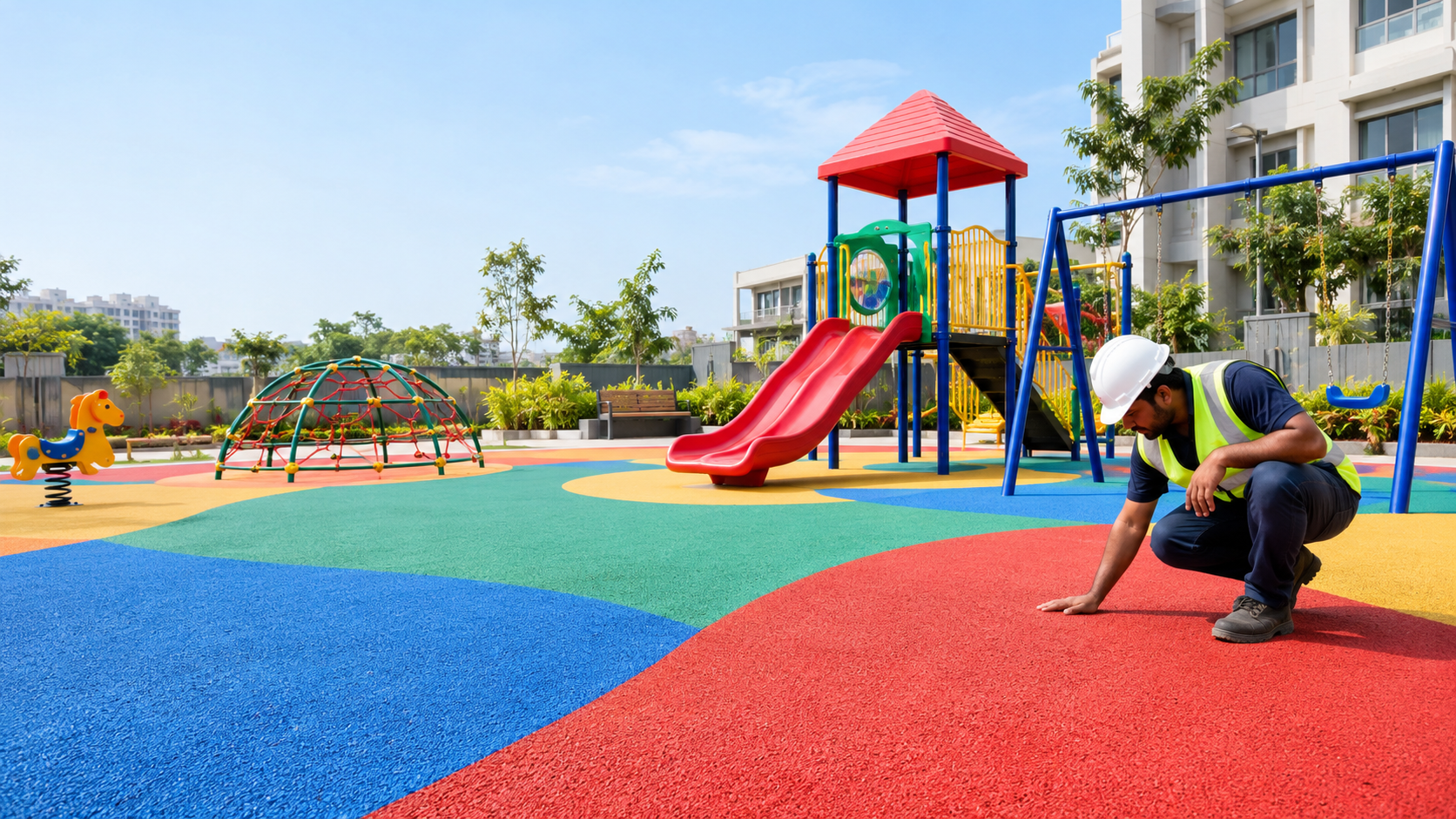
The finished surface should not have visible depressions, loose granules, excessive binder accumulation, or uneven transitions.
The installation team should maintain a consistent working method across the entire court to avoid visible differences in colour and texture.
Allow Proper Curing
After installation, allow the flooring to cure according to the binder and system manufacturer’s instructions.
Protect the area from rain, dust, foot traffic, and premature loading during the curing period.
Do not open the court for playing activities until the flooring has achieved the required curing and performance conditions.
7. Apply Sports Court Line Markings and Colour Designs
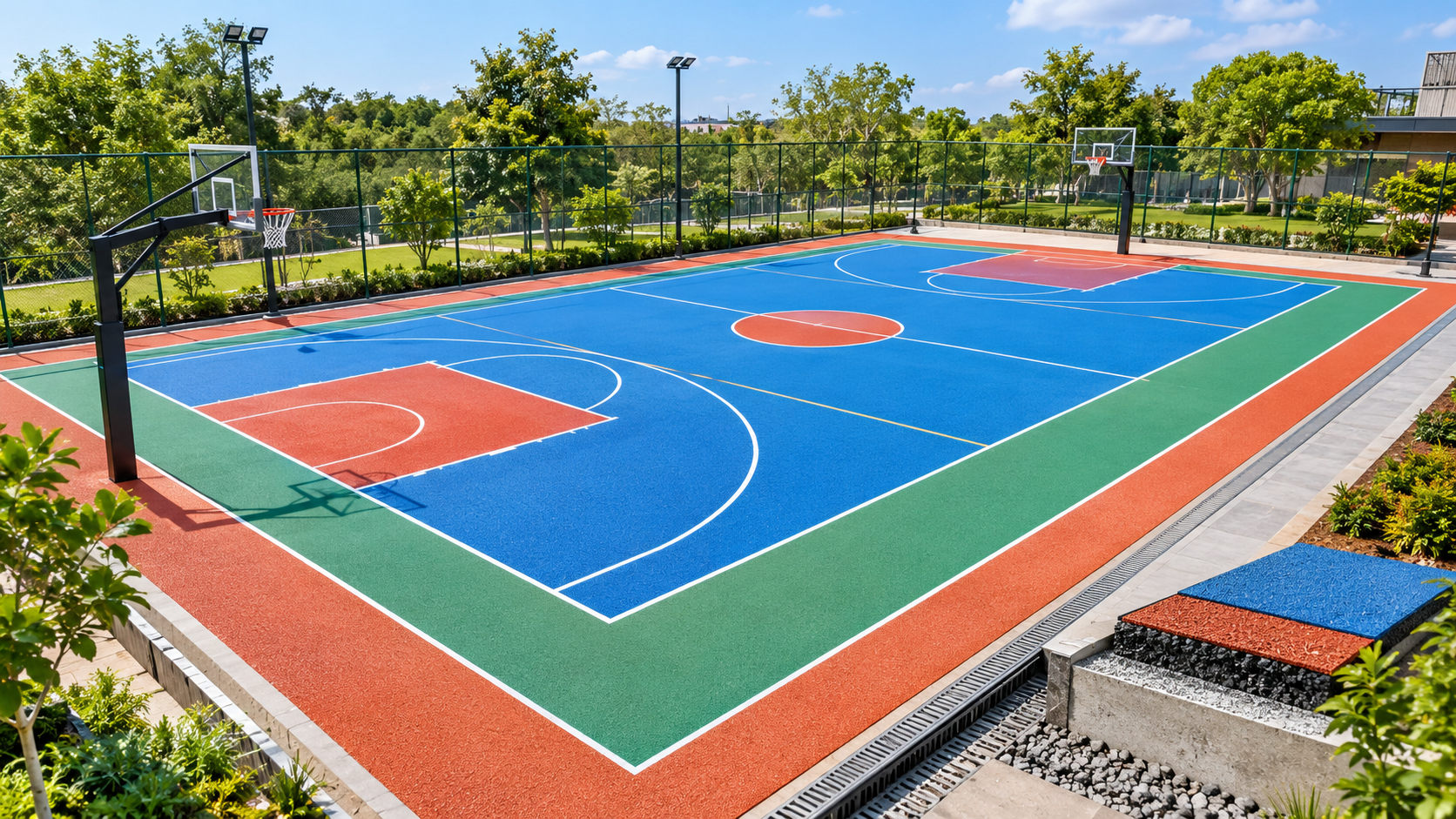
One of the biggest advantages of EPDM flooring is its ability to support attractive and customised court designs.
Different coloured rubber granules can be used to create visually distinct playing zones, activity areas, and court boundaries.
For example:
-
Blue and green combinations for multi-purpose courts.
-
Red and blue zones for basketball facilities.
-
Green and red combinations for recreational sports areas.
-
Multiple colours for school playgrounds and activity zones.
Court markings should be designed according to the relevant sport’s official dimensions and requirements.
Use compatible line-marking materials that are specifically approved for the EPDM surface.
Avoid ordinary paints unless their compatibility, adhesion, flexibility, and outdoor durability have been verified.
Accurate markings improve the functionality of the facility and help users understand different playing zones.
8. Check Safety and Sports Performance Before Opening
A visually attractive sports court is not necessarily a high-performance sports court.
Before handing over the project, conduct a detailed quality inspection.
The following parameters deserve attention:
| Inspection area | What to check |
|---|---|
| Surface uniformity | Consistent texture and thickness |
| Adhesion | No loose or delaminating areas |
| Slip resistance | Appropriate grip under relevant conditions |
| Shock absorption | Suitable impact characteristics for intended use |
| Drainage | No unwanted standing water |
| Surface levels | No significant depressions or irregularities |
| Line markings | Correct dimensions and clear visibility |
| Finishing | Clean edges and properly finished transitions |
For projects requiring formal sports-surface certification, specify the applicable performance standard and testing requirements before construction.
For example, EN 14877 addresses laboratory and installed-facility requirements for synthetic surfaces used in outdoor athletics, tennis, and multi-sport facilities. Its applicability should be assessed against the proposed sports and flooring system.
iss.rs+1
Independent testing by a suitably accredited laboratory can provide additional confidence in the installed surface’s performance.
9. How to Make an EPDM Sports Court Last Longer
Installing quality flooring is only one part of achieving long-term durability. Regular inspection and preventive maintenance are equally important.
Although EPDM rubber is designed for outdoor applications, its lifespan depends on material quality, installation workmanship, environmental exposure, and maintenance practices.
Here are some practical ways to protect your investment.
Regular Cleaning
Clean the court regularly to remove dust, leaves, mud, and other debris.
Use soft brushes, suitable cleaning equipment, and water where appropriate. Avoid aggressive chemicals that could damage the rubber surface or affect its binder.
Prevent Water Accumulation
Inspect drainage channels and outlets, particularly before and during the monsoon season.
Remove accumulated debris from drainage points and investigate any recurring waterlogging.
Inspect Surface Conditions
Periodically check for:
-
Loose or missing rubber granules.
-
Small cracks or surface separation.
-
Damaged line markings.
-
Uneven or worn-out areas.
-
Edge separation.
-
Drainage-related problems.
Addressing minor defects early can prevent more extensive repairs.
Avoid Excessive Mechanical Damage
Do not drag heavy equipment, sharp metal objects, or furniture across the rubber surface.
Use protective pads under movable sports equipment and avoid unnecessary vehicle movement on the court.
Schedule Professional Maintenance
Arrange periodic inspections with an experienced sports flooring contractor.
Professional assessment can identify developing problems with adhesion, drainage, surface performance, and localised wear.
10. Common Mistakes to Avoid During EPDM Sports Court Construction
Even a high-quality flooring material can fail prematurely when the construction process is poorly managed.
Here are some common mistakes that should be avoided.
1. Ignoring soil conditions
Installing a sports court over weak or poorly compacted soil can result in settlement and surface deformation.
2. Choosing flooring based only on price
Low-cost materials may compromise rubber quality, UV stability, binder performance, and overall durability.
3. Neglecting drainage design
Poor drainage can create standing water and contribute to deterioration of the flooring system and its foundation.
4. Using an incompatible binder
The polyurethane binder must be compatible with the EPDM granules and intended installation system.
5. Incorrect material mixing
Improper binder proportions and inadequate mixing can cause weak bonding, loose granules, or inconsistent surface properties.
6. Installing during unsuitable weather
Rain, wet substrates, excessive temperatures, and unsuitable humidity conditions can affect polyurethane curing and installation quality.
7. Ignoring sports-specific performance
A recreational rubber surface should not automatically be treated as suitable for professional competitive sports.
The flooring system must meet the performance requirements of its intended application.
8. Skipping final inspection
Opening the court without checking surface consistency, drainage, adhesion, and sports performance can lead to avoidable safety and maintenance issues.
11. Factors That Influence the Cost of EPDM Sports Court Construction
The overall cost of building an outdoor EPDM sports court depends on several technical and project-specific factors.
Rather than comparing contractors only through their per-square-foot quotations, evaluate the complete construction scope.
The main cost components include:
| Cost component | Factors affecting cost |
|---|---|
| Site preparation | Excavation, soil condition, and earthwork |
| Foundation | Aggregate, concrete, or asphalt requirements |
| Drainage | Channels, pipelines, and water outlets |
| EPDM granules | Quality, colour, and quantity |
| SBR rubber base | Thickness and material requirements |
| PU binder | Binder type and consumption |
| Installation | Labour, equipment, and workmanship |
| Court markings | Design complexity and marking materials |
| Finishing | Edging, fencing, and accessories |
The thickness of the flooring system can significantly influence material consumption and project cost.
For this reason, request a detailed quotation specifying the complete flooring build-up, including the base preparation, SBR layer, EPDM wearing layer, binder consumption, drainage provisions, and installation specifications.
A transparent quotation makes it easier to compare different contractors and avoid unexpected expenses.
12. Why EPDM Flooring Is a Good Choice for Modern Outdoor Sports Infrastructure
Outdoor sports infrastructure must balance safety, functionality, appearance, and long-term maintenance requirements.
EPDM rubber flooring offers several benefits that make it an attractive option for selected outdoor recreational and multi-purpose sports applications.
Weather resistance: Quality EPDM formulations are designed to withstand outdoor exposure, including sunlight and changing weather conditions.
Colour flexibility: EPDM granules are available in multiple colours, allowing attractive and customised court designs.
Surface comfort: Properly designed rubber systems can provide cushioning and impact attenuation, depending on their construction and thickness.
Seamless installation: Wet-pour systems can create a continuous surface with fewer joints than modular flooring products.
Design versatility: EPDM flooring can be used in different recreational layouts, school play areas, fitness zones, and suitable multi-sport facilities.
Repair possibilities: Localised surface damage can often be repaired without replacing the entire court, provided the repair system is compatible with the original installation.
However, it is important to remember that EPDM flooring is not a universal solution for every sport. High-performance facilities should use a surface system specifically engineered and tested for the relevant playing characteristics.
13. Choosing the Right EPDM Flooring Contractor
The success of an outdoor sports court depends as much on installation expertise as it does on the flooring material.
Before selecting a contractor, evaluate their technical experience and previous project performance.
Consider asking the following questions:
-
Does the contractor have experience installing EPDM sports flooring?
-
Can they provide references or photographs of completed projects?
-
What type and grade of EPDM granules will they use?
-
Which polyurethane binder is specified?
-
What is the proposed SBR and EPDM layer thickness?
-
How will the foundation and drainage system be constructed?
-
Can they provide relevant product technical data sheets?
-
Are independent performance test reports available?
-
What quality checks will be conducted during installation?
-
What warranty and maintenance support will be provided?
A reliable contractor should be able to explain the complete construction methodology instead of focusing only on the coloured rubber top layer.
Look for a company that understands site preparation, civil construction, rubber flooring installation, drainage, and sports-surface performance.
Conclusion: Build a Sports Court That Performs for Years
Building a durable outdoor sports court with EPDM flooring requires a combination of proper planning, quality materials, professional installation, and consistent maintenance.
From evaluating soil conditions and preparing a stable foundation to designing effective drainage and installing the EPDM rubber surface, every construction stage contributes to the final performance of the court.
The most important lesson is that long-lasting EPDM sports flooring starts beneath the surface. Even premium rubber granules cannot compensate for a weak foundation, inadequate drainage, or incorrect installation practices.
By selecting a suitable EPDM flooring system, following the manufacturer’s technical recommendations, and working with an experienced installation contractor, property developers, schools, sports academies, and facility managers can create attractive, functional, and durable outdoor sports facilities.
Whether you are planning a basketball court, a recreational playground, or a multi-purpose sports facility, investing in the right construction methodology from the beginning can help deliver better playing conditions and lower long-term maintenance requirements.
Plan the foundation carefully, choose the right EPDM flooring, and build a sports surface designed for long-term performance.
Frequently Asked Questions
Q1. Is EPDM flooring suitable for outdoor sports courts?
Yes. EPDM flooring can be suitable for outdoor recreational and multi-purpose sports courts. Its suitability depends on the flooring system, thickness, surface texture, drainage design, and performance requirements of the intended sport.
Q2. What is the ideal thickness for outdoor EPDM sports flooring?
There is no single ideal thickness for every sports court. The required thickness depends on the intended activity, cushioning requirements, substrate, and selected flooring system. A manufacturer’s tested system specification should determine the final thickness.
Q3. Can EPDM flooring withstand heavy rainfall?
Quality outdoor EPDM systems can be designed for rainy conditions. However, effective drainage is essential. Permeable and impermeable EPDM systems manage water differently, so the correct construction method must be selected.
Q4. Is EPDM flooring UV-resistant?
Quality EPDM granules are available with good resistance to outdoor UV exposure. However, actual colour stability and weathering performance depend on the formulation, pigment quality, binder, and manufacturing standards.
Q5. Can EPDM flooring be installed over concrete?
Yes. Many wet-pour EPDM systems can be installed over properly prepared concrete. The substrate must be sound, clean, sufficiently cured, and compatible with the specified primer and binder system.
Q6. What is the difference between SBR and EPDM flooring?
SBR is commonly used as a recycled rubber cushioning layer, while EPDM is commonly used as the coloured wearing layer. Both materials have different properties and applications, and they are often combined in multi-layer flooring systems.
Q7. How can I maintain an outdoor EPDM sports court?
Regularly remove dust and debris, clean the surface with suitable methods, inspect drainage systems, and repair loose granules or damaged areas. Avoid harsh chemicals and mechanical activities that may damage the flooring.
Q8. Is EPDM flooring suitable for schools and playgrounds?
Yes. Appropriate EPDM systems are widely used in recreational play areas and school facilities. Where fall protection is required, the complete installed system must be assessed against the applicable critical fall-height requirements. Sports-court suitability and playground impact protection should not be assumed to be interchangeable.
Q9. Can different colours be used in one EPDM sports court?
Yes. Different coloured EPDM granules can create playing zones, court boundaries, activity areas, and customised designs. The colours and line markings should be selected according to the facility’s layout and intended sports.
Q10. What is the most important factor in building a durable EPDM sports court?
The most important factor is the quality of the complete construction system. Proper subgrade preparation, a stable foundation, effective drainage, compatible materials, correct installation, and regular maintenance all contribute to long-term durability.