



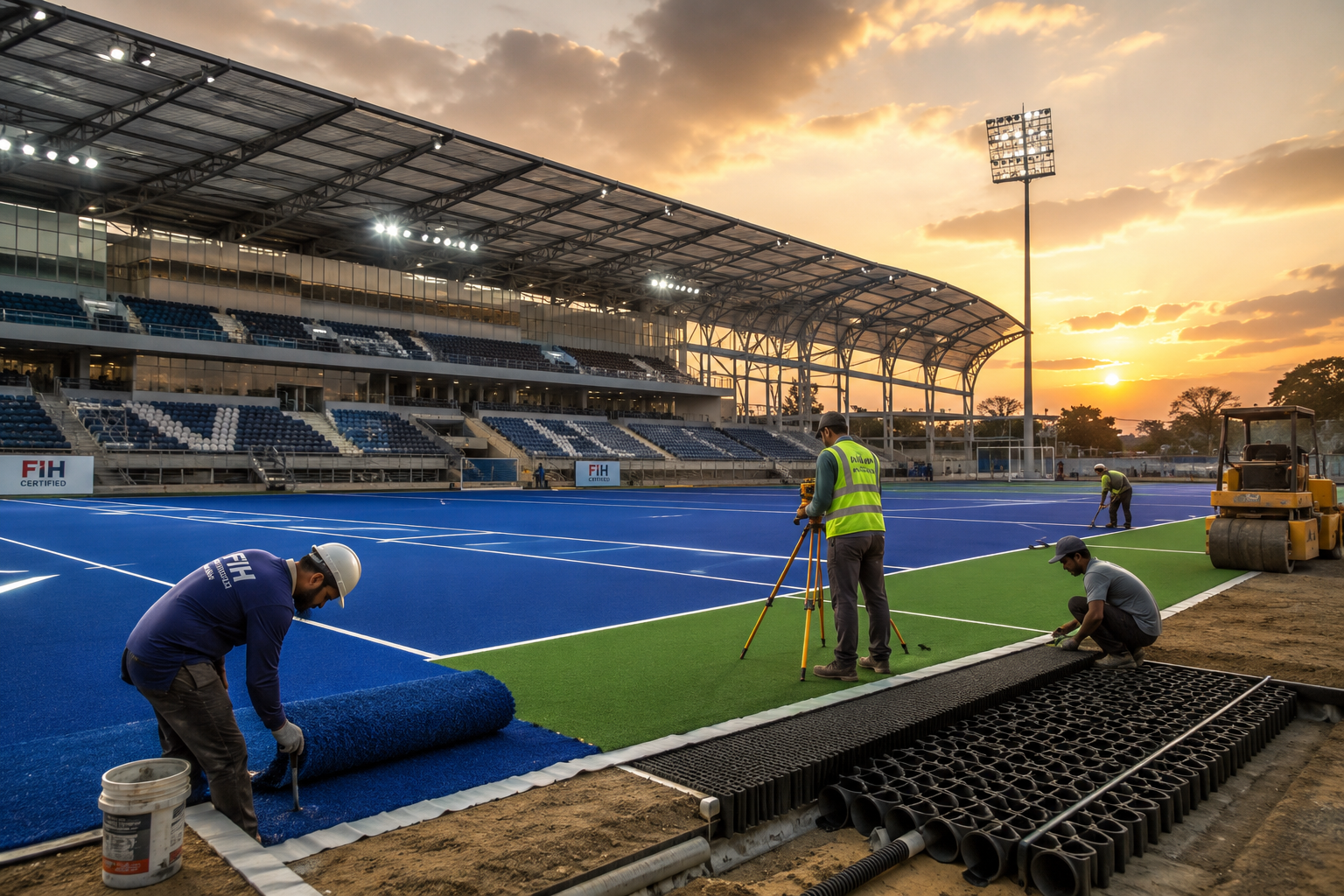
Introduction
Hockey is one of the fastest and most skill-intensive field sports in the world. Whether played at the national, international, or school level, the quality of the playing surface directly impacts performance, safety, and game quality. This is where sports flooring for hockey plays a crucial role.
Modern hockey is no longer played on natural grass at the professional level. Instead, advanced synthetic hockey turf systems dominate stadiums and training centers worldwide. These surfaces are engineered to deliver consistent ball speed, predictable bounce, reduced injury risk, and all-weather usability.
In this detailed guide, we will explore everything about hockey sports flooring—types, materials, installation, benefits, standards, maintenance, and future trends.
What is Sports Flooring for Hockey?
Sports flooring for hockey refers to specially engineered artificial surfaces designed to replicate and improve upon natural grass conditions for field hockey. These surfaces are typically made from synthetic fibers such as polyethylene or polypropylene and installed over a multi-layered base system.
Unlike traditional grass fields, hockey turf flooring provides:
- Smooth and uniform playing surface
- High ball speed and accuracy
- Better traction and player control
- Weather resistance
- Low maintenance requirements
Modern hockey flooring is designed according to FIH (Fédération Internationale de Hockey) standards, ensuring international-level gameplay quality.
Evolution of Hockey Playing Surfaces
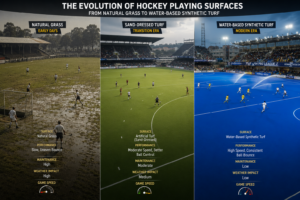
The game of hockey has evolved significantly over time:
1. Natural Grass Era
Earlier hockey was played on natural grass fields. These surfaces were uneven, slow, and heavily dependent on weather conditions. Rain could make fields muddy, while dry conditions made them hard and unpredictable.
2. Sand-Dressed Turf
With modernization, sand-based artificial turfs were introduced. These offered improved consistency but still lacked high-speed gameplay quality.
3. Water-Based Synthetic Turf (Modern Standard)
Today, water-based hockey turf is the global standard for professional matches. These surfaces are irrigated before play to reduce friction and allow faster ball movement.
Types of Sports Flooring for Hockey
Different types of hockey flooring are used depending on the level of play, budget, and purpose.
1. Water-Based Hockey Turf
This is the highest quality hockey surface used in international competitions.
Features:
- Requires irrigation before play
- Extremely fast ball movement
- Minimal friction
- Preferred for professional tournaments
Used in:
- Olympics
- World Cups
- International stadiums
2. Sand-Dressed Hockey Turf
A mid-range option where sand is lightly spread into the turf fibers.
Features:
- Balanced speed and control
- Less expensive than water-based turf
- Suitable for schools and clubs
3. Sand-Filled Hockey Turf
This type is filled with sand up to the base of fibers.
Features:
- Slower ball movement
- High durability
- Low maintenance
Used in:
- Training centers
- Recreational fields
4. Hybrid Hockey Turf Systems
Hybrid systems combine synthetic fibers with natural grass roots.
Features:
- Natural look with artificial durability
- Moderate speed and cushioning
- Environment-friendly option
Structure of Hockey Sports Flooring
A professional hockey turf system consists of multiple engineered layers:
1. Sub-Base Layer
- Compacted soil or asphalt base
- Ensures stability and drainage
2. Shock Pad Layer
- Elastic cushioning layer
- Reduces injury risk
- Enhances player comfort
3. Turf Carpet Layer
- Synthetic grass fibers
- Provides playing surface
4. Infill (if applicable)
- Sand or rubber granules
- Adds stability and weight
5. Irrigation System
- Essential for water-based turf
- Maintains surface speed and cooling
Materials Used in Hockey Turf Flooring
Modern hockey sports flooring uses advanced materials:
Polyethylene Fibers
- Soft and durable
- Ideal for ball control
- Most commonly used material
Polypropylene Fibers
- Strong and cost-effective
- Used in training and practice fields
Latex or PU Backing
- Holds fibers in place
- Ensures dimensional stability
Elastic Shock Pads
- Made from recycled rubber or foam
- Reduces impact injuries
Key Features of High-Quality Hockey Flooring
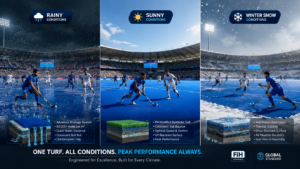
A premium hockey turf system must meet several performance criteria:
1. Ball Roll Consistency
The ball must travel smoothly without unpredictable bouncing.
2. Player Safety
Shock absorption reduces stress on knees and joints.
3. Weather Resistance
Fields must perform in rain, heat, and humidity.
4. Drainage Efficiency
Water must quickly pass through the surface.
5. UV Protection
Prevents fiber degradation from sunlight exposure.
6. Durability
High resistance to wear and tear from intense gameplay.
Benefits of Synthetic Sports Flooring for Hockey
Modern hockey turf systems offer multiple advantages:
1. Improved Performance
Players experience faster gameplay and better control.
2. Year-Round Usability
Weather conditions do not interrupt matches.
3. Low Maintenance
No need for mowing, fertilizing, or re-seeding.
4. Cost Efficiency
Long-term maintenance costs are significantly reduced.
5. Safety Enhancement
Reduced risk of injuries compared to natural grass.
6. Professional Standard
Meets international competition requirements.
Installation Process of Hockey Turf Flooring
Installing a hockey sports floor is a technical process that requires expertise.
Step 1: Site Preparation
- Land leveling
- Soil compaction
- Drainage planning
Base Construction
- Asphalt or stone base layer installation
- Ensures stability
Shock Pad Installation
- Rolled or tile-based cushioning layer applied
Turf Laying
- Synthetic rolls are unrolled and aligned
- Seams are joined using adhesives
Line Marking
- White field markings painted or tufted
Infill Application
- Sand or rubber infill added if required
Final Testing
- Ball roll test
- Surface uniformity check
Maintenance of Hockey Sports Flooring
Although low maintenance, proper care is essential:
Regular Cleaning
- Remove dust and debris
- Brush fibers periodically
Watering (for water-based turf)
- Maintain moisture before matches
Inspection
- Check seams and surface wear
Repair Work
- Fix damaged turf sections immediately
Drainage Maintenance
- Ensure water flow remains efficient
Standards for Hockey Turf (FIH Certification)
The FIH classifies hockey turfs into performance categories:
- Global Category (Elite international matches)
- National Category
- Training Category
Each category defines:
- Ball speed
- Shock absorption
- Surface uniformity
- Water usage
FIH certification ensures global acceptance for competitive matches.
Applications of Hockey Sports Flooring
Hockey turf flooring is used in various environments:
- International stadiums
- School sports grounds
- University campuses
- Sports academies
- Training centers
- Multi-sport complexes
Cost Factors of Hockey Turf Installation
The cost depends on several factors:
- Type of turf (water-based, sand-dressed, etc.)
- Base construction requirements
- Shock pad quality
- Field size
- Drainage system complexity
- Location and labor costs
Water-based FIH-certified turf is the most expensive but highest quality option.
Future of Hockey Sports Flooring
The future of hockey flooring is moving toward innovation and sustainability:
1. Eco-Friendly Turf
Recyclable materials and reduced water usage systems.
2. Smart Sports Flooring
Embedded sensors for performance tracking.
3. Hybrid Systems
Combining natural grass aesthetics with artificial durability.
4. Energy-Efficient Irrigation
Automated water control systems.
5. Advanced Shock Absorption
Improved injury prevention technology.
Conclusion
Sports flooring for hockey is a critical foundation of modern field hockey infrastructure. From school playgrounds to Olympic stadiums, the quality of the playing surface defines the speed, safety, and fairness of the game.
With advanced materials, improved installation techniques, and international standards like FIH certification, modern hockey turf systems deliver world-class performance.
Whether you are building a training ground, a professional stadium, or a recreational field, investing in high-quality hockey sports flooring ensures long-term durability, better athlete performance, and an elevated sporting experience.
FAQ: Sports Flooring for Hockey
1. What is hockey sports flooring made of?
Hockey sports flooring is usually made of synthetic fibers like polyethylene or polypropylene with a strong latex or PU backing for durability and stability.
2. Which type of turf is best for hockey?
Water-based synthetic turf is considered the best for professional hockey as it offers fast ball speed, smooth movement, and international (FIH) standards.
3. How long does hockey turf last?
A good-quality hockey turf typically lasts 8–12 years, depending on usage, maintenance, and weather conditions.
4. Is synthetic hockey turf safe for players?
Yes, it is designed with shock-absorbing layers that reduce impact and help prevent injuries during play.
5. Can hockey turf be used in all weather conditions?
Yes, synthetic hockey flooring is weather-resistant and can be used in rain, heat, and humid conditions with proper drainage systems.
6. How is hockey turf maintained?
Regular brushing, cleaning debris, checking seams, and maintaining drainage are key maintenance practices.
7. What is FIH-certified hockey turf?
FIH-certified turf meets international standards set by the Fédération Internationale de Hockey for professional and global-level competitions.
8. Is hockey turf expensive to install?
Yes, initial installation cost can be high, but it is cost-effective in the long run due to low maintenance and long lifespan.