Introduction
Basketball has grown into a popular sport across schools, colleges, universities, residential societies, sports academies, fitness centres, corporate campuses, and professional training facilities. As participation increases, so does the demand for well-designed basketball courts that provide a safe, comfortable, and reliable playing environment.
However, constructing a basketball court involves much more than preparing a flat surface, painting court markings, and installing basketball hoops. A successful project requires careful site assessment, structural planning, appropriate flooring selection, accurate dimensions, effective drainage, and professional installation. Every stage contributes to the court’s usability, durability, and long-term maintenance requirements.
This is why hiring a professional basketball court construction company is an important decision for anyone planning to develop a new basketball facility or upgrade an existing playing area.
An experienced basketball court contractor can help transform an available space into a functional sports facility tailored to the needs of players, the available budget, and the intended level of use. Whether the requirement is an outdoor basketball court for a school or a high-performance indoor court for a sports academy, professional planning can make a significant difference to the final result.
In this blog, we explore the major reasons to hire a professional basketball court construction company and explain how expert planning, suitable materials, and skilled execution can contribute to a successful project.
1. Expert Planning and Basketball Court Design
Proper planning is the foundation of every successful basketball court construction project. Before any construction work begins, several factors must be evaluated, including the available land area, site conditions, expected number of users, intended playing level, and project budget.
A professional basketball court construction company considers these requirements before developing a suitable layout. The design process may include court orientation, playing dimensions, safety clearances, spectator areas, lighting positions, equipment locations, and access routes.
For example, a basketball court intended for recreational use in a residential society may require a different layout from a court designed for competitive training at a sports academy. Similarly, an indoor facility may need additional planning for ceiling height, lighting glare, ventilation, and the surrounding building structure.
Professional planning helps ensure that the court is designed around its actual purpose rather than relying on a generic layout. It also reduces the likelihood of expensive changes after construction has started.
2. Accurate Court Dimensions and Markings
Basketball requires clearly defined playing boundaries and correctly positioned court markings. Incorrect measurements can affect gameplay, training sessions, and the suitability of a facility for organised competitions.
A professional basketball court contractor understands the importance of accurate measurements and marking layouts. The court can be planned according to the applicable rules of the intended competition, such as FIBA regulations, NBA specifications where relevant, or other governing-body requirements.
Depending on the selected standard, important layout elements include:
- Playing court length and width
- Centre circle and centre line
- Three-point line
- Free-throw line and free-throw lane
- Restricted area and basket positions
- Boundary lines and required surrounding clearances
For example, a standard FIBA playing court measures 28 metres long and 15 metres wide, measured from the inside edges of the boundary lines. The overall site must provide additional space wherever safety clearances, access areas, or spectator zones are required.
A professional team can establish the correct dimensions before installing the flooring and applying the final markings. This improves layout accuracy and creates a more organised playing environment.
3. Selection of the Right Basketball Court Flooring
Flooring is one of the most important decisions in basketball court construction because it influences traction, ball response, movement, player comfort, maintenance, and the overall playing experience.
There is no single flooring material that is ideal for every project. The right option depends on whether the court is indoors or outdoors, how frequently it will be used, the available budget, the local climate, and the performance requirements.
A professional basketball court construction company can explain the differences between available flooring systems and recommend an option suited to the site.
Common Basketball Court Flooring Options
Acrylic basketball court flooring: Acrylic sports surfacing is widely used for outdoor basketball courts. When installed over a suitable, properly prepared base, it can provide a textured playing surface, clear colours, and durable court markings.
Modular interlocking sports tiles: These tiles are designed for certain outdoor and multipurpose sports applications. Depending on the product, they may offer drainage features, replaceable sections, and relatively convenient maintenance. Their suitability should be evaluated against the intended level of basketball use and performance requirements.
Wooden sports flooring: Wooden flooring systems are commonly considered for indoor basketball courts, particularly in facilities designed for structured training and competitive play. The complete system must be selected and installed according to the required performance characteristics and environmental conditions.
Synthetic indoor sports flooring: Certain synthetic sports flooring systems can be suitable for indoor basketball facilities. Their playing characteristics, shock absorption, maintenance needs, and compliance with the intended application should be reviewed before selection.
A professional contractor evaluates the available options rather than recommending a material solely because it is inexpensive or visually attractive. This helps the client make a more informed decision about initial investment, performance, and long-term upkeep.
4. Proper Base Preparation and Civil Construction
A basketball court’s performance depends heavily on the quality of the surface beneath the finished flooring. Even an attractive sports surface can develop problems if the underlying base is uneven, unstable, or inadequately prepared.
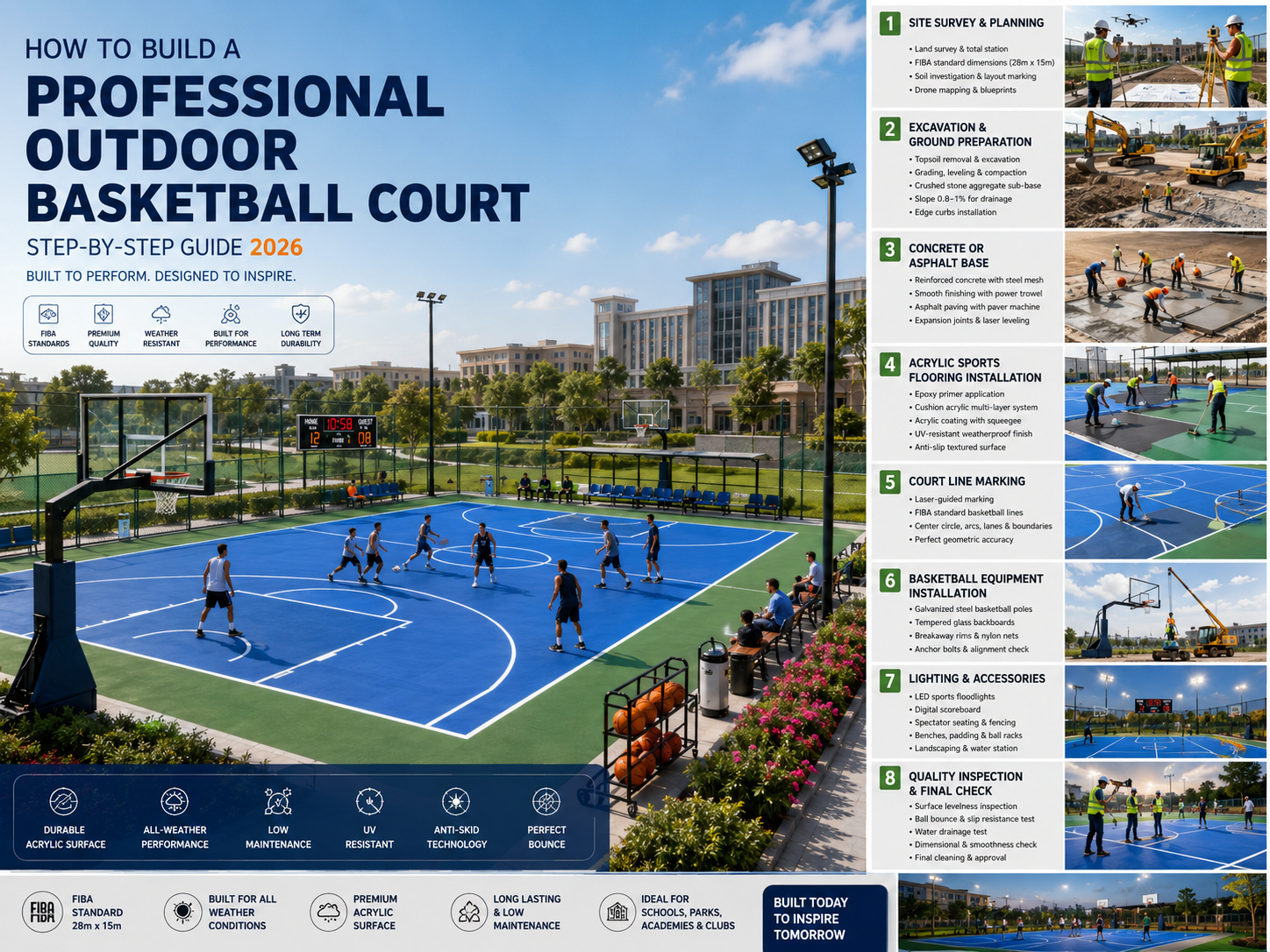
Civil construction may involve site clearing, excavation, soil preparation, compaction, sub-base installation, concrete or asphalt work, and surface levelling, depending on the selected construction system.
A professional construction team assesses the ground conditions and determines the appropriate preparation method. The design should account for the expected loads, local soil characteristics, drainage requirements, and the intended flooring system.
Poor base preparation can contribute to cracking, surface settlement, water accumulation, and premature deterioration. Correcting these issues after the court has been completed can be costly and disruptive.
By coordinating civil work with the sports flooring installation, a professional basketball court builder helps create a more dependable foundation for the finished facility.
5. Effective Drainage and Weather Resistance
Outdoor basketball courts are exposed to sunlight, rain, temperature changes, dust, and other environmental conditions. Without proper drainage and suitable materials, water can collect on the playing surface and interfere with court availability.
A professional basketball court construction company evaluates site gradients, runoff routes, surrounding ground levels, and the drainage arrangements required for the selected system.
Depending on the project, drainage planning may include suitable surface falls, perimeter drains, channels, and connections to an appropriate stormwater outlet. The final solution must comply with the site conditions and applicable requirements.
Material selection is equally important. Outdoor acrylic systems and modular sports tiles have different installation requirements and weather-related characteristics. The contractor should explain how the chosen system is expected to perform under local conditions.
In regions with heavy seasonal rainfall or intense summer heat, this planning becomes especially valuable. Effective drainage and suitable construction methods can help reduce avoidable maintenance and improve the court’s usability throughout the year.
6. Better Player Safety and Playing Comfort
Player safety should be a central consideration during basketball court construction. Basketball involves jumping, landing, sudden stops, changes of direction, and frequent acceleration. The playing environment should therefore be designed to support these movements as appropriately as possible.
A professional contractor considers surface traction, uniformity, suitable flooring characteristics, equipment stability, and the space available around the playing boundaries.
For indoor courts, the selected sports flooring system may need specific shock-absorption and deformation characteristics. For outdoor courts, the surface should provide appropriate grip without creating an excessively abrasive or unsuitable playing environment.
Safety planning also includes securely installed basketball hoops, properly protected equipment where needed, adequate lighting, clear access routes, and the removal of avoidable obstacles around the court.
It is important to recognise that flooring alone cannot eliminate sports injuries. Player footwear, physical conditioning, playing technique, supervision, and maintenance also matter. Nevertheless, a professionally planned court can help reduce certain facility-related risks and provide a more consistent environment for practice and games.
7. Professional Installation and Quality Control
High-quality materials cannot deliver their intended performance if they are installed incorrectly. Each basketball court flooring system has specific requirements for surface preparation, installation conditions, application methods, curing, and finishing.
A professional basketball court construction company coordinates the various stages of work and checks that each phase is completed before the next begins.
For an acrylic court, for instance, the process may involve preparing the base, repairing suitable surface defects, applying compatible coating layers, and completing the playing lines. For modular tiles, the work may involve checking the substrate, planning the tile layout, and installing the system according to the manufacturer’s instructions.
Quality checks can include verifying measurements, inspecting surface uniformity, confirming line placement, checking equipment stability, and reviewing drainage performance.
Proper coordination between the civil construction team, flooring installers, and equipment suppliers helps minimise avoidable installation errors. It also gives the client a clearer understanding of the work completed and any maintenance steps required before the facility is opened for regular use.
8. Customised Solutions for Different Facilities
Every basketball court project has different priorities. A school may need a durable outdoor court for physical education and extracurricular activities, while a residential development may prioritise recreational access and efficient maintenance.
A professional basketball court builder can tailor the design and construction approach to the intended users and available site.
Common applications include:
- Schools and colleges
- Universities and sports academies
- Residential societies and housing complexes
- Indoor stadiums and multipurpose sports halls
- Corporate campuses and employee recreation areas
- Hotels, resorts, and fitness centres
- Private properties and recreational facilities
- Community sports grounds and training centres
Customisation may involve selecting full-court or half-court dimensions, choosing appropriate flooring, planning lighting, installing suitable basketball systems, and incorporating fencing or spectator areas where required.
This flexibility allows clients to prioritise the features that matter most instead of investing in unnecessary facilities.
9. Better Budget Planning and Cost Control
Budget management is another important reason to hire an experienced basketball court construction company. The total project cost depends on several factors, including site preparation, civil construction, flooring materials, court dimensions, equipment, lighting, drainage, transportation, and labour.
A professional contractor can prepare a project-specific estimate that separates major cost components and identifies the proposed scope of work.
This makes it easier to compare quotations on a like-for-like basis. One contractor’s price may include civil work and basketball posts, while another quotation may cover only the flooring. Understanding these differences is essential before making a decision.
A low initial quotation does not necessarily represent the best overall value. Inadequate preparation, unsuitable materials, or incomplete installation may result in additional expenses later.
Clients should request clear specifications, material details, payment terms, exclusions, expected timelines, and warranty conditions. A transparent estimate helps establish realistic expectations and supports better financial decisions.
10. Time-Efficient Project Execution
Basketball court construction involves multiple activities that must be completed in the correct sequence. Delays in civil preparation, material delivery, surface installation, or equipment supply can affect the entire project schedule.
An experienced contractor can develop a work plan based on the project’s size, site readiness, weather conditions, material availability, and installation requirements.
The schedule may cover site inspection, design approval, civil work, base preparation, flooring installation, line marking, equipment fitting, and final inspection.
Proper coordination can reduce unnecessary waiting periods and help different teams work efficiently. However, the actual completion time depends on the project scope, curing requirements, site conditions, and weather. A responsible contractor should provide a realistic schedule rather than promise an unrealistic completion date.
For schools, sports academies, and commercial facilities, this planning can be particularly useful when construction must be coordinated with academic calendars, training programmes, or planned openings.
11. Long-Term Maintenance and After-Sales Support
A basketball court requires regular inspection and maintenance to remain in good playing condition. Dust, leaves, standing water, damaged line markings, loose equipment, and surface deterioration can affect usability over time.
A professional basketball court construction company can provide maintenance guidance based on the flooring system and the site’s environmental conditions.
Typical maintenance measures may include regular sweeping, suitable cleaning, checking drainage outlets, inspecting basketball hoops and fixings, and repairing surface defects before they become more extensive.
The maintenance schedule for an acrylic outdoor court will differ from that of a wooden indoor court or a modular tile system. Clients should follow the manufacturer’s recommendations and avoid cleaning chemicals or maintenance methods that may damage the surface.
Before finalising a contract, it is sensible to ask about workmanship warranties, product warranties, inspection arrangements, repair support, and the availability of replacement materials.
Good after-sales support can help facility managers plan routine maintenance and respond more effectively when repairs are needed.
12. Access to Suitable Materials and Sports Equipment
A complete basketball facility requires more than a playing surface. Depending on the project, it may also need basketball hoops, backboards, support structures, protective padding, lighting, fencing, benches, and other site amenities.
A professional contractor can coordinate the supply and installation of compatible components, helping ensure that the selected equipment suits the intended use and site conditions.
Basketball systems should be selected according to their intended application, installation method, structural requirements, and relevant safety considerations. Outdoor installations may require particular attention to anchoring, corrosion protection, and exposure to weather.
Lighting design should provide suitable visibility while managing glare and avoiding excessive dark areas. Similarly, fencing and access arrangements should be considered in relation to the available space and expected users.
Coordinating these elements as part of one project can make procurement and installation more straightforward than managing every component independently.
13. Support for Standards, Documentation, and Project Accountability
For institutions and organisations, construction quality is only one part of the project. They may also need documented specifications, approved drawings, material details, inspection records, invoices, and warranty information.
A professional basketball court construction company can help organise the relevant project documentation and explain which specifications apply to the proposed facility.
Where the court is intended for organised competition, the client should identify the applicable governing-body requirements at the design stage. Court dimensions, line markings, equipment specifications, lighting, and other requirements should be checked against the relevant rules.
Not every recreational court requires the same level of specification as a competition venue. Clarifying the intended use early helps prevent unnecessary expenditure while ensuring that important requirements are not overlooked.
Clients should verify a contractor’s relevant experience, references, qualifications where applicable, insurance arrangements, and ability to meet the project’s contractual requirements.
14. How to Choose the Right Basketball Court Construction Company
Hiring a professional is valuable, but selecting the right contractor is equally important. Before awarding the project, evaluate the company on the basis of experience, technical understanding, transparency, and the suitability of its proposed solution.
Consider the following points:
Review previous projects: Ask for photographs, project details, and references for completed basketball courts of a similar type.
Understand the construction method: Request a clear explanation of the proposed base preparation, flooring system, installation sequence, and equipment specifications.
Compare detailed quotations: Review material brands or specifications, quantities, labour, civil work, equipment, taxes, exclusions, and additional charges.
Check the flooring recommendation: Ensure that the material is appropriate for the indoor or outdoor location, expected usage, climate, and maintenance capacity.
Confirm the timeline: Ask for a realistic schedule that accounts for site preparation, installation conditions, and any required curing periods.
Discuss warranties and maintenance: Understand the coverage, exclusions, care instructions, and process for reporting defects.
Check communication and accountability: Choose a contractor who answers technical questions clearly and provides written commitments regarding the agreed scope of work.
Taking these steps can help you identify a basketball court construction partner who understands the project’s requirements and can deliver a solution suited to your facility.
Conclusion
Hiring a professional basketball court construction company is an investment in planning, construction quality, playing conditions, and long-term facility management. From accurate court measurements and appropriate flooring selection to civil preparation, drainage, equipment installation, and maintenance guidance, every stage contributes to the final outcome.
An experienced contractor can help you evaluate available options, understand the total project scope, manage installation activities, and avoid common construction mistakes. The result is a basketball facility designed around the needs of its users rather than one built solely around the lowest initial cost.
Whether you are developing a school basketball court, a residential sports facility, a professional training venue, or a recreational half-court, the right construction partner can help turn your plans into a practical and durable sports space.
Before starting your project, arrange a site assessment, define your intended use, compare flooring options, and request a detailed quotation from a qualified basketball court construction company.
Planning a new basketball court? Contact an experienced basketball court construction specialist to discuss your site requirements, preferred flooring, project budget, and installation schedule. A well-planned beginning can help create a court that serves players and facility owners for years to come.
Frequently Asked Questions
1. Why should I hire a professional basketball court construction company?
A professional company can coordinate site assessment, court design, base preparation, flooring selection, line marking, equipment installation, and quality checks. This helps create a facility suited to its intended use and reduces the risk of avoidable construction errors.
2. What is the best flooring for a basketball court?
The best flooring depends on whether the court is indoors or outdoors, its intended playing level, budget, climate, and maintenance requirements. Acrylic sports surfacing and modular tiles are options for certain outdoor applications, while wooden and synthetic systems may suit indoor facilities.
3. How much does basketball court construction cost?
The cost depends on the court dimensions, site condition, civil work, flooring material, drainage, lighting, basketball equipment, and installation requirements. A site inspection and itemised quotation provide a more reliable estimate than a general price range.
4. How long does it take to construct a basketball court?
The construction period varies according to the project size, ground preparation, selected flooring system, weather, material availability, and curing requirements. A contractor should provide a project-specific schedule after reviewing the site and scope of work.
5. Can a professional company construct an outdoor basketball court?
Yes. A qualified contractor can plan outdoor courts using suitable base construction, weather-appropriate sports surfacing, drainage provisions, and outdoor-rated equipment. The design should account for local climate and site conditions.
6. What should I check before hiring a basketball court contractor?
Review relevant project experience, material specifications, construction methods, detailed pricing, realistic timelines, references, warranty conditions, and maintenance support. Confirm that the quotation clearly identifies included work and exclusions.
7. Can an existing basketball court be renovated?
In many cases, yes. Renovation may involve surface repairs, resurfacing, repainting court lines, replacing flooring components, improving drainage, or upgrading basketball equipment. The existing base and surface should be inspected before selecting a renovation method.