Introduction
Cricket has always been one of the most loved sports across India, and in 2026, the demand for professionally built box cricket turfs is growing faster than ever. With shrinking open spaces in cities, increasing interest in fitness activities, and the popularity of short-format cricket, box cricket has become a preferred choice for players of all age groups. Schools, colleges, sports academies, residential communities, clubs, corporate offices, and entrepreneurs are investing in modern box cricket facilities to meet this growing demand.
Unlike traditional cricket grounds that require acres of land and extensive maintenance, a box cricket turf offers a compact, enclosed playing environment designed for fast-paced games. These facilities can operate throughout the year, making them ideal for commercial sports businesses and recreational centers. Modern artificial turf technology, durable steel structures, LED lighting systems, and weather-resistant materials have made it possible to build premium-quality cricket arenas that deliver professional performance with minimal upkeep.
Building a successful box cricket turf requires much more than laying artificial grass. Every stage, from site selection and land preparation to drainage, fencing, lighting, and turf installation, must be carefully planned. Proper construction ensures player safety, enhances the playing experience, and reduces maintenance costs over the long term.
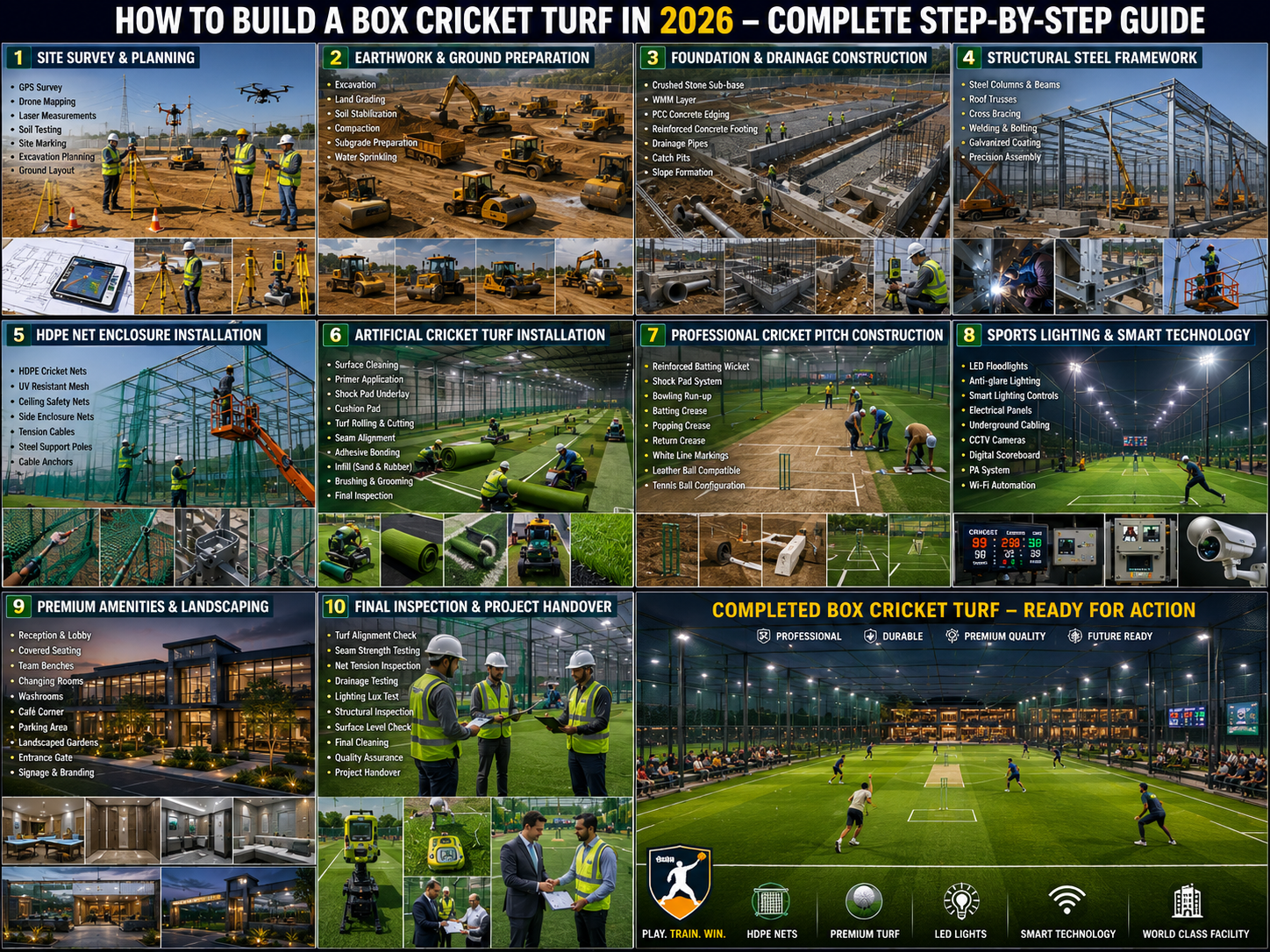
This comprehensive guide explains the complete process of building a professional box cricket turf in 2026. Whether you are a sports infrastructure developer, entrepreneur, school administrator, architect, contractor, or investor, this guide will help you understand every construction stage, the latest technologies, material selection, quality standards, estimated costs, and best practices for creating a high-performance cricket facility.
Why Box Cricket Turfs Are in High Demand in 2026
The sports infrastructure industry is witnessing remarkable growth due to changing lifestyles and increasing investments in recreational facilities. Box cricket has emerged as one of the fastest-growing indoor and outdoor sports business models because it combines entertainment, fitness, and profitability.
Several factors are driving this demand:
Urban Space Optimization
Large cricket grounds are difficult to develop in metropolitan cities due to limited land availability and high property prices. Box cricket facilities require significantly less space while providing an exciting playing experience.
Commercial Revenue Generation
Modern box cricket arenas operate on hourly rental models, tournament hosting, coaching sessions, corporate events, birthday parties, and membership programs. This creates multiple revenue streams throughout the year.
Growing Sports Culture
Government initiatives, private sports academies, schools, and residential townships are actively promoting recreational sports. Cricket remains the first choice for millions of players, making box cricket an attractive investment.
Low Maintenance Compared to Natural Grass
Artificial cricket turf eliminates the need for mowing, watering, fertilizing, and continuous ground maintenance. This significantly reduces operational expenses while maintaining consistent playing quality.
Year-Round Operations
Indoor box cricket facilities can operate regardless of weather conditions. Outdoor facilities equipped with advanced drainage systems also recover quickly after rainfall, minimizing downtime.
Corporate Sports Activities
Companies increasingly organize employee wellness programs, cricket tournaments, and team-building events. Box cricket venues provide the ideal environment for such activities.
Benefits of Building a Professional Box Cricket Turf
Constructing a professionally designed box cricket arena offers long-term advantages for both players and facility owners.
Superior Playing Performance
Premium artificial cricket turf provides a consistent ball bounce, excellent grip, realistic playing conditions, and improved comfort for players. High-quality shock pads further reduce stress on joints during gameplay.
Enhanced Player Safety
Modern cricket turf systems are designed with anti-slip surfaces, impact absorption layers, and proper cushioning to minimize injuries. Secure perimeter netting prevents balls from leaving the playing area, creating a safer environment for participants and spectators.
Long Service Life
Professional-grade artificial turf, galvanized steel structures, UV-resistant netting, and weatherproof construction materials can withstand intensive daily usage for many years with routine maintenance.
Minimal Operational Costs
Unlike natural grass fields, artificial cricket turf requires no irrigation, mowing, or frequent repairs. This substantially lowers maintenance expenses and saves both time and resources.
Higher Return on Investment
Commercial box cricket facilities can generate steady income through:
- Hourly ground bookings
- Cricket coaching programs
- Weekend tournaments
- Corporate leagues
- School competitions
- Birthday celebrations
- Sports memberships
- Sponsorship opportunities
- Food and beverage sales
- Equipment rentals
Professional Appearance
A modern sports arena featuring premium artificial turf, LED floodlights, branded fencing, digital scoreboards, and spectator seating enhances the overall customer experience and attracts more visitors.
Planning Your Box Cricket Turf Project
Successful construction begins with detailed planning. Investing time in the planning stage helps avoid costly mistakes during execution.
Define the Purpose
First, determine the primary objective of your project.
Examples include:
- Commercial sports facility
- Sports academy
- School sports infrastructure
- University campus
- Residential community
- Corporate recreation center
- Indoor entertainment zone
- Multi-sport complex
Each purpose requires different design considerations, amenities, and investment levels.
Estimate Your Budget
Your budget should include every major construction component, such as:
- Land preparation
- Civil construction
- Base foundation
- Artificial turf
- Shock absorption system
- Steel framework
- Protective netting
- LED lighting
- Electrical work
- Drainage
- Player seating
- Pavilion
- Washrooms
- Parking
- CCTV
- Fire safety systems
- Landscaping
- Maintenance equipment
A well-planned budget helps prevent unexpected expenses during construction.
Prepare a Site Layout
Develop a detailed layout showing:
- Playing area
- Entrance gate
- Emergency exits
- Spectator seating
- Parking area
- Reception
- Changing rooms
- Washrooms
- Equipment storage
- Food court (optional)
- Drainage channels
- Lighting poles
- Electrical room
A professional layout improves operational efficiency and customer convenience.
Obtain Necessary Approvals
Depending on your location, approvals may include:
- Local municipal permissions
- Building approvals
- Fire safety clearance
- Electrical safety certification
- Environmental compliance
- Commercial operation licenses
Obtaining approvals before construction begins helps avoid project delays and legal issues.
Choosing the Ideal Location
Selecting the right site is one of the most important decisions in the entire project. Even a premium-quality facility may struggle if it is built in an unsuitable location.
Accessibility
Choose a location that offers:
- Easy road connectivity
- Public transport access
- Sufficient parking
- Safe pedestrian access
- Visibility from main roads
Easy accessibility increases customer footfall and encourages repeat visits.
Land Size
The required land area depends on the number of cricket boxes and additional amenities.
Besides the playing area, allocate space for:
- Reception
- Seating
- Parking
- Washrooms
- Equipment storage
- Cafeteria
- Landscaping
- Future expansion
Planning for expansion during the initial stage can save significant costs later.
Soil Quality
Conduct a professional soil investigation before construction.
The report should evaluate:
- Soil bearing capacity
- Moisture content
- Compaction characteristics
- Drainage capability
- Groundwater level
- Settlement risks
A stable foundation is essential for ensuring the long-term durability and structural integrity of the box cricket turf.
Drainage Conditions
Poor drainage is one of the most common causes of turf deterioration.
The site should naturally support efficient water runoff or be designed with:
- Surface drainage
- Underground drainage pipes
- Stormwater outlets
- Perimeter drainage channels
- Proper slope gradients
Effective drainage protects the artificial turf, base layers, and surrounding infrastructure from water damage.
Future Development Potential
If you plan to expand your sports business, select a site with sufficient surrounding space for future additions such as:
- Additional cricket boxes
- Football turf
- Pickleball courts
- Basketball courts
- Badminton courts
- Café and lounge
- Fitness center
- Event area
- Kids’ play zone
A scalable design increases the long-term value of your investment.
Standard Box Cricket Turf Dimensions and Layout
One of the first technical decisions in any box cricket turf construction project is selecting the right dimensions. Unlike traditional cricket grounds, box cricket facilities are designed for compact spaces while maintaining an enjoyable and competitive playing experience. The exact size depends on the available land, target audience, and whether the facility is intended for recreational play, coaching, or commercial tournaments.
Although there is no universally mandatory size for recreational box cricket, most professional facilities follow industry-accepted dimensions to ensure comfortable gameplay and efficient space utilization.
Common Box Cricket Turf Dimensions
- Length: 80–120 feet (24–36 meters)
- Width: 40–60 feet (12–18 meters)
- Playing Height (Indoor): Minimum 20–30 feet (6–9 meters)
- Boundary Clearance: At least 3–5 feet around the playing area
- Net Height: 18–30 feet depending on facility design
Commercial sports complexes often prefer slightly larger dimensions to accommodate tournaments and coaching sessions, while residential societies and schools may choose more compact layouts.
Designing the Playing Layout
A well-planned layout enhances gameplay, player safety, and operational efficiency. Every section of the arena should be carefully positioned before construction begins.
A professional box cricket facility typically includes:
- Main playing area
- Batting zone
- Bowling run-up
- Safety boundary
- Side and roof netting
- Player seating
- Dugout
- Umpire area
- Entrance gate
- Emergency exit
- Equipment storage room
- Reception area
- Spectator seating
- Washrooms
- Drinking water station
- Electrical control room
Proper circulation space around the turf allows players and staff to move safely without interfering with ongoing matches.
Detailed Site Survey
Before any excavation begins, a comprehensive site survey is essential. This process identifies ground conditions and helps engineers prepare accurate construction drawings.
Professional surveyors typically evaluate:
- Land dimensions
- Existing structures
- Ground slope
- Soil condition
- Underground utilities
- Water flow direction
- Electrical access
- Entry and exit points
Modern projects often use laser surveying equipment, GPS mapping, and drone-based aerial measurements to improve accuracy and reduce construction errors.
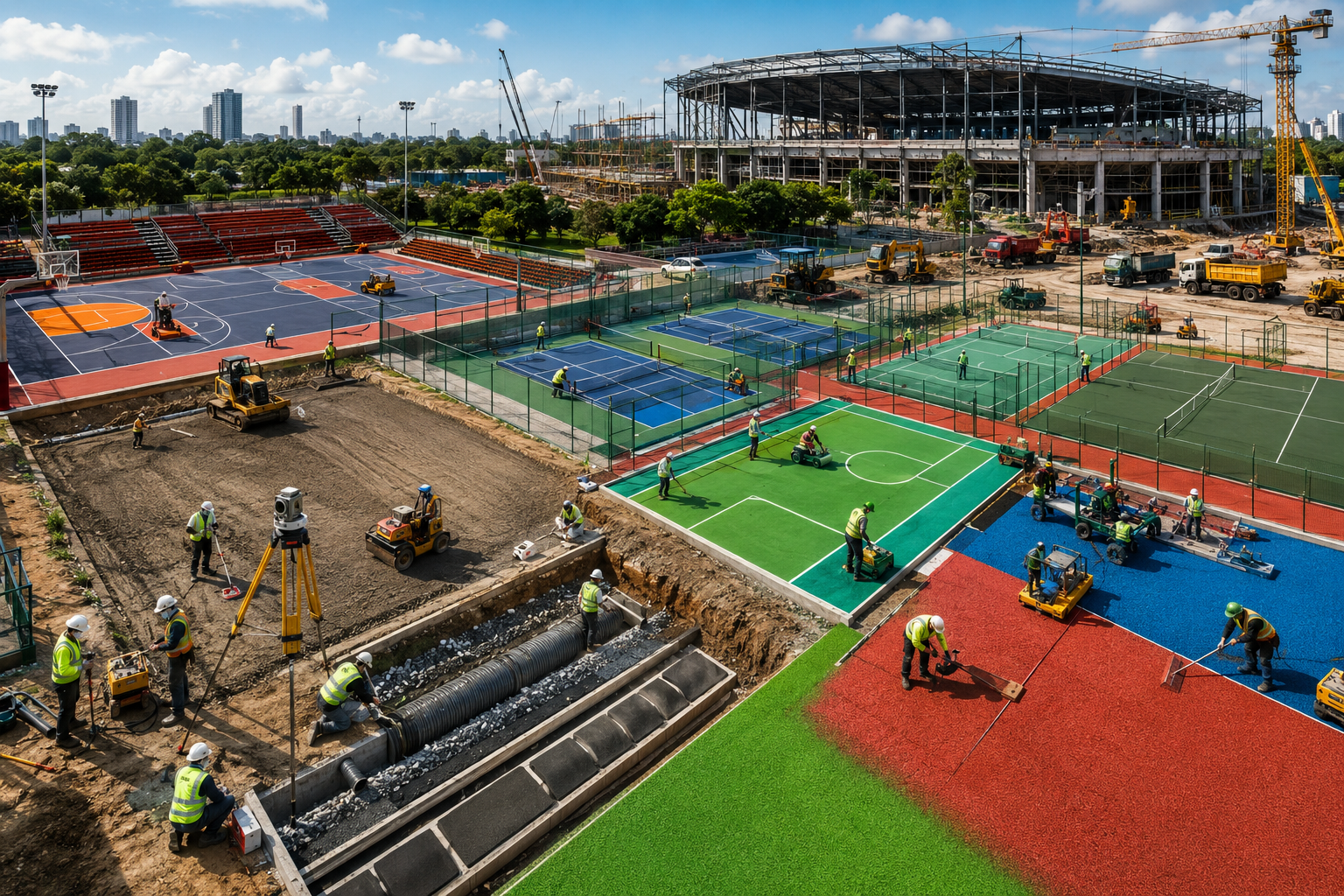
Land Clearing and Site Preparation
Once the survey is complete, the site is prepared for construction.
This stage includes:
Removing Existing Vegetation
All grass, shrubs, roots, weeds, and unwanted plants must be removed to create a clean working surface.
Demolition of Existing Structures
Old concrete slabs, walls, foundations, debris, or abandoned utilities should be safely removed before earthwork begins.
Clearing Construction Waste
Stones, loose soil, tree roots, organic matter, and construction waste must be completely cleared to prevent future settlement issues.
Temporary Site Protection
Construction fencing, warning signs, and temporary barriers should be installed to ensure worker safety and protect nearby properties.
A properly prepared site reduces delays during later construction phases.
Earthwork and Excavation
Excavation creates the foundation required for a stable sports surface.
The excavation depth depends on:
- Soil quality
- Drainage design
- Base material thickness
- Local weather conditions
- Expected player traffic
Generally, excavation ranges between 250 mm and 450 mm, depending on the engineering design.
During excavation, contractors ensure:
- Uniform depth
- Proper side slopes
- Stable soil conditions
- Removal of weak soil
- Accurate level measurements
Laser levels are commonly used to maintain consistent excavation depth across the entire playing area.
Soil Compaction
Compaction is one of the most critical stages in sports infrastructure construction. Poor compaction often leads to uneven surfaces, water accumulation, cracks, and premature turf damage.
Compaction improves:
- Load-bearing capacity
- Surface stability
- Drainage performance
- Structural durability
- Foundation strength
Heavy-duty vibratory rollers, plate compactors, and mechanical rammers are used to compact the soil layer by layer until the required density is achieved.
Engineers usually perform field density tests to verify that compaction meets project specifications.
Installing the Granular Sub-Base
After soil compaction, a granular sub-base is constructed to distribute loads evenly and support the upper layers of the turf system.
The sub-base typically consists of:
- Crushed stone
- Granular aggregate
- Gravel
- Well-graded crushed rock
These materials provide:
- Excellent drainage
- High structural strength
- Uniform support
- Reduced settlement
- Long-term durability
Each layer is compacted separately to achieve maximum stability.
Importance of the Sub-Base
A properly constructed sub-base offers several advantages:
- Prevents sinking
- Supports player movement
- Improves shock absorption
- Extends turf lifespan
- Minimizes maintenance costs
- Maintains level playing conditions
Skipping or reducing sub-base quality often results in expensive repairs within a few years.
Drainage System Installation
Water management is one of the most important aspects of box cricket turf construction. Even high-quality artificial turf can fail if rainwater is not removed efficiently.
A modern drainage system includes:
Surface Drainage
The playing surface is designed with a gentle slope, typically between 0.5% and 1%, allowing water to flow naturally toward drainage channels without affecting gameplay.
Underground Drainage Pipes
Perforated HDPE or PVC pipes are installed beneath the base to collect and carry excess water away from the field.
Drainage Aggregate
Clean gravel surrounds the drainage pipes, improving water infiltration and preventing soil blockage.
Drainage Channels
Peripheral drainage channels collect runoff and direct it toward stormwater systems or designated outlets.
Proper drainage prevents:
- Waterlogging
- Turf damage
- Mold growth
- Surface deformation
- Slippery playing conditions
Base Construction
Once drainage is complete, the structural base is constructed. This layer provides the smooth, durable platform on which the artificial turf will be installed.
There are two common base options:
Concrete Base
Concrete is widely used for indoor box cricket facilities because it provides:
- Excellent strength
- Smooth finish
- Long lifespan
- Minimal settlement
- Stable surface
Proper reinforcement and expansion joints are incorporated to prevent cracking.
Asphalt Base
Many outdoor sports facilities prefer asphalt because it offers:
- Slight flexibility
- Faster installation
- Good drainage compatibility
- Reduced cracking
- Excellent performance under varying temperatures
Asphalt also provides a comfortable playing feel when combined with quality shock pads.
Step 8: Surface Leveling
A perfectly level surface is essential before installing the turf.
Engineers use laser-guided equipment to verify:
- Flatness
- Slope consistency
- Elevation accuracy
- Edge alignment
- Drainage direction
Even minor irregularities can affect ball bounce, player movement, and water drainage, making precision leveling a crucial quality-control step.
Step 9: Edge Restraints and Border Construction
The edges of the playing surface require strong restraints to prevent movement of the turf system and base materials.
Common edge materials include:
- Reinforced concrete curbs
- Steel edging
- Precast concrete blocks
- Galvanized metal frames
Proper edging ensures:
- Stable borders
- Neat appearance
- Reduced material displacement
- Easier turf maintenance
- Longer installation life
Quality Testing Before Turf Installation
Before the artificial turf is laid, several inspections should be completed to ensure the foundation meets professional standards.
Surface Flatness Test
Checks for any high or low spots that could affect gameplay.
Compaction Test
Verifies that the soil and sub-base have achieved the required density for long-term stability.
Drainage Test
Water is introduced to confirm that the drainage system removes moisture efficiently without ponding.
Level Survey
Laser instruments confirm that the finished base matches the approved design levels.
Structural Inspection
Engineers inspect the concrete or asphalt base for cracks, weak areas, or defects that need correction before proceeding.
Only after these tests are successfully completed should the project move to the turf installation stage.
Materials Required for Box Cricket Turf Construction
A high-quality box cricket turf typically requires the following materials:
- Artificial cricket grass
- Shock absorption pad
- Polyurethane adhesive
- Joint tapes
- Silica sand infill
- Rubber granules (where specified)
- Crushed stone aggregate
- Gravel
- Geotextile membrane
- Cement
- Reinforcement steel
- Concrete or asphalt mix
- HDPE/PVC drainage pipes
- Drainage channels
- Galvanized steel sections
- Protective netting
- Fasteners and anchors
- LED lighting fixtures
- Electrical conduits and wiring
Selecting premium-grade materials enhances durability, player comfort, and overall facility performance.
Construction Equipment Required
Professional contractors typically use the following equipment during construction:
- Excavators
- Backhoe loaders
- Bulldozers
- Motor graders
- Vibratory rollers
- Plate compactors
- Laser leveling machines
- Concrete mixers
- Asphalt pavers
- Power trowels
- Core cutting machines
- Turf cutting tools
- Adhesive applicators
- Roller brushes
- Forklifts
- Mobile cranes
- Welding machines
- Total station surveying equipment
- Water tankers
- Safety equipment and PPE
Using the right machinery ensures precision, reduces construction time, and maintains consistent quality throughout the project.
Box Cricket Turf Maintenance Guide
Constructing a premium box cricket turf is only the beginning. Regular maintenance is essential to preserve playing quality, extend the lifespan of the turf, and ensure a safe environment for players. A professionally maintained turf not only enhances the playing experience but also reduces long-term repair costs and protects your investment.
Unlike natural grass fields, artificial cricket turfs require significantly less maintenance, but they should never be neglected. A structured maintenance schedule helps prevent fiber wear, uneven surfaces, drainage issues, and equipment deterioration.
Daily Maintenance Checklist
Routine daily inspections help identify minor issues before they become expensive repairs.
Daily tasks include:
- Remove leaves, dust, and litter from the playing area.
- Inspect the turf for loose seams or lifted edges.
- Check the cricket pitch for damage or excessive wear.
- Clean the player seating and spectator areas.
- Ensure entry and exit pathways are free from obstacles.
- Inspect netting for tears or loose connections.
- Verify that LED floodlights are functioning correctly.
- Check drinking water stations and washroom cleanliness.
- Empty waste bins and maintain overall hygiene.
Consistent daily maintenance creates a professional appearance and improves customer satisfaction.
Weekly Maintenance
Weekly maintenance focuses on preserving the turf’s performance and appearance.
Tasks include:
- Power brush the artificial turf to keep fibers upright.
- Redistribute silica sand or rubber infill where necessary.
- Remove embedded dirt using specialized turf cleaning equipment.
- Inspect steel columns and structural bolts.
- Check drainage channels for blockages.
- Tighten loose netting cables.
- Test the scoreboard and electrical systems.
- Inspect fencing and gate mechanisms.
These activities help maintain consistent ball bounce and player traction.
Monthly Maintenance
Monthly inspections ensure that the facility continues to meet professional standards.
Recommended tasks:
- Deep-clean the artificial turf.
- Inspect adhesive joints and repair any separation.
- Measure infill depth across the playing surface.
- Check shock pad performance.
- Test lighting levels using a lux meter.
- Inspect underground drainage outlets.
- Lubricate gate hinges and moving parts.
- Examine steel structures for corrosion.
- Review CCTV and security systems.
Professional maintenance every month minimizes unexpected downtime and extends the life of the facility.
Annual Maintenance
A comprehensive annual inspection should be carried out by experienced sports infrastructure professionals.
Annual maintenance includes:
- Complete turf condition assessment.
- Replacement of worn infill materials.
- Deep grooming of artificial grass.
- Structural safety inspection.
- Repainting steel structures if required.
- Electrical safety testing.
- Floodlight alignment and cleaning.
- Net replacement where necessary.
- Drainage system flushing.
- Surface level verification.
This proactive approach helps maintain peak performance for many years.
Estimated Box Cricket Turf Construction Cost in 2026
The total investment required depends on factors such as location, land conditions, construction materials, amenities, and whether the facility is indoor or outdoor.
Key Cost Components
- Land development and excavation
- Earthwork and compaction
- Drainage system installation
- Concrete or asphalt base
- Artificial cricket turf
- Shock absorption layer
- Cricket pitch
- Steel framework
- Side and roof netting
- LED sports lighting
- Electrical installation
- Player seating
- Reception and waiting area
- Changing rooms and washrooms
- Parking and landscaping
- CCTV and security systems
- Signage and branding
A premium facility with high-quality materials may require a higher initial investment, but it generally offers lower maintenance costs and a longer service life.
Factors Affecting Construction Cost
Several variables influence the overall project budget:
1. Project Size
Larger facilities require more materials, labor, and equipment, increasing overall costs.
2. Indoor vs. Outdoor Construction
Indoor facilities involve additional expenses for steel structures, roofing, insulation, ventilation, and lighting systems, while outdoor turfs may require more extensive drainage solutions.
3. Quality of Artificial Turf
Premium turf with UV-resistant fibers, higher pile density, and advanced backing systems provides better durability and performance but comes at a higher cost.
4. Ground Conditions
Sites with poor soil conditions may require additional excavation, stabilization, or foundation work.
5. Additional Amenities
Features such as digital scoreboards, spectator galleries, cafeterias, changing rooms, Wi-Fi, and parking areas add to the project cost but also enhance the user experience.
6. Location
Labor rates, transportation costs, and local regulations can vary significantly between regions, affecting the total investment.
Common Mistakes to Avoid
Avoiding common construction errors can save significant time and money.
Poor Site Selection
Choosing land with inadequate drainage or unstable soil can lead to long-term structural problems.
Inadequate Base Preparation
A weak or uneven foundation can cause surface settlement, inconsistent ball bounce, and premature turf failure.
Using Low-Quality Materials
Substandard turf, adhesives, netting, or steel structures often result in higher maintenance costs and shorter facility lifespan.
Ignoring Drainage Design
Insufficient drainage can lead to waterlogging, turf damage, and unsafe playing conditions.
Improper Turf Installation
Incorrect seam alignment, uneven infill distribution, or inadequate adhesive application can compromise the playing surface.
Insufficient Lighting
Poor lighting affects visibility, player safety, and the overall quality of evening matches.
Neglecting Maintenance
Failure to perform routine maintenance accelerates wear and reduces the lifespan of the turf and supporting infrastructure.
Return on Investment (ROI)
A professionally managed box cricket turf can generate substantial revenue through multiple income streams.
Revenue Sources
- Hourly ground rentals
- Cricket coaching programs
- Weekend tournaments
- Corporate cricket leagues
- School and college competitions
- Membership plans
- Birthday parties and private events
- Sponsorship and advertising
- Equipment rentals
- Food and beverage sales
High-quality facilities in accessible locations with effective marketing strategies often achieve strong occupancy rates and long-term profitability.
Sustainability in Modern Box Cricket Turf Construction
Environmental sustainability is becoming increasingly important in sports infrastructure.
Consider incorporating:
- Energy-efficient LED lighting
- Solar power systems
- Rainwater harvesting
- Recycled rubber shock pads
- Water-efficient landscaping
- Eco-friendly construction materials
- Smart irrigation for surrounding green areas
- Waste segregation and recycling systems
Sustainable practices reduce operational costs and enhance the facility’s environmental credentials.
Future Trends in Box Cricket Turf Construction
The sports industry continues to evolve with new technologies and innovations.
Emerging trends include:
- Smart LED lighting with automated controls
- Online booking and mobile app integration
- AI-powered facility management
- Contactless payment systems
- Digital scoreboards with live streaming
- Performance analytics for coaching
- IoT-enabled maintenance monitoring
- Eco-friendly synthetic turf materials
- Solar-powered sports complexes
- Multi-sport convertible arenas
Adopting these innovations can improve operational efficiency and provide a competitive advantage.
Frequently Asked Questions (FAQs)
1. What is the ideal size for a commercial box cricket turf?
Most commercial facilities range between 80–120 feet in length and 40–60 feet in width, depending on available land and intended use.
2. How long does it take to build a box cricket turf?
A standard project typically takes 6–12 weeks, depending on site conditions, weather, approvals, and project complexity.
3. Which surface is best for box cricket?
High-quality UV-resistant artificial cricket turf with an appropriate shock pad and silica sand infill offers excellent performance, durability, and low maintenance.
4. Is artificial turf better than natural grass?
Artificial turf provides consistent ball bounce, lower maintenance costs, year-round usability, and greater durability, making it ideal for commercial box cricket facilities.
5. How often should artificial turf be maintained?
Daily cleaning, weekly brushing, monthly inspections, and annual professional servicing are recommended to maximize performance and lifespan.
6. Can a box cricket turf be used for other sports?
Yes. Many facilities are designed as multi-sport arenas suitable for football training, fitness activities, and recreational events, depending on the turf specifications and layout.
Expert Tips for Building a Successful Box Cricket Turf
- Conduct a professional feasibility study before investing.
- Choose experienced sports infrastructure contractors.
- Invest in premium artificial turf and certified materials.
- Prioritize effective drainage and foundation quality.
- Install energy-efficient LED lighting for lower operating costs.
- Incorporate player amenities such as changing rooms and seating.
- Implement an online booking and payment system.
- Schedule regular maintenance to preserve playing quality.
- Use branding and sponsorship opportunities to generate additional revenue.
- Design the facility with future expansion in mind.
Conclusion
Building a professional box cricket turf in 2026 requires careful planning, high-quality materials, precise engineering, and a commitment to long-term maintenance. From selecting the right location and preparing a stable foundation to installing premium artificial turf, protective netting, and advanced lighting systems, every construction stage contributes to the safety, durability, and overall success of the facility.
As the popularity of recreational cricket continues to rise, well-designed box cricket arenas present an excellent opportunity for entrepreneurs, schools, sports academies, residential communities, and commercial sports operators. By following best construction practices, investing in durable infrastructure, and maintaining the facility consistently, you can create a high-performance sports venue that delivers exceptional playing experiences and strong long-term returns.
Whether your goal is to establish a community recreation center, a training academy, or a profitable commercial sports business, a professionally built box cricket turf is a future-ready investment that meets the growing demand for modern, accessible, and engaging cricket facilities.