Introduction
Pickleball has rapidly become one of the most popular recreational and competitive sports, creating growing demand for professionally designed pickleball court construction services across India. Schools, colleges, sports academies, residential communities, hotels, resorts, fitness centres, clubs, and commercial sports facilities are increasingly investing in dedicated pickleball courts to accommodate players of different skill levels.
A professionally constructed pickleball court is much more than a marked playing area. It requires careful site evaluation, accurate dimensions, proper foundation preparation, high-quality sports surfacing, efficient drainage, suitable fencing, professional lighting, and correctly installed sports equipment. Every stage of construction influences playing comfort, safety, durability, maintenance requirements, and the overall performance of the facility.
Choosing an experienced pickleball court construction company helps ensure that the court is designed according to the intended usage, available space, environmental conditions, and project budget. From a single residential court to a multi-court commercial sports complex, professional construction teams can provide complete solutions from planning and civil work through surface installation and final finishing.
What Is Pickleball Court Construction?
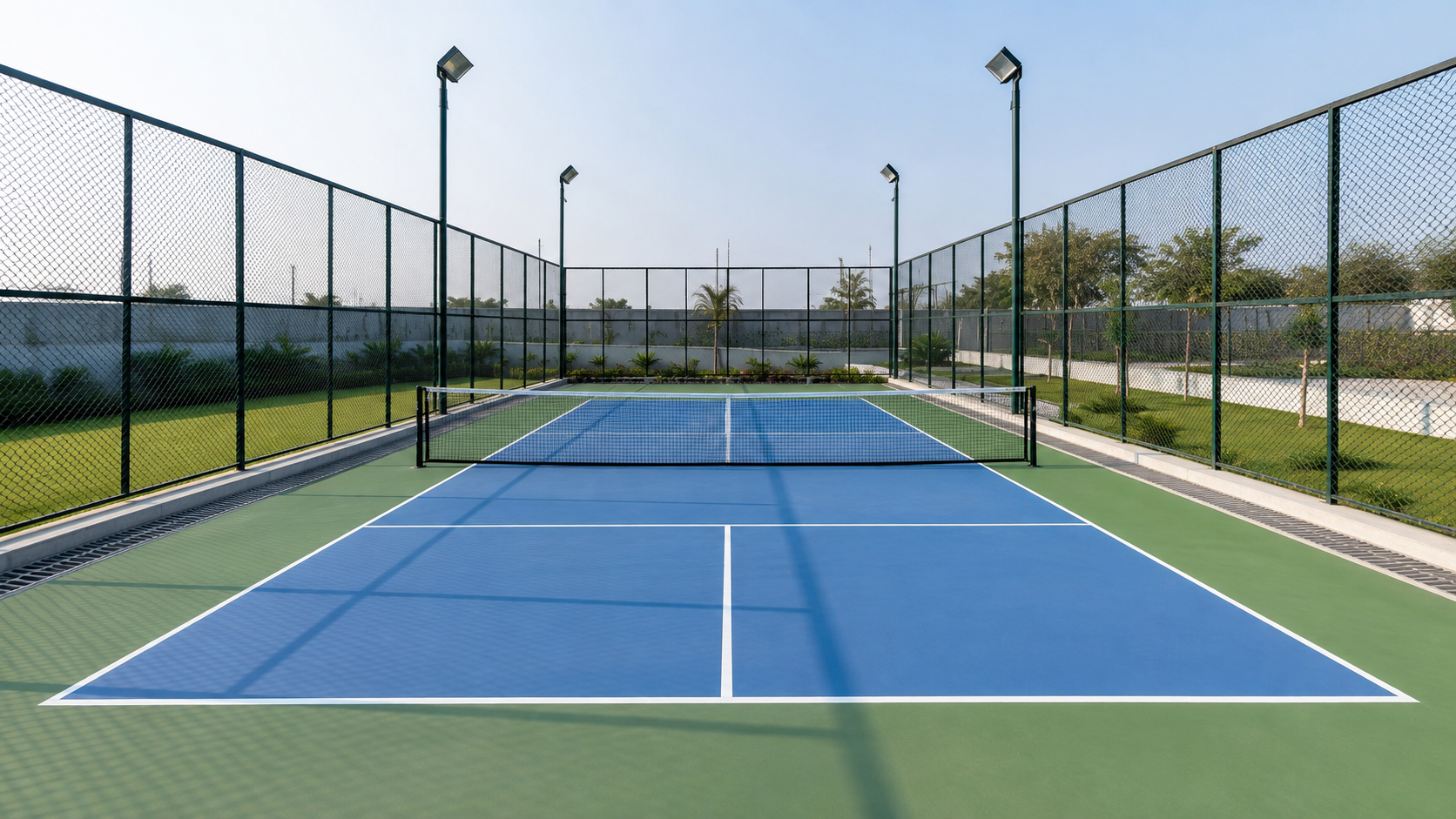
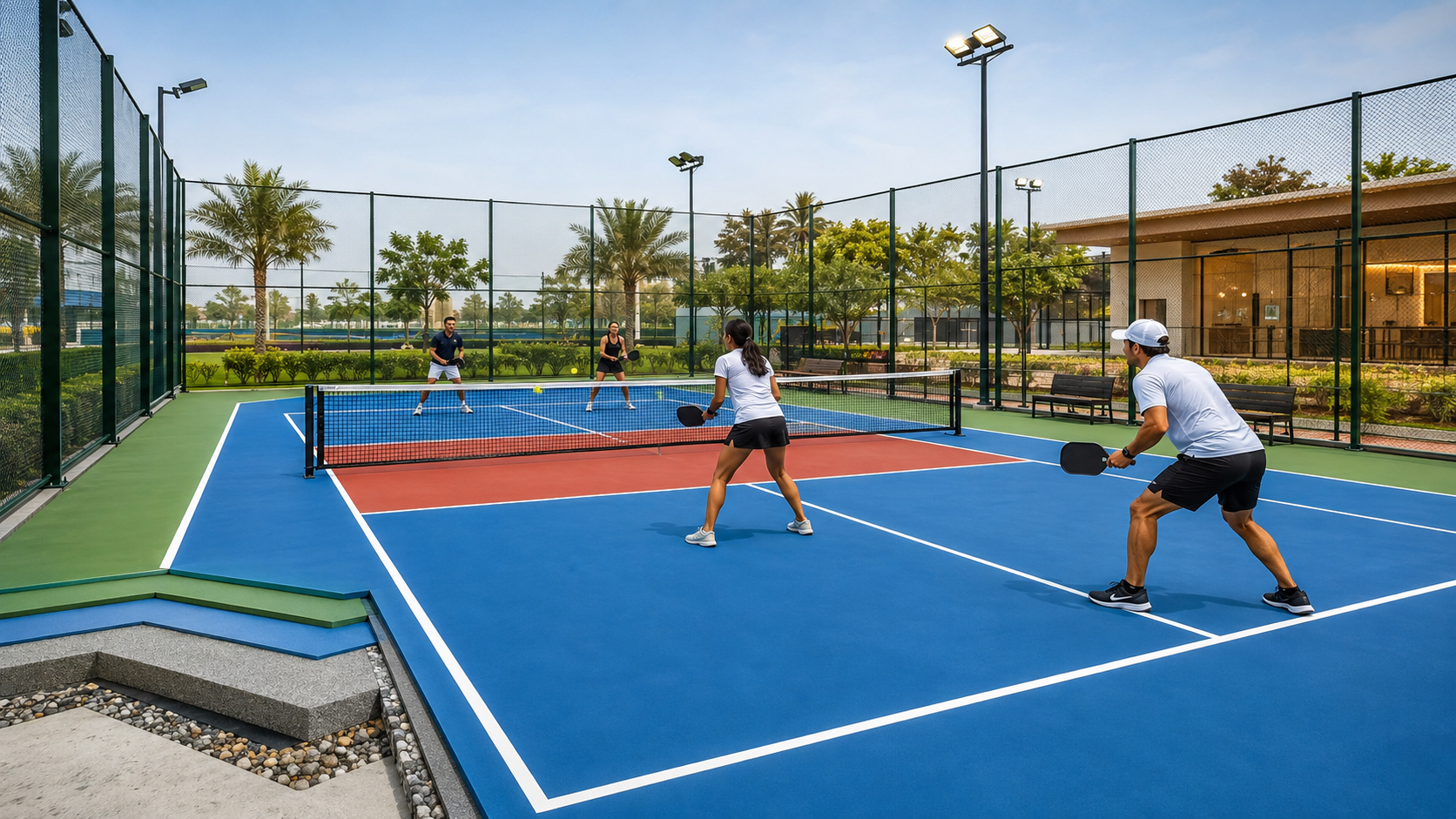
Pickleball court construction is the process of developing a purpose-built playing surface with appropriate dimensions, foundation, sports flooring, court markings, fencing, lighting, drainage, and equipment.
The standard playing area for a pickleball court is 20 feet wide and 44 feet long for both singles and doubles play. However, additional space around the court is important for player movement, safety, fencing, access, and maintenance. Therefore, the total site requirement is larger than the playing area itself.
Professional contractors consider several factors before beginning construction, including:
- Available land area
- Soil and ground conditions
- Indoor or outdoor installation
- Drainage requirements
- Surface selection
- Climate and weather exposure
- Expected player traffic
- Lighting requirements
- Fencing and netting
- Sports equipment
- Long-term maintenance
A properly planned court delivers a more consistent playing experience while helping the facility owner avoid unnecessary repairs and reconstruction.
Why Professional Pickleball Court Construction Matters
The quality of construction directly affects how a pickleball court performs over time. An improperly prepared base can result in cracks, uneven surfaces, water accumulation, premature coating failure, and poor ball response.
Professional pickleball court builders follow a systematic construction process to create a stable and reliable sports surface. The foundation is prepared according to site conditions, followed by suitable sports flooring and accurate line marking.
Professional construction provides several important advantages:
- Consistent playing surface
- Improved player safety
- Better traction and movement
- Controlled ball bounce
- Reduced surface deterioration
- Effective rainwater drainage
- Longer service life
- Lower maintenance requirements
- Professional appearance
- Better suitability for recreational and competitive use
For commercial facilities, a professionally developed court can also improve the overall appearance and usability of the sports complex.
Pickleball Court Construction Process
A successful project begins with detailed planning rather than immediate surface installation. Professional contractors normally follow several stages.
1. Site Inspection and Evaluation
The first step is a technical inspection of the proposed location. The construction team evaluates the ground condition, slope, soil stability, accessibility, existing drainage, surrounding structures, and available space.
For outdoor courts, natural water flow and rainfall patterns should be considered carefully. The objective is to prevent standing water and protect the playing surface from moisture-related damage.
2. Court Layout and Design
After the site inspection, the court layout is developed. The design establishes the playing area, safety zones, access points, fencing, lighting positions, and equipment locations.
Accurate measurements are essential because even small layout errors can affect the playing experience.
3. Ground Preparation
The existing ground is cleared and prepared for construction. Depending on the site, excavation, filling, grading, compaction, and soil stabilization may be required.
The objective is to establish a stable base capable of supporting the sports surface and handling regular player activity.
4. Foundation and Base Construction
A strong foundation is one of the most important components of a durable pickleball court. Outdoor courts commonly use engineered concrete or asphalt-based systems depending on project requirements.
The base should be properly compacted and finished to achieve suitable stability and surface regularity. Correct preparation at this stage can significantly reduce future cracking and settlement problems.
5. Surface Preparation
Once the base is ready, the surface is cleaned, levelled, and prepared for the selected sports coating. Minor imperfections may need to be corrected before applying the sports flooring system.
Surface preparation ensures proper adhesion between the base and subsequent coating layers.
6. Sports Flooring Installation
The appropriate sports surface is installed according to the court’s location and intended use. Multiple coating layers may be used to provide durability, traction, cushioning, and weather resistance.
The selected system should be suitable for the expected level of activity and local environmental conditions.
7. Court Line Marking
Accurate court markings are essential for proper gameplay. The playing lines, non-volley zone, service areas, centre line, and boundary lines are measured and marked precisely.
High-quality line marking products should provide strong visibility and resistance to regular wear.
8. Net and Equipment Installation
A professional pickleball net system is installed at the correct position and height. Posts are securely fixed to provide stability during regular use.
Other accessories can include player benches, scoreboards, ball baskets, storage systems, and protective equipment depending on the facility.
9. Fencing and Safety Netting
For outdoor and commercial courts, perimeter fencing can improve safety and prevent balls from leaving the playing area. It also provides a defined boundary around the facility.
The height and configuration of fencing can be customized according to site conditions and the number of courts being developed.
10. Lighting Installation
Artificial lighting allows courts to operate during evening hours and improves the commercial value of sports facilities.
LED sports lighting is commonly selected because it provides efficient illumination and can be configured to reduce glare and shadows on the playing surface.
11. Final Inspection
Before handover, the completed facility should be inspected for surface quality, court dimensions, line accuracy, drainage, equipment installation, fencing, and overall finish.
A final inspection helps identify construction defects before the facility becomes operational.
Pickleball Court Flooring Options
Selecting the right surface is essential for player comfort and long-term performance. Different flooring systems can be considered depending on whether the court is indoors or outdoors.
Acrylic Sports Flooring
Acrylic sports surfaces are widely used for outdoor pickleball courts. These systems can provide good traction, colour stability, durability, and resistance to outdoor conditions.
Acrylic surfaces can also be customized with different colour combinations to create an attractive professional appearance.
PU Sports Flooring
Polyurethane flooring is suitable for facilities that prioritize enhanced comfort and premium performance. PU systems can provide cushioning and controlled surface characteristics when correctly engineered.
They are particularly useful for indoor sports environments and premium multi-purpose facilities.
Modular Sports Tiles
Interlocking sports tiles can provide a practical solution for selected indoor and outdoor applications. Their modular design allows individual sections to be replaced if necessary.
They can also offer quick installation and convenient maintenance depending on the product system.
Synthetic Sports Surfaces
Specialized synthetic surfaces can be considered for projects requiring specific performance characteristics. The correct system should always be selected according to the playing environment, base structure, drainage conditions, and expected usage.
Indoor vs Outdoor Pickleball Courts
Both indoor and outdoor pickleball courts can deliver excellent playing experiences, but their construction requirements differ.
Outdoor Pickleball Courts
Outdoor courts need to withstand sunlight, rain, temperature changes, dust, and other environmental conditions. Proper drainage and weather-resistant sports coatings are therefore important.
The foundation should be designed to minimize water-related problems and surface movement.
Indoor Pickleball Courts
Indoor courts provide greater protection from weather and can operate throughout the year with fewer environmental interruptions. They are often developed inside sports halls, gyms, schools, clubs, and commercial recreation centres.
Indoor facilities may require additional considerations for lighting, ventilation, ceiling height, acoustics, and surrounding player space.
Key Features of a Well-Built Pickleball Court
A high-quality pickleball court should combine performance, safety, durability, and appearance.
Important features include:
- Accurate court dimensions
- Smooth and stable playing surface
- Suitable sports flooring system
- Effective drainage
- High-visibility court markings
- Secure net posts
- Professional pickleball net
- Perimeter fencing
- Adequate player clearance
- Proper LED lighting where required
- Durable construction materials
- Easy maintenance
These features help create a facility suitable for regular practice, coaching sessions, recreational games, tournaments, and community sports activities.
Benefits of Investing in Pickleball Court Construction
Professional pickleball court development offers long-term value to a wide range of property owners and sports operators.
Better Player Safety
A properly engineered sports surface can provide appropriate traction and reduce the risk associated with slippery or uneven playing areas.
Improved Playing Performance
Consistent surface characteristics help players move confidently and support predictable ball response.
Durability
Professional construction methods and suitable materials can help the court withstand regular usage and changing environmental conditions.
Lower Maintenance
A correctly constructed surface requires less frequent corrective work compared with poorly prepared courts.
Attractive Facility Appearance
Modern sports flooring, professional line marking, fencing, lighting, and equipment can transform unused space into an appealing sports destination.
Increased Facility Usage
A dedicated pickleball court allows sports clubs, schools, residential communities, resorts, and commercial facilities to offer an additional recreational activity.
Where Pickleball Courts Can Be Constructed
Pickleball facilities can be developed in many types of environments, including:
- Schools and universities
- Sports academies
- Fitness centres
- Residential societies
- Apartment communities
- Hotels and resorts
- Country clubs
- Commercial sports complexes
- Corporate campuses
- Community recreation centres
- Private properties
- Government sports facilities
- Multi-sport training centres
The design can be adapted according to the available land, number of courts, expected usage, and project requirements.
Pickleball Court Construction Cost Factors
The total cost of pickleball court construction varies from one project to another. There is no single fixed price because multiple technical and site-specific factors influence the final estimate.
Important cost factors include:
- Site size and condition
- Ground preparation
- Foundation requirements
- Flooring system
- Number of courts
- Drainage work
- Fencing and safety netting
- Lighting requirements
- Net systems and accessories
- Civil construction
- Site accessibility
- Material specifications
- Project location
- Labour and installation requirements
A professional site assessment is the best way to develop an accurate project estimate.
How to Choose the Right Pickleball Court Builder
Selecting the right construction company is an important decision because the quality of installation directly affects the court’s performance.
Before choosing a contractor, consider:
Experience: Look for a team with experience in sports flooring and court construction.
Technical Capability: The contractor should understand foundation preparation, drainage, sports surfaces, court dimensions, and finishing requirements.
Material Quality: High-quality flooring and construction materials can improve durability and performance.
Customization: Every site has different requirements, so the builder should be able to adapt the design accordingly.
Project Management: A reliable contractor should coordinate civil work, flooring, equipment, fencing, and finishing efficiently.
After-Sales Support: Maintenance guidance and repair services can help protect the investment over the long term.
Maintenance of Pickleball Courts
Regular maintenance helps preserve the appearance and playing characteristics of the court. Outdoor courts should be kept free from leaves, dirt, dust, and other debris.
Routine maintenance can include:
- Sweeping the playing surface
- Removing standing water
- Cleaning stains and debris
- Inspecting surface cracks
- Checking net posts
- Inspecting fencing
- Monitoring drainage
- Maintaining lighting systems
- Repainting lines when required
- Repairing damaged surface areas
The maintenance schedule should depend on the court’s surface type, location, weather exposure, and frequency of use.
Why Choose Professional Pickleball Court Construction Services?
A professional construction team can manage the project from initial planning through final handover. This reduces coordination challenges and helps maintain consistency across different construction stages.
A complete service may include:
- Site consultation
- Technical survey
- Court design
- Civil construction
- Foundation development
- Sports flooring
- Court marking
- Drainage
- Fencing
- Lighting
- Net installation
- Sports accessories
- Quality inspection
- Maintenance guidance
A turnkey approach makes it easier for facility owners to develop a complete playing environment through one coordinated project.
Frequently Asked Questions
What is the standard size of a pickleball court?
The standard playing area is 20 feet wide by 44 feet long for both singles and doubles play. Additional clearance around the court should be planned for player safety and movement.
Which flooring is best for a pickleball court?
The ideal flooring depends on whether the court is indoor or outdoor, the expected usage, local climate, base condition, and performance requirements. Acrylic, PU, and modular sports flooring systems can all be considered for suitable applications.
Can a pickleball court be constructed outdoors?
Yes. Outdoor pickleball courts are widely developed, provided the foundation, drainage, surface coating, and materials are selected to suit local weather conditions.
How long does pickleball court construction take?
Project duration depends on site preparation, foundation work, surface installation, weather, court quantity, fencing, lighting, and other requirements. A detailed schedule can be provided after technical site evaluation.
Can multiple pickleball courts be constructed together?
Yes. Multi-court facilities are increasingly used by sports clubs, academies, resorts, residential communities, and commercial recreation centres.
Does a pickleball court require drainage?
Outdoor courts should have an effective drainage strategy to prevent standing water and reduce moisture-related surface damage.
Conclusion
Professional pickleball court construction services provide the foundation for creating safe, durable, attractive, and high-performance sports facilities. From site assessment and foundation preparation to sports flooring, court markings, fencing, lighting, and equipment installation, every stage needs careful planning and technical execution.
As pickleball continues to gain popularity, professionally developed courts are becoming valuable additions to schools, clubs, residential communities, hotels, fitness centres, sports academies, and commercial facilities. Investing in quality construction can improve player experience, reduce maintenance requirements, extend surface life, and create a professional environment suitable for both recreational and competitive play.
Whether the requirement is for a single outdoor court, an indoor training facility, or a complete multi-court sports complex, working with experienced pickleball court builders can help transform available space into a reliable and attractive sports destination.