Introduction
Basketball is becoming increasingly popular among young athletes, schools, colleges, and professional sports academies. A well-planned basketball court can become the centre of a successful sports academy by providing a professional environment for training, coaching, fitness, tournaments, and player development.
However, basketball court construction for a sports academy is much more than simply applying paint and installing basketball poles. The performance, safety, durability, and long-term maintenance of the court depend on proper planning from the beginning.
Before starting a basketball court project, academy owners need to consider several important factors, including available space, court dimensions, flooring selection, base construction, drainage, lighting, basketball equipment, fencing, and maintenance requirements.
This complete guide explains everything a sports academy should know before starting a professional basketball court construction project.
Why Proper Planning Is Important for Basketball Court Construction
A basketball court is a high-impact sports surface. Players constantly run, jump, stop, change direction, and land on the floor. If the court surface is uneven, slippery, excessively hard, or poorly constructed, it can affect player performance and increase the risk of injuries.
Professional planning helps achieve:
- Accurate basketball court dimensions
- Safe and comfortable playing conditions
- Better ball bounce
- Improved traction and player movement
- Proper shock absorption
- Long-lasting sports flooring
- Effective drainage for outdoor courts
- Reduced maintenance costs
- Professional appearance
- Better utilisation of academy infrastructure
For a sports academy, the basketball court should be designed according to the expected level of training. A beginner coaching centre may have different requirements from a professional basketball academy that hosts competitive events.
Therefore, the first step should always be defining the purpose of the facility.
Define the Purpose of the Basketball Court
Before selecting flooring or starting civil work, academy owners should clearly identify how the court will be used.
Ask the following questions:
- Will the court be indoor or outdoor?
- Is it designed for children, beginners, advanced players, or professional athletes?
- Will the academy organise tournaments?
- Will the court be used for training only or also for competitive matches?
- Will other sports be played on the same surface?
- How many players will use the court daily?
- Is the court expected to generate revenue through rentals?
The answers will influence the overall design and budget.
For example, an academy focused on professional coaching may require a premium synthetic basketball court flooring system, while a community academy may prefer a durable and cost-effective acrylic sports surface.
A multi-purpose sports academy may also require a court that can accommodate basketball, volleyball, badminton training, or fitness activities.
Select the Right Location
The location of the court plays a major role in the construction process.
The site should be evaluated for:
- Available land area
- Ground stability
- Soil condition
- Natural drainage
- Sun direction
- Accessibility
- Existing structures
- Utility connections
- Future expansion possibilities
For outdoor basketball courts, the orientation of the court is important. Proper positioning can reduce the impact of direct sunlight on players during training sessions.
The site should also allow sufficient circulation space around the playing area. Sports academies should avoid constructing the court in an extremely congested location where players, coaches, spectators, and maintenance teams cannot move comfortably.
A proper site survey before construction can help identify potential problems related to water accumulation, weak soil, uneven ground, or restricted access.
Understand Basketball Court Dimensions
A professional basketball court requires accurate dimensions and properly marked lines.
For international full-court basketball, the standard playing area is generally 28 metres long and 15 metres wide.
However, the actual space required for a sports academy should be larger than the playing area. Additional safety zones around the court are necessary to provide comfortable movement and reduce the risk of players colliding with walls, fencing, or other obstacles.
The final court layout should include:
- Main playing area
- Free-throw areas
- Centre circle
- Three-point lines
- Baselines
- Sidelines
- Team bench areas
- Safety run-off zones
- Equipment storage space
If the academy has limited space, half-court basketball construction may be a practical option. A half court can be used for shooting practice, individual training, skill development, and recreational play.
The dimensions should always be planned before civil construction begins because changing the layout after flooring installation can increase the project cost.
Choose Between Indoor and Outdoor Basketball Courts
One of the most important decisions is whether to construct an indoor or outdoor basketball court.
Indoor Basketball Court
An indoor court provides a controlled playing environment. Players are protected from rain, extreme sunlight, dust, and weather changes.
Common advantages include:
- Year-round training
- Better surface protection
- Controlled lighting
- Professional training environment
- Reduced weather-related interruptions
- Suitable for tournaments and academies
Indoor courts commonly use wooden flooring, PVC sports flooring, polyurethane systems, or specialised multi-layer synthetic flooring.
However, the construction of an indoor basketball facility usually requires a larger investment because of the building structure, roofing, ventilation, electrical systems, and lighting requirements.
Outdoor Basketball Court
Outdoor courts are popular because they are comparatively easier to develop and can serve a large number of players.
- Sunlight
- UV exposure
- Rain
- Temperature changes
- Dust
- Foot traffic
- Regular cleaning
Acrylic basketball court flooring is one of the most commonly used options for outdoor facilities because it provides a durable, textured, and professional sports surface.
The key to a successful outdoor basketball court is not only the surface coating. The quality of the base and drainage system is equally important.
Select the Right Basketball Court Flooring
The flooring system has a direct impact on player safety, comfort, and game performance.
Several flooring options are available for sports academy basketball court construction.
Acrylic Basketball Court Flooring
Acrylic sports flooring is widely used for outdoor basketball courts.
The system usually consists of multiple layers applied over a properly prepared concrete or asphalt base. Depending on the project requirements, the system may include:
- Primer
- Resurfacer
- Cushion layers
- Acrylic colour coatings
- Anti-slip texture
- Line marking
Acrylic flooring offers good traction, attractive colour options, weather resistance, and easy maintenance.
Cushion Acrylic Flooring
Cushion acrylic systems include additional resilient layers beneath the top surface.
These layers can improve player comfort and help reduce the impact experienced during running and jumping.
For sports academies where athletes train for long hours, a cushioned surface can be a valuable investment.
Polyurethane Sports Flooring
Polyurethane, commonly known as PU flooring, is often used in indoor sports facilities.
It can provide:
- Seamless construction
- Durable performance
- Good traction
- Comfortable player movement
- High impact resistance
PU systems can be suitable for basketball and multi-sport applications depending on the selected specification.
Wooden Basketball Court Flooring
Wooden flooring is traditionally associated with premium indoor basketball courts.
A properly designed sports wood floor can offer excellent ball response and player comfort. However, it requires a controlled indoor environment and proper maintenance.
It may not be the ideal choice for every academy, particularly where humidity control and regular maintenance are difficult.
Build a Strong and Level Base
The base is one of the most important parts of basketball court construction.
Even the best sports flooring can fail if it is installed on a poor-quality foundation.
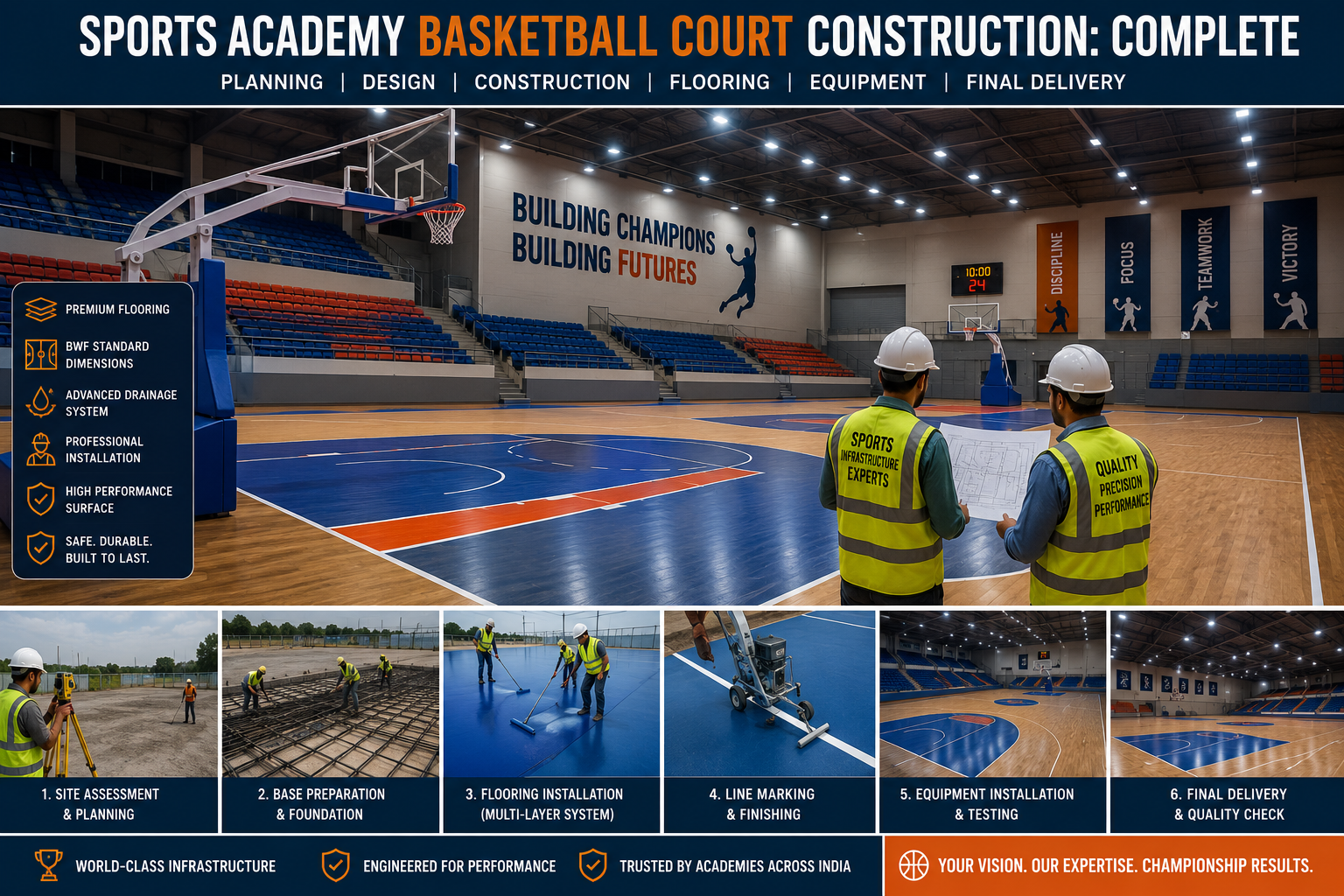
The construction process generally begins with:
- Site clearing
- Excavation if required
- Ground levelling
- Soil compaction
- Sub-base preparation
- Aggregate layers
- Base construction
- Surface finishing
The final concrete or asphalt base must be sufficiently stable, smooth, and properly cured before sports flooring installation.
Common problems caused by poor base construction include:
- Surface cracks
- Water accumulation
- Uneven ball bounce
- Peeling coatings
- Flooring failure
- Premature maintenance requirements
Professional contractors should inspect the surface before applying the final basketball flooring system.
Plan Proper Drainage for Outdoor Courts
Water is one of the biggest threats to an outdoor sports court.
If rainwater remains on the surface or penetrates into the base, it can cause long-term damage.
An outdoor basketball court should have proper slope and drainage planning. The slope must be carefully designed so that water flows away from the playing area without affecting the levelness of the court.
Drainage planning may include:
- Surface slope
- Side drainage channels
- Perimeter drains
- Rainwater outlets
- Proper site grading
The exact drainage design depends on local rainfall conditions and site characteristics.
Ignoring drainage during construction may result in repeated repair costs and reduced flooring life.
Install Professional Basketball Equipment
A complete basketball court requires more than flooring.
Essential equipment may include:
- Basketball poles
- Backboards
- Basketball rims
- Nets
- Protective padding
- Player benches
- Scoreboards
- Shot clocks
- Training equipment
For sports academies, adjustable basketball systems can be useful when training athletes from different age groups.
The basketball poles should be securely installed and positioned correctly according to the selected court layout.
Safety padding around poles and other hard structures can also help reduce the risk of impact injuries.
Plan Sports Lighting
Good lighting is essential for evening training and indoor basketball facilities.
Poor lighting can affect:
- Player visibility
- Ball tracking
- Coaching sessions
- Video recording
- Tournament quality
- Player safety
The lighting system should provide reasonably uniform illumination across the court.
Lights should also be positioned carefully to minimise glare. Strong glare can make it difficult for players to track the basketball during high passes or shooting.
LED sports lighting is commonly preferred because of its energy efficiency, long operating life, and lower maintenance requirements.
Lighting should be planned during the design stage rather than added as an afterthought.
Consider Fencing and Safety Infrastructure
Outdoor sports academies often require fencing around the basketball court.
Fencing helps:
- Keep basketballs inside the facility
- Improve player safety
- Protect surrounding property
- Control access
- Create a professional appearance
The fence height and design should be selected based on the court location and surrounding environment.
Academies should also consider:
- Emergency access
- Entry gates
- Spectator areas
- First-aid facilities
- Fire safety
- CCTV where required
- Non-slip walkways
A safe facility improves the overall experience for players, parents, coaches, and visitors.
Create a Realistic Basketball Court Construction Budget
The cost of basketball court construction can vary significantly.
The final budget depends on factors such as:
- Court size
- Indoor or outdoor construction
- Flooring type
- Base preparation
- Soil condition
- Drainage requirements
- Lighting
- Fencing
- Basketball equipment
- Labour costs
- Transportation
- Local site conditions
A low initial price should not be the only factor when selecting a contractor or flooring system.
A cheaper surface installed on an inadequate base may require expensive repairs in the future.
Sports academy owners should focus on the total value of the project, including expected durability, maintenance costs, player safety, and long-term performance.
Select an Experienced Basketball Court Contractor
The quality of the contractor can determine the success of the entire project.
Before selecting a basketball court construction company, academy owners should evaluate:
- Experience with sports infrastructure
- Previous basketball court projects
- Technical knowledge
- Flooring systems offered
- Quality of materials
- Site inspection process
- Installation methodology
- Warranty or service support
- Maintenance guidance
A professional contractor should not recommend the same flooring solution for every project.
The right system depends on the location, usage level, budget, weather conditions, and performance expectations of the academy.
Common Mistakes to Avoid During Basketball Court Construction
Many sports facility projects experience problems because of poor planning.
Common mistakes include:
Starting Construction Without a Site Survey
The soil, drainage, and ground condition should be inspected before construction begins.
Choosing Flooring Based Only on Price
The cheapest option may not provide the required durability or player comfort.
Ignoring Drainage
Poor drainage can significantly reduce the life of an outdoor basketball court.
Using an Uneven Base
A high-quality sports surface cannot fully correct major problems in the underlying foundation.
Poor Line Marking
Incorrect court markings can affect training and competition use.
Inadequate Lighting
Dark areas and glare can create safety and performance issues.
No Maintenance Plan
Every sports surface requires periodic cleaning and inspection.
Basketball Court Maintenance for Sports Academies
Regular maintenance can significantly increase the lifespan of the court.
Basic maintenance practices include:
- Regular sweeping and cleaning
- Removing leaves and debris
- Avoiding standing water
- Inspecting cracks
- Checking basketball equipment
- Repairing damaged coatings
- Keeping drainage channels clear
- Avoiding harsh chemicals
Indoor courts should also be protected from excessive moisture and improper cleaning methods.
Sports academy management should create a routine maintenance schedule instead of waiting for major problems to appear.
How Long Does Basketball Court Construction Take?
The construction timeline depends on the project size and site conditions.
A simple outdoor court with a ready and properly prepared base may be completed relatively quickly. However, projects involving major excavation, drainage, civil work, lighting, fencing, roofing, or indoor building construction can take significantly longer.
The timeline may also be affected by:
- Weather
- Material availability
- Base curing requirements
- Flooring system drying time
- Equipment installation
- Site accessibility
Proper project scheduling helps avoid unnecessary delays.
Why a Professional Basketball Court Can Benefit a Sports Academy
A professionally constructed basketball court can provide long-term value for a sports academy.
It can help the academy:
- Attract more students
- Improve training quality
- Support professional coaching
- Organise tournaments
- Generate rental income
- Build a stronger brand
- Expand sports programmes
- Create a safer training environment
A quality court is also a visible investment in the academy’s reputation. Parents and athletes are more likely to trust a facility that provides safe, clean, and professionally designed sports infrastructure.
Frequently Asked Questions
What is the best flooring for a sports academy basketball court?
The best flooring depends on whether the court is indoor or outdoor, the training level, usage frequency, and budget. Acrylic and cushioned acrylic systems are commonly considered for outdoor courts, while wooden, PVC, PU, and specialised indoor sports flooring systems may be suitable for indoor facilities.
What is the standard size of a basketball court?
A full-size international basketball playing court is generally 28 metres long and 15 metres wide. Additional safety and circulation space should also be included during planning.
Is acrylic flooring suitable for basketball courts?
Yes, a properly designed acrylic sports flooring system can be suitable for outdoor basketball courts. The quality of the base preparation and installation is important for long-term performance.
Why is drainage important for an outdoor basketball court?
Drainage prevents water accumulation and helps protect the base and sports surface from moisture-related damage.
Can a basketball court be used for multiple sports?
Yes. Multi-purpose court markings and suitable flooring can allow a facility to support other activities. However, the flooring system should be selected according to the performance requirements of all intended sports.
Final Thoughts
A successful basketball court construction project begins with planning, not flooring installation. Every stage—from site selection and court dimensions to base preparation, drainage, sports flooring, lighting, equipment, and maintenance—plays an important role in the final quality of the facility.
For sports academies, the goal should be to create a court that balances player safety, performance, durability, appearance, and long-term operating costs.
Whether you are developing a new basketball academy, upgrading an existing sports complex, or adding basketball infrastructure to a multi-sport facility, investing time in professional planning can prevent expensive mistakes later.
A well-designed basketball court is more than a playing surface. It is an investment in athlete development, coaching quality, academy growth, and the future of the sports facility.