Basketball has grown far beyond professional stadiums. Today, schools, colleges, sports academies, residential communities, hotels, fitness centres, clubs, and private sports facilities are investing in professionally constructed basketball courts to provide players with a safe and high-performance playing environment.
However, building a basketball court is not simply a matter of laying a coloured surface and painting court lines. A successful project depends on several technical factors, including site selection, dimensions, base preparation, drainage, flooring, shock absorption, surface texture, equipment installation, lighting, and long-term maintenance.
A poorly prepared base can lead to cracks, unevenness, water accumulation, and premature surface damage. On the other hand, a professionally designed basketball court can provide consistent ball response, player traction, comfort, durability, and a significantly better playing experience.
This complete guide explains basketball court construction, including court dimensions, flooring options, construction steps, cost factors, indoor and outdoor requirements, equipment, maintenance, and common mistakes to avoid.
What Is Basketball Court Construction?
Basketball court construction is the complete process of designing and developing a playing surface according to the intended level of use and required technical specifications.
The work can include:
- Site inspection and measurement
- Soil and ground assessment
- Court layout planning
- Excavation and grading
- Sub-base preparation
- Drainage planning
- Concrete or asphalt base construction
- Surface installation
- Sports flooring application
- Court line marking
- Basketball hoop and backboard installation
- Fencing and safety provisions
- Lighting installation
- Finishing and quality inspection
The exact construction method depends on whether the court is indoor, outdoor, recreational, institutional, academy-level, or competition-oriented.
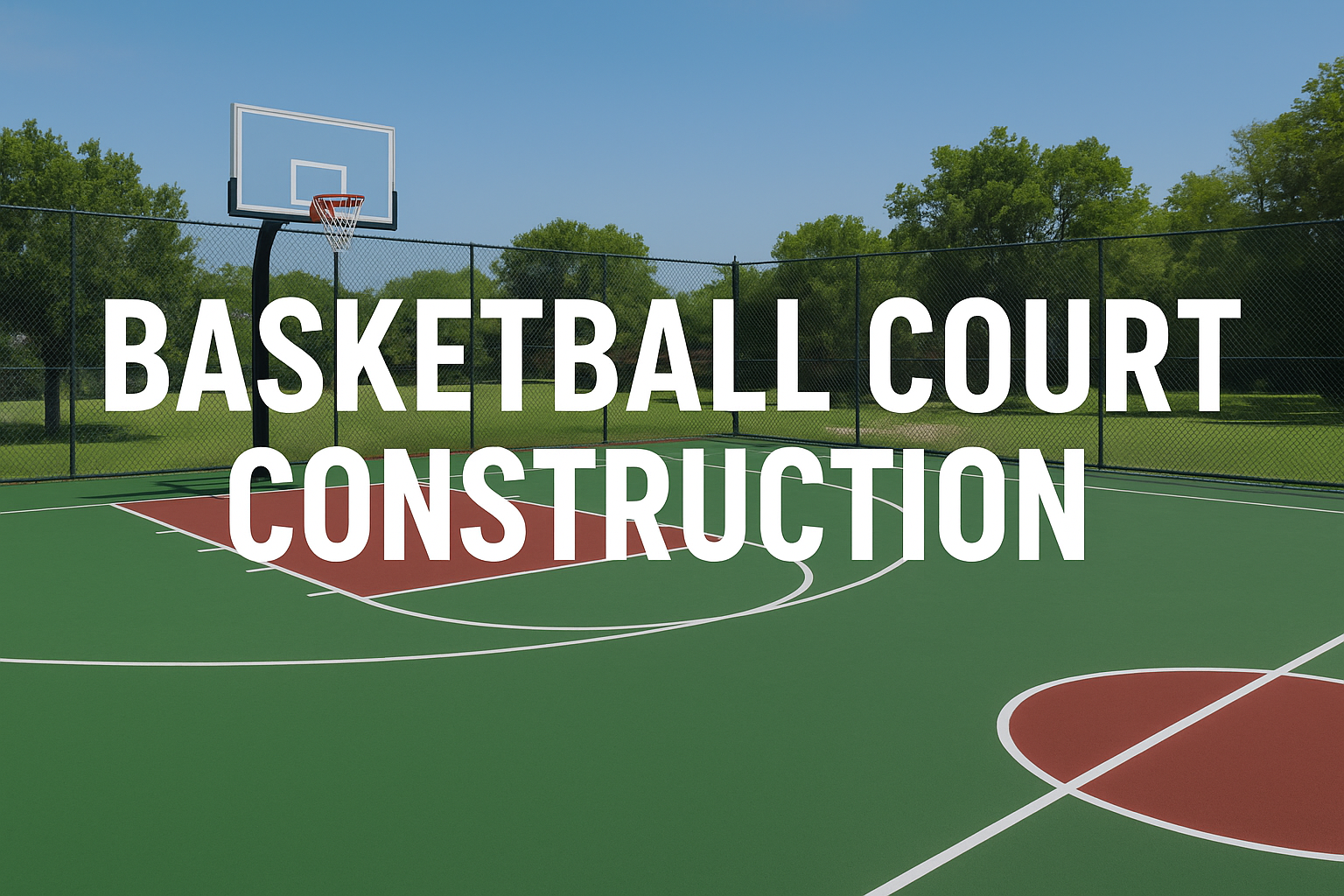
For example, an outdoor community court may use an acrylic sports coating over a properly engineered concrete or asphalt base, while a professional indoor facility may require a specialized resilient or sprung sports flooring system.
Why Proper Basketball Court Construction Matters
The quality of the court directly affects how players move and perform.
Basketball involves constant running, jumping, sudden stops, direction changes, and landing. Because of this, the playing surface must provide a suitable balance between grip, smoothness, impact response, and durability.
A professionally constructed court can help provide:
Better player safety
A properly engineered surface reduces the likelihood of excessive slipping and provides a more predictable playing environment.
Consistent ball bounce
An even and stable base helps maintain more consistent ball response across the playing area.
Improved playing comfort
Appropriate sports flooring can help manage impact and reduce unnecessary stress during repeated movement.
Longer service life
Quality materials and correct installation can significantly reduce premature cracking, peeling, surface failure, and other problems.
Better appearance
Professional line marking, colour selection, finishing, and equipment installation give the facility a clean and competition-ready appearance.
Standard Basketball Court Dimensions
Court dimensions depend on the governing rules and level of competition.
For an FIBA-style full court, the playing court is generally 28 metres long and 15 metres wide.
However, the total construction area must be larger than the playing lines because additional space is needed around the court for safety, circulation, equipment, walls, fencing, seating, and other facility requirements.
Before construction begins, the project team should determine:
- Playing area dimensions
- Safety clearance
- Run-off area
- Spectator requirements
- Basketball equipment locations
- Access routes
- Lighting positions
- Drainage requirements
- Fencing or enclosure requirements
For school and recreational projects, the available land may influence the final design. It is therefore important to establish the intended use before finalizing the layout.
Basketball Court Size: Full Court vs Half Court
Not every project requires a full-size basketball court.
Full Basketball Court
A full court is suitable for:
- Basketball academies
- Schools and colleges
- Sports clubs
- Professional training facilities
- Tournament venues
- Large residential developments
It provides sufficient space for complete five-on-five play.
Half Basketball Court
A half court can be useful where space is limited.
It may be suitable for:
- Residential societies
- Recreational facilities
- Schools with limited land
- Private properties
- Community parks
- Training areas
A half-court design can reduce construction requirements while still providing a practical space for shooting practice, drills, and recreational basketball.
Types of Basketball Court Flooring
Choosing the right flooring is one of the most important decisions in the entire project.
There is no single flooring solution suitable for every basketball facility. The correct option depends on location, budget, expected usage, climate, performance requirements, and maintenance expectations.
1. Acrylic Basketball Court Flooring
Acrylic sports flooring is widely used for outdoor basketball courts.
It is generally installed as a multi-layer coating system over a properly prepared concrete or asphalt base.
Typical components may include:
- Primer
- Resurfacer
- Cushion layer where required
- Acrylic colour coating
- Textured finish
- Line marking
Advantages
- Suitable for outdoor applications
- Good weather resistance
- Available in different colours
- Relatively easy to maintain
- Provides a consistent playing surface
- Suitable for recreational and institutional facilities
Acrylic systems can also be customized according to the desired level of cushioning and performance.
2. PU Basketball Flooring
Polyurethane, commonly called PU flooring, is used in several indoor sports applications.
A properly designed PU sports flooring system can provide a seamless surface with good resilience and durability.
It can be considered for:
- Indoor basketball facilities
- Sports academies
- Training centres
- Multipurpose indoor halls
- Institutional sports facilities
The performance of the finished floor depends heavily on the complete system rather than simply the top coating. Base preparation, thickness, cushioning layers, installation quality, and curing conditions all matter.
3. Wooden Basketball Court Flooring
Wooden flooring is associated with high-level indoor basketball facilities.
A professional wooden sports floor is not simply ordinary timber flooring. Sports-specific systems are designed with structural and performance characteristics appropriate for athletic activity.
A typical system may include:
- Prepared structural base
- Subfloor
- Resilient or sprung components
- Hardwood playing surface
- Sanding
- Sealing
- Finishing coats
- Professional court markings
Benefits of wooden flooring
- Excellent indoor appearance
- Premium playing experience
- Suitable for high-level facilities
- Good ball response
- Can provide controlled resilience when properly engineered
Because installation requires precision and specialist workmanship, wooden basketball flooring generally represents a higher investment than basic outdoor court coatings.
4. PVC Sports Flooring
PVC sports flooring can also be used for indoor multipurpose sports facilities.
Depending on the system, it may provide:
- Resilience
- Slip resistance
- Comfortable movement
- Easy maintenance
- Consistent surface characteristics
PVC sports flooring can be particularly useful where a facility is expected to accommodate several indoor sports rather than basketball alone.
5. Synthetic Basketball Flooring
Synthetic sports flooring includes several modern systems designed to balance performance, durability, maintenance, and cost.
Depending on the application, synthetic flooring can include acrylic, PU, PVC, rubberized, or hybrid multi-layer systems.
The key is to select a flooring system based on the actual requirements of the facility rather than choosing material purely on appearance or initial price.
Indoor Basketball Court Construction
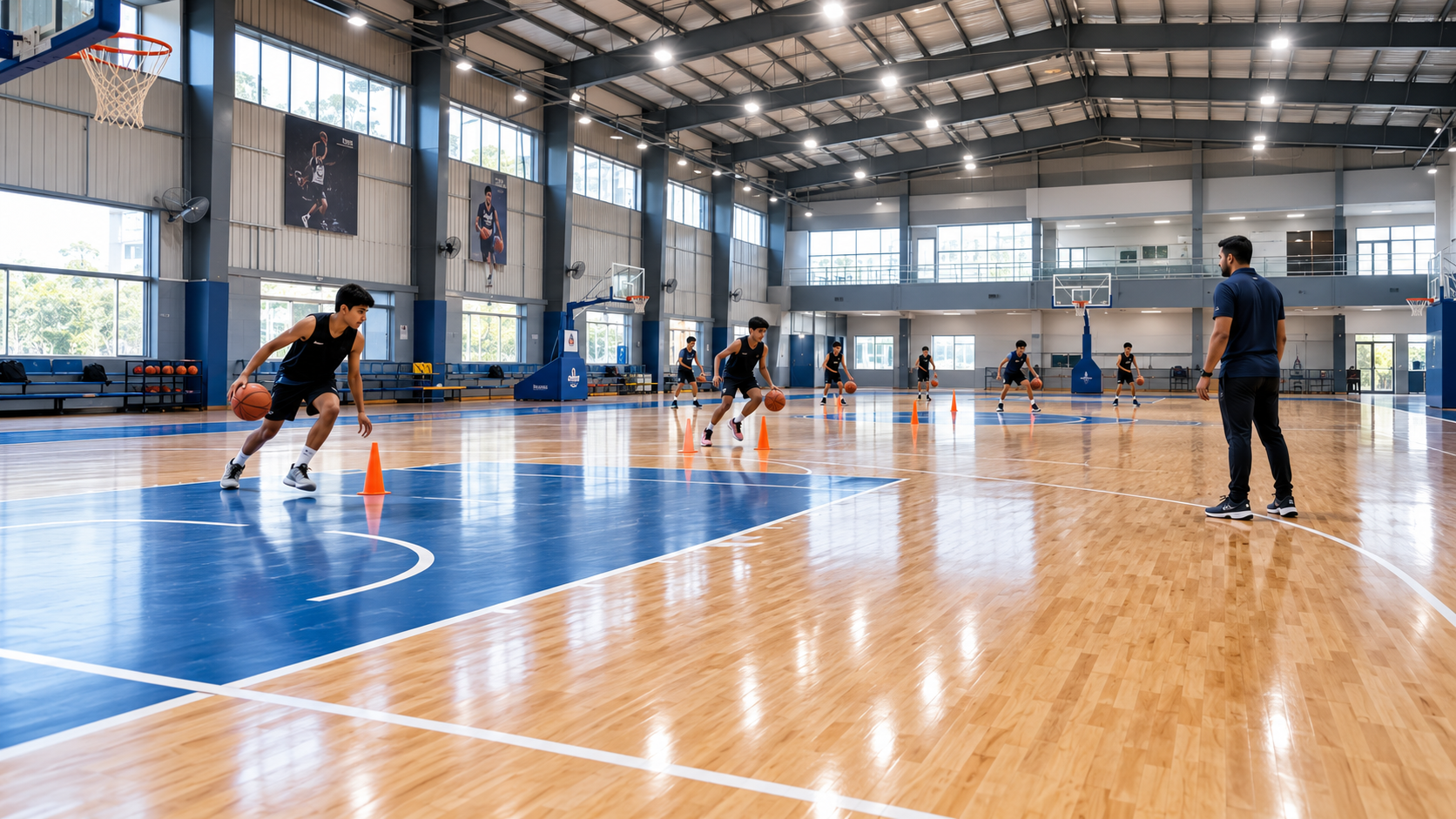
Indoor basketball courts provide better control over weather conditions and can support year-round use.
However, indoor construction requires more than simply putting a court inside a building.
Important considerations include:
Building height
Adequate clear height is required above the playing area so that players can shoot and pass without interference.
Ventilation
The indoor environment should have suitable air circulation and temperature management.
Lighting
Lighting must be positioned to provide uniform illumination while minimizing glare.
Floor construction
The floor system must be suitable for basketball movement and impact.
Moisture control
Moisture coming from the substrate can cause serious flooring problems, especially for sensitive indoor systems.
Wall protection
In high-use facilities, wall padding may be installed around areas where players could potentially collide with walls or structural elements.
Outdoor Basketball Court Construction
Outdoor courts must be designed to handle environmental exposure.
Sunlight, rain, temperature changes, dust, humidity, and drainage all influence the life of the surface.
A successful outdoor court usually requires particular attention to:
- Site grading
- Drainage
- Base stability
- Expansion joints
- Concrete quality
- Surface coating
- UV exposure
- Water management
- Crack treatment
Outdoor basketball courts should never be constructed on an unstable or poorly drained surface simply because the top coating appears durable.
The foundation underneath the sports surface is one of the most important parts of the project.
Basketball Court Construction Process
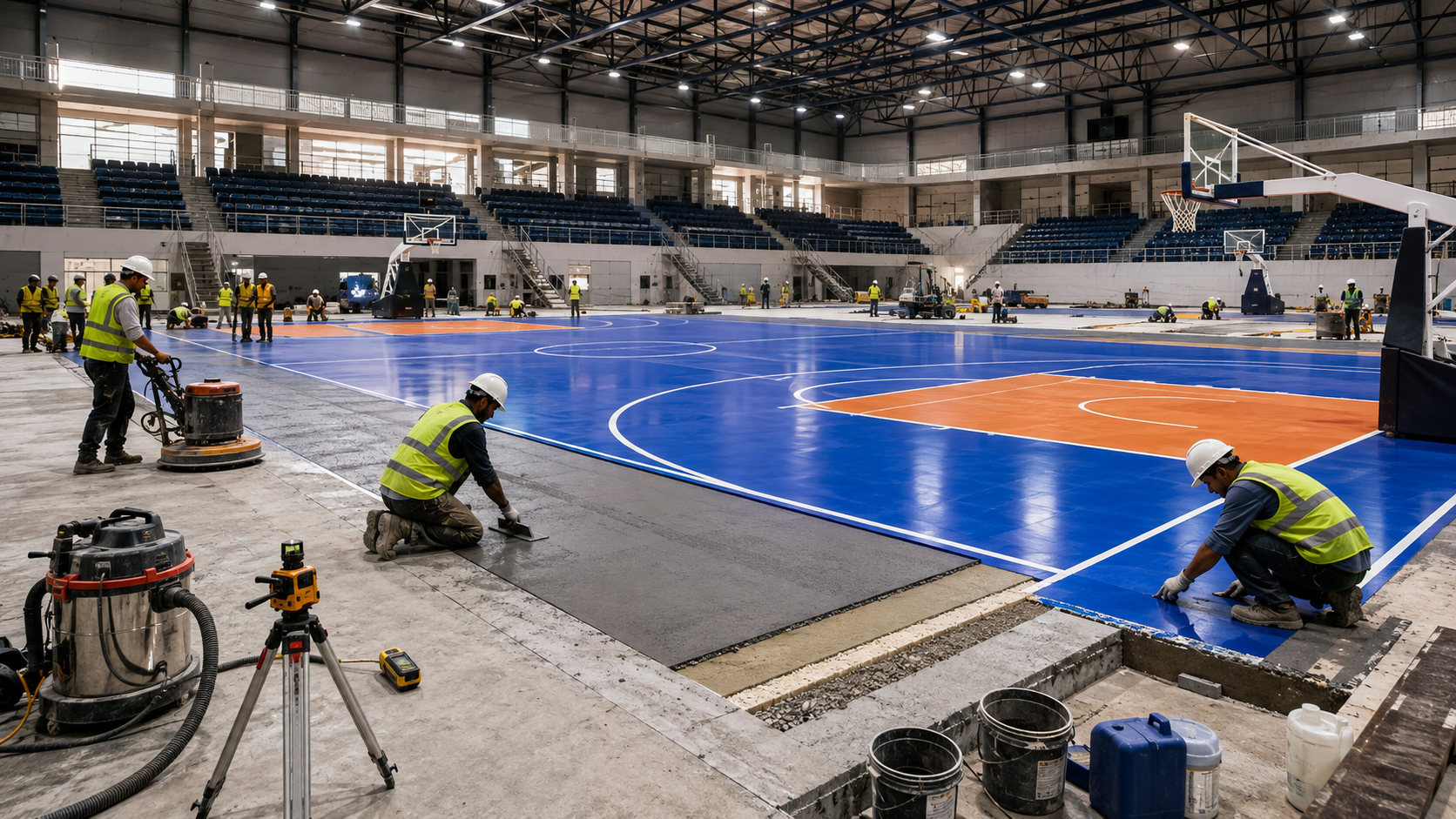
A professional construction project generally follows several stages.
Step 1: Site Inspection
Before any physical work begins, the site should be evaluated.
The assessment may include:
- Available area
- Soil condition
- Existing ground level
- Drainage
- Access for construction equipment
- Nearby structures
- Utility lines
- Sun exposure
- Water flow
- Existing pavement condition
This stage helps identify problems before construction starts.
Site Preparation
The site is cleared of unwanted vegetation, debris, loose material, and unsuitable soil.
If the existing ground is weak, additional excavation and replacement may be necessary.
The objective is to establish a stable platform for the court foundation.
Grading and Leveling
The ground is graded according to the approved design.
Proper levels are extremely important because an uneven foundation can create problems later.
For outdoor courts, drainage planning should also be incorporated at this stage.
Water should not remain standing on the playing surface after rainfall.
Sub-Base Preparation
The sub-base provides structural support beneath the court.
Depending on site conditions and the selected construction system, layers of suitable aggregate may be placed, spread, compacted, and tested.
Poor compaction can result in settlement and surface problems.
This is one area where cutting costs can create expensive repairs later.
Base Construction
The sports surface needs a stable structural base.
Common options include:
- Reinforced concrete
- Asphalt
- Engineered slab systems
- Existing structural floors for suitable indoor applications
The appropriate solution depends on the site and flooring system.
The base must be sufficiently level and structurally sound before the sports surface is installed.
Concrete Curing and Surface Preparation
When a concrete base is used, sufficient curing time is required before the next stage.
The surface may then be checked for:
- Levelness
- Cracks
- Surface defects
- Moisture
- Contamination
- Uneven areas
Grinding, filling, cleaning, or other preparation may be required before applying sports flooring.
Sports Flooring Installation
The selected flooring system is installed according to the manufacturer’s technical requirements.
For acrylic systems, multiple coating stages may be used.
For wooden courts, specialist installation, sanding, sealing, finishing, and line marking are required.
Court Line Marking
Once the playing surface has been properly prepared and cured, court markings are applied.
The lines should be:
- Straight
- Clearly visible
- Consistent in width
- Accurately positioned
- Properly bonded to the surface
Poor line marking can make an otherwise attractive court look unprofessional.
Basketball Equipment Installation
A complete basketball facility requires more than flooring.
Depending on the project, equipment can include:
- Basketball poles
- Backboards
- Rims
- Nets
- Padding
- Scoreboards
- Shot clocks
- Benches
- Team seating
- Ball storage
- Safety padding
The basketball goal system must be installed securely and aligned correctly.
Lighting Installation
Good lighting is essential for indoor and outdoor basketball.
Poor lighting can create:
- Glare
- Shadows
- Uneven visibility
- Eye strain
- Difficulties tracking the ball
Lighting should be planned before construction is completed so that pole positions, electrical requirements, mounting locations, and cable routes can be incorporated into the overall design.
Final Quality Inspection
Before the court is handed over, the completed facility should be inspected.
Checks can include:
- Surface uniformity
- Court dimensions
- Line accuracy
- Drainage
- Flooring adhesion
- Equipment stability
- Lighting
- Surface cleanliness
- Finishing quality
A final inspection helps identify minor problems before the facility enters regular use.
Basketball Court Construction Cost
One of the most common questions asked by schools, academies, builders, and property owners is:
How much does it cost to build a basketball court?
There is no universal price because construction costs depend on the complete specification.
The total budget can be influenced by:
- Court size
- Indoor or outdoor construction
- Site condition
- Foundation requirements
- Flooring type
- Cushioning system
- Drainage
- Lighting
- Basketball equipment
- Fencing
- Roofing
- Civil work
- Labour
- Transportation
- Location
- Project design
- Quality of materials
Therefore, a basic outdoor recreational court and a professional indoor basketball facility can have very different budgets.
What should be included in a quotation?
A detailed quotation should clearly explain whether the price includes:
- Site preparation
- Civil work
- Base construction
- Flooring
- Court markings
- Basketball equipment
- Lighting
- Drainage
- Fencing
- Transportation
- Installation
- Taxes
- Warranty
Comparing quotations only on the final number can be misleading. Two contractors may quote very different prices because their specifications are completely different.
Factors That Increase Basketball Court Construction Cost
Several factors can increase the overall project investment.
Premium Flooring
High-performance wooden, PU, or advanced synthetic flooring generally costs more than basic acrylic coatings.
Poor Ground Conditions
Weak soil, settlement, or an existing damaged surface may require additional civil work.
Indoor Construction
An indoor basketball facility may require a complete building structure, roofing, ventilation, electrical systems, lighting, and other infrastructure.
Professional Equipment
Competition-grade basketball equipment and electronic scoring systems can increase the budget.
Advanced Lighting
High-quality sports lighting requires proper fixture selection and electrical installation.
Spectator Facilities
Bleachers, seating, changing rooms, toilets, reception areas, and other amenities add to the project cost.
How to Choose the Right Basketball Flooring
Choosing flooring should begin with the purpose of the court.
Ask the following questions:
Where will the court be located?
Indoor and outdoor environments require different considerations.
How frequently will it be used?
A school court with daily use has different requirements from a private recreational court.
What level of performance is expected?
Training, recreational, academy, and competition facilities may require different flooring specifications.
What is the maintenance capacity?
Some systems require more specialized maintenance than others.
What is the available budget?
The cheapest initial solution may not always be the most economical over the complete life of the court.
Basketball Court for Schools
Schools often need a durable and practical basketball court that can withstand frequent use.
Important considerations include:
- Student safety
- Durable flooring
- Proper drainage
- Secure basketball equipment
- Adequate lighting
- Easy maintenance
- Safe surrounding areas
For schools with multipurpose grounds, the basketball court can also be designed to complement other sports infrastructure.
Basketball Court for Sports Academies
Sports academies generally require a higher-performance environment.
The facility may need:
- Professional flooring
- High-quality basketball equipment
- Adequate lighting
- Training zones
- Seating
- Player changing areas
- Storage
- Video or coaching facilities
Academy construction should prioritize performance and long-term durability rather than simply achieving the lowest initial cost.
Basketball Court for Residential Societies
Residential developments increasingly include sports facilities as part of their amenities.
For a residential basketball court, the design should consider:
- Available space
- Noise
- Lighting
- Neighbouring buildings
- Safety
- Drainage
- Maintenance
- Usage hours
A well-planned court can become a valuable recreational feature for residents.
Common Basketball Court Construction Mistakes
Even expensive flooring can fail if the construction process is poorly managed.
1. Ignoring the Base
The sports surface cannot compensate for a structurally weak foundation.
2. Poor Drainage
Standing water can damage outdoor surfaces and accelerate deterioration.
3. Choosing Flooring Only by Price
The lowest quotation may exclude important layers or services.
4. Incorrect Court Dimensions
Inaccurate layout can create problems for organized play.
5. Poor Surface Preparation
Dust, moisture, contamination, and unevenness can affect flooring adhesion.
6. Using Inappropriate Paint
Ordinary exterior paint is not necessarily suitable for sports flooring.
7. Poor Equipment Installation
Loose or incorrectly aligned basketball equipment creates safety and performance issues.
8. Ignoring Maintenance
Even a professionally constructed court needs regular inspection and cleaning.
Basketball Court Maintenance Guide
Regular maintenance can extend the useful life of the court.
For outdoor courts
- Remove leaves and debris regularly.
- Keep drainage outlets clear.
- Clean dirt and dust from the surface.
- Inspect cracks early.
- Check court markings.
- Inspect basketball poles and backboards.
- Avoid allowing standing water to remain for long periods.
For indoor courts
- Use appropriate cleaning methods.
- Control moisture and humidity.
- Avoid unsuitable chemicals.
- Inspect flooring joints or surface damage.
- Maintain equipment regularly.
- Keep the playing area free from unnecessary dirt.
Maintenance requirements depend on the flooring system, so the manufacturer’s recommendations should always be followed.
How Long Does a Basketball Court Take to Build?
Construction time depends on the scope of work.
A relatively straightforward outdoor court may take significantly less time than a complete indoor sports facility.
The schedule can be affected by:
- Site preparation
- Weather
- Concrete curing
- Material availability
- Flooring system
- Equipment installation
- Lighting
- Civil work
- Project size
A contractor should provide a project-specific timeline rather than promising the same completion period for every court.
How to Select a Basketball Court Construction Company
Choosing the right contractor is just as important as selecting the flooring.
Before awarding the project, check:
Previous projects
Ask for examples of completed basketball courts.
Technical expertise
The contractor should understand both civil construction and sports flooring.
Material specifications
Request details about the flooring layers, thickness, base system, and finishing products.
Installation process
A professional contractor should be able to explain how the court will be constructed from the ground upward.
Warranty
Ask what workmanship and material warranties are provided.
Maintenance support
Post-installation support can be valuable for institutional and commercial facilities.
Detailed quotation
Avoid vague quotations that only mention “basketball court construction” without explaining the specification.
Basketball Court Construction Checklist
Before starting the project, confirm the following:
- Site measurement completed
- Soil and ground condition assessed
- Court layout finalized
- Required dimensions confirmed
- Drainage planned
- Base specification finalized
- Flooring selected
- Lighting planned
- Basketball equipment selected
- Fencing requirements confirmed
- Construction schedule agreed
- Material specifications documented
- Cost quotation reviewed
- Warranty terms confirmed
- Maintenance plan prepared
This simple checklist can prevent many common project mistakes.
Frequently Asked Questions About Basketball Court Construction
How much does it cost to construct a basketball court?
The cost depends on court size, flooring, civil work, site condition, indoor or outdoor design, lighting, equipment, and other project requirements. A site-specific quotation is more reliable than a generic per-square-foot estimate.
Which flooring is best for a basketball court?
There is no single best flooring for every project. Acrylic is commonly considered for outdoor courts, while PU, PVC, wooden, and other specialized sports flooring systems can be suitable for indoor applications depending on performance and budget requirements.
Can a basketball court be built outdoors?
Yes. Outdoor basketball courts are commonly constructed using engineered concrete or asphalt bases with suitable sports surface coatings.
Can a basketball court be built on an existing concrete surface?
Sometimes, but the existing slab must first be evaluated for structural condition, levelness, cracks, moisture, drainage, and suitability for the selected sports flooring system.
What is the standard size of a basketball court?
An FIBA-style playing court measures approximately 28 metres by 15 metres. Additional surrounding space is required for safety and facility planning.
Is acrylic flooring suitable for outdoor basketball?
A properly designed acrylic sports surface can be a practical option for outdoor basketball courts, provided the underlying base is correctly constructed and drainage is properly managed.
How often should a basketball court be maintained?
Maintenance frequency depends on usage, environment, flooring type, and facility conditions. Routine cleaning and inspection should be carried out regularly, while repairs and resurfacing should be performed when the surface begins showing signs of deterioration.
Can a basketball court be constructed for a residential society?
Yes. Residential projects can use full or half-court layouts depending on available space, expected usage, budget, and local planning considerations.
Final Thoughts
A basketball court is a long-term sports infrastructure investment. The visible playing surface may attract the most attention, but the real quality of a court begins underneath it—with proper site assessment, drainage, grading, compaction, structural support, and base preparation.
The right flooring system then builds on that foundation by providing the traction, durability, comfort, and playing characteristics required for the facility.
Whether you are planning a basketball court for a school, college, sports academy, residential society, club, commercial sports complex, or professional training facility, the best approach is to begin with a detailed site assessment and a clearly defined technical specification.
Instead of selecting a contractor based only on the lowest quotation, compare the complete construction system, materials, installation process, equipment, warranty, and long-term maintenance requirements.
A professionally planned and correctly installed basketball court can provide years of reliable use while creating a safer, more attractive, and more enjoyable environment for players.
Planning a basketball court project? Start with the site, define the intended use, choose the right flooring system, and build the foundation correctly. The quality of every layer matters.