Box cricket has quickly become one of the most popular recreational sports facilities in India. From residential communities and schools to commercial sports arenas and dedicated turf businesses, the demand for box cricket turf construction continues to grow because it requires less land than a traditional cricket ground and can generate revenue through hourly bookings.
But one question comes before every project:
How much does it cost to build a box cricket turf in India in 2026?
The answer depends on several factors, including the size of the playing area, artificial grass quality, base construction, steel structure, protective netting, floodlights, drainage, pitch specifications, roofing and additional facilities.
As a broad 2026 market indication, a professionally constructed single box cricket setup can fall around ₹8 lakh to ₹16 lakh, while larger multi-turf facilities can move considerably higher. Some suppliers quote on a per-square-foot basis, but comparing only the turf rate can be misleading because civil work, structure, netting, lighting and drainage may be excluded.
This guide explains the major costs involved in box cricket turf construction in India, the construction process, space requirements, flooring options, maintenance expenses and important points to check before hiring a contractor.
What Is Box Cricket?
Box cricket is a compact version of cricket played inside an enclosed or semi-enclosed playing area. The sides and often the roof are protected with high-strength nets or fencing so that the ball remains within the playing zone.
Unlike a conventional cricket ground, box cricket does not require a large outfield. This makes it particularly suitable for urban locations where land is expensive or limited.
A commercial box cricket facility can be used for:
- Hourly turf bookings
- Corporate cricket matches
- School and college sports
- Cricket academies
- Weekend tournaments
- Birthday and private events
- Sports training
- Community recreation
The enclosed design also allows operators to control the playing environment and make better use of the available land.
Box Cricket Turf Construction Cost in India 2026
The total project cost varies from one location to another. A practical budget should include much more than artificial grass.
Indicative 2026 Cost Range
| Component | Approximate Cost |
|---|---|
| Artificial cricket turf | ₹60–₹120+ per sq. ft. depending on specification |
| Civil/base preparation | ₹2–₹5 lakh+ |
| Steel/MS/GI structure | ₹2–₹5 lakh+ |
| Safety netting | ₹1–₹3 lakh+ |
| Floodlighting | ₹2–₹4 lakh+ |
| Cricket pitch | ₹50,000–₹2 lakh+ |
| Drainage | ₹50,000–₹2 lakh+ |
| Basic amenities | ₹1–₹5 lakh+ |
| Typical single setup | ₹8–₹16 lakh+ |
These are planning-level figures rather than fixed quotations. Recent 2026 industry estimates place a single-lane box cricket setup around ₹8–16 lakh, with larger facilities and premium specifications costing more.
Another important point is that land purchase or rent is normally separate. In many urban projects, land can become the largest component of the overall investment.
Major Factors Affecting Box Cricket Turf Cost
1. Size of the Box Cricket Turf
The first factor is the total playing area.
A compact facility requires less turf, netting, steel and lighting. A larger playing area increases almost every construction component.
Before purchasing land, calculate:
- Playing area
- Entry and reception
- Player waiting area
- Washrooms
- Equipment storage
- Parking
- Electrical room
- Walkways
- Emergency access
Do not select land based only on the dimensions of the playing surface.
For a commercial facility, additional circulation and customer facilities can significantly increase the required plot area.
2. Artificial Cricket Turf
Artificial grass is one of the most visible components of a box cricket facility, but it should not be selected only by price.
Important specifications include:
- Pile height
- Turf density
- Backing quality
- UV resistance
- Drainage performance
- Stitching quality
- Infill system
- Abrasion resistance
- Expected playing frequency
A low-cost turf may initially reduce the project budget but can result in faster wear, poor ball response and higher replacement costs.
Current 2026 market references put turf/tile surface pricing in the broad range of roughly ₹70–₹120 per sq. ft. before all the other components of a complete box cricket installation are considered.
For a commercial facility with heavy daily bookings, investing in better-quality turf can be more economical over the long term.
3. Base Construction
One of the biggest mistakes in turf projects is focusing on artificial grass while ignoring the foundation underneath it.
The base should provide:
- Stability
- Proper levels
- Adequate load-bearing capacity
- Smoothness
- Drainage
- Long-term dimensional stability
Depending on the site, construction may involve excavation, soil improvement, compaction, granular layers, concrete or other engineered base systems.
If the base settles after installation, the turf surface can develop depressions and uneven areas.
This is particularly important in regions with:
- Heavy monsoon rainfall
- Expansive soil
- Poor natural drainage
- Soft soil
- High groundwater
- Previously undeveloped land
A professional site investigation should therefore be completed before finalizing the construction quotation.
4. Steel Structure and Netting
A box cricket facility needs a strong enclosure system.
The structure may include:
- Vertical steel columns
- Horizontal beams
- Roof framework
- Side supports
- Net-support cables
- Protective netting
- Entry gates
The exact design depends on the facility’s dimensions and whether it is completely enclosed.
Outdoor projects also need to account for local wind and weather conditions.
Using undersized structural members simply to reduce the initial quotation can create maintenance and safety problems later.
The structure should be designed according to the site conditions and expected loads rather than using a generic template for every project.
5. Safety Netting
Safety netting is essential for an enclosed box cricket facility.
The net prevents cricket balls from leaving the playing area and protects nearby people, vehicles and property.
The final price depends on:
- Net material
- Mesh size
- Net thickness
- Height
- Total coverage
- UV resistance
- Installation method
- Supporting structure
For outdoor facilities, UV-resistant and weather-suitable netting is particularly important.
A cheap net may appear attractive during construction but may become brittle or damaged sooner when continuously exposed to sunlight and rain.
6. Floodlight Cost
Commercial box cricket is frequently played in the evening, which makes professional lighting extremely important.
A good lighting system should provide:
- Adequate brightness
- Uniform illumination
- Reduced glare
- Minimal dark spots
- Reliable electrical protection
- Efficient energy consumption
The number and power of LED floodlights depend on the court dimensions and required illumination level.
Industry estimates for sports facilities show that lighting can become a significant component of project cost, particularly when higher lighting levels and professional fixtures are specified.
Avoid judging lighting quality by wattage alone. Beam angle, mounting height, fixture distribution and uniformity all affect the actual playing experience.
7. Cricket Pitch
The central pitch is another important part of the facility.
Depending on the intended use, the pitch may use:
- Cricket matting
- Synthetic cricket surface
- Artificial turf
- Specialized cricket carpet
- Other sports-grade systems
The pitch should provide predictable ball response and sufficient grip for players.
For a commercial facility, the pitch also needs to withstand repeated bowling, batting and foot traffic.
8. Drainage System
Drainage is often ignored until the first heavy rainfall.
Water should be directed away from the playing surface through an appropriately designed drainage system.
Possible components include:
- Surface slope
- Peripheral drains
- Drain channels
- Collection points
- Perforated drainage pipes
- Suitable sub-base layers
A turf that looks excellent on a dry day can become unusable if rainwater remains trapped underneath the surface.
Therefore, drainage should be designed during the initial planning stage rather than added as an afterthought.
Box Cricket Turf Construction Process
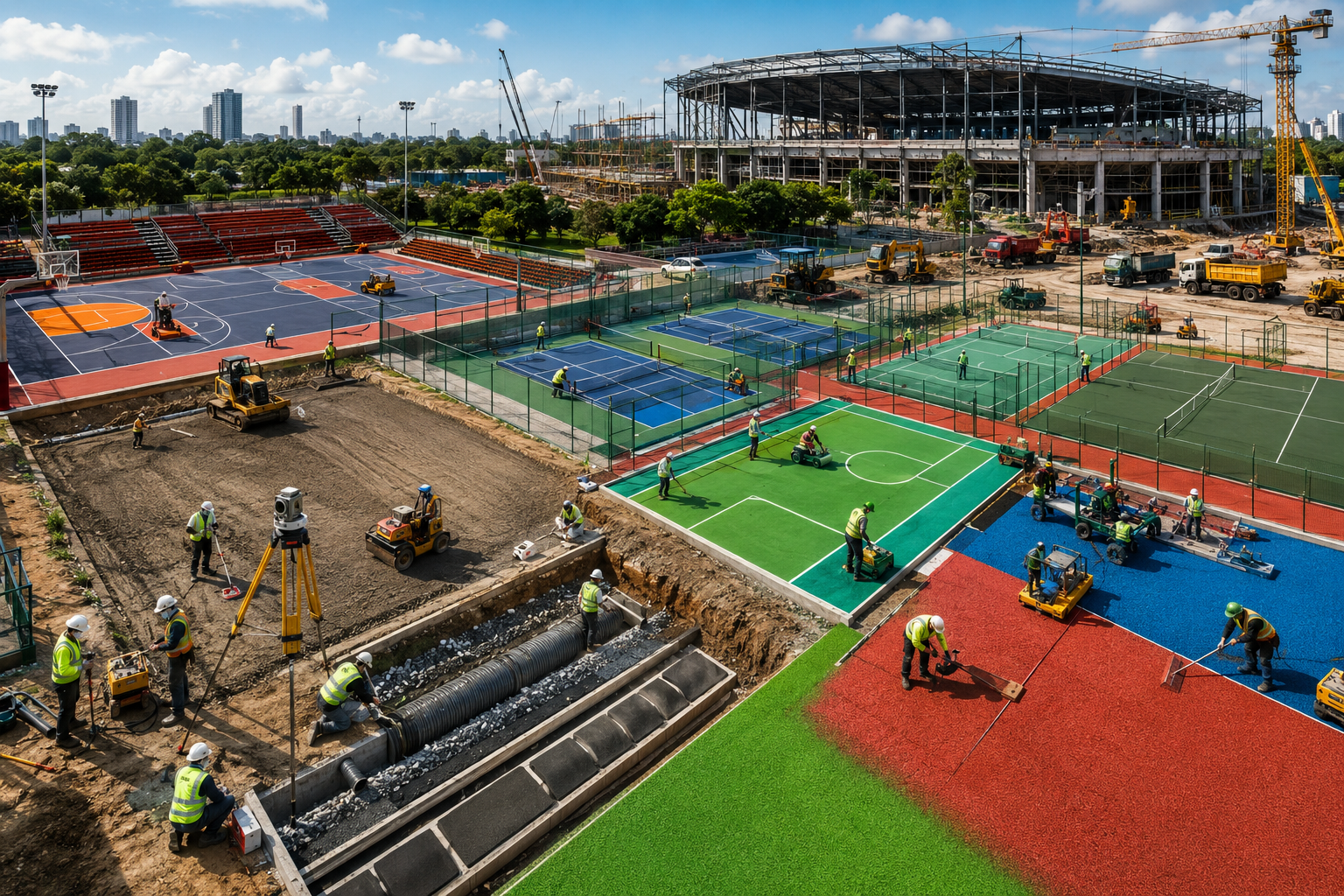
A professional project generally follows several stages.
Site Survey
The contractor evaluates:
- Available land
- Soil condition
- Existing levels
- Drainage
- Access
- Electricity availability
- Surrounding structures
Design and Layout
The playing dimensions, entrance, lighting positions, steel structure and supporting facilities are planned.
Ground Preparation
The existing soil is excavated or prepared according to the engineering requirements.
Base Construction
The foundation layers are installed, compacted and levelled.
Drainage Installation
Drainage channels and associated systems are installed where required.
Steel Structure Installation
Columns, beams and roof-support members are fabricated and installed.
Net Installation
Side and overhead protective nets are fixed to the structure.
Artificial Turf Installation
The turf is cut, positioned, joined and secured according to the surface specification.
Pitch Installation
The cricket playing strip is installed and aligned correctly.
Lighting and Electrical Work
LED floodlights, cabling, panels and controls are installed.
Final Testing
The contractor checks:
- Turf joints
- Surface levels
- Drainage
- Net tension
- Structural stability
- Lighting
- Gates
- Electrical safety
Only after final inspection should the facility be opened for regular bookings.
How Much Land Is Required for Box Cricket?
The required land depends on the design and commercial model.
A compact turf may operate within a relatively small footprint, while a premium facility requires additional space for customer amenities.
Consider allocating land for:
Playing area + safety clearance + structure + entrance + parking + washrooms + reception + circulation
A recent 2026 discussion from a planned Indian turf project illustrates why investors should account for parking and non-playing areas instead of calculating land requirements from the turf dimensions alone.
For commercial projects, it is better to prepare the complete site layout before signing a land lease.
Box Cricket Turf Cost Per Square Foot
Per-square-foot pricing is useful for initial comparison, but it should never be the only basis for selecting a contractor.
For example, one contractor may quote a low turf installation rate while excluding:
- Base preparation
- Drainage
- Steel structure
- Netting
- Lighting
- Electrical work
- Transportation
- GST
- Civil finishing
Another contractor may provide an all-inclusive quotation.
Therefore, always request a complete BOQ (Bill of Quantities).
A proper BOQ should clearly show material specifications, quantities, rates, installation charges and exclusions.
Indoor vs Outdoor Box Cricket Turf Cost
An outdoor facility is generally simpler than a fully covered indoor facility.
An indoor or roofed facility may require:
- Heavy structural framework
- Roofing sheets
- Additional ventilation
- More electrical work
- Higher structural engineering requirements
- Additional fire-safety provisions
- More construction time
Therefore, if your objective is to operate throughout the year, compare the additional construction cost against the expected increase in bookings during the rainy and extremely hot seasons.
Maintenance Cost of Box Cricket Turf
Construction is only the beginning.
Regular maintenance helps preserve the playing quality and extends the useful life of the facility.
Routine maintenance may include:
- Cleaning the turf
- Removing debris
- Checking seams
- Grooming the surface
- Maintaining infill
- Inspecting nets
- Checking steel joints
- Cleaning drains
- Testing lights
- Repairing damaged areas
High-traffic commercial facilities should have a preventive maintenance schedule rather than waiting for visible damage.
How to Reduce Box Cricket Construction Cost Without Reducing Quality
Cost optimization does not mean choosing the cheapest material.
Instead:
Choose the correct turf specification
Do not pay for features that are unnecessary for your application, but avoid low-grade commercial turf.
Optimize the structure
A structural engineer can help determine the appropriate member sizes instead of overbuilding or underbuilding.
Plan lighting correctly
Correct fixture placement can improve illumination without simply increasing the number of floodlights.
Prepare the drainage plan early
Late drainage modifications can be expensive.
Compare complete quotations
Compare contractors using the same BOQ and specifications.
Consider future expansion
If you plan to add another turf later, design the site circulation and utilities accordingly.
Is Box Cricket Turf a Good Business Investment in India?
Box cricket can be an attractive sports-business model because the facility can be booked multiple times throughout the day.
Potential revenue sources include:
- Hourly bookings
- Memberships
- Corporate tournaments
- School partnerships
- Cricket coaching
- Weekend leagues
- Tournament entry fees
- Food and beverage sales
- Sports merchandise
- Event packages
However, profitability depends heavily on location, competition, pricing, occupancy and operating costs.
Some 2026 industry estimates suggest a basic investment can start around ₹10–15 lakh, while other estimates put a complete single-lane setup around ₹8–16 lakh. These differences demonstrate why investors should treat online cost figures as planning benchmarks rather than guaranteed project prices.
Your actual ROI calculation should include:
Monthly revenue − rent/EMI − electricity − staff − maintenance − marketing − taxes − other operating expenses = operating profit
Do not calculate ROI from gross booking revenue alone.
Common Mistakes to Avoid
Choosing a Contractor Only on Price
The cheapest quotation is not necessarily the lowest-cost project in the long run.
Ignoring Drainage
Poor drainage can damage the turf and make the facility unusable during rain.
Using Low-Quality Netting
Net replacement becomes a recurring expense if unsuitable material is installed.
Installing Weak Lighting
Players notice dark areas immediately, particularly during fast-paced cricket.
Skipping Base Preparation
Uneven settlement can damage the entire playing surface.
Not Checking the BOQ
A low quotation may exclude important components.
Ignoring Maintenance
Even high-quality turf requires regular inspection and cleaning.
Checklist Before Starting Your Box Cricket Project
Before construction begins, confirm:
- Site survey completed
- Soil and drainage conditions checked
- Final playing dimensions approved
- Structural design prepared
- Turf specification finalized
- Pitch specification finalized
- Net specification finalized
- Lighting plan prepared
- Electrical load calculated
- Drainage design approved
- BOQ received
- Warranty terms confirmed
- Maintenance requirements understood
- Local permissions checked
- Parking and customer access planned
This checklist can prevent many expensive changes after construction has already started.
Final Thoughts
The Box Cricket Turf Construction Cost in India in 2026 depends on much more than the price of artificial grass. A successful facility requires a properly engineered base, suitable turf, durable steel structure, quality safety netting, effective drainage, reliable floodlighting and a layout designed around the customer experience.
For a basic commercial setup, a realistic starting planning range is approximately ₹8 lakh to ₹16 lakh, while premium, larger or multi-turf developments can cost substantially more.
The best approach is to avoid selecting a contractor solely on a per-square-foot rate. Instead, compare detailed BOQs, material specifications, construction methodology, drainage design, structural quality, warranty and previous project experience.
If the facility is being developed as a business, construction quality should be considered an investment rather than simply an expense. A well-built turf can provide a better playing experience, fewer maintenance problems and a stronger foundation for repeat bookings.
In short: build the base correctly, choose the right turf, engineer the enclosure properly and plan the complete business before construction starts.