Introduction
Box cricket has become one of the most popular urban sports formats in India because it delivers the excitement of cricket without requiring the huge land area of a conventional cricket ground. From commercial sports arenas and rooftop turfs to schools, residential communities and corporate recreation spaces, box cricket facilities can be designed around different plot sizes and playing formats.
However, choosing the right box cricket turf dimensions is one of the most important decisions before construction begins. The court size affects player movement, bowling distance, batting experience, safety, netting requirements, lighting, turf installation and even the commercial potential of the facility.
Unlike traditional cricket, box cricket does not have one universally mandated court size. It is a modified format, so dimensions vary according to the available land, number of players, playing style and purpose of the facility. Current industry references commonly place commercial box cricket layouts within approximately 80–120 ft in length and 40–60 ft in width, while smaller courts can be designed for restricted urban spaces.
This guide explains the important measurements, recommended net height, pitch layout, safety clearances, turf area and planning considerations for building a functional box cricket turf.
What Is the Standard Size of a Box Cricket Turf?
There is no single official dimension that applies to every box cricket facility. Different operators use different court sizes depending on their target audience and available land.
For practical planning, box cricket courts can generally be divided into compact, standard commercial and large-format layouts.
| Court Type | Typical Length | Typical Width | Recommended Use |
|---|---|---|---|
| Compact | 60–70 ft | 28–35 ft | Small spaces, societies, rooftops |
| Standard | 80–95 ft | 38–45 ft | Commercial turf facilities |
| Large | 100–110 ft | 50–60 ft | Leagues and larger matches |
| Custom | Project-specific | Project-specific | Academies and multi-sport facilities |
A 40 × 80 ft playing area is frequently used for recreational and commercial box cricket in Indian cities, while larger venues may extend beyond this footprint. Other industry references recommend layouts around 48 × 80 ft or approximately 80–120 × 40–60 ft, demonstrating why the term “standard size” should be treated as a practical range rather than a strict rule.
For a commercial project, the ideal dimensions should be selected only after considering the site, player capacity, business model and intended format.
Recommended Box Cricket Turf Dimensions
For a professional-looking commercial facility, a medium-sized court is usually a strong balance between playing quality and land utilization.
An example layout could be:
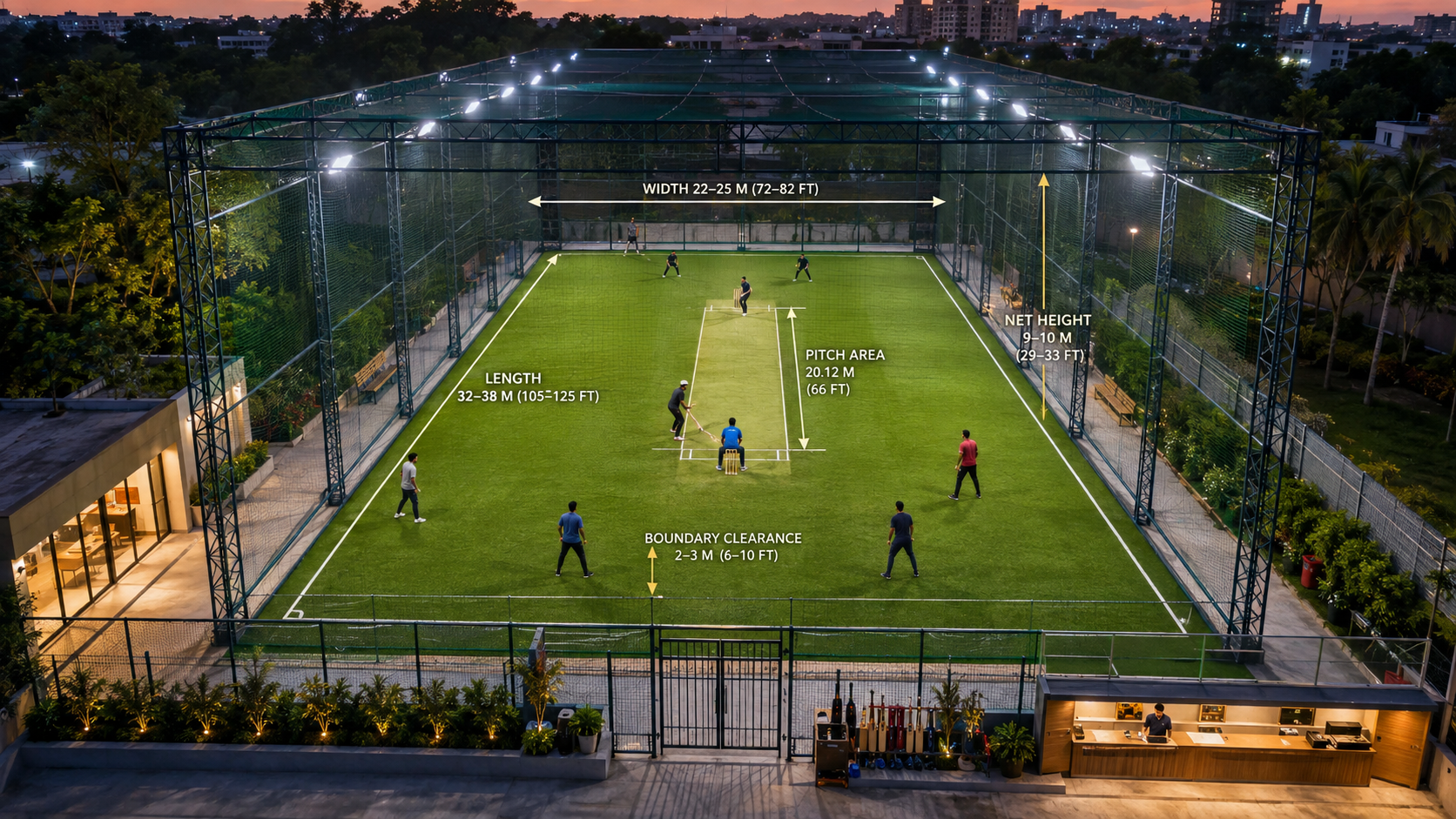
- Length: 80–95 ft
- Width: 38–45 ft
- Playing area: Approximately 3,000–4,275 sq. ft.
- Net height: Around 22–25 ft
- Players: Generally 6–8 per side depending on the rules
- Pitch: Approximately 18–22 yards depending on the court configuration
Some commercial facilities use a smaller 60 × 30 ft arrangement, while premium venues can exceed 100 × 50 ft. The correct choice depends on the available land and the type of cricket you intend to offer.
Why Court Dimensions Matter
The dimensions of a box cricket turf are not simply measurements on a construction drawing. They directly influence the way the game feels.
A court that is too short can make bowling uncomfortable and reduce the time available for batting reactions. A court that is too narrow can restrict fielding positions and create excessive contact with the side netting.
On the other hand, an oversized court may require more investment in:
- Artificial turf
- Steel structures
- Protective netting
- LED lighting
- Drainage
- Flooring preparation
- Maintenance
The goal is therefore to create a balanced playing environment rather than simply constructing the largest possible turf.
Box Cricket Pitch Dimensions
The pitch is the central part of the playing area and should be positioned carefully within the enclosure.
Traditional cricket uses a 22-yard pitch, but box cricket commonly uses a shortened pitch because the entire playing environment is smaller. Current box-cricket references commonly place the pitch around 16–20 yards, while some larger layouts can accommodate approximately 20–22 yards.
For commercial construction, the pitch length can be selected according to the format.
Compact Pitch
A shorter pitch can work well where the court is designed for children, beginners or underarm cricket.
Standard Pitch
An approximately 18–20 yard pitch offers a practical compromise for recreational adult cricket.
Large Pitch
A 20–22 yard pitch can be considered when the available court length allows greater bowling and batting distance.
The pitch should be aligned centrally and should provide sufficient space around the wickets, creases and playing zones.
Pitch Width
Box cricket pitch width also varies according to the court design.
A practical playing strip may be around 8–10 ft wide, although the surrounding artificial turf remains part of the overall playing surface.
The important point is to maintain clear markings and enough lateral space for safe player movement.
The pitch surface may use a dedicated cricket mat, synthetic cricket turf or an integrated artificial grass system depending on the facility’s design.
Box Cricket Net Height
Net height is one of the most important features of an enclosed cricket turf.
The purpose of the netting is to keep the ball inside the playing area, reduce interruptions and improve safety around the facility.
There is no universal box cricket net-height standard. Practical recommendations vary depending on the court size and playing intensity. Commercial facilities often use approximately 20–25 ft, while larger or higher-performance facilities may use taller enclosures.
A typical planning range is:
| Facility Type | Suggested Net Height |
|---|---|
| Compact court | 16–20 ft |
| Standard commercial court | 20–25 ft |
| Large-format court | 25–28 ft |
| Special indoor/high-performance facility | Project-specific |
Higher netting becomes increasingly useful when players regularly hit lofted shots.
Why Net Height Is Important
Imagine a batter playing a powerful lofted shot toward the boundary. If the side or roof net is too low, the ball may escape the enclosure.
This creates several problems:
- Frequent interruptions during matches
- Increased risk to people outside the court
- More difficulty recovering balls
- Faster deterioration of the netting
- A less professional playing experience
Adequate height creates a better enclosed environment and allows players to use a wider range of shots.
Side Netting and Roof Netting
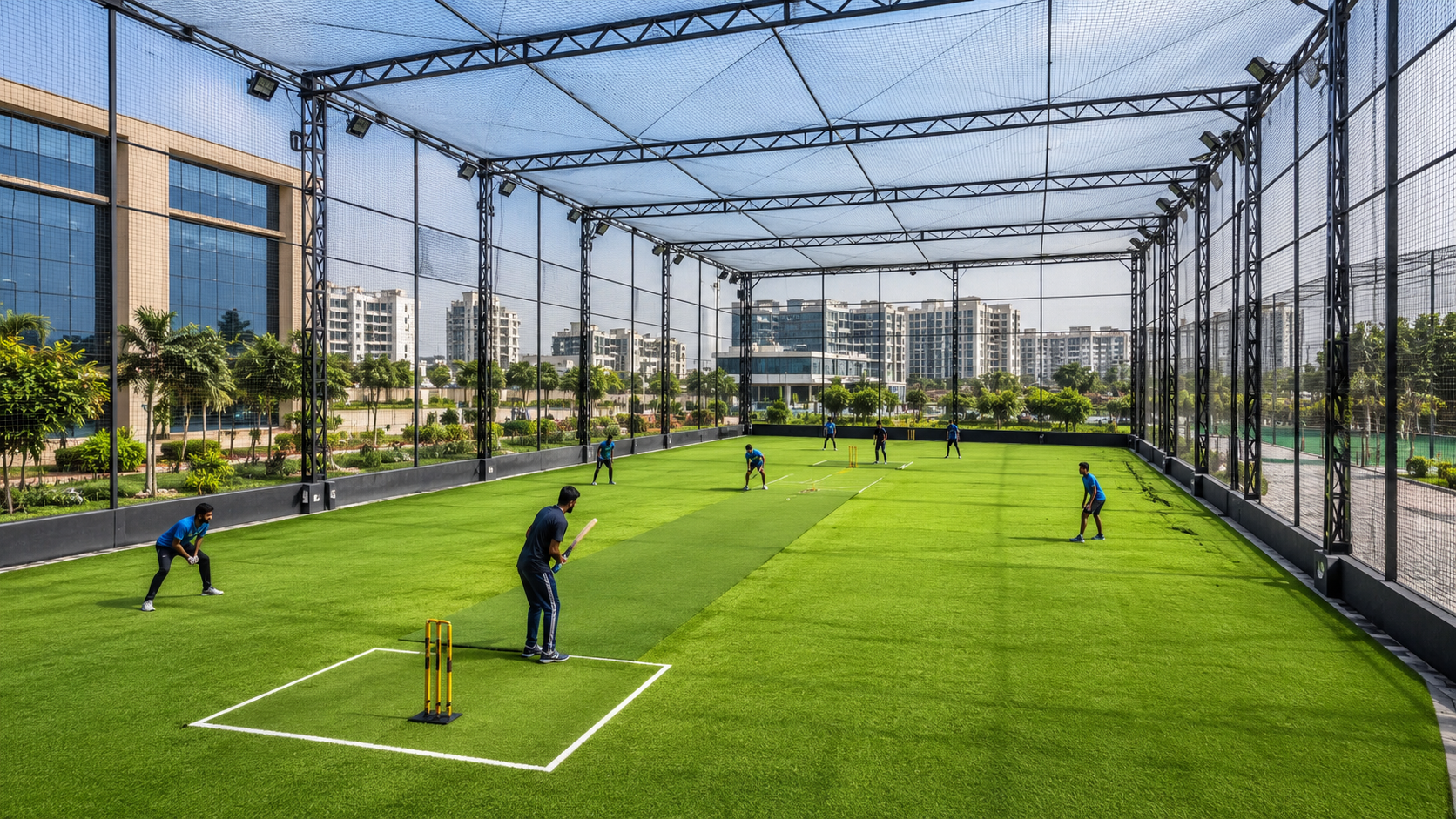
A complete box cricket enclosure normally requires netting around the playing area.
This generally includes:
- Side netting
- End netting
- Roof or overhead netting
- Entry gate netting
- Reinforced corner sections
The roof net is especially important for outdoor box cricket because it prevents lofted balls from leaving the court.
The netting should be securely attached to a properly engineered steel structure. Simply installing lightweight poles without considering wind loads, tension and anchoring can compromise the safety and durability of the facility.
Steel Structure for Box Cricket Turf
The steel framework provides the skeleton of the enclosure.
Depending on the design, it may consist of:
- Vertical steel columns
- Horizontal beams
- Roof supports
- Corner reinforcement
- Net-support cables
- Gate frames
- Bracing members
The structural design should account for the height of the enclosure, net tension, wind conditions, roof arrangement and whether the turf is installed at ground level or on a rooftop.
For rooftop installations, structural assessment is particularly important because the existing building must safely support the additional load.
Box Cricket Turf Layout
A good box cricket layout should be planned as a complete system rather than simply marking a rectangle on the ground.
A typical layout contains:
Entry Zone → Playing Area → Pitch → Boundary Netting → Lighting → Safety Buffer
The playing surface should be rectangular and properly aligned. The wicket areas should be positioned at opposite ends of the pitch, while sufficient movement space should remain around the playing zones.
The exact layout can change depending on whether the court is intended for 5-a-side, 6-a-side, 8-a-side or another locally adopted format.
Safety Clearance Around the Court
The playing dimensions are not necessarily the same as the total land requirement.
If your turf measures 80 × 40 ft, you should not assume that exactly 3,200 sq. ft. of land is enough for the complete facility.
Additional space may be needed for:
- Structural columns
- Entry and exit
- Player waiting areas
- Walkways
- Equipment storage
- Reception
- Washrooms
- Electrical equipment
- Parking
- Emergency access
Some planning references suggest adding approximately 5–8 ft around the playing enclosure for structural and circulation requirements, although the exact requirement depends on the site and facility design.
Total Land Required for a Box Cricket Turf
The total land requirement depends on the playing-area dimensions and supporting facilities.
For example, an 80 × 40 ft playing area provides 3,200 sq. ft. of turf. But the complete project may require substantially more land once access, structural clearance, parking and other facilities are included.
A commercial project should therefore begin with a site survey, not simply a turf-size calculation.
A professional layout should identify:
- Exact plot boundaries
- Available construction area
- Court orientation
- Entry and exit points
- Drainage direction
- Electrical supply
- Parking
- Reception
- Player circulation
- Emergency access
Artificial Turf for Box Cricket
The artificial turf is the primary playing surface and should be selected according to usage.
Common considerations include:
- Turf pile height
- Density
- Backing quality
- UV resistance
- Drainage performance
- Shock absorption
- Wear resistance
- Maintenance requirements
For box cricket, synthetic sports turf is widely used because it provides a consistent surface and can be maintained more easily than natural grass in a high-use commercial environment.
Some current construction references recommend turf systems in the approximate 40–50 mm range for professional-style box cricket applications, although the final specification should depend on the product, base system and intended usage.
Base Preparation Before Turf Installation
High-quality turf cannot compensate for a poorly prepared base.
The foundation should be designed to provide:
- Proper level
- Structural stability
- Water drainage
- Long-term surface performance
- Resistance to settlement
- Suitable turf installation conditions
For outdoor facilities, drainage deserves particular attention. Rainwater should be directed away from the playing surface rather than allowed to accumulate beneath the artificial grass.
Depending on the site, the construction may include compacted sub-base layers, concrete or other engineered foundation systems.
Box Cricket Court Markings
Court markings help players understand boundaries, pitch position and playing zones.
The exact markings depend on the rules used by the facility, but common elements include:
- Wicket markings
- Crease lines
- Pitch boundaries
- Entry zones
- Special scoring zones
- Safety markings
Because box cricket rules vary from one venue to another, markings should be coordinated with the rules that will actually be used for matches.
Lighting Requirements
For commercial facilities that operate in the evening, lighting is essential.
LED sports floodlights are commonly selected because they provide high illumination with comparatively efficient energy use.
The lighting design should aim for:
- Even illumination
- Minimal dark spots
- Reduced glare
- Good visibility of the ball
- Adequate coverage of the pitch
- Safe visibility around the enclosure
Lights should be positioned so that the structural frame and netting do not create excessive shadows across the playing surface.
Indoor Box Cricket Dimensions
Indoor facilities offer greater protection from rain and weather but introduce another important measurement: clear height.
The available ceiling height must allow players to hit the ball safely without constantly contacting the roof or overhead net.
A practical indoor design should therefore consider:
- Playing-area height
- Roof structure
- Lighting clearance
- Ventilation
- Netting
- Player safety
- Maintenance access
Some sources cite lower net heights for compact indoor recreational courts, while commercial and high-performance installations commonly use much greater clear heights.
The appropriate height should be determined from the actual playing format rather than applying one number to every indoor project.
Rooftop Box Cricket Turf
Rooftop turfs are increasingly attractive in cities where ground-level land is expensive or difficult to obtain.
However, rooftop construction requires additional planning.
Before construction, the building should be evaluated for:
- Structural load capacity
- Existing slab condition
- Waterproofing
- Drainage
- Wind exposure
- Safe access
- Emergency exits
- Steel-frame anchoring
A rooftop court should never be designed solely around the available open terrace. The structural and waterproofing requirements must also be considered.
Best Orientation for a Box Cricket Court
Court orientation should be planned according to the site’s surroundings and lighting conditions.
For outdoor facilities, the position of the sun can affect visibility, particularly during evening transitions and daytime matches.
The orientation should also consider:
- Sun glare
- Surrounding buildings
- Wind direction
- Natural drainage
- Access roads
- Adjacent properties
- Available electrical connection
There is no single orientation that is perfect for every plot. A site-specific layout is generally more effective than applying a fixed direction to every project.
Common Box Cricket Layout Mistakes
Several mistakes can reduce the performance of an otherwise attractive facility.
1. Choosing the Court Size Before Measuring the Site
The available plot should be measured first. The playing area should then be designed around the actual site.
2. Using Low Netting
Insufficient net height can allow balls to escape and can make the facility less enjoyable.
3. Ignoring Drainage
Water accumulation can damage the turf system and reduce usability during rainy weather.
4. Poor Lighting Placement
Too few lights or badly positioned fixtures can create glare and shadows.
5. No Safety Buffer
The enclosure should provide adequate clearance around structural components and entry points.
6. Overcrowding the Court
Trying to fit too many players into a very small turf can compromise movement and safety.
7. Neglecting the Steel Structure
The enclosure must be structurally sound. Netting is only as reliable as the framework supporting it.
How to Choose the Right Box Cricket Turf Size
The best size depends on five major factors.
Available Land
Start with the exact dimensions of the plot rather than choosing a court size from a catalogue.
Player Capacity
A 5-a-side facility does not require the same space as an 8-a-side commercial venue.
Type of Cricket
Underarm, recreational overarm and competitive formats require different playing environments.
Commercial Objectives
A commercial turf should balance player experience with construction and operating costs.
Future Expansion
If the property allows it, leave room for additional facilities such as football turf, pickleball courts, changing rooms or spectator areas.
Suggested Box Cricket Dimensions at a Glance
| Feature | Practical Recommendation |
|---|---|
| Compact court | 60–70 × 28–35 ft |
| Commercial court | 80–95 × 38–45 ft |
| Large court | 100–110 × 50–60 ft |
| Pitch | Approximately 16–22 yards |
| Pitch width | Approximately 8–10 ft |
| Commercial net height | Approximately 20–25 ft |
| Large-format net height | Approximately 25–28 ft |
| Turf | Synthetic sports turf |
| Lighting | LED sports floodlights |
| Enclosure | Side, end and overhead netting |
| Base | Engineered, level and well-drained |
| Safety | Adequate clearance and protected access |
These figures should be treated as planning ranges, not universal competition rules, because box cricket has no single governing standard that fixes one court dimension.
Final Thoughts
Choosing the correct box cricket turf dimensions is the foundation of a successful sports facility. The ideal design must combine sufficient playing space, appropriate pitch length, reliable netting, adequate height, quality artificial turf, safe structural support, effective drainage and proper lighting.
For many commercial projects, a medium-sized enclosure around 80–95 ft long and 38–45 ft wide, with approximately 20–25 ft of net height, provides a practical starting point. Larger sites can accommodate bigger layouts, while compact rooftops and residential facilities may require customized dimensions. These ranges align with current Indian turf-construction practices, but the final specification should always be based on the site and intended playing format.
Before construction, measure the complete site, determine the desired player capacity, decide whether the facility will be indoor, outdoor or rooftop, and allocate additional space for access, drainage, lighting, structural supports and safety.
A well-planned box cricket turf is not simply a rectangular area covered with artificial grass. It is an engineered sports environment in which every dimension—from the pitch length to the net height—contributes to player experience, safety and long-term performance.