Introduction
Box cricket has become one of the fastest-growing recreational sports formats in India. Its compact design, flexible playing environment, and suitability for urban locations make it an attractive option for sports clubs, schools, gyms, residential communities, commercial sports arenas, and entrepreneurs looking to develop a profitable sports facility.
A professionally installed box cricket turf is more than an enclosed ground with artificial grass. It requires proper site preparation, structural fabrication, drainage, sports flooring, turf installation, safety netting, lighting, cricket equipment, and quality finishing. Every component affects player safety, playing performance, durability, and long-term maintenance.
This comprehensive guide explains the complete box cricket turf installation process, important design considerations, flooring options, construction requirements, maintenance practices, and factors to consider when selecting a professional contractor.
What Is Box Cricket Turf?
Box cricket is a modified form of cricket played within an enclosed sports area. Unlike conventional cricket grounds, box cricket facilities generally use artificial turf, perimeter netting, steel structures, compact dimensions, and controlled boundaries.
The enclosed design allows players to enjoy cricket in a smaller space while reducing the need for a large open field. This makes box cricket particularly suitable for cities where land availability is limited.
A modern box cricket facility may include:
- Artificial cricket turf
- Concrete or asphalt base
- Shock-absorbing underlay
- Steel framework
- Side and roof netting
- Cricket wickets
- Boundary markings
- LED sports lighting
- Player safety padding
- Drainage arrangements
- Seating or spectator areas
- Entry gates and access systems
The exact configuration depends on the available site, intended usage, budget, and type of players.
Why Professional Box Cricket Turf Installation Matters
The quality of installation directly influences the performance and lifespan of a cricket turf. Poorly prepared ground can result in uneven surfaces, water accumulation, turf displacement, loose joints, and premature deterioration.
Professional installation begins with site assessment and continues through engineering, ground preparation, turf laying, structural installation, testing, and final inspection.
A professionally constructed facility provides:
- Better playing consistency
- Improved player safety
- Reliable drainage
- Longer turf life
- Strong structural stability
- Better ball response
- Reduced maintenance requirements
- Professional appearance
- Efficient use of available land
- Better customer experience for commercial facilities
For a facility intended for daily commercial use, proper construction is especially important because the playing surface may experience hundreds of hours of activity every month.
Planning Your Box Cricket Turf
Before construction begins, the project should be carefully planned. The available land should be evaluated according to its dimensions, accessibility, surrounding buildings, drainage conditions, electricity availability, and expected usage.
The facility should also be planned around the intended audience.
For example, a recreational facility may prioritize affordability and efficient space utilization, while a commercial academy may require premium turf, professional lighting, stronger netting, spectator seating, changing rooms, and additional amenities.
Important planning considerations include:
1. Available Land Area
Measure the complete site before finalizing the court layout. Allow sufficient space for the playing area, structural supports, entrance, equipment, circulation, and safety zones.
2. Site Accessibility
Construction materials, steel components, turf rolls, machinery, and installation equipment must be transported to the site. Easy access can make construction faster and more efficient.
3. Ground Condition
The existing soil and surface condition should be assessed before selecting the foundation and base construction method.
4. Drainage
Outdoor box cricket facilities require an effective drainage system to prevent rainwater from collecting underneath or on top of the turf.
5. Lighting
Lighting should be considered during the design stage rather than added as an afterthought. Electrical conduits, mounting positions, and structural supports can be integrated into the original design.
Step-by-Step Box Cricket Turf Installation Process
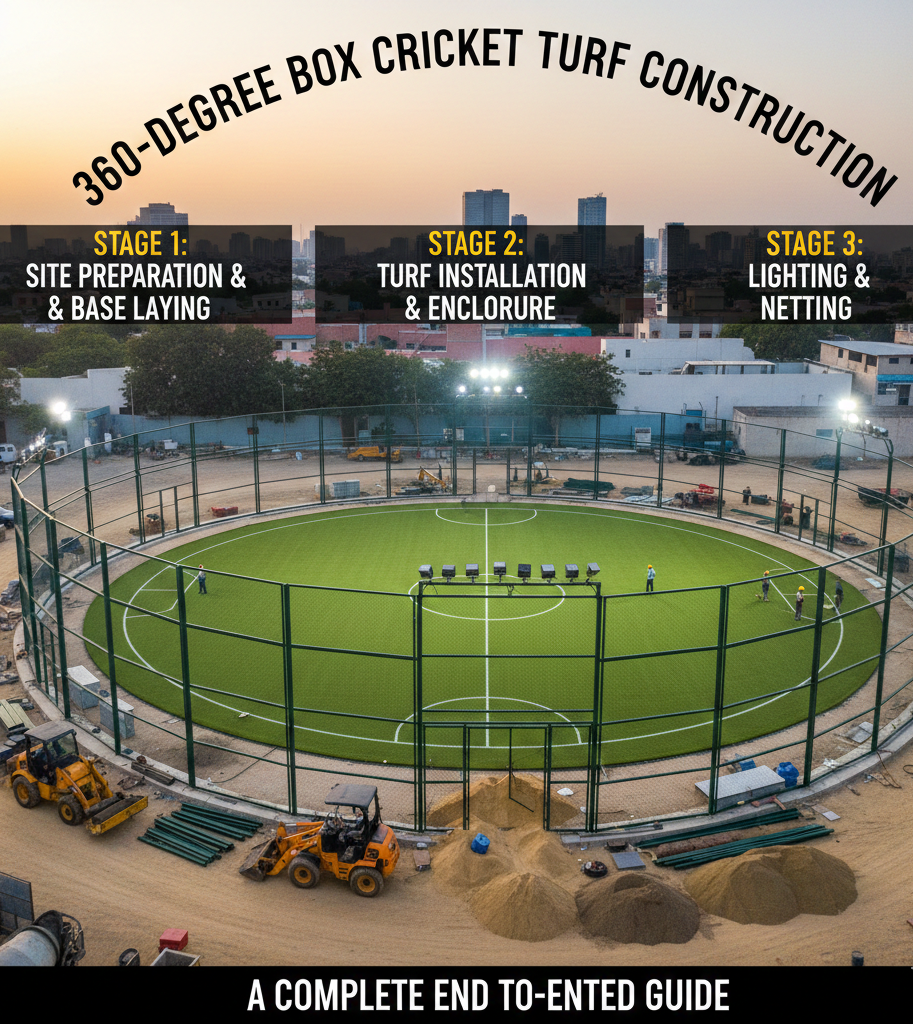
A professional box cricket turf installation normally follows several stages.
Step 1: Site Survey and Measurement
The first stage is a detailed site survey. The contractor evaluates the dimensions, levels, soil conditions, existing surface, drainage, accessibility, and surrounding environment.
Measurements are taken to prepare an accurate layout.
The survey helps determine:
- Playing area dimensions
- Turf quantity
- Foundation requirements
- Steel framework requirements
- Netting requirements
- Lighting positions
- Drainage design
- Entrance location
- Equipment placement
A proper survey reduces construction errors and unnecessary material wastage.
Step 2: Layout and Design
After the site survey, the complete facility layout is prepared.
The design should show the playing area, pitch location, wickets, boundary zones, steel columns, netting, entrances, lighting, and other relevant features.
For commercial facilities, designers may also incorporate reception areas, spectator seating, advertising zones, changing rooms, washrooms, refreshment areas, and player waiting areas.
A well-planned layout improves both playing experience and business functionality.
Step 3: Ground Preparation
Ground preparation is one of the most important parts of turf installation.
The existing area may need to be cleared, excavated, leveled, compacted, and prepared according to the proposed base system.
Loose soil or unsuitable material should be removed where necessary. The foundation should provide sufficient stability and uniformity for the sports surface.
Proper compaction helps minimize settlement and surface deformation over time.
Step 4: Base Construction
The base provides the foundation for the artificial turf.
Depending on the site and design, the installation may involve layers of compacted aggregate, granular material, concrete, asphalt, or another engineered base.
The objective is to create a stable, smooth, and appropriately graded surface.
An uneven base can eventually create visible imperfections in the turf, so accurate leveling is essential.
Step 5: Drainage Installation
For outdoor facilities, drainage plays a major role in protecting the playing surface.
Rainwater should be directed away from the court through an appropriate drainage system. Depending on site conditions, this may include perimeter drains, channels, slopes, collection points, and underground drainage arrangements.
The drainage design should be completed before the final turf installation.
Effective drainage helps prevent:
- Waterlogging
- Mud formation
- Bad odors
- Turf deterioration
- Surface damage
- Unplayable conditions after rainfall
Step 6: Steel Structure Installation
The enclosure is usually constructed using a strong metal framework.
Vertical columns, horizontal members, roof supports, and other structural components are fabricated and installed according to the approved design.
The structure must be securely anchored to the foundation.
The steel framework supports the protective netting and, in many designs, lighting fixtures.
The quality of welding, anchoring, corrosion protection, and structural alignment is important for long-term performance.
Step 7: Protective Netting Installation
Netting creates the enclosed playing environment that distinguishes box cricket from conventional cricket grounds.
High-quality sports netting should be selected according to the expected intensity of use and facility design.
The netting should be securely attached to the structural framework without creating loose sections that could interfere with play.
The enclosure helps keep the cricket ball inside the playing area and improves safety for players, spectators, and nearby property.
Step 8: Artificial Turf Installation
Artificial turf is one of the most important components of a box cricket facility.
The selected turf should be appropriate for cricket and designed to withstand frequent running, batting, bowling, and ball impact.
During installation, the prepared base is cleaned and checked before turf rolls are positioned.
The process generally includes:
- Preparing the base surface
- Positioning turf rolls
- Aligning turf sections
- Cutting edges accurately
- Joining seams
- Securing the turf
- Installing infill where required
- Brushing and leveling the fibers
- Adding cricket pitch markings
The installation should be carried out carefully to avoid visible seams, wrinkles, loose edges, or uneven sections.
Choosing the Right Artificial Cricket Turf
Not every artificial grass product is suitable for cricket.
A quality cricket turf should provide an appropriate combination of durability, ball response, traction, resilience, and comfort.
Important characteristics include:
Fiber Quality
The turf fiber should be durable enough for repeated sports use. Fiber construction influences the appearance, resilience, and playing characteristics of the surface.
Pile Height
The appropriate pile height depends on the turf system and intended application. The contractor should recommend the specification based on actual cricket usage rather than selecting a product solely by appearance.
Density
Higher-density turf can provide a fuller surface and better resistance to heavy use, depending on its construction.
UV Resistance
Outdoor turf should be designed to withstand prolonged exposure to sunlight and changing weather conditions.
Drainage Performance
Outdoor artificial turf should allow water to move efficiently through the surface and underlying system.
Infill
Some artificial turf systems use specialized infill materials to support fibers, improve stability, and influence surface performance.
Shock Pad and Underlay Systems
For facilities expecting heavy usage, a shock-absorbing layer can improve comfort and reduce surface hardness.
A properly selected underlay system can contribute to:
- Better impact absorption
- Improved player comfort
- Reduced surface stress
- Enhanced playing experience
- Additional protection for the turf system
The exact system should be selected according to the turf specification, base construction, and facility requirements.
Cricket Pitch Installation
The central pitch area deserves special attention because it receives concentrated activity from batsmen and bowlers.
The pitch should provide a consistent surface for batting and bowling while remaining durable enough for frequent use.
Professional installation should ensure:
- Accurate alignment
- Uniform surface
- Secure turf fixing
- Correct crease markings
- Stable wicket placement
- Consistent playing characteristics
Synthetic cricket pitches are particularly useful for recreational box cricket because they require less maintenance than natural grass.
Wicket Installation
Wickets should be installed accurately at both ends of the pitch.
Depending on the facility, fixed or removable wicket systems may be used.
The wicket area should be firmly secured so that it does not move during normal play.
Proper wicket positioning also ensures that the pitch dimensions remain consistent.
Court Markings and Finishing
Clear markings help players understand the playing area and improve the professional appearance of the facility.
Markings may include:
- Batting crease
- Bowling crease
- Popping crease
- Pitch boundaries
- Entry and safety zones
The markings should be durable and compatible with the selected turf surface.
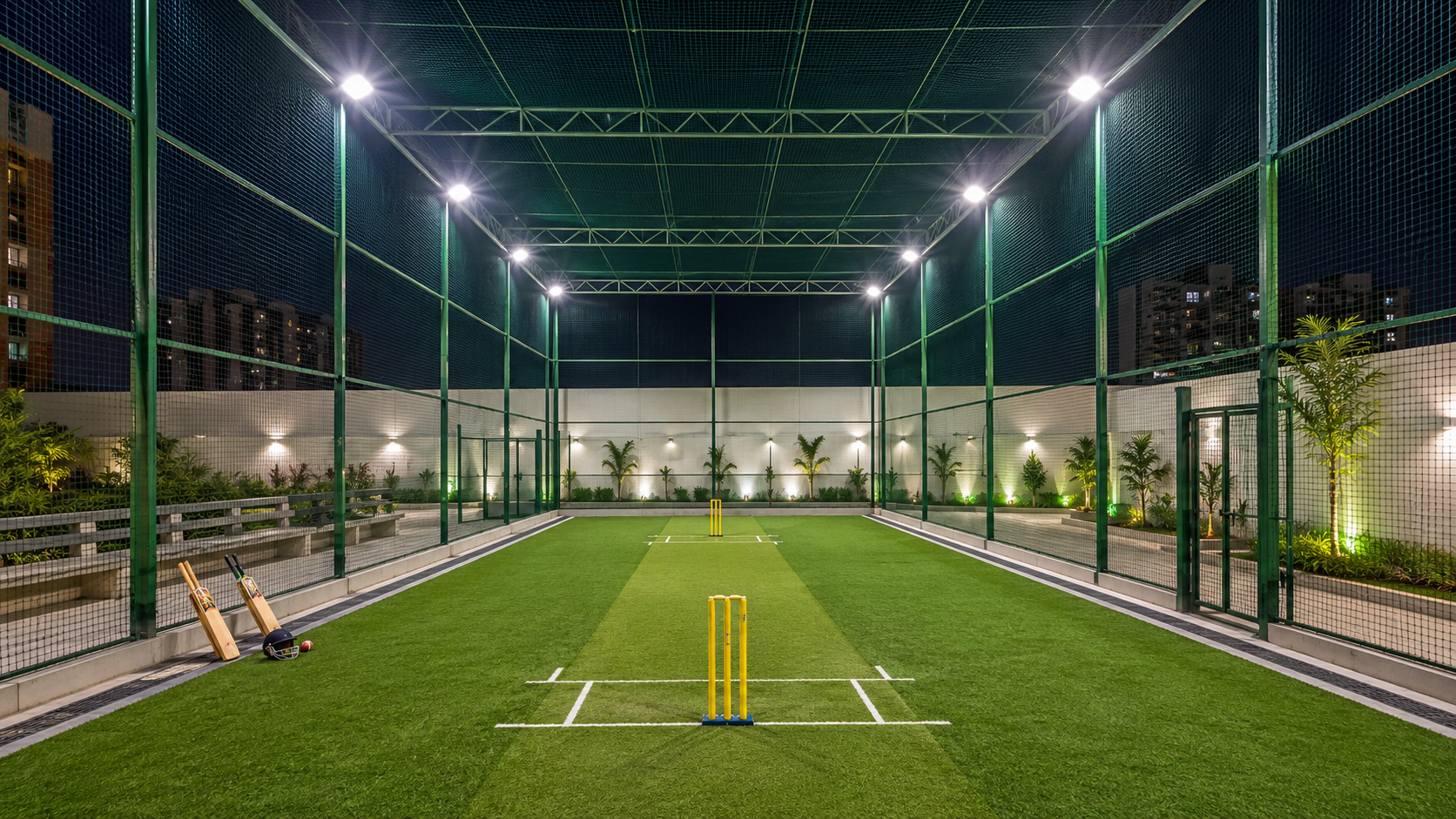
LED Lighting for Box Cricket
Lighting is essential for facilities that operate during evening and nighttime hours.
Modern LED sports lighting can provide bright and efficient illumination while helping reduce energy consumption compared with older lighting technologies.
Lighting should be positioned to minimize:
- Glare
- Shadows
- Dark zones
- Direct visibility issues
- Uneven illumination
A professional lighting layout improves visibility for batsmen, bowlers, fielders, and spectators.
For commercial facilities, reliable lighting also allows longer operating hours and better utilization of the property.
Safety Features in Box Cricket Construction
Safety should remain a priority throughout construction.
Important safety elements can include:
- Strong perimeter netting
- Properly anchored steel structures
- Padded structural areas where appropriate
- Safe entrance and exit points
- Non-slip playing surfaces
- Adequate lighting
- Proper drainage
- Secure cricket equipment
- Clear walkways
Structural components should not create unnecessary hazards within the active playing zone.
Box Cricket Turf for Commercial Facilities
Box cricket can be an attractive addition to commercial sports businesses because the compact format can support multiple booking sessions throughout the day.
A professionally designed facility can be used for:
- Hourly cricket bookings
- Corporate sports events
- School activities
- Cricket coaching
- Amateur competitions
- Weekend leagues
- Birthday events
- Community sports programs
- Sports academy training
Commercial operators can also combine box cricket with other activities such as football, badminton, fitness training, or recreational events depending on the available property.
Box Cricket Turf for Schools and Colleges
Educational institutions can use box cricket facilities to provide students with convenient access to cricket without requiring a full-size cricket ground.
A compact enclosed facility can support physical activity, recreational competitions, cricket coaching, and inter-school events.
Schools should pay particular attention to safety, access control, lighting, drainage, and easy maintenance when planning the facility.
Box Cricket Turf for Residential Communities
Apartment complexes, gated communities, and residential townships increasingly use compact sports facilities to improve recreational amenities.
A box cricket court can provide residents with a convenient space for regular games without requiring extensive land.
It can also become a shared recreational facility for children, teenagers, and adults.
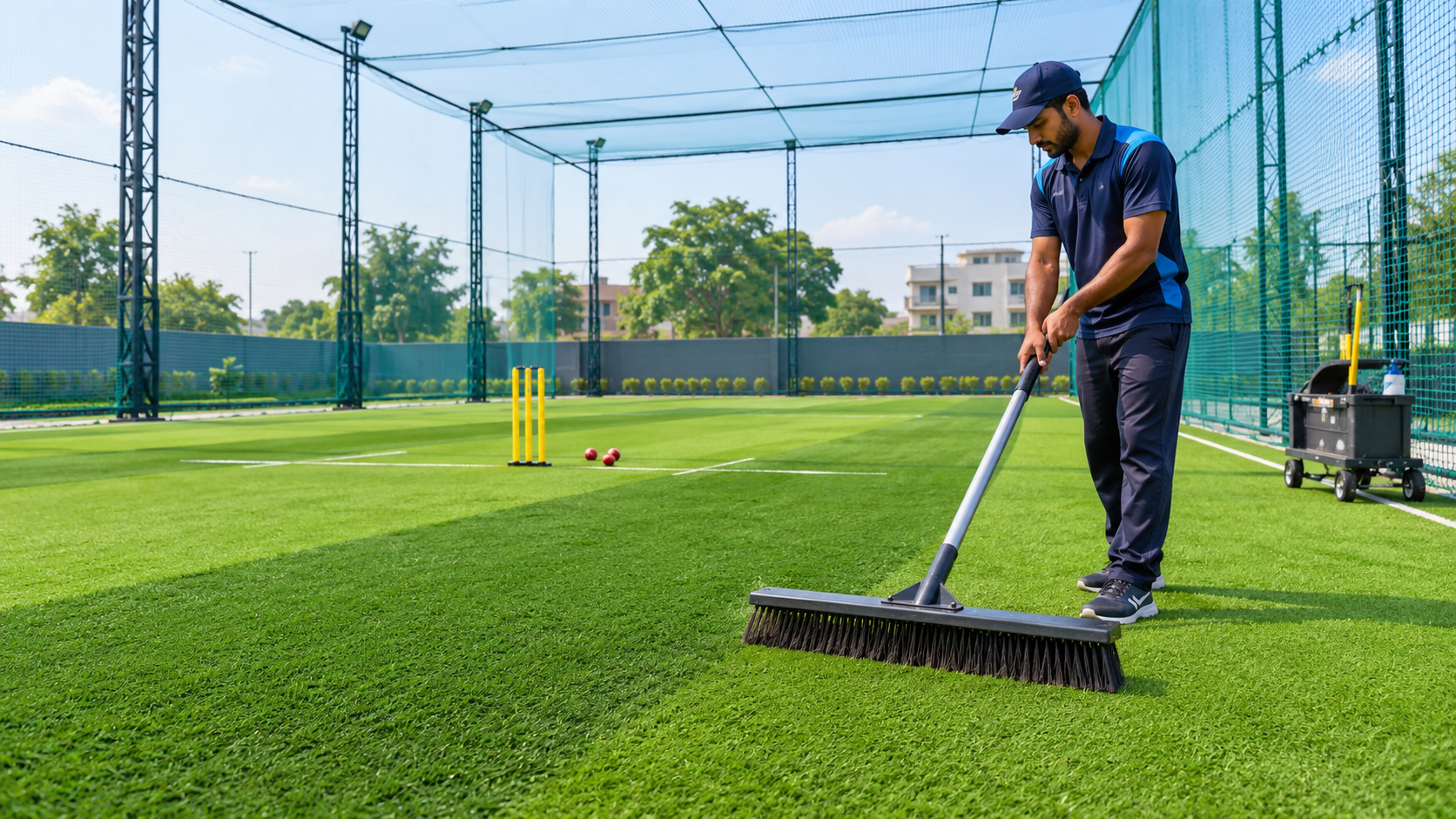
Box Cricket Turf Maintenance
Even high-quality artificial turf requires regular maintenance.
A maintenance program should include:
Regular Cleaning
Remove leaves, dust, packaging materials, and other debris from the playing surface.
Brushing
Regular brushing helps maintain the upright position of artificial fibers and distributes infill where applicable.
Inspection
Check seams, edges, netting, structural connections, wickets, and lighting regularly.
Drainage Cleaning
Outdoor drainage channels should remain clear of leaves, dirt, and debris.
Turf Repairs
Damaged seams, loose sections, or heavily worn areas should be repaired promptly to prevent further deterioration.
Netting Inspection
Sports netting should be checked for cuts, loose connections, and excessive wear.
Regular preventive maintenance is generally more economical than waiting for major damage to occur.
How Long Does Box Cricket Turf Last?
The lifespan of a box cricket turf depends on several factors, including turf quality, installation standards, daily usage, climate, maintenance, and player behavior.
A facility used intensively every day will naturally experience greater wear than a private recreational court used occasionally.
Using suitable materials and following a planned maintenance schedule can significantly improve the service life of the facility.
How to Choose a Box Cricket Turf Installation Company
Selecting the right contractor is one of the most important project decisions.
Consider the following factors:
Experience
Look for a contractor with practical experience in sports facility construction and artificial turf installation.
Previous Projects
Ask to see completed box cricket projects. Visiting an operational installation can provide useful insight into construction quality.
Material Specifications
Request detailed information about turf, steel, netting, lighting, foundation materials, and other components.
Customized Design
Every site is different. A reliable contractor should develop a solution around the actual property instead of offering an unsuitable standard design.
Installation Team
Experienced installation teams can improve alignment, finishing quality, structural stability, and overall project execution.
Transparent Quotation
The quotation should clearly identify the scope of work, materials, installation requirements, exclusions, and applicable warranty terms.
After-Sales Support
Maintenance and repair support can be valuable after project completion, particularly for commercial facilities with intensive daily usage.
Common Mistakes to Avoid
Several mistakes can negatively affect the performance of a box cricket facility.
Choosing Turf Only by Price
The cheapest turf may not provide the durability or playing characteristics required for commercial use.
Ignoring Drainage
Poor drainage can cause serious problems for outdoor installations.
Using Weak Structural Components
The steel framework and netting support system should be designed for the facility’s requirements.
Poor Base Preparation
Turf cannot compensate for an unstable or uneven foundation.
Inadequate Lighting
Uneven illumination can reduce visibility and affect the quality of play.
Skipping Maintenance
Neglecting routine cleaning and inspections can shorten the lifespan of the facility.
Cost Factors for Box Cricket Turf Installation
The cost of a box cricket turf project depends on multiple variables rather than one fixed rate.
Major cost factors include:
- Site dimensions
- Ground preparation
- Foundation requirements
- Artificial turf specification
- Shock pad or underlay
- Steel structure
- Netting height and quality
- Roofing requirements
- Drainage
- LED lighting
- Wickets and cricket equipment
- Seating and amenities
- Site accessibility
- Location
- Custom design requirements
A professional contractor should conduct a site assessment before providing a final project estimate.
Why Invest in Professional Box Cricket Turf Installation?
A professionally constructed facility provides more than an attractive playing environment. It creates a durable sports asset that can support recreational activities, training programs, community engagement, and commercial operations.
Professional installation helps ensure that the surface, structure, drainage, lighting, and safety systems work together as one complete facility.
The result is a better experience for players and operators while reducing the likelihood of expensive construction-related problems later.
Conclusion
Box cricket turf installation requires careful planning, quality materials, technical expertise, and proper execution. From site preparation and drainage to artificial turf, structural framework, protective netting, lighting, wickets, and maintenance, every component contributes to the performance and longevity of the facility.
Whether you are developing a commercial sports arena, school sports facility, residential recreation area, cricket academy, gym, or private sports ground, choosing the right design and installation partner is essential.
A professionally installed box cricket turf can transform a limited area into a modern, attractive, and highly functional cricket facility. With suitable artificial turf, a stable foundation, reliable drainage, strong enclosure systems, effective lighting, and regular maintenance, the facility can deliver a consistent playing experience for years.
Before beginning construction, evaluate your site carefully, define your expected usage, compare material specifications, and select a contractor with proven sports facility installation experience. A well-planned project not only improves playing quality but can also enhance the long-term value and usability of the entire sports facility.