Introduction
Badminton is a fast-paced sport that demands quick footwork, sudden changes of direction, repeated jumping, lunging, and rapid recovery movements. Every rally places continuous demands on a player’s ankles, knees, hips, and other parts of the body. While players often focus on rackets, shoes, training, and technique, one of the most important elements of a safe playing environment is directly beneath them: the badminton court flooring.
A professionally designed and properly installed badminton court floor can make a significant difference to player comfort, traction, movement control, and overall playing experience. On the other hand, an unsuitable, excessively hard, slippery, uneven, or poorly maintained surface can make movement less predictable and increase the possibility of slips, awkward landings, and unnecessary physical stress.
For schools, sports academies, clubs, residential facilities, fitness centres, universities, hotels, and professional training facilities, investing in professional badminton court flooring is therefore more than an aesthetic decision. It is an important part of creating a safer and more reliable sports environment.
Modern sports flooring systems are designed around specific performance characteristics rather than simply providing a flat surface. BWF flooring certification, for example, considers characteristics such as friction, shock absorption, and vertical deformation.
What Is Professional Badminton Court Flooring?
Professional badminton court flooring refers to a purpose-built sports flooring system designed to support the movement and playing requirements of badminton.
Unlike ordinary concrete, ceramic tiles, stone, or generic indoor flooring, sports flooring is engineered to provide a controlled combination of grip, impact management, surface response, and durability.
Depending on the facility and its requirements, badminton courts may use systems such as:
- Wooden sprung flooring
- Synthetic badminton court mats
- PVC or vinyl sports flooring
- PU sports flooring systems
- Cushioned synthetic sports surfaces
- Approved sports flooring systems installed over suitable subfloors
The correct flooring solution depends on factors such as the building structure, usage intensity, budget, climate, maintenance requirements, and the desired level of play.
For high-level competition facilities, the Badminton World Federation specifies a wooden sprung floor or an equivalent subfloor for badminton court mats, along with approved badminton court mats for certain international competition levels.
For recreational, educational, corporate, residential, and club facilities, the exact specification can vary, but the underlying principle remains the same: the playing surface should be designed for badminton rather than adapted from an ordinary floor.
Why Badminton Flooring Matters for Player Safety
A badminton player can make hundreds or even thousands of movements during a training session or match. These movements include explosive starts, braking, lateral shuffles, lunges, jumps, and sudden changes in direction.
The floor influences how safely those movements can be performed.
A professional badminton flooring system helps provide:
- Controlled traction
- Appropriate shock absorption
- Consistent surface response
- Better movement stability
- Reduced impact from repeated landings
- A more comfortable playing experience
- A consistent playing surface
The goal is not to create the hardest or softest possible surface. Instead, good sports flooring aims to create an appropriate balance between grip, movement, impact response, and stability.
1. Helps Provide Better Traction
Traction is one of the most important characteristics of a badminton court.
Players frequently move sideways, stop suddenly, push off from one foot, and change direction within fractions of a second. The flooring needs to provide sufficient grip to support these movements without becoming excessively sticky.
A surface with inadequate traction can make a player’s foot slide unexpectedly. This can affect balance and make sudden movements more difficult to control.
Professional badminton flooring is designed with a surface texture and friction characteristics appropriate for sports movement. BWF certification criteria for synthetic badminton flooring include friction and related surface-performance characteristics.
At the same time, excessive grip is not automatically better. A surface that prevents natural foot movement can also interfere with efficient movement patterns.
The objective is controlled traction, allowing players to accelerate, stop, pivot, and recover with confidence.
2. Provides Shock Absorption During Movement
Badminton involves repeated jumping and landing.
Players regularly perform overhead shots, smashes, jumps, lunges, and rapid recovery movements. Every landing transfers force through the feet and lower body.
This is why shock absorption in badminton court flooring is such an important consideration.
A properly designed sports floor can help manage some of the impact generated during movement. BWF’s synthetic flooring certification framework specifically includes shock absorption and vertical deformation as important performance characteristics.
Professional sports floors may incorporate cushioning layers or sprung subfloor systems to provide controlled impact response.
This is particularly important for facilities where players train frequently.
A recreational player using a court occasionally and an athlete training several hours every day place very different demands on the flooring system. The more frequently a court is used, the more important it becomes to select a surface designed for repeated sports activity.
3. Supports Safer Lunges and Direction Changes
Badminton is not played by moving in a straight line.
Players constantly move forward, backward, sideways, and diagonally. One of the most characteristic movements is the deep lunge toward the front or side of the court.
During a lunge, the player needs to control their body weight while maintaining stability and preparing for the next movement.
A properly installed sports floor provides a predictable interaction between the player’s footwear and the surface.
This consistency helps players develop reliable movement patterns.
If one section of a court is significantly more slippery or harder than another, the player’s response can become unpredictable. Even minor surface inconsistencies can affect confidence during fast movements.
For this reason, uniform badminton court flooring is an important part of professional court construction.
4. Helps Reduce the Problems Associated With Hard Flooring
Ordinary concrete and other rigid surfaces are not designed specifically for badminton movement.
Although a hard floor may initially appear strong and durable, durability alone does not make a surface suitable for sports.
Badminton requires repeated jumping, running, stopping, and lateral movement. A purpose-built sports floor can provide characteristics that ordinary construction flooring does not.
Professional badminton court systems are designed to introduce appropriate performance characteristics between the player’s footwear and the structural floor.
This is one reason international badminton facilities use sprung flooring or approved equivalent systems rather than treating the playing surface as an ordinary building floor.
The choice of flooring should therefore consider not only how long it will last, but also how it performs under repeated athletic movement.
5. Creates a More Consistent Playing Surface
Player safety is closely connected with surface consistency.
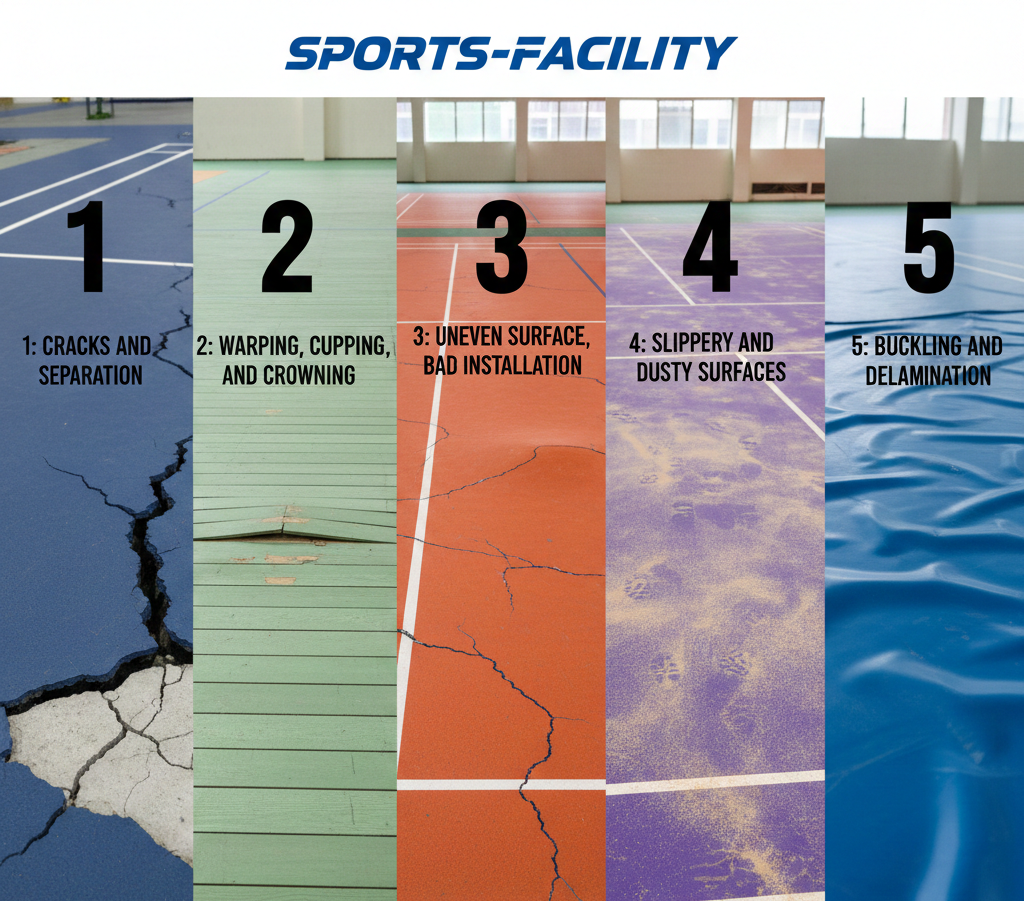
A professional badminton court should have a level, stable, and uniform playing surface. Uneven areas, loose flooring, raised edges, damaged seams, bubbles, or worn sections can interfere with movement.
In addition to creating safety concerns, inconsistent flooring can affect the quality of play.
Players need to know what to expect from the surface beneath their feet. When the floor performs consistently across the entire court, players can focus more effectively on their technique and movement.
Professional installation therefore involves more than simply placing a top layer over an existing floor.
The subfloor must be appropriately prepared, levels must be checked, and the flooring system must be installed according to the manufacturer’s requirements.
6. Proper Installation Is as Important as Flooring Material
Choosing a high-quality flooring product is only one part of building a professional badminton court.
Even a good flooring material can perform poorly if it is installed over an unsuitable or improperly prepared base.
Before installation, contractors should assess factors such as:
- Existing floor condition
- Surface level and flatness
- Moisture conditions
- Structural stability
- Expansion and movement
- Drainage where applicable
- Required cushioning or subfloor system
- Court dimensions
- Safety clearance
- Expected usage
The installation process should be planned around the specific flooring system.
For example, a cushioned synthetic system may require a properly prepared base before the sports surface is installed. A wooden sprung system requires appropriate structural planning and installation techniques.
This is why working with an experienced badminton court flooring contractor can be more valuable than simply selecting the cheapest flooring material.
7. Helps Maintain Player Confidence
Safety is not only about preventing physical problems. It is also about creating confidence.
When players trust the surface, they can move aggressively without constantly worrying about slipping or losing balance.
This becomes particularly important for competitive players.
A badminton athlete must react quickly to the opponent’s shots. Hesitation during a lunge or change of direction can affect both performance and confidence.
A predictable sports surface gives players a more consistent environment for training and competition.
For academies and sports clubs, this can contribute to a better overall training experience.
8. Professional Flooring Can Improve Playing Comfort
Comfort matters during long badminton sessions.
Players may spend one to several hours on court during training. Coaches may conduct multiple sessions every day. Competitive athletes can spend many hours each week practicing.
A properly specified flooring system can make the playing environment more comfortable by providing an appropriate balance between surface stability and impact response.
This is particularly relevant for facilities with high daily usage.
The flooring should be selected according to the users of the facility rather than based purely on appearance.
A professional badminton academy, for example, may require a more performance-focused system than a residential court used occasionally by family members.
9. Why BWF Flooring Standards Matter
The Badminton World Federation provides technical requirements and equipment certification systems for badminton facilities.
Its flooring certification framework evaluates important characteristics including:
- Friction
- Shock absorption
- Vertical deformation
- Slip resistance
- Force reduction
- Surface performance
Different certification grades apply to different flooring applications.
For international competition courts, BWF specifications call for a wooden sprung floor or equivalent subfloor beneath approved badminton court mats.
This demonstrates an important point: professional badminton flooring is a performance system, not simply a decorative surface.
However, not every badminton court needs BWF certification.
A residential badminton court, school, recreational club, or community facility may not require an internationally certified competition floor. The appropriate specification should be determined by the intended use.
Nevertheless, using the principles behind professional sports flooring—controlled traction, suitable impact response, consistent performance, and proper installation—is beneficial at every level.
10. Different Badminton Flooring Options
There is no single flooring material suitable for every badminton facility.
Wooden Sprung Flooring
Wooden sprung flooring is widely associated with high-performance indoor sports environments.
A sprung construction can provide controlled impact response and is specified by BWF for certain international competition environments.
It is particularly suitable for premium sports facilities, professional training centres, and competition venues when designed and maintained correctly.
PVC or Vinyl Badminton Flooring
Synthetic PVC or vinyl court mats are widely used in indoor badminton facilities.
They can provide a durable playing surface with appropriate sports characteristics when installed over a suitable subfloor.
For facilities seeking a practical combination of performance, maintenance, and durability, synthetic court mats can be an effective solution.
PU Sports Flooring
Polyurethane sports flooring can be designed as a cushioned sports surface.
Depending on its construction, PU systems can provide a combination of durability, comfort, traction, and impact management.
The exact performance depends on the complete flooring system rather than the name of the material alone.
Cushioned Synthetic Flooring
Cushioned sports flooring incorporates resilient layers beneath the playing surface.
This type of construction can be useful where player comfort and repeated-use performance are important considerations.
The correct system should be selected according to the facility’s usage, subfloor, climate, and performance requirements.
11. Flooring Selection Should Consider the Building Environment
A badminton court floor does not operate independently from its surroundings.
Temperature, humidity, ventilation, moisture, sunlight, building conditions, and maintenance can all influence flooring performance.
This is particularly relevant in parts of India where seasonal humidity and temperature changes can affect sports facilities.
Before installation, the contractor should evaluate the existing floor and building conditions rather than simply installing a standard product.
For indoor facilities, proper ventilation and moisture management can also contribute to long-term flooring performance.
The right flooring system is therefore one that matches both the sporting requirements and the building environment.
12. Maintenance Is Essential for Continued Safety
Even the best badminton court flooring can become unsafe if it is neglected.
Regular maintenance should include:
- Removing dust and debris
- Cleaning according to the manufacturer’s recommendations
- Checking for damaged areas
- Inspecting seams and edges
- Monitoring surface wear
- Addressing moisture problems
- Keeping the court free from unnecessary obstacles
- Repairing damaged sections promptly
Dust can affect surface traction. Moisture can create slippery areas. Damaged flooring can create irregularities in the playing surface.
Facility managers should therefore treat badminton court maintenance as part of their overall player-safety program.
A clean and properly maintained court is much more likely to deliver the performance characteristics for which the flooring system was selected.
13. Common Badminton Flooring Mistakes to Avoid
Several mistakes can reduce the safety and performance of a badminton court.
Choosing Flooring Based Only on Price
The cheapest flooring option may not be the most economical solution over the long term.
A low-cost floor that wears quickly, loses traction, or requires frequent repairs can ultimately cost more.
Installing Over an Unsuitable Base
The top surface cannot compensate for major problems in the underlying floor.
Subfloor preparation is an essential part of professional installation.
Ignoring Moisture
Moisture can cause problems for many flooring systems.
The floor should be assessed before installation, and appropriate moisture-control measures should be considered.
Using Ordinary Building Flooring
Concrete, ceramic tiles, and other general-purpose surfaces may be durable, but they are not automatically suitable for badminton.
Badminton flooring should be selected for sports performance.
Neglecting Maintenance
Even premium flooring needs regular cleaning and inspection.
Ignoring small problems can allow them to become expensive repairs.
14. How to Choose the Right Badminton Court Flooring
Before choosing a flooring system, consider the following questions:
What level of play will the court support?
A residential court, school court, professional academy, and tournament venue may require very different specifications.
How frequently will the court be used?
Daily training requires flooring designed for significantly more intensive use than occasional recreational play.
What is the existing subfloor?
The existing floor condition will influence the appropriate flooring construction.
What performance characteristics are required?
Look at traction, shock absorption, deformation, durability, and maintenance requirements rather than choosing purely by appearance.
Does the product have relevant technical documentation?
Ask manufacturers or contractors for technical specifications rather than relying only on marketing terms such as “premium” or “professional.”
Who will install the flooring?
Professional installation is critical to achieving the intended performance of the complete system.
Professional Badminton Court Flooring Is a Safety Investment
Badminton is a sport of speed, agility, balance, and precision. Every movement begins with the player’s interaction with the floor.
That makes professional badminton court flooring one of the most important components of a safe and high-quality badminton facility.
The right flooring can provide controlled traction, appropriate impact response, consistent movement characteristics, and improved playing comfort. More importantly, professional flooring design considers the entire court system—from the structural base and subfloor to the final playing surface and ongoing maintenance.
BWF’s own flooring criteria highlight the importance of measurable characteristics such as friction, shock absorption, and vertical deformation, while international competition specifications place particular emphasis on sprung or equivalent flooring systems and approved court mats.
For facility owners, the goal should not simply be to install a floor that looks like a badminton court. The goal should be to create a safe, durable, consistent, and performance-oriented playing environment.
Whether you are planning a badminton court for a residential property, school, sports academy, club, fitness centre, hotel, university, corporate facility, or professional training centre, flooring should be considered from the beginning of the court design process.
A properly planned and professionally installed badminton court flooring system is not just an investment in infrastructure. It is an investment in player safety, playing comfort, court quality, and long-term facility performance.
Frequently Asked Questions About Badminton Court Flooring
Is professional badminton flooring necessary for player safety?
Yes. A purpose-built sports flooring system can provide controlled traction, suitable impact response, and a more consistent playing surface compared with ordinary building floors.
Which flooring is best for a badminton court?
The best option depends on the facility. Wooden sprung systems, approved synthetic mats, PVC/vinyl flooring, PU systems, and other specialist sports floors can be suitable when correctly specified and installed.
Is wooden flooring required for every badminton court?
No. BWF requirements for international competition courts specify particular flooring arrangements, but recreational and other facilities can use suitable synthetic systems depending on their requirements.
What makes badminton flooring different from normal flooring?
Badminton flooring is designed around sports-specific characteristics such as traction, shock absorption, deformation, and consistent surface performance rather than simply durability or appearance.
How often should badminton court flooring be maintained?
Routine cleaning should be performed regularly, while detailed inspections should depend on court usage. High-traffic facilities should monitor the surface more frequently for wear, damage, moisture, and changes in traction.
Can badminton flooring be installed over concrete?
Some sports flooring systems can be installed over properly prepared concrete or other suitable structural floors. However, the base must meet the requirements of the selected flooring system, including appropriate levelness and moisture conditions.
Does BWF approval matter for a local badminton court?
BWF approval is particularly relevant to facilities and competitions where the applicable BWF regulations require approved equipment. For recreational and private courts, the priority should be selecting a technically appropriate sports flooring system that matches the intended level of use.
Final Takeaway
A badminton court is only as good as the environment in which players can safely move.
The racket may produce the shot, the shoes may provide the connection to the surface, and training may develop the athlete’s skills—but professional badminton court flooring provides the foundation for every movement.
Choosing the right sports flooring, installing it correctly, and maintaining it properly can help create a safer and more reliable court for beginners, recreational players, competitive athletes, and professional training programs.
For any new badminton court construction or renovation project, flooring should therefore be treated as a core performance and safety component—not an afterthought.