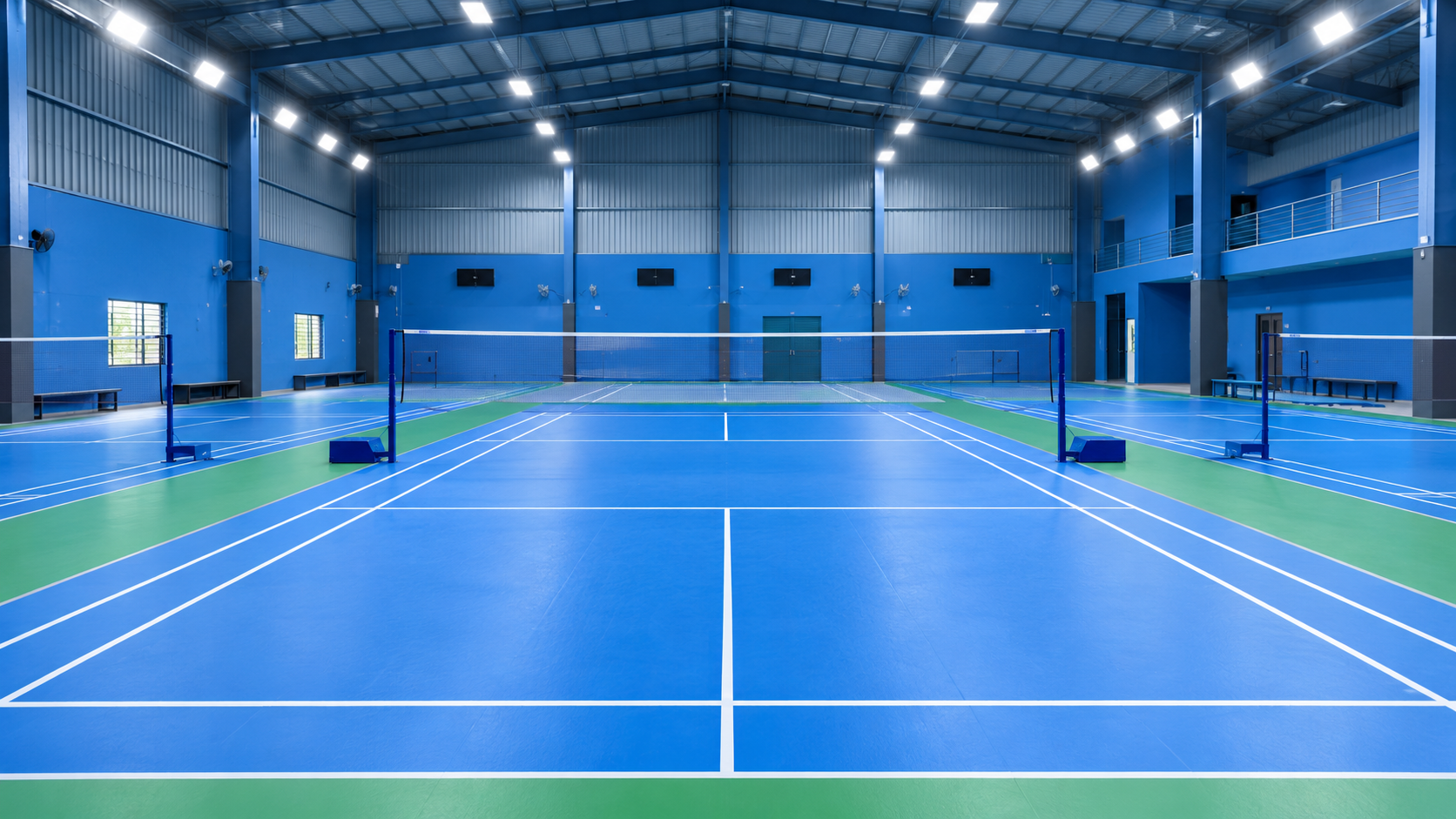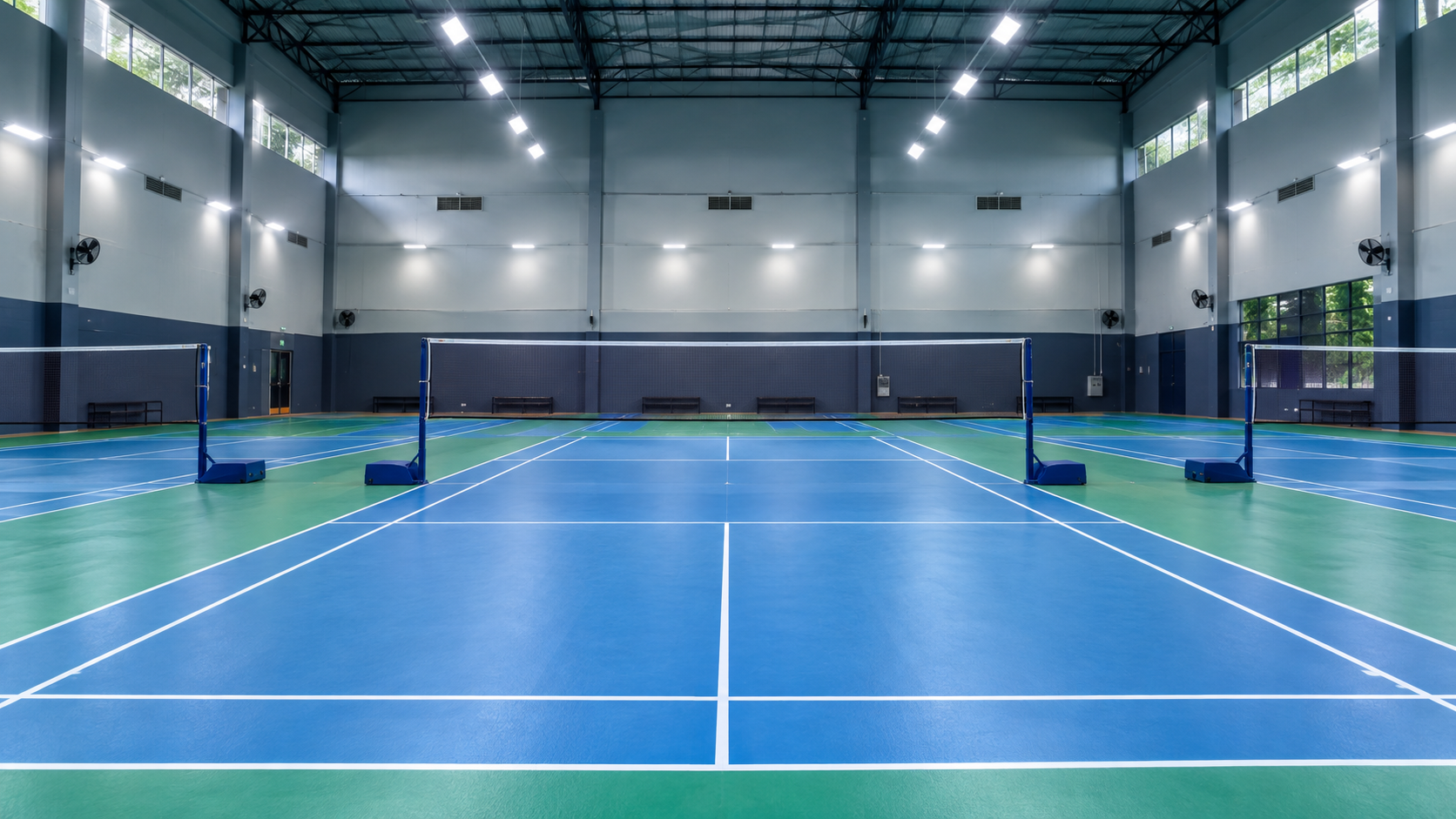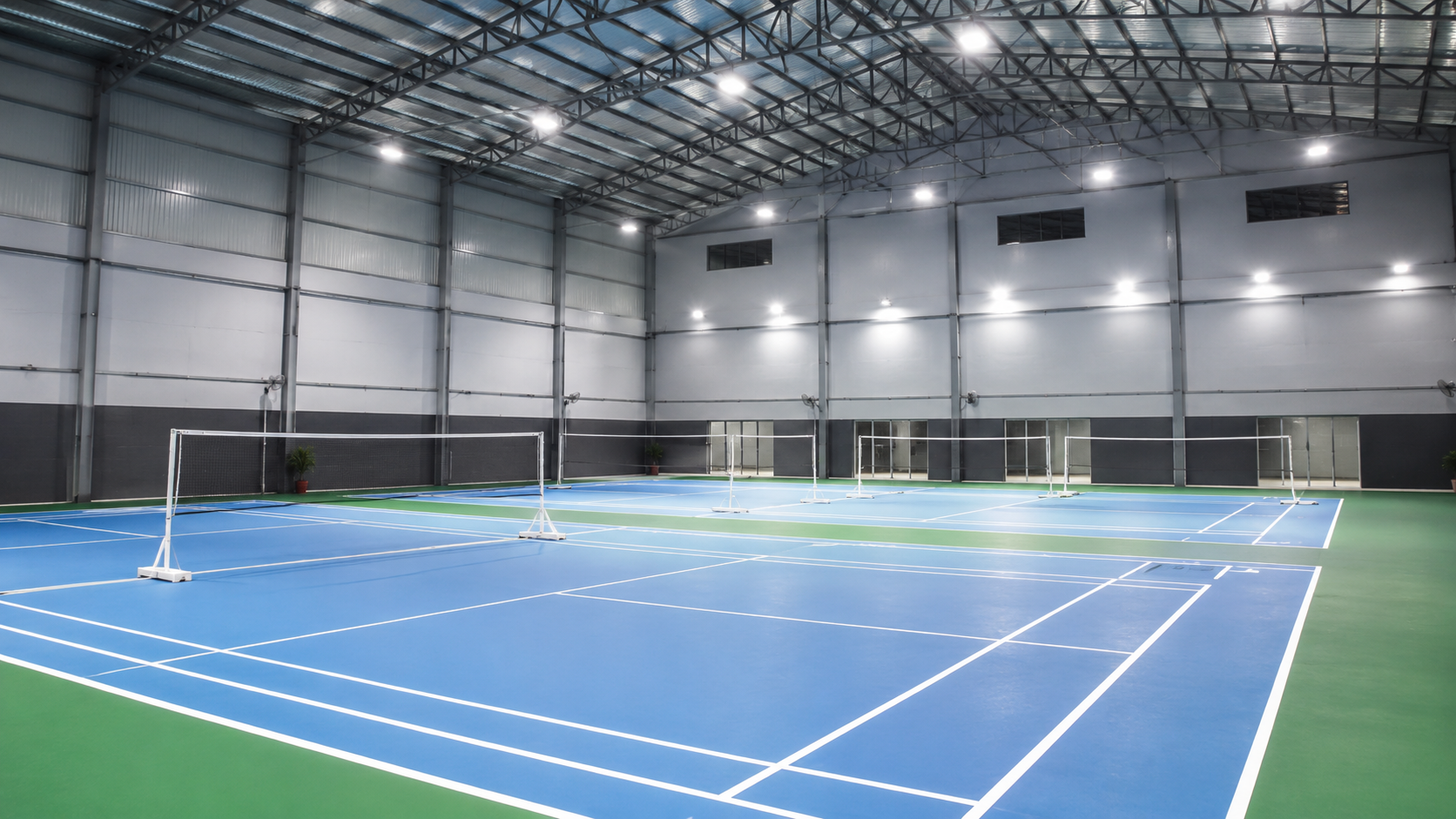
Introduction
Badminton has become one of the most popular indoor sports in India. Schools, colleges, residential societies, sports academies, fitness clubs, corporate campuses and private property owners are increasingly investing in dedicated badminton courts. But building a good badminton court involves much more than simply preparing a flat surface and painting court lines.
A professionally constructed badminton court needs the right combination of planning, civil work, flooring, lighting, ventilation, safety features and finishing. The quality of these elements directly affects how players move, how comfortably they play and how long the facility remains usable.
This is where choosing the best badminton court construction company and sports facility contractor becomes important.
A reliable sports-facility company should be capable of handling the complete project, from site inspection and design to flooring installation, court marking and final finishing. Instead of dealing with different contractors for different components, a turnkey sports facility provider can coordinate the entire construction process.
What Makes a Good Badminton Court Construction Company?
Not every flooring contractor is a badminton court construction specialist.
A professional badminton court builder should understand the technical requirements of the sport as well as the practical requirements of the site. The company should be able to recommend the right construction system based on whether the court is intended for recreational use, academy training, school sports, club-level play or professional competition.
The most important qualities to look for include:
- Experience in sports court construction
- Knowledge of badminton court dimensions and layouts
- Professional sports flooring installation
- Proper base preparation and leveling
- Good-quality court marking
- Appropriate lighting design
- Safe and comfortable playing surfaces
- Quality net posts and accessories
- Moisture and drainage planning where required
- Transparent project estimation
- Complete installation and finishing support
A good contractor does not simply sell flooring. They understand how all the components of a sports facility work together.
Why Professional Badminton Court Construction Matters
A badminton court experiences constant movement. Players frequently accelerate, stop, jump, turn and change direction. Because of this, the playing surface needs to provide a suitable combination of traction, cushioning and stability.
An unsuitable floor can become slippery, excessively hard or uneven. Over time, poor construction can also result in cracks, surface deterioration, moisture problems or uneven playing conditions.
Professional construction focuses on creating a surface that supports comfortable movement while maintaining consistent playing characteristics.
For academies and commercial sports facilities, this becomes even more important because the court may be used for several hours every day.
Badminton Court Construction for Different Facilities
A professional sports facility company can design courts for a wide range of applications.
1. Badminton Courts for Sports Academies
Training academies require durable courts capable of handling intensive daily use.
The flooring should provide good grip and cushioning while allowing players to move naturally across the surface. Lighting should also be carefully planned so that players can track the shuttle without excessive glare.
Multiple courts can be designed together with common lighting, spectator areas, circulation spaces and storage facilities.
2. Badminton Courts for Schools and Colleges
Educational institutions often require sports facilities that are durable, safe and easy to maintain.
A properly planned badminton court can become an important part of the school’s physical education infrastructure. Depending on the available space, the court can be installed inside an existing hall or incorporated into a new sports building.
3. Badminton Courts for Clubs and Sports Complexes
Commercial clubs need attractive and durable facilities that can accommodate frequent usage.
In addition to the playing surface, the overall facility may include seating, reception areas, changing rooms, lighting systems, ventilation and other amenities.
A turnkey contractor can coordinate these requirements to create a more integrated sports environment.
4. Residential Badminton Courts
Badminton courts can also be developed within large residential properties, villas, housing societies and community spaces.
The design can be customized according to the available area and intended usage. In smaller residential projects, the focus may be on recreational play, while larger housing communities can develop dedicated indoor sports facilities.
Badminton Court Dimensions
Court dimensions are one of the first technical aspects that should be considered during planning.
A standard doubles badminton court is 13.4 metres long and 6.1 metres wide, while the singles court uses a narrower playing width.
However, simply having the official playing area is not enough.
The overall construction space should also account for player movement, circulation, equipment, net posts and other operational requirements. For an indoor facility, ceiling clearance is particularly important because badminton requires considerable vertical playing space.
This is why an experienced contractor should inspect the complete site before finalizing the layout.
Choosing the Right Badminton Court Flooring
Flooring is arguably the most important component of a badminton court.
Different facilities require different flooring systems. Common options include:
PVC or Vinyl Sports Flooring
PVC and vinyl flooring systems are widely used for indoor badminton facilities.
They can provide a cushioned playing surface, good traction and relatively easy maintenance when properly installed. They are suitable for clubs, schools, academies and recreational facilities.
PU Sports Flooring
Polyurethane flooring is another popular option for indoor sports facilities.
A properly designed PU system can provide a balance of durability, grip and impact management. It can be particularly useful for facilities where player comfort and frequent usage are important.
Wooden Sports Flooring
Wooden sprung flooring is considered a premium solution for high-level indoor sports environments.
The construction normally involves a specialized subfloor system designed to provide controlled flexibility and shock absorption. Because wood is more sensitive to environmental conditions, the indoor environment and maintenance requirements should be considered carefully.
Acrylic Flooring
Acrylic systems are commonly considered for outdoor or semi-outdoor courts.
They can provide a durable surface and can be designed with weather-resistant coatings. However, badminton-specific performance requirements should be considered before selecting a hard acrylic system for intensive play.
The best flooring isn’t necessarily the most expensive flooring. It is the system that matches the type of facility, expected usage, player requirements, environment and budget.
Step-by-Step Badminton Court Construction Process
A professional badminton court construction project generally involves several stages.
Step 1: Site Inspection
The project begins with a detailed inspection of the proposed location.
The contractor evaluates:
- Available dimensions
- Existing floor condition
- Ground levels
- Moisture conditions
- Drainage
- Roof and ceiling height
- Natural ventilation
- Electrical requirements
- Accessibility
- Number of proposed courts
This information helps determine the most suitable construction approach.
Step 2: Court Layout and Design
Once the site has been evaluated, the court layout is prepared.
The design should consider the official playing dimensions as well as circulation and safety requirements.
For multiple-court facilities, spacing between courts and access routes should also be planned carefully.
Step 3: Base Preparation
The playing surface is only as good as the base beneath it.
Any uneven or damaged substrate should be corrected before flooring installation. Depending on the project, this may involve concrete work, leveling, moisture protection, subfloor preparation or other civil work.
Poor base preparation can eventually lead to flooring problems, so this stage should never be treated as an afterthought.
Step 4: Sports Flooring Installation
After the base is ready, the selected sports flooring system is installed.
Installation methods vary according to the material. PVC, PU, acrylic and wooden systems each require different preparation and installation techniques.
The objective is to achieve a smooth, stable and consistent playing surface.
Step 5: Court Line Marking
Accurate line marking is essential.
The singles and doubles boundaries, service lines and other markings should be positioned correctly and finished with clean, highly visible lines.
Poorly positioned markings can affect gameplay and make an otherwise good court look unprofessional.
Step 6: Net and Post Installation
The badminton net system should be installed securely and aligned correctly.
Quality posts and properly tensioned nets contribute to a professional playing environment.
Step 7: Lighting Installation
Lighting is particularly important for indoor badminton.
The lighting system should provide adequate and uniform illumination across the playing area while minimizing glare and distracting shadows.
LED lighting is commonly used in modern indoor sports facilities because it can provide efficient, consistent illumination.
Step 8: Final Inspection
Before handover, the complete facility should be inspected.
The contractor should check the flooring, court dimensions, line markings, net installation, lighting, surface finish and general safety conditions.
Only after these elements have been checked should the facility be considered ready for regular use.
Indoor Badminton Court Construction
Indoor badminton courts provide several advantages, especially in regions where weather can interfere with outdoor sports.
An indoor facility offers greater control over:
- Rain
- Direct sunlight
- Wind
- Dust
- Surface moisture
- Playing schedules
A complete indoor badminton project may include the structural building, roofing, insulation, flooring, lighting, ventilation and electrical systems.
For this reason, indoor court construction should ideally be handled by a contractor with experience in sports infrastructure, rather than a general civil contractor alone.
Outdoor Badminton Court Construction
Outdoor badminton courts require a different approach.
The surface must be able to withstand sunlight, rain and changing weather conditions. Proper drainage becomes particularly important because standing water can damage the playing surface and underlying structure.
The base should be designed to prevent water accumulation, while the selected surface should be suitable for the local climate.
Outdoor courts can be suitable for schools, residential communities, resorts and recreational facilities where covered indoor infrastructure is not required.
Importance of Lighting in a Badminton Facility
Badminton players need to track a fast-moving shuttle against the background of the ceiling and surrounding environment.
Poor lighting can therefore affect gameplay.
A professional lighting design should aim for:
- Uniform illumination
- Reduced glare
- Minimal dark spots
- Appropriate light distribution
- Efficient LED fixtures
- Proper fixture positioning
Lighting should be planned during the design stage rather than added after the court has already been constructed.
Ventilation and Indoor Environment
Indoor sports facilities can become uncomfortable quickly when several players are active simultaneously.
Good ventilation helps maintain a more comfortable environment and can also help control humidity.
Depending on the size and location of the facility, the project may include natural ventilation, exhaust systems, air circulation or air-conditioning.
The objective is to create an environment where players can train comfortably for extended periods.
Badminton Court Construction Cost in India
There is no single fixed price for constructing a badminton court.
The final cost depends on several factors, including:
- Number of courts
- Flooring system
- Existing floor condition
- Civil work
- Indoor structure
- Roofing
- Lighting
- Electrical work
- Net posts and accessories
- Ventilation
- Site location
- Drainage requirements
- Spectator facilities
- Quality of finishing
Current industry estimates vary substantially depending on specification. For example, published Indian estimates place complete per-court projects anywhere from several lakh rupees upward, while flooring-only rates vary considerably by material and specification.
Therefore, it is better to request an itemized project estimate instead of selecting a contractor solely on the lowest quoted price.
How to Select the Best Badminton Court Construction Company
Before hiring a sports facility contractor, ask a few important questions.
Check Previous Projects
Ask the company to show completed badminton court projects.
Photographs, videos and site references can help you understand the quality of their workmanship.
Ask About Flooring Specifications
Don’t simply ask, “Which flooring do you use?”
Ask for details about:
- Flooring thickness
- Subfloor system
- Cushioning
- Surface finish
- Manufacturer
- Warranty
- Maintenance requirements
Request an Itemized Quotation
Your quotation should clearly explain what is included.
For example:
- Civil work
- Flooring
- Line marking
- Lighting
- Net posts
- Net
- Electrical work
- Structure
- Transportation
- Installation
- Taxes
This makes it easier to compare different contractors.
Look Beyond the Initial Price
A cheap court may become expensive if the flooring needs frequent repairs or the base develops problems.
Consider the total lifecycle cost, not just the initial construction price.
Choose a Turnkey Sports Facility Partner
A company that can coordinate design, civil work, flooring and accessories can make project management significantly easier.
This is particularly useful for large academies, schools and multi-court sports facilities.
Why Sports Facility Planning Should Be Done Professionally
A badminton court is part of a larger sports environment.
The best facilities consider the player’s entire experience rather than focusing exclusively on flooring.
A well-designed sports facility can include:
- Badminton courts
- Multi-purpose courts
- Spectator seating
- Changing rooms
- Reception areas
- Storage
- Washrooms
- Lighting
- Ventilation
- Safety padding
- Equipment areas
Professional planning ensures that these components work together rather than being added randomly during construction.
Badminton Court Maintenance
Even a professionally constructed court requires regular maintenance.
Basic maintenance may include:
- Routine cleaning
- Checking flooring for damage
- Inspecting court lines
- Checking net posts
- Cleaning lighting fixtures
- Monitoring moisture
- Repairing damaged surfaces promptly
- Following the flooring manufacturer’s maintenance recommendations
Outdoor courts generally require additional attention because they are exposed to weather.
Regular maintenance can help preserve the appearance and performance of the facility for a longer period.
Common Mistakes to Avoid
Several mistakes can affect the quality of a badminton court.
Choosing Flooring Only on Price
The cheapest flooring is not necessarily the most economical choice over the long term.
Ignoring the Base
A premium surface installed over a poorly prepared base will not deliver premium performance.
Poor Lighting Planning
Lighting should be considered during the design phase.
Incorrect Court Marking
Small errors in line placement can affect the usability of the court.
Insufficient Space Around the Court
The playing area should not be treated as the only space required.
Hiring Multiple Uncoordinated Contractors
When civil work, flooring and electrical installation are handled independently, coordination problems can occur.
A turnkey sports contractor can reduce this complexity.
Why Choose a Professional Sports Facility Company?
A professional badminton court construction company brings together several areas of expertise.
Instead of simply installing a floor, the contractor evaluates the entire project and develops a solution around the facility’s purpose.
The right contractor should therefore recommend a solution based on the actual project rather than trying to sell the same system to every customer.
Final Thoughts
Building a badminton court is a long-term investment in sports infrastructure. Whether you are developing a professional academy, school facility, residential society, club, fitness centre or private sports space, proper planning can make a significant difference to the final result.
The best badminton court construction company is not simply the one offering the lowest quotation. It is the company that understands site conditions, flooring technology, court layout, lighting, safety and long-term maintenance.
A professionally designed and constructed badminton facility can provide players with a safer and more enjoyable environment while giving the property a durable and valuable sports amenity.
If you are planning a badminton court project, start with a proper site assessment and a detailed, itemized construction proposal. That gives you a much clearer idea of the required investment and helps you choose the right flooring and construction system for your facility.
Frequently Asked Questions
Q1. What is the standard badminton court size?
A standard doubles court measures 13.4 m × 6.1 m, while a singles court is 13.4 m × 5.18 m.
Q2. Which flooring is best for a badminton court?
There is no universal answer. PVC/vinyl, PU and sprung wooden systems can all be suitable depending on the facility, playing level, budget and environmental conditions.
Q3. Can a badminton court be constructed outdoors?
Yes. Outdoor courts can use weather-resistant systems, but drainage, sunlight and moisture protection need to be considered during construction.
Q4. How much does badminton court construction cost in India?
The cost depends heavily on flooring, civil work, indoor structure, lighting and other specifications. Published 2026 estimates show a broad range, so a site-specific quotation is recommended.
Q5. Can one company handle the complete badminton facility?
Yes. Turnkey sports facility companies can coordinate site planning, civil preparation, flooring, markings, lighting, nets and other project requirements.
Q6. What should I check before hiring a badminton court contractor?
Check previous projects, flooring specifications, warranty, construction methodology, itemized pricing, installation experience and after-sales support.
Q7. Is professional badminton flooring necessary for an academy?
For facilities with regular training and high player usage, a purpose-designed sports flooring system is generally preferable to a basic hard floor because surface performance, grip and player comfort become much more important.