Introduction
A 400m athletics track is one of the most widely used sports infrastructure layouts for schools, universities, sports academies, stadiums, training centres and professional athletics facilities. Although a track may look like a simple oval, its construction requires highly accurate surveying, geometry, lane marking and surface preparation.
For a competition-standard facility, even a small dimensional error can affect race distances, lane staggers and ultimately the certification of the track.
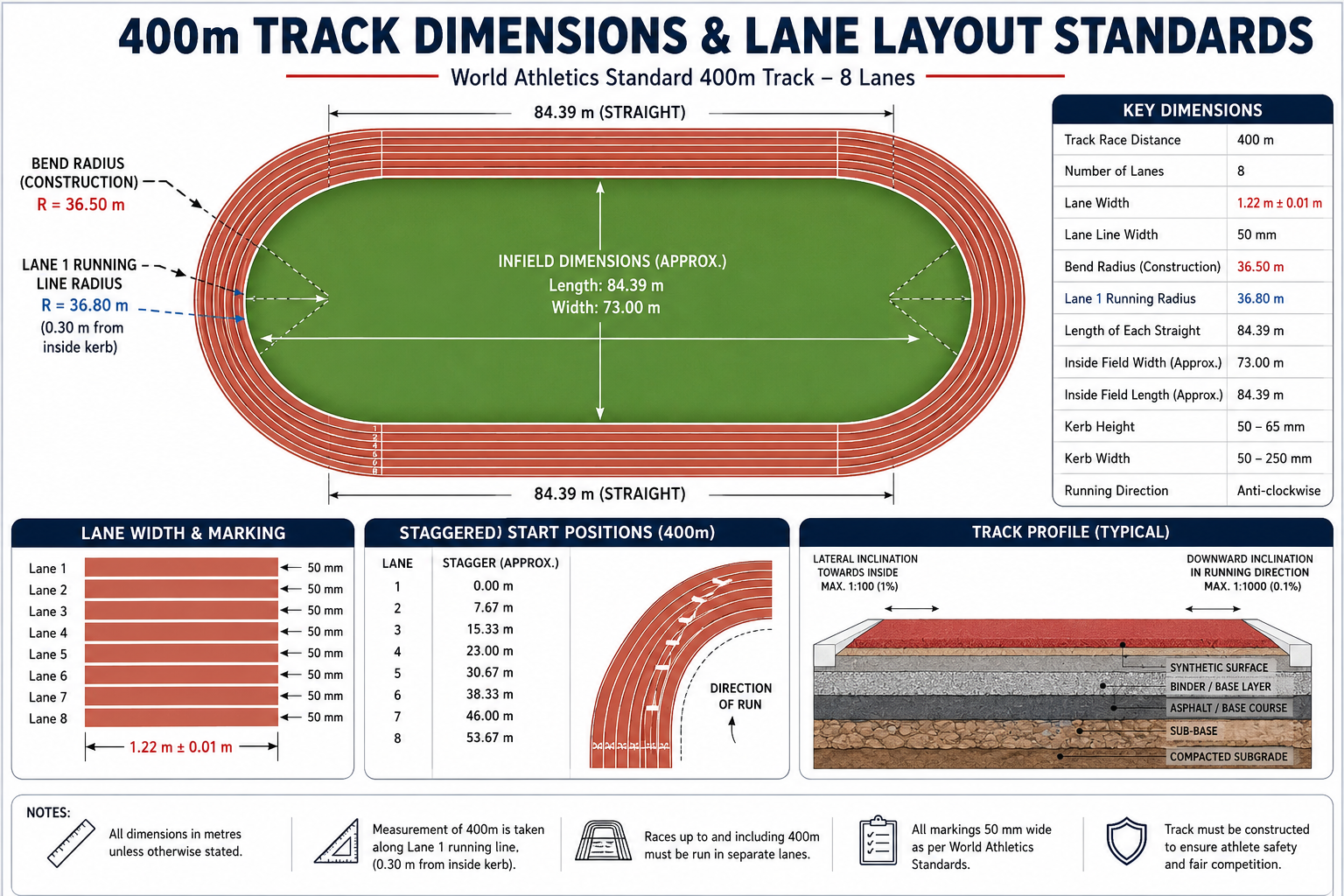
The World Athletics standard 400m track consists of two straight sections connected by two semicircular bends. The standard layout uses a 36.50 m construction radius and 84.39 m straight sections, with the inside lane measured along its theoretical running line to produce approximately 400 m.
In this guide, we explain the important 400m track dimensions, lane layout standards, track geometry, lane width, stagger distances, marking requirements and construction considerations in simple language.
What Is a Standard 400m Athletics Track?
A standard 400m athletics track is an oval running facility designed so that one complete lap in Lane 1, measured along the prescribed running line, is approximately 400 metres.
The standard configuration contains:
- Two straight sections
- Two semicircular bends
- Usually 8 running lanes
- 1.22 m nominal lane width
- 50 mm lane lines
- 36.50 m construction radius
- 84.39 m straight sections
- A central infield suitable for other sports and field events
World Athletics identifies the 36.50 m radius configuration as the 400m Standard Track because its uniform curves provide a consistent running rhythm and simplify construction and certification.
400m Track Dimensions at a Glance
| Track Component | Standard Dimension |
|---|---|
| Track race distance | 400 m |
| Number of standard lanes | 8 |
| Lane width | 1.22 m ± 0.01 m |
| Lane marking width | 50 mm |
| Construction radius of bend | 36.50 m |
| Lane 1 running-line radius | 36.80 m |
| Length of each straight | 84.39 m |
| Number of bends | 2 semicircles |
| Inside field width | Approximately 73 m |
| Inside field length | Approximately 84.39 m |
| Typical running direction | Counter-clockwise |
| Measurement line for Lane 1 | 0.30 m from kerb |
These dimensions are based primarily on the World Athletics Track and Field Facilities Manual and current technical rules.
400m Track Layout Diagram
A simplified representation of the standard track looks like this:
                 84.39 m STRAIGHT
        ┌───────────────────────────────┐
      /                                   \
     /                                     \
    /                                       \
   |              INFIELD                  |
   |                                       |
   |             400m TRACK                |
    \                                     /
     \                                   /
      └─────────────────────────────────┘
                 84.39 m STRAIGHT

        ←────── 2 × semicircular bends ──────→

              Bend Radius = 36.50 m
The actual construction drawing requires accurate setting-out points, centre lines, tangent points and measurement lines. Therefore, the diagram above is for understanding the geometry rather than for construction execution.
Standard 400m Track Geometry
The basic geometry of a World Athletics standard track is straightforward.
The track consists of:
2 × 84.39 m straights
plus
2 × semicircular bends
The construction radius of each bend is 36.50 m. However, the official running measurement for Lane 1 is taken along a theoretical line 0.30 m outward from the inside kerb, producing a running-line radius of approximately 36.80 m.
This distinction is extremely important.
Construction Radius vs Running-Line Radius
          OUTER PART OF TRACK
        ______________________
      /                        \
     /                          \
    |                            |
    |   Lane 1                   |
    |    ┌──────────────┐        |
    |    |              |        |
    |    |   INFIELD    |        |
    |    |              |        |
    |    └──────────────┘        |
     \                          /
      \________________________/

       R = 36.50 m
       Running line = R + 0.30 m
                    = 36.80 m
The 36.50 m figure should not simply be treated as the radius of the Lane 1 racing line. The measurement line is offset from the kerb according to the prescribed measurement method.
Lane Width of a 400m Track
One of the most important standards in athletics track construction is lane width.
Under the current World Athletics technical rules, races up to and including 400m use individual lanes with a nominal width of:
1.22 m ± 0.01 m
The lane width includes the lane line on the right side, and the lane lines are 50 mm wide. All lanes should have the same nominal width.
Lane Layout Diagram
      ←──────── 1.22 m ± 0.01 m ────────→

      |       Lane 1       | 50 mm line
      |                    |
      |       Lane 2       | 50 mm line
      |                    |
      |       Lane 3       | 50 mm line
      |                    |
      |       Lane 4       | 50 mm line
      |                    |
      |       Lane 5       | 50 mm line
      |                    |
      |       Lane 6       | 50 mm line
      |                    |
      |       Lane 7       | 50 mm line
      |                    |
      |       Lane 8       |
Correct lane width is essential because lane dimensions influence the calculated distance of every runner, particularly on bends.
How Is a 400m Track Actually Measured?
A common misconception is that the inside edge of Lane 1 itself measures exactly 400 m.
That is not the correct measurement principle.
For the standard track, the inner edge is approximately 398.116 m, while the theoretical Lane 1 running line at 0.30 m from the kerb produces approximately 400.001 m.
Simplified Calculation
The standard track has:
Two straights:
84.39 × 2 = 168.78 m
Two semicircles together:
They form one complete circle with a running-line radius of approximately 36.80 m.
Therefore:
Circumference = 2 × π × 36.80
≈ 231.22 m
Adding the two straights:
168.78 + 231.22 ≈ 400.00 m
This is why precise radius, straight length and measurement-line positioning are so important.
8-Lane 400m Track Layout
An eight-lane track is the most familiar configuration for major athletics facilities.
The nominal running surface width across eight lanes is approximately:
8 × 1.22 m = 9.76 m
This does not represent the complete footprint of the athletics facility. Additional space is required for kerbs, safety zones, field-event areas, access routes, officials, equipment and spectator infrastructure.
8-Lane Layout
                    FINISH
                       ↓
     ┌─────────────────────────────────┐
     │ Lane 8                          │
     │ Lane 7                          │
     │ Lane 6                          │
     │ Lane 5                          │
     │ Lane 4                          │
     │ Lane 3                          │
     │ Lane 2                          │
     │ Lane 1                          │
     └─────────────────────────────────┘
                       ↑
                     START
World Athletics states that competition facilities within specified World Rankings categories should provide a minimum of eight lanes.
Why Do Outer Lanes Have Staggered Starts?
If all runners started from exactly the same line on a curved 400m track, athletes in the outside lanes would run a longer distance.
This happens because the circumference increases as the radius increases.
To compensate, the starting positions for 200m and 400m races are staggered.
Stagger Concept
Lane 8       ──────────────── Start
Lane 7         ───────────── Start
Lane 6           ──────────── Start
Lane 5             ────────── Start
Lane 4               ──────── Start
Lane 3                 ────── Start
Lane 2                   ──── Start
Lane 1                     ── Start
                              ↓
                           FINISH
The farther the lane is from the centre of the track, the greater the distance travelled around the bends. The stagger therefore compensates for this difference.
For a standard 400m track, commonly referenced stagger values are approximately:
| Lane | Approx. 400m Stagger |
|---|---|
| Lane 1 | 0 m |
| Lane 2 | 7.67 m |
| Lane 3 | 15.33 m |
| Lane 4 | 23.00 m |
| Lane 5 | 30.67 m |
| Lane 6 | 38.33 m |
| Lane 7 | 46.00 m |
| Lane 8 | 53.67 m |
These values should be treated as layout references rather than substitutes for a certified setting-out calculation, because final markings must follow the exact geometry and measurement methodology of the facility. The fundamental requirement is that every athlete receives the same race distance when running the shortest permitted route.
200m and 400m Starting Positions
The starting arrangement changes according to the race.
100m
The 100m race is conducted on the straight, so runners begin from a straight starting line.
Lane 1  | START |
Lane 2  | START |
Lane 3  | START |
Lane 4  | START |
Lane 5  | START |
Lane 6  | START |
Lane 7  | START |
Lane 8  | START |
             ↓
           FINISH
200m
Because the race includes one bend, starting positions are staggered.
Lane 8     START
Lane 7      START
Lane 6       START
Lane 5        START
Lane 4         START
Lane 3          START
Lane 2           START
Lane 1            START
                    \
                     \
                     FINISH
400m
The entire race is completed in lanes, requiring carefully calculated staggered starts.
World Athletics rules require races up to and including 400m to be conducted with each athlete assigned a separate lane.
Inside Kerb Dimensions
The inside edge of a standard track is normally defined by a kerb around the bends.
World Athletics specifies that the kerb should be:
- White
- Approximately 50–65 mm high
- Approximately 50–250 mm wide
The kerb is particularly important around the bends because it establishes the inside boundary used for track measurement.
On the straights, the kerb can be omitted in certain configurations and replaced by a white line, but the bend kerb plays an important role in defining the track geometry.
Track Lane Marking Standards
Correct marking is just as important as correct track construction.
Standard track lane lines are:
50 mm wide
The markings need to be accurately positioned because they define the usable running lanes and influence official race measurements.
A professional marking plan generally includes:
- Finish line
- 100m start
- 200m start
- 400m start
- Relay exchange zones
- Break lines
- Hurdle positions
- Steeplechase markings
- Lane numbers
- Other event-specific markings
World Athletics publishes dedicated marking plans for the 400m Standard Track.
Track Gradient and Level Requirements
Track construction is not only about length and width.
The surface also needs appropriate gradients to ensure athletes can run safely while preventing excessive slopes from affecting competition conditions.
Under current World Athletics technical rules:
- Lateral inclination toward the inside should not exceed 1:100 (1%), unless an approved exemption applies.
- Overall downward inclination in the running direction should not exceed 1:1000 (0.1%) between relevant start and finish lines.
These requirements make accurate surveying and surface-level control critical during construction.
How Much Land Is Required for a 400m Track?
The actual land requirement is considerably greater than the dimensions of the running lanes alone.
A standard 400m track has an interior area that can accommodate a football/soccer field and can also support various field athletics events. World Athletics identifies an interior area capable of accommodating a standard 68 m × 105 m football pitch within the standard arrangement.
However, the complete sports facility requires additional space for:
- Safety zones
- Long jump and triple jump facilities
- High jump
- Pole vault
- Shot put
- Discus
- Hammer
- Javelin
- Steeplechase
- Athlete circulation
- Officials’ areas
- Spectator access
- Maintenance access
- Drainage infrastructure
Therefore, the track itself should never be considered the entire site requirement.
400m Track Safety Zone
A professional athletics facility should include adequate clearance beyond the running lanes.
A safety zone helps reduce the risk of athletes colliding with:
- Fences
- Walls
- Lighting poles
- Equipment
- Spectator barriers
- Drainage structures
- Other fixed objects
Some competition-area guidance recommends safety zones on both the inside and outside of the oval.
The exact safety arrangement should be established during facility planning according to the intended competition category and site conditions.
400m Track Construction Process
Constructing a professional athletics track requires much more than applying synthetic material over an existing surface.
A typical construction process includes the following stages.
1. Site Survey
The first step is a detailed topographical and engineering survey.
We assess:
- Available land
- Existing levels
- Soil conditions
- Drainage
- Access
- Existing structures
- Underground services
- Orientation
- Available infield area
2. Track Layout Planning
The track geometry is then established using the required dimensions.
This includes:
- Centre points
- Straight lengths
- Bend radii
- Track width
- Lane arrangement
- Infield dimensions
- Start and finish positions
For a competition facility, this stage needs specialist surveying equipment and technical expertise.
3. Earthwork and Excavation
The site is prepared to the required formation level.
Depending on existing conditions, this may include:
- Excavation
- Filling
- Soil removal
- Compaction
- Formation preparation
- Grading
Poor formation preparation can eventually cause settlement, cracking or surface deformation.
4. Drainage Installation
Drainage is a major component of an outdoor athletics track.
The drainage design may include:
- Perimeter drains
- Subsurface drainage
- Collection channels
- Catch pits
- Outfall systems
- Surface water management
Efficient drainage helps prevent water accumulation and protects the track foundation.
5. Sub-Base Construction
A properly engineered sub-base provides structural stability to the track.
The construction may involve carefully selected aggregate layers with controlled:
- Thickness
- Compaction
- Gradation
- Moisture content
- Surface tolerance
The final surface should be sufficiently uniform before the synthetic sports system is installed.
6. Asphalt or Base Layer
Depending on the selected track system, an engineered asphalt or suitable structural base may be installed.
The base must provide:
- Stability
- Smoothness
- Consistent levels
- Proper drainage performance
- Long-term load resistance
Any significant imperfections at this stage can affect the final synthetic surface.
7. Synthetic Athletics Track Surface
Modern athletics tracks commonly use synthetic systems designed for high-performance running.
Depending on the specification, systems may include:
- Spray-coated polyurethane
- Full polyurethane systems
- Sandwich systems
- Prefabricated rubber systems
The appropriate system depends on the project budget, competition requirements, climate and intended use.
8. Track Marking
After the surface has been completed and cured, the track is precisely marked.
This includes the required:
- Lane lines
- Start lines
- Finish line
- Relay markings
- Event markings
- Lane numbers
- Hurdle marks
The markings should be set out using accurate surveying procedures rather than simply measuring from visible track edges.
9. Quality Inspection
Before commissioning, the completed facility should be inspected for:
- Lane width
- Track dimensions
- Surface evenness
- Gradient
- Drainage
- Line accuracy
- Radius
- Start positions
- Finish position
- Surface performance
For facilities seeking formal certification, testing and documentation must follow the applicable World Athletics requirements.
Why Accurate Track Dimensions Matter
A small error in a track’s geometry can create significant problems.
1. Incorrect Race Distance
If the running line is incorrectly positioned, athletes may run more or less than the intended distance.
2. Unequal Lane Distances
Incorrect bend radii can produce incorrect stagger calculations.
3. Poor Athlete Experience
Uneven surfaces, incorrect gradients or inconsistent synthetic surfacing can affect running performance.
4. Certification Problems
Competition facilities need to comply with applicable technical requirements if they are intended for recognised high-level competition.
5. Expensive Corrections
Correcting geometry after the surface has been installed can be considerably more expensive than getting the setting-out right during initial construction.
Standard vs Non-Standard 400m Track Layouts
Not every 400m track has exactly the same geometry.
World Athletics documentation describes several track configurations, including standard and double-bend arrangements. However, the 36.50 m radius standard track is the preferred configuration for uniformity and straightforward construction.
For a new facility, selecting the geometry should therefore depend on:
- Available land
- Competition level
- Infield requirements
- Other sports
- Budget
- Site restrictions
- Certification objectives
A restricted site may require a different configuration, but it should not be assumed that every alternative geometry will have the same certification characteristics as the standard track.
400m Track for Schools and Colleges
Educational institutions often require athletics tracks for:
- Annual sports events
- Inter-school competitions
- Inter-college competitions
- Athletics training
- Fitness programs
- Football
- Multi-sport activities
An eight-lane professional track may be ideal for major institutions, while a smaller training facility may use a different configuration depending on available land and intended use.
The key is to design the track around the actual sports requirements and available site, rather than simply copying an oval layout.
400m Track for Sports Academies
For sports academies, track design needs to support frequent training.
Important considerations include:
- Durable synthetic surface
- Accurate lane markings
- Drainage
- High footfall resistance
- Sprint training
- Hurdle training
- Relay practice
- Middle-distance running
- Athlete safety
- Maintenance access
A well-designed track can support both daily training and organised competitions.
Common Mistakes in 400m Track Construction
Assuming Any Oval Is a 400m Track
An oval shape does not automatically make a track 400 metres long.
The distance depends on precise geometry and the prescribed measurement line.
Using 1.22m as the Entire Track Width
1.22 m is the nominal width of each lane, not the width of the complete track.
Ignoring the Measurement Line
The inside lane is measured using a defined running line rather than simply following the inner edge.
Incorrect Stagger Calculation
Every curved race requires careful calculation to compensate for the additional distance in outer lanes.
Poor Drainage
Standing water can damage the surface and negatively affect usability.
Marking Without Survey Equipment
Professional track markings should be set out accurately rather than relying on rough measurements.
400m Track Dimensions Diagram: Quick Reference
                         84.39 m
              ←──────────────────────→

                 STRAIGHT SECTION
        ┌───────────────────────────────┐
      /                                   \
     /                                     \
    /                                       \
   │                                         │
   │               INFIELD                   │
   │                                         │
   │               73.00 m*                  │
    \                                       /
     \                                     /
      \                                   /
        └───────────────────────────────┘

              ←──── 84.39 m ────→

             Bend construction radius
                    R = 36.50 m

             Lane 1 running radius
                    R = 36.80 m

             Lane width
                    1.22 m ± 0.01 m

             Lane marking
                    50 mm
*The infield dimensions shown are associated with the standard track setting-out configuration and should not be treated as a substitute for a project-specific construction drawing.
400m Track Dimensions in Feet
For projects where imperial measurements are useful:
| Measurement | Approx. Feet |
|---|---|
| Lane width 1.22 m | 4.00 ft |
| Straight 84.39 m | 276.87 ft |
| Bend radius 36.50 m | 119.75 ft |
| Lane 1 running radius 36.80 m | 120.73 ft |
| 50 mm line | 1.97 in |
| 73 m infield width | 239.50 ft |
| 400 m | 1,312.34 ft |
Metric dimensions should remain the primary reference for professional setting-out and construction.
Frequently Asked Questions About 400m Track Dimensions
What is the standard size of a 400m running track?
A World Athletics standard 400m track uses two 84.39 m straights and two semicircular bends with a 36.50 m construction radius. Lane 1 measures approximately 400 m along its prescribed theoretical running line.
How wide is one athletics track lane?
A standard lane is 1.22 m ± 0.01 m wide under the current World Athletics technical rules.
How many lanes are there on a 400m track?
Eight lanes are the typical configuration for major competition facilities. Standard tracks can also be constructed with six lanes, while four-lane tracks are generally not intended for international running competition.
What is the radius of a standard 400m track?
The construction radius of each semicircular bend is 36.50 m. The Lane 1 theoretical running line is approximately 36.80 m from the centre of the bend.
Why are 400m track starts staggered?
Outer lanes have larger curve radii and therefore cover more distance around the bends. Staggered starting positions compensate for this difference so athletes run an equal race distance.
What is the width of the lane marking?
World Athletics specifies a 50 mm lane-line width.
Can a 400m track have fewer than eight lanes?
Yes. World Athletics documentation describes standard tracks with eight, six or occasionally four lanes. However, the appropriate number depends on the intended use and competition category.
What surface is best for a 400m athletics track?
For modern outdoor facilities, synthetic polyurethane and rubber-based athletics surfaces are widely used. The right system depends on the required performance, competition level, climate, drainage design, maintenance plan and project budget.
How much land is needed for a 400m track?
The running track is only one part of the facility.
Final Thoughts
Designing a 400m athletics track requires precision from the first survey to the final line marking. The standard World Athletics configuration provides a useful benchmark, with 84.39 m straights, 36.50 m bend construction radius, 1.22 m lane width and approximately 400 m of running distance in Lane 1.
However, successful track construction is about more than dimensions. Drainage, sub-base preparation, surface tolerance, gradients, synthetic surfacing, lane markings, safety zones and event requirements all influence the quality and usability of the finished facility.
For schools, universities, sports academies, stadiums and professional athletics facilities, accurate planning at the beginning can prevent costly corrections later.