Introduction
Choosing the right jogging track flooring is one of the most important decisions when developing a professional running facility. The surface directly affects running comfort, traction, shock absorption, durability, maintenance, and long-term performance. Among the many synthetic flooring options available today, EPDM and PU (Polyurethane) jogging track flooring are two of the most widely considered systems.
Both materials can provide a high-quality running surface, but they are not identical. Their construction methods, performance characteristics, maintenance requirements, costs, and suitability for different facilities can vary considerably.
For schools, universities, residential communities, fitness parks, sports academies, clubs, hotels, corporate campuses, and professional athletics facilities, understanding the difference between EPDM vs PU jogging track flooring can help owners and project planners select a surface that matches their intended usage and budget.
World Athletics maintains technical specifications and certification systems for synthetic track surfaces and certified track-surfacing products, making performance testing and installation specifications important considerations for facilities intended for competitive athletics.
This detailed guide explains EPDM and PU jogging track flooring, compares their major features, and helps determine which option may be better for different types of runners and sports facilities.
What Is EPDM Jogging Track Flooring?
EPDM stands for Ethylene Propylene Diene Monomer, a synthetic rubber material commonly used for outdoor sports and recreational surfaces.
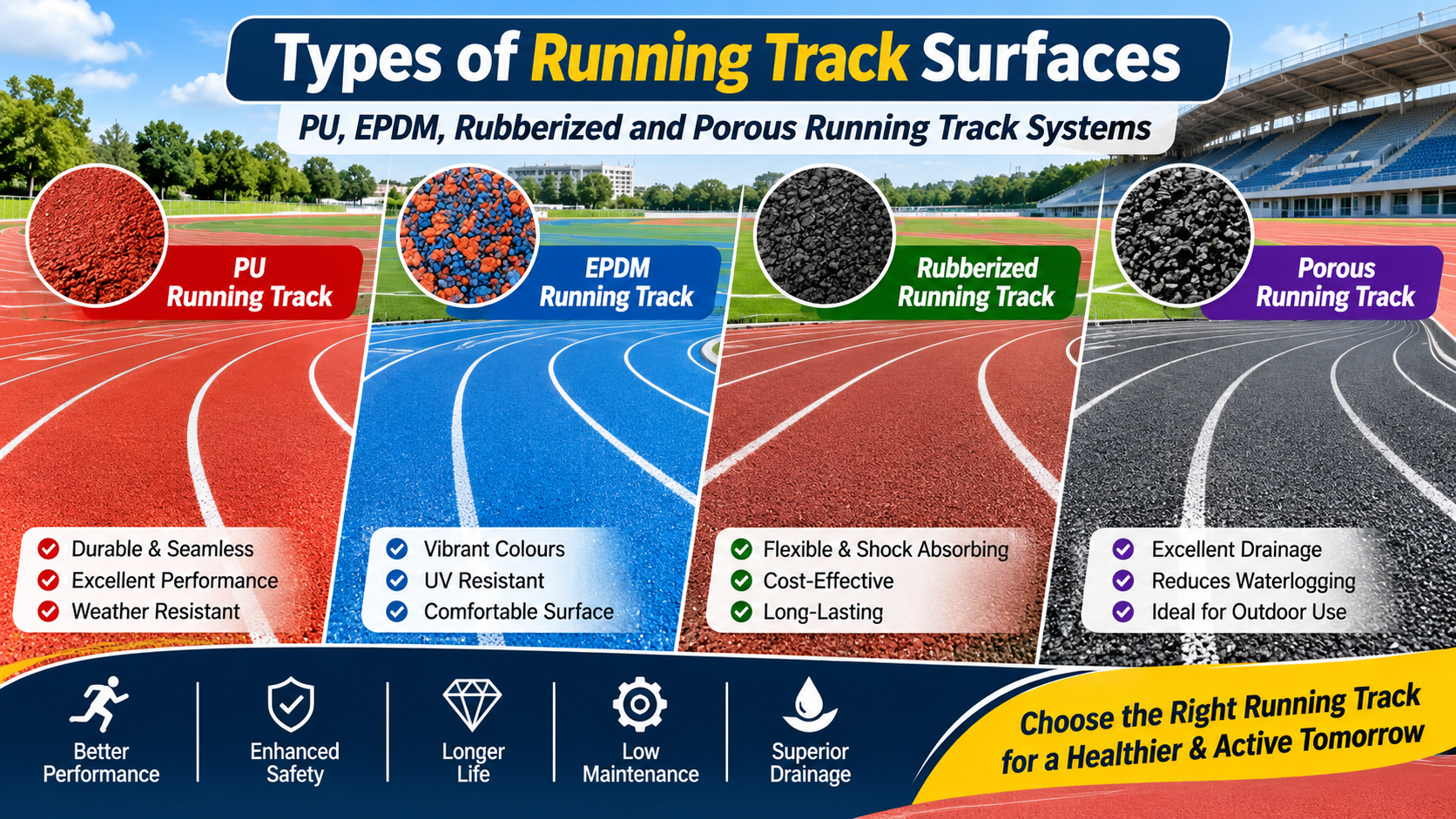
EPDM jogging tracks are generally constructed using coloured rubber granules combined with a polyurethane binder. Depending on the track design, EPDM can form part of a porous or multi-layer synthetic track system.
The rubber granules provide flexibility, traction, resilience, and impact absorption. Because EPDM is available in different colours and particle sizes, designers can create attractive running tracks with consistent surface texture and professional lane markings.
EPDM systems are commonly considered for:
- Jogging tracks
- School running tracks
- Community fitness tracks
- Residential society tracks
- Public parks
- Fitness centres
- Sports academies
- University facilities
- Training tracks
- Recreational athletics facilities
One of the biggest advantages of EPDM is its combination of comfort, durability, weather resistance, and relatively straightforward maintenance.
Some porous running-track systems use a black SBR rubber base with a polyurethane binder and an EPDM/PU textured top layer, allowing water to pass through the surface.
What Is PU Jogging Track Flooring?
PU, or Polyurethane, is a high-performance synthetic material used extensively in sports flooring and athletics track construction.
PU running tracks can be constructed using different systems, including:
- Full-pour PU
- Sandwich PU
- Spray-coated systems
- Prefabricated polyurethane systems
A full-pour PU system uses polyurethane as a major structural component of the synthetic surface. Other systems may combine rubber layers with polyurethane and EPDM granules.
PU flooring is particularly attractive when the project requires a high-performance athletic surface, consistent playing characteristics, excellent energy response, and potential competition-level certification.
World Athletics’ certified surfacing-product documentation includes multiple polyurethane track systems, including full-PUR and sandwich constructions at specified thicknesses.
This makes PU particularly relevant for:
- Professional athletics tracks
- Sports academies
- Universities
- Stadiums
- High-performance training centres
- Competition facilities
- Institutional sports complexes
However, it is important to understand that “PU track” does not describe just one construction system. Performance depends on the complete build-up, material specification, thickness, sub-base, drainage, installation quality, and testing.
EPDM vs PU Jogging Track Flooring: Key Differences
The simplest way to understand the difference is to consider what the facility actually needs.
| Feature | EPDM Flooring | PU Flooring |
|---|---|---|
| Surface feel | Cushioned and comfortable | Responsive and performance-oriented |
| Shock absorption | Very good | Excellent, depending on system |
| Traction | Very good | Excellent |
| Durability | High | Very high with proper installation |
| UV resistance | Excellent | Very good to excellent depending on system |
| Maintenance | Relatively easy | Requires specialist maintenance |
| Installation complexity | Moderate | Higher |
| Initial investment | Generally lower | Generally higher |
| Recreational jogging | Excellent | Excellent |
| School facilities | Excellent | Excellent |
| Professional athletics | Good to very good depending on specification | Excellent |
| Competition applications | Depends on system/certification | Strong choice |
| Custom colours | Wide range | Wide range |
| Long-distance comfort | Excellent | Excellent |
| Performance training | Very good | Excellent |
The table is a general comparison. Actual performance varies according to the specific system and installation specification.
1. Running Comfort and Shock Absorption
For everyday runners, comfort is one of the most important factors when selecting jogging track flooring.
Every running stride produces impact when the foot contacts the surface. A properly designed synthetic track helps manage that impact and provides a more comfortable surface than conventional concrete or rigid paving.
EPDM
EPDM rubber provides a naturally resilient surface. Its granulated structure can create a cushioned feel that is particularly suitable for recreational runners, walkers, beginners, and people using a track regularly.
The flexibility of the rubber surface can help create a comfortable running experience during longer sessions.
PU
PU systems can also provide excellent shock absorption, but their characteristics depend heavily on the construction system.
A professionally engineered PU track can provide a controlled balance between cushioning and energy response. This can be especially useful for athletes performing sprint training, interval workouts, and high-intensity running.
Winner for general jogging comfort: EPDM
Winner for performance-oriented running: PU
2. Energy Return and Running Performance
Energy return is another important consideration for athletes.
A running surface should not simply absorb impact. It should also provide an appropriate response during each stride.
PU systems are often selected for competition and high-performance athletics because they can provide a highly controlled and consistent surface response.
For athletes training regularly, surface consistency can become increasingly important. Small variations in surface behaviour can affect running rhythm, acceleration, turning, and overall training quality.
EPDM systems can also provide excellent athletic performance, particularly when properly engineered and installed. However, high-performance PU systems are generally the preferred choice where competition-level performance is a primary requirement.
Winner for high-performance athletics: PU
3. Durability
A jogging track is exposed to continuous foot traffic, sunlight, rain, temperature fluctuations, dust, and environmental conditions.
The durability of the surface therefore depends not only on the top material but also on:
- Sub-base quality
- Drainage
- Surface thickness
- Material quality
- Installation technique
- Traffic levels
- Maintenance
- Weather exposure
EPDM Durability
EPDM has strong resistance to outdoor environmental exposure and is widely used in outdoor recreational and sports surfaces.
Its colour stability and weather resistance make it particularly attractive for outdoor jogging tracks.
PU Durability
A properly installed PU system can also offer excellent long-term performance. However, the complete system must be correctly designed and installed.
A premium surface installed over a poorly prepared base can still develop problems.
This is why experienced sports flooring contractors place significant emphasis on sub-base preparation, drainage, moisture management, and surface leveling.
Winner: Both can be highly durable when correctly specified and installed.
4. Weather and UV Resistance
Outdoor jogging tracks must withstand challenging weather conditions.
In India, track surfaces can experience:
- Strong sunlight
- High temperatures
- Monsoon rainfall
- Humidity
- Dust
- Seasonal temperature changes
EPDM is well known for its resistance to outdoor exposure and colour stability.
PU systems can also perform effectively outdoors, but the complete surface specification must be selected according to the environmental conditions.
For Indian projects, contractors should consider the local climate before selecting the surface system rather than simply choosing a material based on price.
EPDM is particularly attractive for outdoor recreational jogging tracks because of its weather-resistant characteristics.
5. Water Drainage
Drainage is one of the most overlooked aspects of jogging track construction.
A high-quality surface can still fail prematurely if rainwater remains trapped beneath it or accumulates on the track.
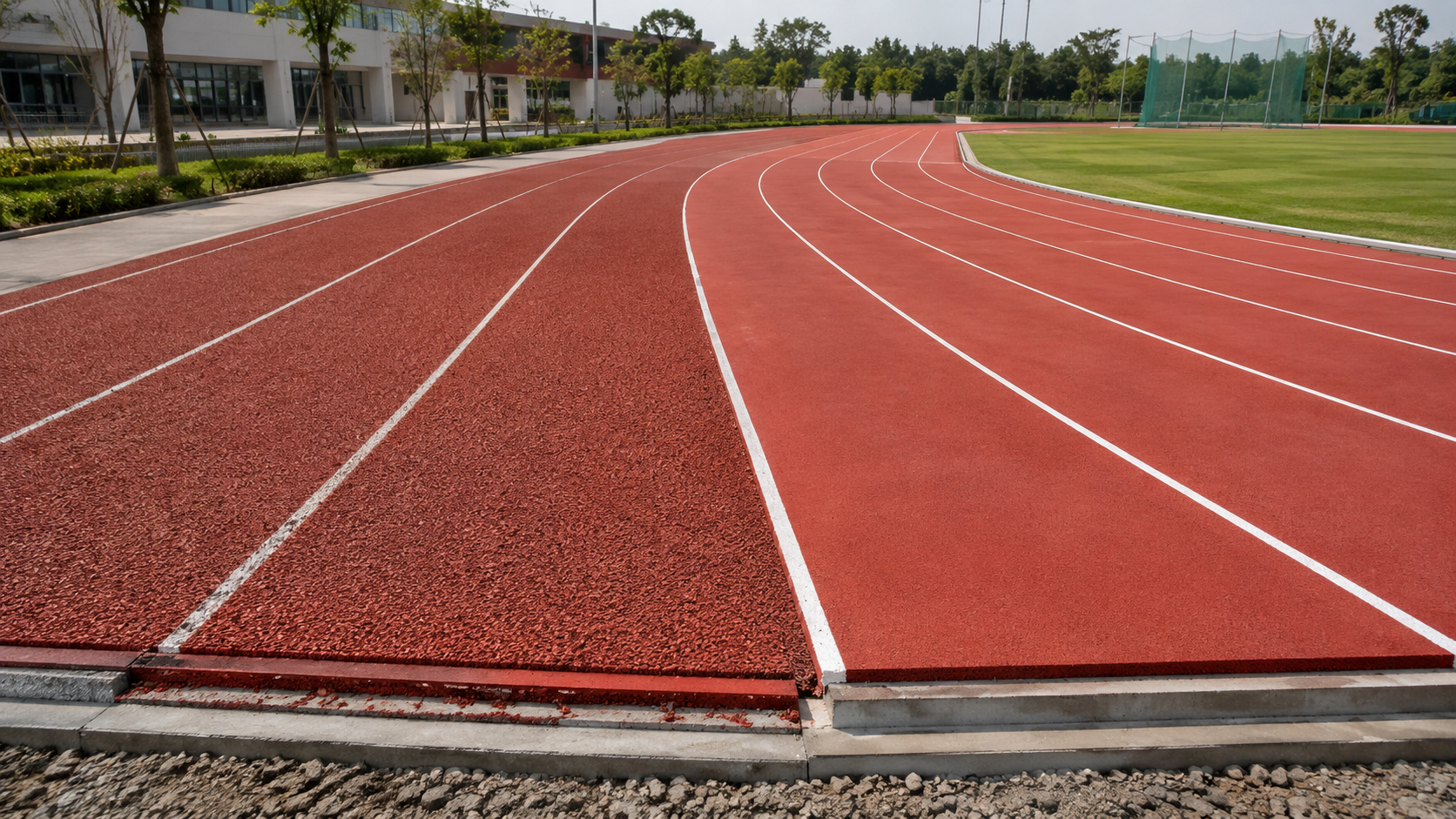
Depending on the design, EPDM systems can be constructed as porous surfaces that allow water to pass through the surface into the underlying drainage system.
Other synthetic systems may rely on carefully designed gradients and drainage channels to move water away from the track.
This makes the following elements extremely important:
- Proper slope
- Correct sub-base
- Drainage channels
- Perimeter drainage
- Waterproofing where required
- Correct surface installation
- Adequate water outlets
The best jogging track is not simply the one with the best surface material—it is the one with the best complete construction system.
6. Maintenance Requirements
Maintenance affects the total cost of ownership of a jogging track.
Regular maintenance can include:
- Surface cleaning
- Removal of leaves and debris
- Inspection for damaged areas
- Drainage cleaning
- Moss and algae control
- Line-marking maintenance
- Local repairs
- Periodic professional inspection
EPDM systems are generally straightforward to maintain, and localized damage can often be repaired without replacing the entire track.
PU systems can also have excellent service life, but specialist repair and maintenance may be required depending on the system.
A proper maintenance schedule can significantly extend the useful life of either surface.
7. Installation Process
The quality of installation is just as important as the flooring material.
Typical EPDM Track Construction
A professional EPDM track may involve:
- Site inspection
- Ground preparation
- Excavation where necessary
- Subgrade compaction
- Drainage installation
- Sub-base construction
- Asphalt or suitable structural layer
- Surface preparation
- PU binder application
- EPDM granule installation
- Surface finishing
- Track line marking
- Quality inspection
Typical PU Track Construction
A PU system may involve:
- Detailed site survey
- Subgrade preparation
- Drainage planning
- Structural sub-base construction
- Asphalt or concrete base
- Primer application
- Rubber/resilient layer where specified
- Polyurethane installation
- EPDM broadcast or textured finish where specified
- Curing
- Line marking
- Testing and inspection
The exact construction method depends on the selected system.
8. Which Flooring Is Better for Schools?
For most schools, the decision depends on the intended use.
If the track is primarily intended for:
- Student jogging
- Physical education
- Recreational running
- School athletics training
- Fitness activities
- Walking
then EPDM can be an excellent choice.
It provides a comfortable, attractive, durable surface without necessarily requiring the investment associated with a high-performance competition track.
However, schools with serious athletics programmes or plans to host sanctioned competitions may consider a higher-performance PU system.
9. Which Is Better for Sports Academies?
Sports academies generally place greater emphasis on athletic performance.
Athletes may use the track for:
- Sprint training
- Endurance training
- Interval workouts
- Acceleration drills
- Competition preparation
- Repeated daily training
For such facilities, a professionally engineered PU system can provide an advantage because of its consistent performance characteristics.
If certification or sanctioned competition is part of the project’s objective, the selected product and complete track construction must be evaluated against the applicable World Athletics requirements rather than simply choosing “PU” as a label. World Athletics publishes technical specifications and certification information for track surfaces and athletics facilities.
10. Which Is Better for Residential and Community Jogging Tracks?
For residential communities, housing societies, parks, wellness centres, and community fitness areas, EPDM is often a highly practical option.
The main reasons include:
- Comfortable running surface
- Attractive appearance
- Good weather resistance
- Good traction
- Suitable cushioning
- Flexible design possibilities
- Relatively easy maintenance
- Good suitability for frequent recreational use
For a jogging track where professional competition is not the goal, investing in the overall construction quality and drainage may deliver more value than selecting the most expensive surface system.
EPDM vs PU: Which Is More Cost-Effective?
Cost should never be judged solely by the price per square foot.
The actual project cost depends on:
- Track dimensions
- Number of lanes
- Existing ground conditions
- Excavation requirements
- Drainage
- Sub-base thickness
- Asphalt work
- Surface thickness
- Material quality
- Labour
- Site accessibility
- Track geometry
- Line marking
- Additional sports infrastructure
Current Indian market estimates vary considerably depending on specifications and project scope. Recent industry guides, for example, show substantially different cost ranges for EPDM and PU systems, reinforcing the importance of comparing complete project specifications rather than isolated surface rates.
A low-cost quotation may exclude important components such as proper drainage, high-quality sub-base preparation, testing, or adequate surface thickness.
Therefore, when comparing quotations, ask contractors to provide a complete technical specification, not just a per-square-foot price.
Why the Sub-Base Matters More Than Many Buyers Realize
One of the biggest mistakes in jogging track construction is focusing entirely on the visible surface.
The surface is only one component of the complete system.
A professional track requires a stable foundation capable of supporting repeated dynamic loads.
Problems caused by inadequate sub-base construction can include:
- Cracking
- Settlement
- Uneven surfaces
- Water accumulation
- Surface separation
- Premature wear
- Drainage problems
- Local deformation
A technically excellent EPDM or PU system cannot compensate for a fundamentally poor foundation.
Therefore, before selecting the flooring material, evaluate the entire track construction system.
EPDM vs PU for Indian Climate
India presents diverse environmental conditions, from hot and dry regions to humid coastal areas and heavy monsoon zones.
For Indian projects, the flooring specification should account for:
UV exposure: Outdoor surfaces should be designed for prolonged sunlight.
Temperature: Materials must tolerate seasonal heat and temperature variation.
Rainfall: Drainage should prevent standing water and moisture-related damage.
Humidity: Moisture management is particularly important during installation.
Usage: A community jogging track and a professional athletics track have very different performance requirements.
For coastal cities such as Mumbai, Chennai, Kochi, and other humid regions, proper drainage and moisture management become particularly important.
How to Choose the Right Jogging Track Flooring
Before selecting EPDM or PU, answer these questions:
1. Who will use the track?
Is it for children, recreational runners, professional athletes, or mixed users?
2. How frequently will it be used?
A residential jogging path may have significantly lower traffic than a sports academy.
3. Is competition certification required?
If the facility will host sanctioned athletics competitions, certification requirements should guide the surface specification.
4. What is the available budget?
Instead of selecting the cheapest material, consider the complete lifecycle cost.
5. What is the local climate?
Sunlight, rain, humidity, and temperature should influence material selection.
6. Is drainage adequate?
Never compromise on drainage.
7. Who will install the track?
Experience in synthetic sports surfaces is critical.
8. What warranty and maintenance support are provided?
Ask for written documentation covering materials, installation, workmanship, and maintenance.
EPDM vs PU Jogging Track Flooring: Final Verdict
So, EPDM vs PU jogging track flooring—which is better for runners?
The answer depends on the purpose of the facility.
Choose EPDM when:
- The track is primarily for jogging and recreational running.
- The project is for a school or community.
- Comfortable cushioning is important.
- Outdoor weather resistance is a priority.
- You want a practical and visually attractive surface.
- The project has a controlled construction budget.
Choose PU when:
- Athletic performance is a major priority.
- The facility is designed for professional training.
- The track will be used intensively.
- Competition-level performance is required.
- The project may require World Athletics certification.
- Consistent high-performance characteristics are a key objective.
For many recreational jogging tracks, a professionally installed EPDM system can provide an excellent balance of comfort, durability, traction, appearance, and cost.
For high-performance athletics facilities, a correctly specified PU system may be the better investment.
Most importantly, don’t make the decision based only on the words “EPDM” or “PU.” The surface system, sub-base, drainage, thickness, installation quality, material certification, and maintenance programme collectively determine how well a jogging track performs.
World Athletics itself emphasizes that certified surfacing products must meet specified technical requirements when installed at the required thickness, while also noting that certification does not mean every certified product is identical in overall quality.
Frequently Asked Questions
Is EPDM good for jogging tracks?
Yes. EPDM is widely used for outdoor running and jogging surfaces because it provides good cushioning, traction, durability, colour stability, and weather resistance.
Is PU better than EPDM for running?
PU can be better for high-performance athletics because certain PU systems are engineered for consistent energy response and competition-level requirements. For recreational jogging, however, a properly installed EPDM system can provide excellent performance.
Which lasts longer, EPDM or PU?
Service life depends heavily on the complete construction system, installation quality, climate, traffic, and maintenance. A well-designed system of either type can provide many years of service.
Is EPDM flooring safe for runners?
A properly designed EPDM running surface can provide cushioning and traction suitable for running and jogging. The final performance depends on surface thickness, texture, sub-base quality, and installation.
Can EPDM tracks be used in rainy areas?
Yes, provided the track is designed with appropriate drainage and the selected system is suitable for the site conditions. Porous synthetic systems can allow water to pass through the surface, while other systems rely on surface gradients and drainage infrastructure.
Which is better for a school running track?
EPDM is often a practical choice for school jogging and athletics facilities. If the school requires competition-level performance or certification, a suitable PU-based system should be evaluated.
Which is better for a professional athletics track?
A professionally engineered PU system is generally the stronger choice for high-level athletics applications, especially where competition performance and certification are required.
Conclusion
The choice between EPDM vs PU jogging track flooring should be based on the facility’s actual requirements rather than simply choosing the most expensive or cheapest option.
EPDM offers an excellent combination of comfort, durability, traction, aesthetics, and outdoor performance, making it highly suitable for schools, communities, parks, residential developments, and recreational jogging tracks.
PU, particularly high-performance systems, offers consistent athletic performance, controlled energy response, and suitability for advanced athletics facilities.
Whichever system you choose, prioritize professional site assessment, proper drainage, a strong sub-base, quality materials, accurate installation, correct surface thickness, and regular maintenance.
A running track is a long-term sports investment. The right flooring system, combined with expert construction, can create a safer, more comfortable, durable, and enjoyable running environment for years to come.