Introduction
Badminton is a fast and physically demanding sport that requires speed, balance, agility, coordination, and rapid changes in direction. Players constantly move forward, backward, sideways, and diagonally while performing lunges, jumps, sudden stops, and powerful overhead shots. Because of this intense movement, the quality of the playing surface has a direct influence on both player safety and performance.
A professionally designed badminton court flooring does much more than provide an attractive surface. The right flooring system helps absorb impact, provide suitable traction, support quick movement, reduce excessive stress on the joints, and create a consistent playing environment. Whether the facility is a professional badminton academy, school, university, sports club, fitness centre, community facility, or private indoor court, selecting the right flooring is an important part of court construction.
This guide explains how badminton court flooring contributes to player safety and performance, what features to consider, the most common flooring options, and why professional installation matters.
Why Badminton Court Flooring Matters
The playing surface is one of the most important components of an indoor badminton court. Players may cover considerable distances during a match, and many movements involve sudden acceleration followed by immediate braking or changes in direction.
A poor-quality floor can create problems such as excessive slipping, insufficient shock absorption, uneven traction, hard impact, surface fatigue, and inconsistent movement. Over time, these issues can affect comfort and increase the possibility of injuries.
A properly constructed badminton flooring system is designed to balance several performance factors, including:
- Shock absorption
- Surface stability
- Controlled traction
- Foot grip
- Energy return
- Uniformity
- Ball and player response
- Durability
- Maintenance requirements
- Long-term structural performance
The goal is not simply to create a soft floor. Instead, the flooring should provide the right combination of cushioning and stability so players can move confidently without losing responsiveness.
1. Shock Absorption Helps Protect Players
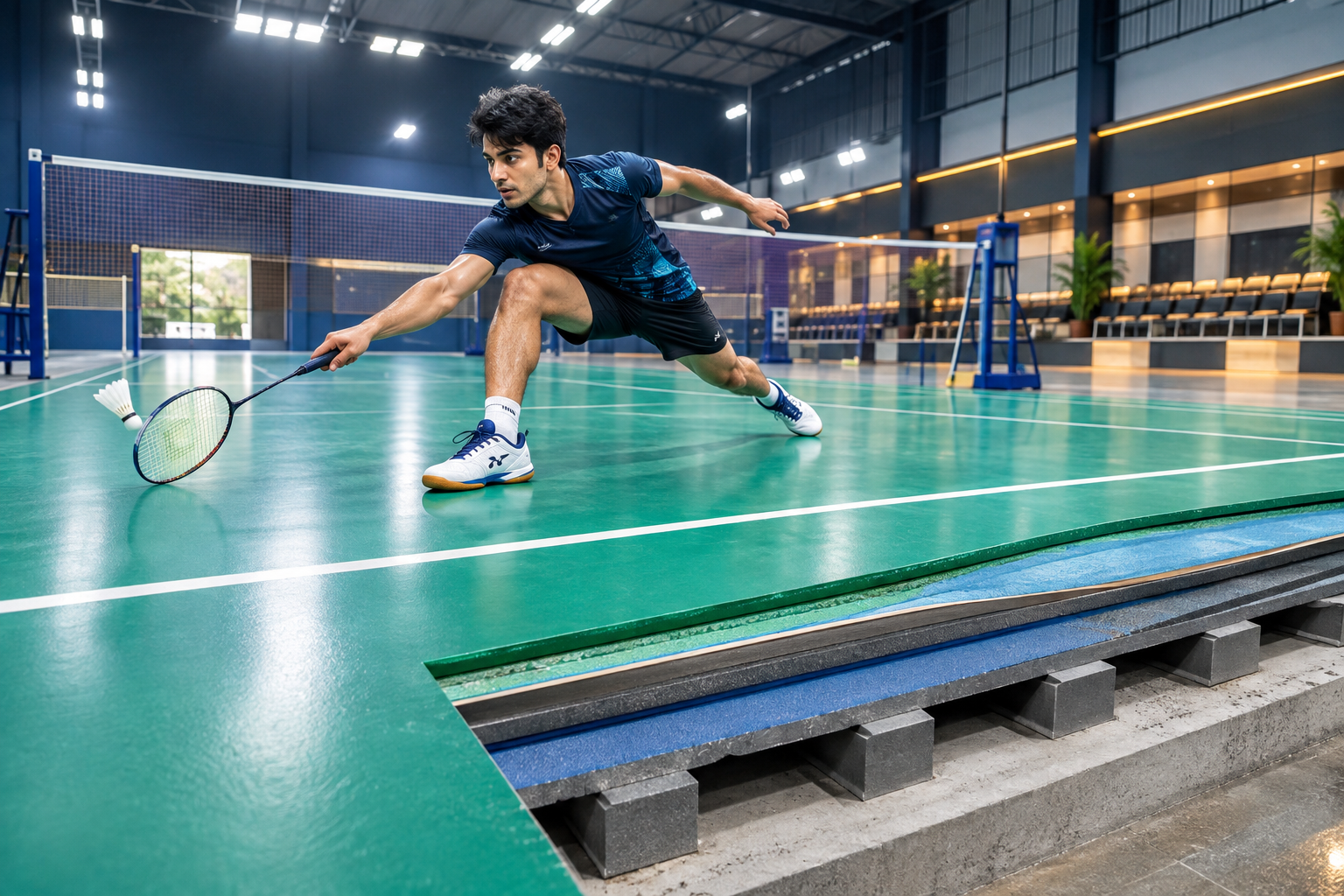
One of the biggest advantages of professional badminton court flooring is its ability to manage impact.
During a match, players repeatedly land from jumps, perform deep lunges, and stop suddenly. These movements generate forces that travel through the feet, ankles, knees, hips, and lower back.
A hard conventional surface may transfer a greater portion of these forces directly through the player’s body. A professionally designed sports flooring system can reduce the severity of these impacts by incorporating cushioning or resilient layers.
Depending on the flooring design, shock absorption may be achieved through:
- Resilient pads
- Rubber cushioning layers
- Elastic underlays
- Sprung wooden systems
- Specialized sports mats
- Synthetic cushioned layers
Proper impact management can make the court more comfortable during long training sessions and competitive matches.
This is particularly important for facilities where players practice for several hours every day.
2. Controlled Traction Improves Footwork
Badminton requires extremely precise footwork. Players must be able to accelerate quickly while also stopping and changing direction safely.
If the floor is too slippery, the player’s foot may slide unexpectedly. This can affect balance and increase the risk of falls or lower-limb injuries.
On the other hand, a surface with excessive grip can restrict natural foot movement. When a player’s shoe cannot release smoothly from the surface, twisting forces may increase during rapid directional changes.
For this reason, quality badminton court flooring should provide controlled traction rather than simply maximum grip.
The ideal surface allows players to:
- Push off confidently
- Stop under control
- Change direction quickly
- Perform lunges safely
- Recover from shots efficiently
- Maintain balance during rapid movement
The interaction between sports shoes and the flooring surface is therefore an important part of court performance.
3. Better Flooring Supports Faster Movement
Speed is fundamental to badminton. Players need to reach the shuttle quickly and return to their ideal court position after every shot.
A high-performance floor provides a stable platform for movement. When the surface has appropriate traction and resilience, players can transfer energy efficiently through their feet.
This helps support explosive movements such as:
- Forward lunges
- Side steps
- Backward movement
- Jump smashes
- Defensive recovery
- Rapid changes of direction
- Short acceleration bursts
A floor that feels unstable, overly soft, or inconsistent can make movement less predictable.
Professional sports flooring is therefore designed to provide a reliable response across the entire playing area.
4. Consistent Surface Performance
Consistency is especially important in competitive badminton.
Players develop movement patterns and techniques based on how the court feels beneath their feet. If one area of the floor has significantly different grip, hardness, or resilience from another, movement can become unpredictable.
Professional installation focuses on achieving a uniform surface throughout the court.
Important construction factors include:
- Accurate subfloor preparation
- Proper moisture management
- Correct leveling
- Uniform installation of flooring materials
- Controlled expansion gaps
- Proper adhesive application where required
- Accurate finishing
- Professional line marking
A consistent floor gives players greater confidence because they know how the surface will respond regardless of where they move.
5. Wooden Badminton Flooring and Player Comfort
Wood remains a popular choice for premium indoor badminton courts because of its natural resilience, performance characteristics, and professional appearance.
Wooden badminton court flooring can be constructed using hardwood materials such as maple, beech, oak, or other suitable species. In sprung systems, the wooden playing surface works together with an engineered substructure to provide controlled cushioning.
A properly designed wooden sports floor can offer:
- Excellent shock absorption
- Comfortable movement
- Controlled elasticity
- Stable foot placement
- Professional appearance
- Long service life with appropriate maintenance
However, not every wooden floor is suitable for badminton. Ordinary residential or decorative wood flooring may not provide the technical performance required for sports.
A sports-specific wooden system should be designed around athletic movement and impact requirements.
6. Synthetic Badminton Court Flooring Offers Practical Performance
Synthetic flooring is another popular solution for badminton facilities. These systems may include PVC, vinyl, rubber, polyurethane, or specialized sports surfaces.
Synthetic badminton flooring can be engineered to provide specific performance characteristics while offering relatively straightforward maintenance.
Depending on the system, benefits can include:
- Consistent traction
- Shock absorption
- Comfortable underfoot response
- Durable surface construction
- Easy cleaning
- Resistance to regular sports use
- Consistent appearance
Synthetic surfaces are often suitable for schools, academies, recreational centres, multi-purpose sports halls, and professional training environments.
The correct product should always be selected according to the facility’s intended use, playing level, subfloor conditions, and maintenance requirements.
7. Flooring Can Reduce Excessive Joint Stress
Badminton players repeatedly load their lower limbs during training and competition. The knees and ankles are particularly involved in landing, braking, pushing off, and directional changes.
A suitable sports flooring system can help manage mechanical impact by providing controlled cushioning.
This does not mean flooring can prevent every sports injury. Injuries can result from many factors, including technique, training load, footwear, fatigue, conditioning, and previous injury.
However, a well-engineered floor can create a more supportive playing environment by reducing excessive surface hardness and providing appropriate shock absorption.
This is one reason professional sports facilities invest in purpose-built athletic flooring rather than using ordinary concrete or general-purpose tiles.
8. Proper Flooring Improves Player Confidence
Performance is not only physical. Confidence also plays an important role.
Players perform rapid movements more effectively when they trust the surface beneath their feet. If they are worried about slipping or encountering an uneven area, they may unconsciously reduce their movement speed.
A professionally installed court gives players confidence to:
- Chase difficult shots
- Perform aggressive lunges
- Jump for smashes
- Recover quickly
- Change direction without hesitation
- Maintain proper footwork
That confidence can improve both training quality and match performance.
9. A Level Subfloor Is Essential
The visible playing surface is only one part of badminton court construction. The condition of the base underneath it is equally important.
Before flooring installation, contractors should assess the existing floor and identify problems such as:
- Uneven areas
- Cracks
- Moisture
- Weak sections
- Surface contamination
- Improper slopes
- Structural movement
A stable and properly prepared subfloor provides the foundation for the complete flooring system.
Laser levels and precision measuring equipment can be used during preparation and installation to verify surface accuracy.
If the base is poorly prepared, even a high-quality sports flooring material may fail to perform properly.
10. Moisture Control Protects the Flooring System
Moisture is an important consideration in indoor court construction, especially when installing wooden flooring.
Excess moisture can contribute to swelling, dimensional movement, adhesive failure, surface deformation, or long-term deterioration.
Before installation, moisture conditions should be evaluated according to the flooring manufacturer’s requirements and the construction environment.
Appropriate moisture-control measures may include:
- Moisture testing
- Vapor-control systems
- Proper ventilation
- Suitable adhesives
- Correct subfloor preparation
- Environmental conditioning of materials
Wooden flooring may also need to acclimatize to the indoor environment before installation.
These steps help improve dimensional stability and long-term performance.
11. Accurate Court Line Marking Supports Better Play
Court markings are another important part of badminton flooring.
Clearly visible lines help players judge boundaries quickly during fast rallies. Accurate markings also create a professional playing environment for coaching and competition.
Line marking should be:
- Straight
- Consistent
- Clearly visible
- Properly positioned
- Durable
- Compatible with the flooring surface
For facilities intended for serious competition, court dimensions and markings should be established according to the applicable badminton regulations and governing requirements.
Poorly positioned or faded markings can create confusion and reduce the professional quality of the facility.
12. Surface Finish Affects Maintenance and Durability
Badminton courts experience continuous foot traffic, especially in academies and commercial sports centres.
Players repeatedly move across the same areas, while sports shoes can create friction and surface wear.
A suitable sports flooring finish should be selected to withstand the expected usage level while maintaining appropriate playing characteristics.
Routine maintenance may include:
- Regular dust removal
- Damp cleaning with approved products
- Immediate removal of spills
- Periodic inspection
- Repair of damaged areas
- Recoating or refinishing where applicable
Cleaning methods should always follow the flooring manufacturer’s recommendations.
Using unsuitable chemicals or excessive water can damage certain sports flooring systems.
13. Flooring Selection Depends on the Facility
There is no single badminton floor that is perfect for every project.
The correct solution depends on factors such as:
- Indoor or outdoor environment
- Professional or recreational use
- Training intensity
- Number of playing hours
- Available budget
- Existing subfloor
- Required shock absorption
- Maintenance capacity
- Expected service life
For a professional academy, a premium sprung wooden system may be appropriate. A school or multi-purpose hall may benefit from a durable synthetic sports floor.
The important point is to select a system based on performance requirements rather than appearance alone.
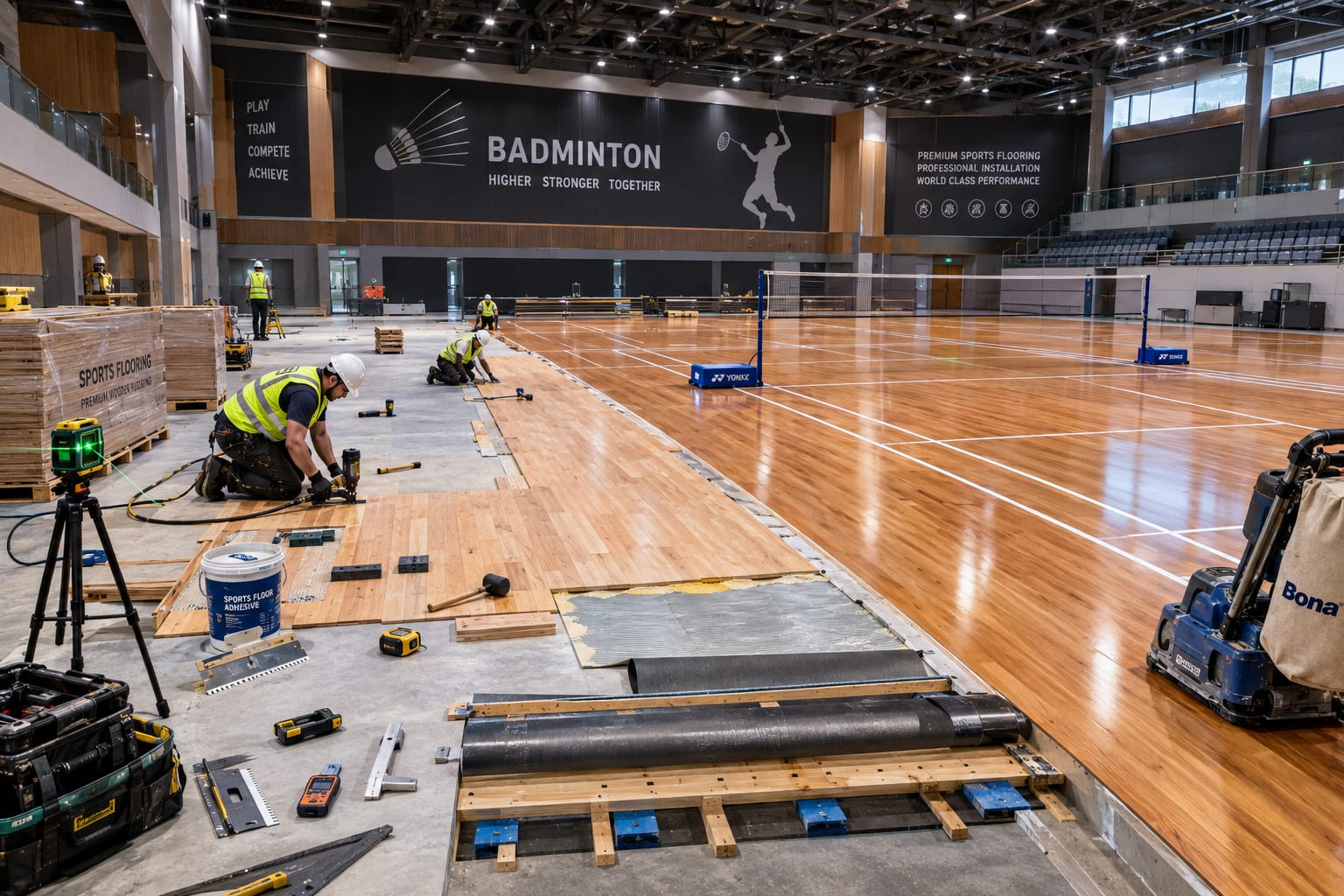
14. Professional Installation Makes a Major Difference
Even premium flooring materials can perform poorly if installation is rushed or incorrectly executed.
Professional badminton flooring installation generally involves several stages.
Site Inspection
The installation team evaluates the existing structure, dimensions, moisture conditions, ventilation, and subfloor.
Surface Preparation
The base is cleaned, repaired, leveled, and prepared for the selected flooring system.
Installation of Cushioning or Support Layers
Depending on the design, resilient pads, rubber layers, underlays, sleepers, or other components are installed.
Flooring Installation
Wooden boards, sports mats, PVC flooring, or other selected materials are installed according to the manufacturer’s specifications.
Surface Finishing
Wooden floors may require sanding and sports-specific finishing. Synthetic floors may require appropriate seam treatment or surface preparation.
Court Marking
Badminton lines are accurately measured and applied.
Final Inspection
The completed court is inspected for surface quality, levelness, visible defects, markings, and overall finish.
This systematic approach helps ensure that the flooring performs as intended.
15. Good Badminton Flooring Is a Long-Term Investment
Choosing the cheapest flooring solution may reduce initial construction expenses, but it can create higher costs over time if the surface wears quickly or requires frequent repairs.
A high-quality badminton court floor can provide long-term value through:
- Better durability
- Reduced maintenance requirements
- Improved player comfort
- Professional appearance
- Reliable performance
- Better facility usability
For commercial academies and sports centres, flooring quality can also influence the experience of players and visitors.
A comfortable, attractive, professionally maintained court can strengthen the overall reputation of a sports facility.
How to Choose the Best Badminton Court Flooring
Before selecting a flooring system, facility owners should consider several questions:
What level of play will the court support?
Professional competition and casual recreation may require different flooring specifications.
How frequently will the court be used?
A busy academy needs a durable system capable of handling intensive daily traffic.
What is the existing subfloor condition?
The flooring solution should be compatible with the existing structure.
How much shock absorption is required?
Players who train for long periods may benefit from a properly engineered cushioned or sprung system.
What maintenance resources are available?
The selected floor should fit the facility’s cleaning and maintenance capabilities.
What is the long-term budget?
Consider installation, maintenance, refinishing, repairs, and expected service life—not just the initial price.
Conclusion
Badminton court flooring plays a crucial role in creating a safe, comfortable, and high-performance playing environment. The right flooring system helps manage impact, provide controlled traction, support rapid footwork, improve stability, and maintain consistent surface performance.
Whether a facility chooses a sprung wooden floor, synthetic PVC sports flooring, rubber-based cushioning system, or another specialized sports surface, the flooring should be designed specifically for badminton rather than adapted from a general-purpose floor.
Equally important is professional installation. A properly prepared subfloor, suitable moisture control, accurate leveling, correctly installed cushioning layers, quality surface finishing, and precise court markings all contribute to the final performance of the court.
For schools, badminton academies, universities, sports clubs, fitness centres, community halls, and professional training facilities, investing in quality badminton court flooring is ultimately an investment in players, performance, safety, and the long-term value of the sports facility.
A well-engineered badminton court should allow players to focus on what matters most—moving faster, playing confidently, training harder, and enjoying the game safely.