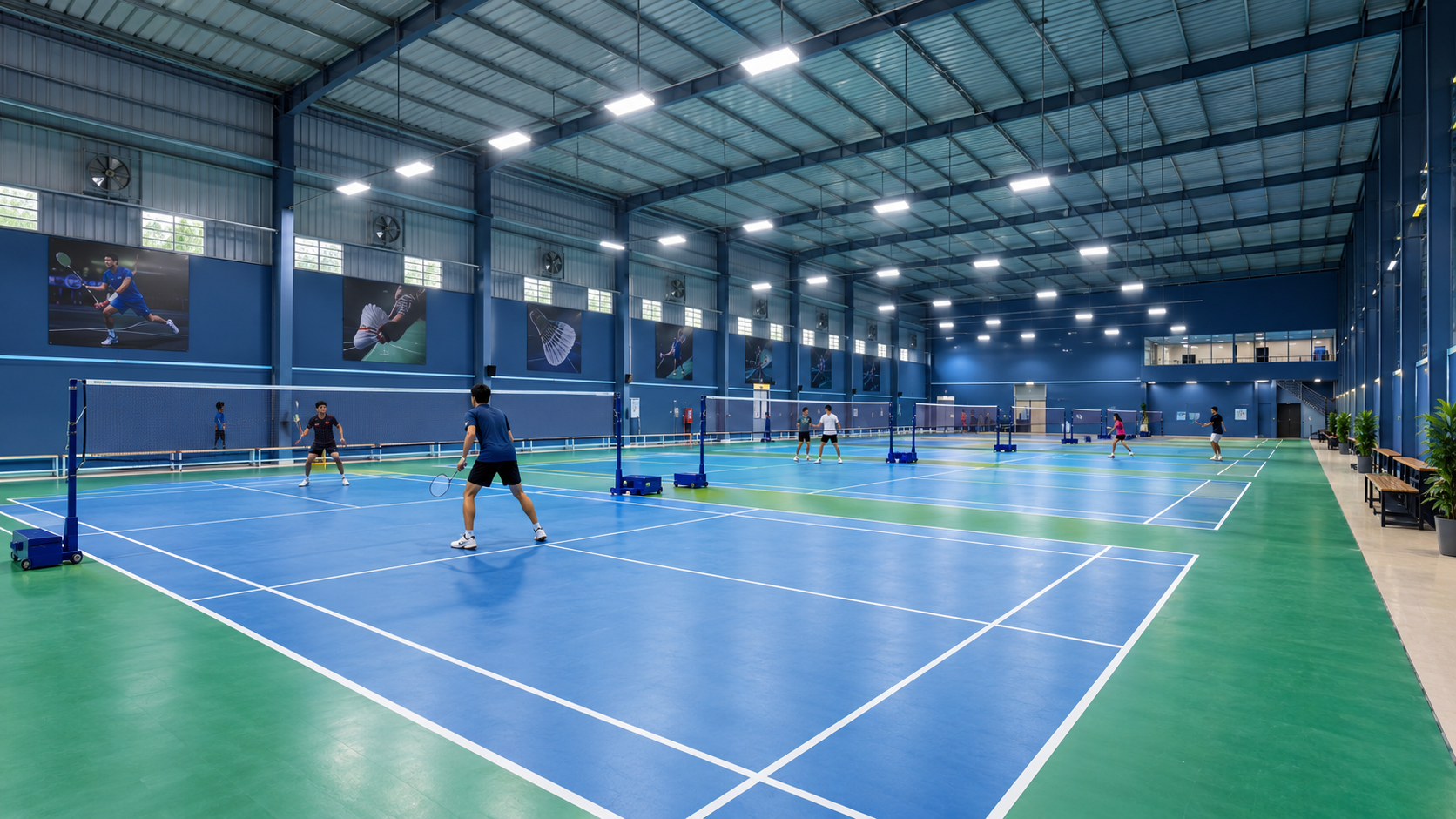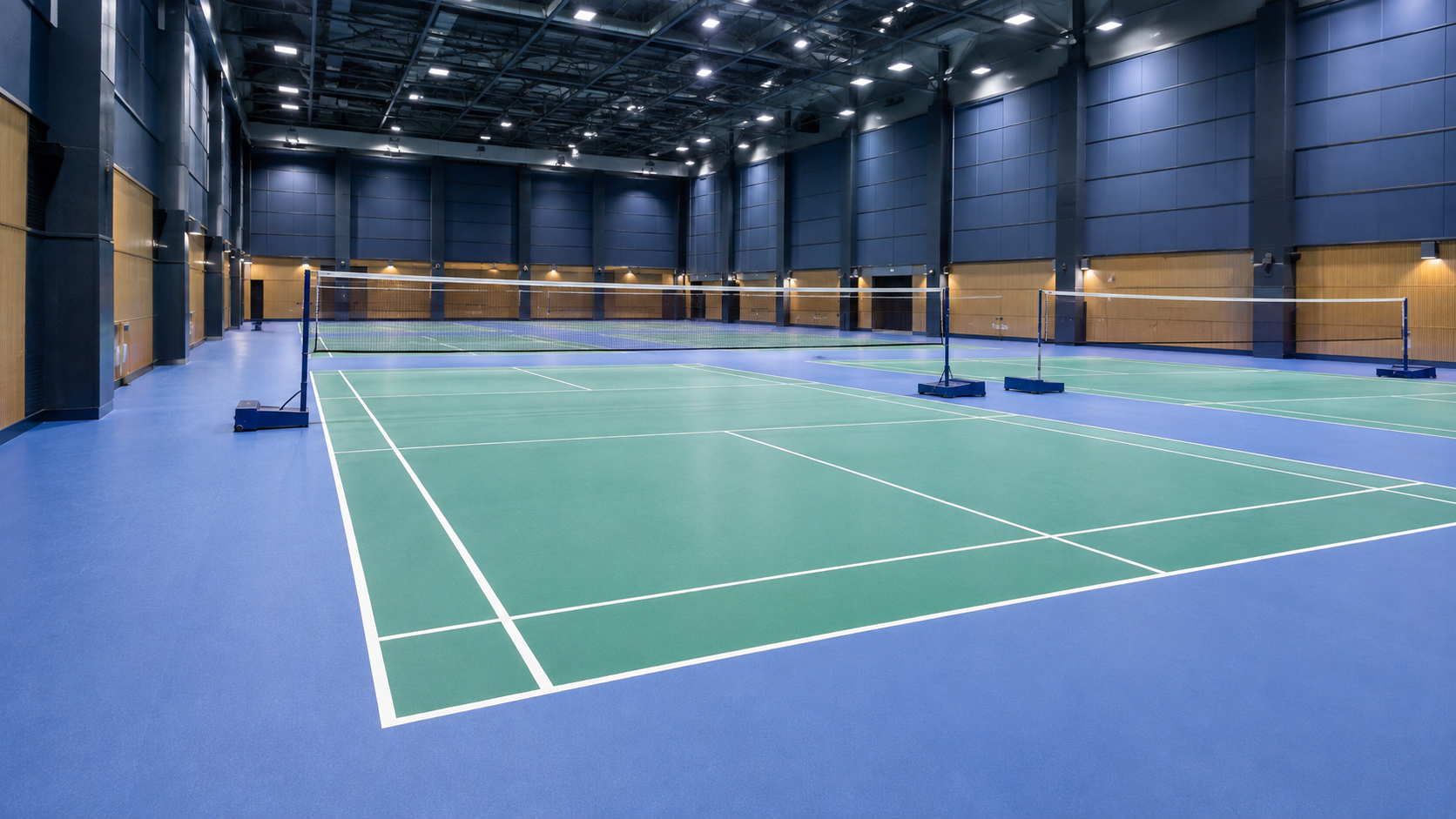
Badminton is a fast-paced sport that demands quick movement, sudden stops, powerful lunges, jumps, and frequent changes of direction. While players often focus on rackets, shuttlecocks, lighting, and court dimensions, the badminton court flooring is one of the most important factors affecting safety, comfort, and playing performance.
A poorly designed or improperly installed floor can create uneven bounce, excessive slipperiness, uncomfortable movement, premature surface damage, and unnecessary stress on the knees and ankles. On the other hand, a professionally constructed badminton flooring system provides controlled grip, suitable shock absorption, consistent playing characteristics, and long-term durability.
Whether the court is being developed in a school, sports academy, fitness centre, club, residential complex, university, or professional training facility, flooring should be treated as a complete performance system rather than simply a finished surface.
This guide explains the most common badminton court flooring problems, why they occur, and how professional badminton flooring services identify and solve them.
Why Badminton Court Flooring Matters
Badminton players move differently from athletes in many other sports. The game involves repeated short sprints, rapid lateral movements, lunges, jumps, and sudden braking. These movements place considerable demand on the player’s feet and lower body.
A suitable badminton court floor should provide:
- Controlled traction
- Appropriate shock absorption
- Consistent surface response
- Comfortable foot movement
- Stable and level construction
- Reliable durability
- Good resistance to wear
- Easy maintenance
- Accurate court-line marking
- A playing surface appropriate for the facility’s environment
The flooring system may include several layers rather than one visible top coating. Depending on the application, it can consist of a prepared base, moisture protection, cushioning components, subfloor elements, structural layers, and a specialized sports surface.
When any part of this system is poorly designed or installed, problems can appear quickly.
1. Uneven Badminton Court Surface
One of the most common problems is an uneven playing surface. Small irregularities may not be obvious when looking at the court, but players can notice them during movement.
Common symptoms
- Minor bumps or depressions
- Uneven surface height
- Visible waves
- Gaps between flooring components
- Areas that feel different underfoot
- Poor installation of surface panels
An uneven floor can interfere with footwork and make fast movement less predictable.
Why does it happen?
The problem may originate from an improperly prepared subfloor. If the concrete base is not sufficiently level, subsequent flooring layers can reproduce those imperfections.
Other causes include:
- Poor surface preparation
- Incorrect installation techniques
- Inadequate leveling
- Movement in the underlying structure
- Poor-quality materials
- Improper expansion provisions
How professional flooring services solve it
Professional installers begin by assessing the existing base before installing the sports flooring. They check levelness, surface condition, moisture, cracks, and structural stability.
Depending on the severity, the solution may involve mechanical preparation, leveling compounds, repairs, or reconstruction of damaged sections.
The objective is to establish a stable and uniform foundation before the final sports surface is installed.
2. Excessive Slipperiness
A badminton court should provide controlled traction. Players need enough grip to accelerate, stop, and change direction without losing balance.
If the surface becomes excessively slippery, quick movements can become difficult and potentially dangerous.
Common causes
Slipperiness can result from:
- Incorrect surface material
- Excessive polishing
- Contamination from dust or oils
- Incorrect cleaning products
- Worn-out surface coatings
- Moisture accumulation
- Poorly selected finishing systems
Even a technically good floor can become slippery if maintenance practices are inappropriate.
Professional solution
Professional badminton flooring contractors assess the existing surface and determine whether the issue is related to contamination, wear, moisture, or material selection.
For a maintenance-related problem, deep cleaning and appropriate surface treatment may restore traction.
If the surface coating has deteriorated, professional resurfacing may be necessary.
For new courts, installers select a sports flooring system designed specifically for athletic movement rather than using a general-purpose floor coating.
3. Excessive Hardness and Poor Shock Absorption
A hard floor may appear durable, but excessive hardness can reduce player comfort during repeated movement.
Badminton involves frequent jumping and lunging. A flooring system without appropriate cushioning can transfer greater impact through the feet and lower limbs.
Potential effects
Players may experience greater discomfort after extended training sessions, particularly during repetitive jumping and rapid movement.
Why does it happen?
Typical causes include:
- Lack of a suitable cushioning layer
- Incorrect sports flooring specification
- Deteriorated shock-absorbing components
- Improper subfloor construction
- Installation of conventional flooring instead of sports flooring
How professionals address it
A professional flooring service evaluates the complete floor assembly rather than simply adding a soft coating to the surface.
Depending on the project, the system may incorporate resilient pads, cushioning layers, sprung construction, engineered wooden subfloors, synthetic sports surfaces, or other specialized components.
The correct system depends on the court’s intended use, expected traffic, building structure, budget, and performance requirements.
4. Insufficient Shock Absorption in Wooden Courts
Wooden badminton floors are popular because they can offer excellent playing characteristics when properly designed.
However, a wooden floor is not automatically a high-performance sports floor.
A conventional wood floor installed directly over a hard base may not provide the cushioning expected from a professional badminton court.
Professional solution
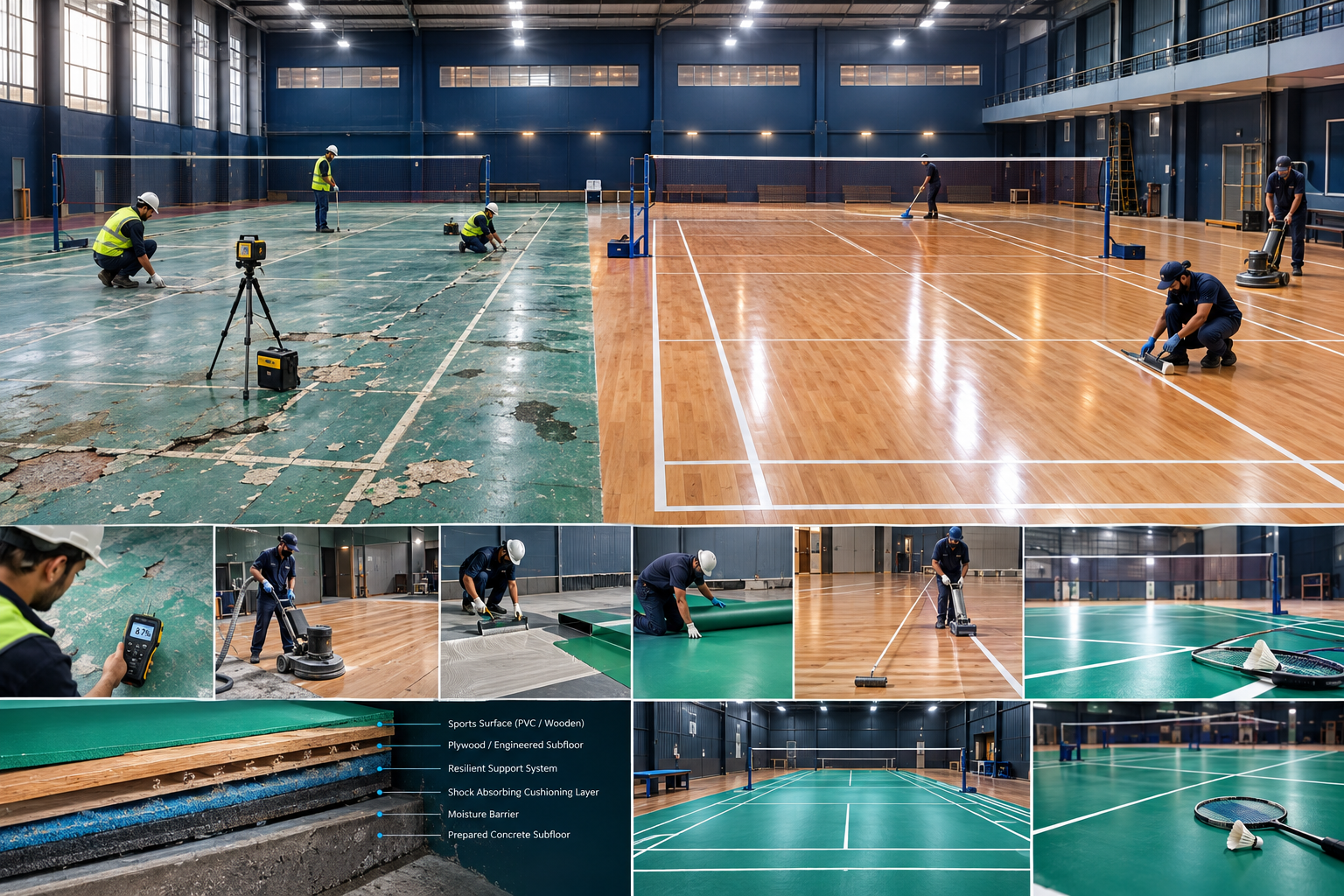
Professional wooden badminton flooring may use a multi-layer construction incorporating:
- Structural subfloor
- Resilient supports
- Wooden sleepers
- Plywood or engineered panels
- Hardwood surface layers
- Expansion provisions
- Sports-grade finishing
The exact construction is selected according to the performance requirements of the facility.
A properly engineered system balances stability, resilience, durability, and playing comfort.
5. Moisture and Water Damage
Moisture is one of the most serious threats to badminton flooring, particularly for wooden courts.
Wood naturally responds to changes in humidity and moisture. Excessive moisture can cause dimensional changes, swelling, warping, or other forms of deterioration.
Synthetic floors can also be affected by moisture trapped beneath the surface.
Common warning signs
- Swollen wooden boards
- Gaps between planks
- Buckling
- Surface discoloration
- Adhesive failure
- Peeling
- Unpleasant odors
- Mold-related problems
Why moisture problems occur
Possible causes include:
- High subfloor moisture
- Inadequate moisture barriers
- Water leakage
- Poor drainage
- Condensation
- Incorrect cleaning practices
- Installation before the substrate has sufficiently dried
Professional approach
Experienced installers conduct moisture assessments before flooring installation.
Where necessary, the construction can include an appropriate moisture-control strategy, vapor barrier, substrate treatment, drainage improvements, and expansion allowances.
Professional installation also considers the indoor climate of the facility because temperature and humidity can influence flooring performance.
6. Cracks and Surface Damage
Over time, badminton flooring can develop cracks, chips, scratches, dents, or worn areas.
Heavy equipment movement, improper cleaning, excessive traffic, impact, or substrate movement can contribute to surface damage.
Professional repair
The appropriate repair depends on the flooring type.
For synthetic systems, damaged sections may be repaired, resurfaced, or recoated.
For wooden courts, damaged boards may sometimes be replaced before the entire surface is sanded and refinished.
Professional inspection helps determine whether the problem is limited to the top layer or indicates a deeper structural issue.
7. Peeling or Delamination
Synthetic sports flooring may sometimes develop peeling, bubbling, or delamination.
This occurs when one flooring layer loses proper adhesion to another.
Common causes
- Poor substrate preparation
- Moisture beneath the flooring
- Incorrect adhesive
- Incompatible materials
- Incorrect installation conditions
- Contamination of the substrate
- Poor application technique
Professional solution
Professional installers identify the source before repairing the visible damage.
Simply applying another coating over a failing surface may provide only a temporary result.
The damaged area may need to be removed, the substrate properly prepared, moisture conditions checked, and compatible materials applied according to the flooring manufacturer’s requirements.
8. Poor Ball and Shuttle Response
Flooring can influence how players perceive the court during fast-paced play.
Although shuttlecock behavior is strongly influenced by factors such as air movement, temperature, equipment, and player technique, an unsuitable or inconsistent floor can affect footwork and overall playing confidence.
A floor that varies significantly from one area to another can create an inconsistent playing experience.
Professional solution
Professional court construction focuses on creating a uniform surface across the playing area.
Accurate leveling, controlled installation thickness, consistent finishing, and quality inspection help minimize differences across the court.
9. Faded or Incorrect Court Line Markings
Court markings are not merely decorative. Accurate lines are essential for proper gameplay and professional presentation.
Common problems include:
- Faded markings
- Incorrect dimensions
- Uneven line width
- Poorly aligned lines
- Paint bleeding
- Peeling markings
Professional solution
Professional badminton court installers measure and mark the court carefully before applying sports-grade line-marking products.
The process typically involves:
- Measuring the court
- Establishing reference points
- Checking diagonals and alignment
- Masking the required areas
- Applying suitable line-marking material
- Removing masking carefully
- Inspecting the finished markings
Accurate preparation helps create clean and professional-looking lines.
10. Poor Court Drainage in Outdoor Installations
Traditional indoor badminton flooring is generally preferred for performance environments, but outdoor badminton facilities may require specialized flooring solutions.
Outdoor courts face challenges that indoor courts do not, including rain, sunlight, temperature changes, dust, and standing water.
Poor drainage can result in:
- Water accumulation
- Surface deterioration
- Algae or biological growth
- Reduced traction
- Cracking
- Premature coating failure
Professional solution
Outdoor flooring projects require proper site assessment and drainage planning.
The supporting surface should be designed to manage water effectively, while the selected sports surface should be appropriate for outdoor exposure.
Trying to use an indoor flooring system in an outdoor environment can significantly shorten its service life.
11. Flooring Becomes Too Noisy
Noise can become an important concern in badminton facilities, especially when multiple courts operate inside schools, clubs, academies, or residential sports centres.
Hard surfaces can transmit impact sounds through the building structure.
How professional flooring services help
Professional sports flooring systems can incorporate resilient layers or acoustic components designed to reduce impact transmission.
The flooring design can be selected based on:
- Building structure
- Number of courts
- Player traffic
- Intended operating hours
- Adjacent rooms
- Acoustic requirements
This makes flooring selection an important part of the overall facility design.
12. Premature Wear and Loss of Surface Performance
A badminton court may look attractive when newly installed but begin showing wear much earlier than expected if the wrong materials or installation methods were used.
High-traffic areas usually experience more wear around:
- Court entrances
- Net areas
- Service zones
- Player movement zones
- Training areas
Professional solution
Professionals select materials according to expected usage.
A school court with hundreds of users may require a different flooring specification from a private training facility.
Routine maintenance, appropriate cleaning, periodic inspection, and timely resurfacing can also extend the useful life of the floor.
13. Poor Installation of the Subfloor
Many badminton flooring problems originate below the visible surface.
A professional flooring system depends on the performance of the entire assembly.
The subfloor must be:
- Stable
- Properly leveled
- Structurally sound
- Clean
- Appropriately dry
- Suitable for the selected flooring system
If the foundation is unstable, even expensive top-quality flooring materials may fail to deliver the expected performance.
This is why professional badminton court flooring services usually treat subfloor preparation as a critical construction stage, not an afterthought.
14. Incorrect Flooring Selection
One of the biggest mistakes facility owners make is selecting flooring based solely on appearance or initial price.
A beautiful surface may not necessarily be suitable for badminton.
Different environments may require different solutions, such as:
Wooden Sports Flooring
Suitable for premium indoor facilities where a resilient wood-based sports floor is desired.
PVC Sports Flooring
Can provide a seamless or low-maintenance synthetic solution with controlled surface characteristics.
PU Sports Flooring
Polyurethane systems can be engineered as durable sports surfaces with suitable performance characteristics.
Acrylic Sports Flooring
Often considered for certain multi-purpose and outdoor applications where environmental exposure and surface durability are important.
The best choice depends on the facility rather than simply the flooring material itself.
How Professional Badminton Court Flooring Services Solve These Problems
Professional installation is not limited to laying the final floor. A reliable service provider normally follows a systematic process.
Site Inspection
The first stage involves evaluating the existing or proposed court location.
Professionals consider:
- Building condition
- Substrate type
- Floor level
- Moisture
- Drainage
- Temperature and humidity
- Intended court usage
- Existing damage
This information helps determine the appropriate flooring system.
Subfloor Preparation
The substrate is cleaned, repaired, leveled, and prepared for installation.
Cracks, uneven areas, contaminants, and weak sections should be addressed before the flooring system is installed.
Good preparation is one of the strongest defenses against future flooring failure.
Moisture Assessment
Moisture testing is especially important for wood and resilient flooring systems.
If moisture is above acceptable levels for the selected system, installation may need to be delayed or additional moisture-control measures may be required.
Flooring System Selection
Professionals choose the flooring construction based on the project’s requirements.
Factors may include:
- Indoor or outdoor location
- Professional or recreational use
- Number of players
- Expected traffic
- Shock absorption requirements
- Maintenance expectations
- Available budget
- Building structure
- Environmental conditions
Precision Installation
The flooring components are installed according to the selected system.
Depending on the flooring type, this can involve adhesives, mechanical fixing, resilient supports, panels, surface coatings, sanding, sealing, or finishing.
Precision during this stage directly affects the final court.
Court Marking
After the surface has been prepared, accurate badminton court markings are applied.
Measurements should be carefully checked before the final markings are completed.
Quality Inspection
A professional contractor should inspect the completed floor for:
- Levelness
- Surface consistency
- Adhesion
- Visible defects
- Line accuracy
- Surface finish
- Movement characteristics
- General workmanship
This final inspection helps identify installation issues before the court is placed into regular use.
Maintenance Tips to Prevent Badminton Flooring Problems
Even the best flooring requires regular care.
Keep the court clean
Dust and grit can affect traction and gradually wear the surface.
Use suitable cleaning products
Avoid harsh chemicals unless they are specifically recommended for the flooring system.
Control moisture
Do not allow water to remain on the playing surface.
Use appropriate footwear
Players should use non-marking indoor sports shoes suitable for badminton.
Protect the floor during equipment movement
Heavy equipment should not be dragged across the surface.
Schedule inspections
Periodic professional inspections can identify minor issues before they develop into expensive repairs.
Address damage early
Small cracks, loose sections, or worn coatings should not be ignored.
Why Professional Badminton Court Flooring Is a Better Investment
Choosing professional flooring services may have a higher initial cost than a basic floor installation, but the long-term benefits can be significant.
A properly engineered badminton flooring system can provide:
- Better player comfort
- More predictable movement
- Improved traction
- Reduced surface-related risks
- Better durability
- Professional appearance
- Easier maintenance
- Longer service life
- Consistent playing conditions
Most importantly, professional installation considers the complete floor assembly rather than focusing only on the visible surface.
Choosing the Right Badminton Flooring Contractor
Before hiring a badminton court flooring company, consider its experience with sports surfaces rather than general flooring alone.
Ask about:
- Previous badminton court projects
- Flooring materials and systems
- Subfloor preparation methods
- Moisture testing
- Installation process
- Warranty terms
- Maintenance recommendations
- Project timeline
- Court marking accuracy
- Post-installation support
It is also useful to inspect completed projects whenever possible.
A reliable contractor should be able to explain why a particular flooring system is suitable for your facility, not simply recommend the most expensive option.
Conclusion
Badminton court flooring has a direct influence on player movement, comfort, safety, durability, and the overall quality of a sports facility. Problems such as slippery surfaces, uneven flooring, moisture damage, poor shock absorption, peeling, premature wear, inaccurate markings, and inadequate subfloor preparation can reduce the performance and lifespan of a court.
The key to avoiding these issues is a combination of proper design, high-quality materials, accurate installation, suitable surface selection, and regular maintenance.
Professional badminton flooring services approach the court as a complete engineered system. They inspect the site, prepare the substrate, manage moisture, select appropriate flooring technology, install the layers accurately, apply precise markings, and inspect the completed surface.
For schools, academies, clubs, universities, residential communities, fitness centres, and professional sports facilities, investing in a professionally constructed badminton court can provide a safer, more comfortable, durable, and performance-oriented playing environment.
The right badminton flooring is therefore not simply about creating an attractive court. It is about building a reliable sports surface that can support thousands of movements, training sessions, matches, and players over its service life.