Introduction
EPDM sports flooring has become a widely used surface solution for outdoor and indoor recreational areas where safety, durability, comfort, and long-term performance are important. Made using EPDM rubber granules combined with a suitable polyurethane (PU) binder, these flooring systems can create resilient surfaces for playgrounds, running tracks, fitness areas, multipurpose courts, and other sports environments.
Unlike conventional hard flooring, EPDM surfaces are designed to provide a degree of elasticity underfoot. This can help improve walking and running comfort, reduce the harshness of impact, and provide better traction when the surface is correctly designed and installed.
For schools, sports academies, residential developments, municipal projects, fitness centres, and commercial facilities, selecting the right sports flooring is not simply about appearance. The substrate, drainage, expected traffic, weather conditions, sports activity, thickness, rubber granule quality, and installation method all influence the final performance of the floor.
This comprehensive guide explains what EPDM sports flooring is, its major benefits, applications, installation process, maintenance requirements, and the factors that influence project cost and performance.
What Is EPDM Sports Flooring?
EPDM stands for Ethylene Propylene Diene Monomer, a synthetic rubber material known for its flexibility, weather resistance, and durability.
In sports flooring applications, EPDM rubber is generally supplied in colored granules. These granules are mixed with a polyurethane binder and installed over a properly prepared base. Depending on the project, the system may incorporate one or more resilient layers beneath the EPDM wearing surface.
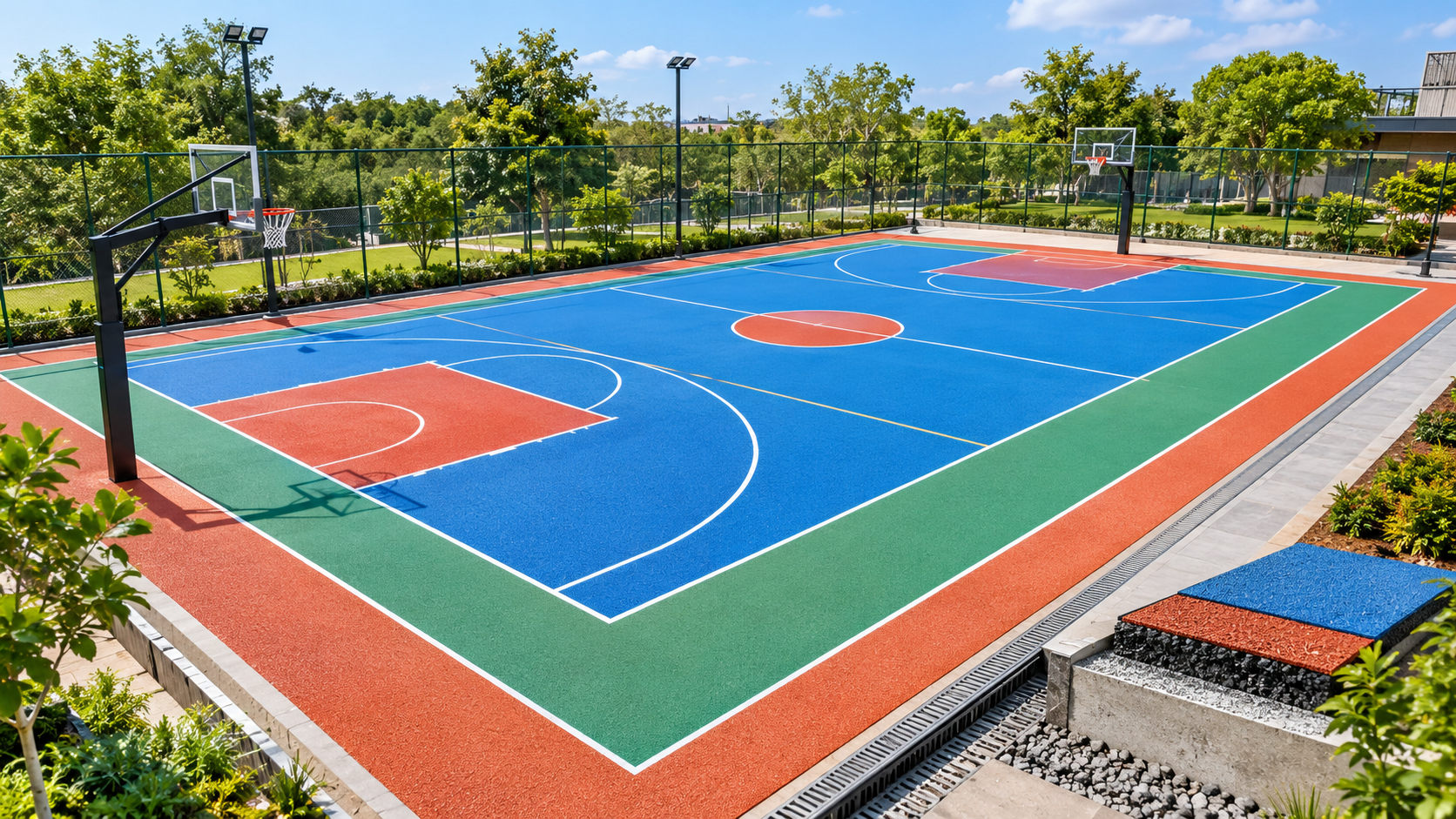
A typical EPDM sports flooring system can include:
- Prepared concrete or asphalt substrate
- Shock-absorbing rubber base layer
- PU bonding layer
- EPDM granule wearing layer
- Optional protective or finishing treatment
The exact construction varies according to the application. A children’s play area, athletic training zone, and high-traffic recreational surface may require different thicknesses and layer configurations.
Why Is EPDM Flooring Used for Sports Areas?
Sports surfaces experience repeated movement, impact, friction, changing weather conditions, and regular cleaning. A suitable floor therefore needs to provide more than a visually attractive finish.
EPDM flooring can offer a combination of:
- Surface resilience
- Comfortable foot contact
- Slip resistance
- Impact attenuation
- Weather resistance
- Colour stability
- Design flexibility
- Low routine maintenance
Its ability to be installed in different colours and patterns also makes it useful for recreational projects where functionality and visual design need to work together.
Key Benefits of EPDM Sports Flooring
1. Improved Surface Comfort
Hard concrete and similar surfaces can feel uncomfortable during prolonged walking, running, jumping, or exercise. EPDM systems provide a resilient surface that offers greater underfoot comfort.
This characteristic is particularly useful in playgrounds, jogging areas, outdoor gyms, and recreational spaces where users remain active for extended periods.
2. Impact-Absorbing Properties
One of the most important characteristics of resilient sports flooring is its ability to absorb a portion of impact energy.
When the system is correctly engineered, its elastic structure can reduce the harsh sensation associated with repeated contact between footwear and a rigid substrate. The degree of shock absorption depends on factors such as system design, thickness, rubber composition, substrate, and installation quality.
For this reason, the flooring specification should be selected according to the intended activity rather than simply choosing the thickest available option.
3. Slip-Resistant Surface
Traction is an essential consideration for active spaces. A properly formulated EPDM surface can provide useful grip under normal conditions.
The texture and aggregate size influence how the surface interacts with footwear. Outdoor areas should also be designed with appropriate drainage because standing water can affect surface conditions regardless of the flooring material.
4. Excellent Colour Options
EPDM granules are available in numerous colours, allowing designers to create functional zones and attractive patterns.
Common choices include:
- Green
- Blue
- Red
- Grey
- Black
- Terracotta
- Yellow
- Orange
- Purple
Multiple colours can be combined to create logos, borders, activity zones, pathways, geometric designs, or children’s play patterns.
5. Weather Resistance
Outdoor sports flooring must tolerate exposure to sunlight, rain, temperature changes, and general environmental conditions.
EPDM rubber is valued for its resistance to weathering and ultraviolet exposure. However, actual service life depends on the quality of the EPDM material, binder, installation, drainage, usage, and maintenance.
A good flooring system should therefore be considered as a complete assembly rather than simply as rubber granules.
6. Durable for High-Use Areas
Sports facilities can experience significant pedestrian traffic. Schools, public parks, academies, fitness centres, and recreational facilities may have hundreds of users over time.
EPDM flooring can provide a durable surface when the appropriate formulation and thickness are selected for the expected level of use.
7. Design Flexibility
EPDM flooring can be used for both practical and decorative purposes.
Different colours and layouts can divide an area into:
- Walking zones
- Running lanes
- Exercise stations
- Children’s activity areas
- Warm-up areas
- Recreational sections
This makes EPDM particularly useful for modern sports and recreation projects where visual planning is part of the overall facility design.
8. Seamless Appearance
Many EPDM systems are installed as continuous surfaces. When properly executed, the finished floor has a relatively uniform appearance without the numerous joints associated with tile-based systems.
A seamless surface can also make routine cleaning easier because there are fewer joint lines where dirt can accumulate.
9. Practical Maintenance
EPDM sports flooring generally does not require complicated day-to-day maintenance.
Routine care commonly includes:
- Removing loose dirt and leaves
- Sweeping or vacuuming where suitable
- Washing the surface with appropriate cleaning methods
- Removing spills promptly
- Checking for damaged sections
- Keeping drainage routes clear
The maintenance procedure should always follow the flooring manufacturer’s recommendations.
Major Applications of EPDM Sports Flooring
EPDM is adaptable to many recreational and sporting environments. Its suitability, however, depends on the required performance characteristics of each application.
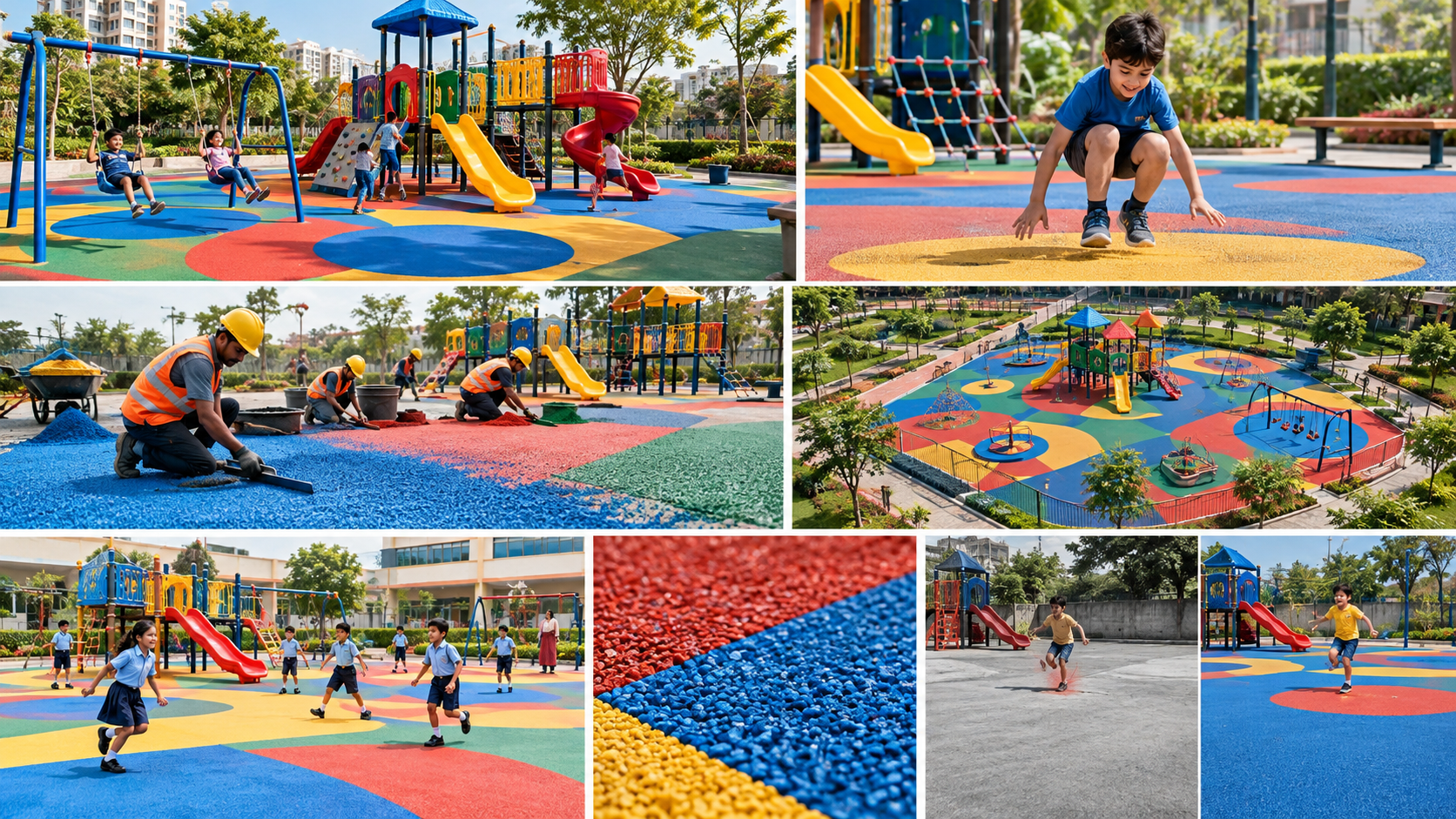
1. Children’s Play Areas
EPDM is frequently selected for playground environments because resilient surfaces can provide a more forgiving surface than bare concrete or other hard substrates.
Colourful designs can also transform a basic play zone into a visually engaging environment.
Depending on the equipment and fall-height requirements, the complete surface system should be designed to meet the applicable safety requirements.
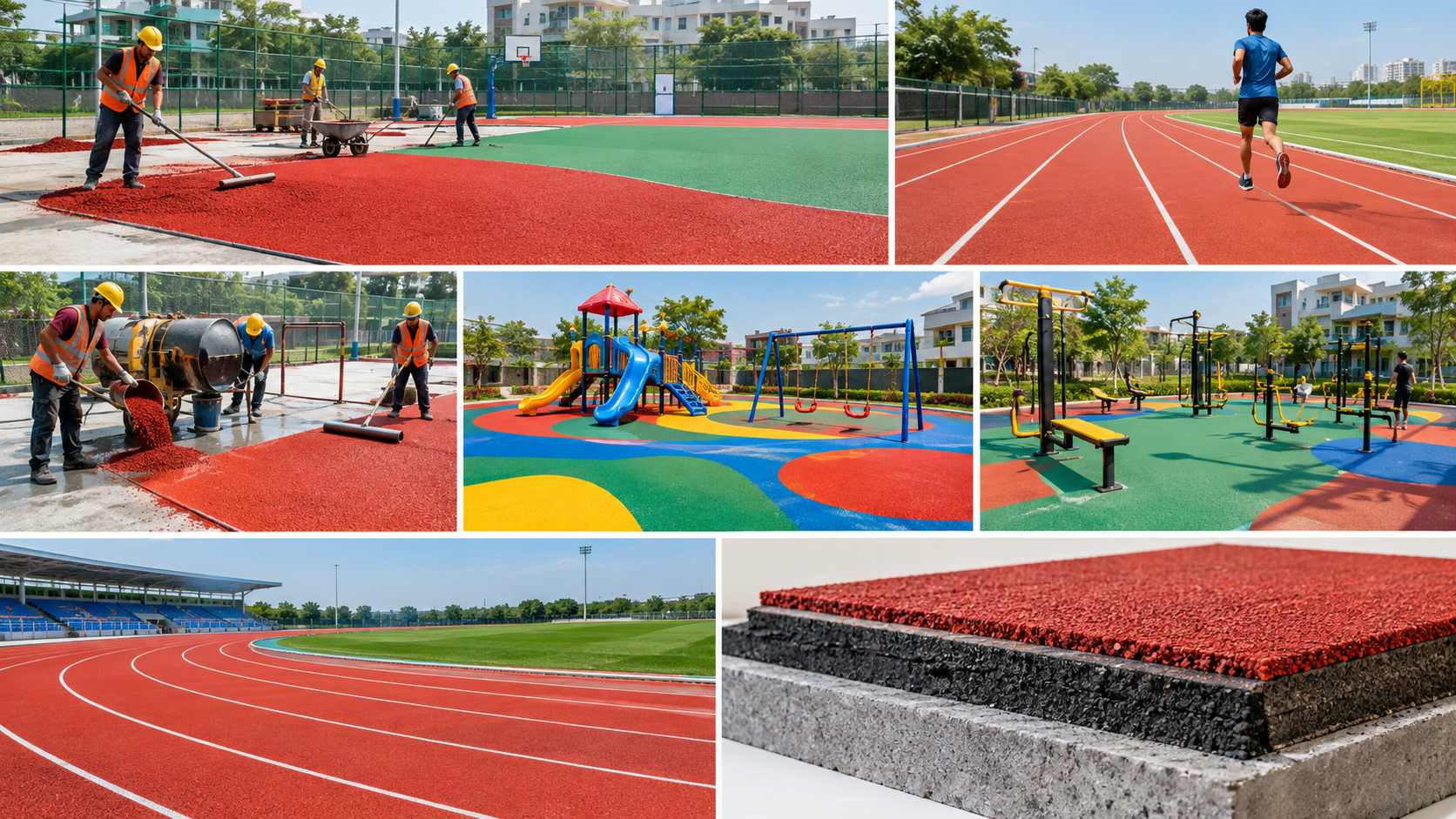
2. Running Tracks and Jogging Paths
EPDM-based surfaces can be used for jogging tracks, walking tracks, school running areas, and recreational pathways.
The resilient character of the material provides a different underfoot experience compared with conventional concrete pathways.
For running tracks, factors such as surface uniformity, drainage, base construction, thickness, and intended running intensity should be considered during specification.
3. Outdoor Fitness Areas
Outdoor gyms require flooring that can withstand regular exercise activity and environmental exposure.
EPDM surfaces can be used around:
- Outdoor fitness equipment
- Functional training zones
- Stretching areas
- Exercise stations
- Community fitness parks
The correct system can create a more comfortable and visually organized exercise environment.
4. School Sports Facilities
Schools often require multipurpose recreational surfaces that can handle daily use by students.
EPDM flooring may be considered for:
- Playgrounds
- Running areas
- Activity zones
- Outdoor exercise areas
- Recreational pathways
- Training spaces
The design should take into account student traffic, sports activities, maintenance resources, and local climatic conditions.
5. Sports Training Areas
Sports academies and training facilities may use resilient flooring in warm-up areas, conditioning zones, and selected outdoor training spaces.
The flooring specification should be matched to the sport because the requirements of a running or fitness zone may differ substantially from those of a specialized court.
6. Multipurpose Recreation Areas
Community parks, residential developments, resorts, and commercial recreation facilities can use EPDM flooring to create attractive multipurpose spaces.
Colour combinations can be used to differentiate activities without constructing separate hard barriers.
7. Walking and Recreation Zones
EPDM surfaces can also be used for pedestrian paths and recreational areas where comfort and visual appearance are priorities.
EPDM Sports Flooring Installation Process
Professional installation is essential because even high-quality materials can perform poorly when the substrate or installation procedure is inadequate.
A typical installation process includes the following stages.
Site Inspection
The project begins with an assessment of the proposed installation area.
The installer generally evaluates:
- Existing substrate
- Surface levels
- Cracks and defects
- Drainage
- Moisture conditions
- Area dimensions
- Accessibility
- Expected usage
- Environmental exposure
This stage helps determine the appropriate flooring system.
Substrate Preparation
The base must be stable, clean, dry, and sufficiently prepared before flooring installation.
Depending on the existing surface, preparation may involve:
- Cleaning
- Grinding
- Levelling
- Repairing cracks
- Filling damaged areas
- Removing loose material
- Correcting surface irregularities
Poor substrate preparation can lead to unevenness, debonding, premature wear, and other problems.
Base Layer Installation
For systems requiring cushioning, a resilient rubber layer may be installed over the prepared substrate.
The base layer contributes to the overall elasticity and shock-attenuation characteristics of the finished system.
The thickness is selected according to the project’s performance requirements rather than using a single thickness for every application.
Binder Application
A suitable PU binder is mixed with the rubber aggregate according to the manufacturer’s specified proportions.
Correct mixing is important because the binder connects the rubber granules and contributes to the mechanical integrity of the surface.
Temperature, humidity, mixing time, material ratios, and working conditions can influence installation quality.
EPDM Wearing Layer
The coloured EPDM granules are installed over the prepared system to form the visible wearing surface.
The material is distributed and compacted to achieve the required thickness and consistency.
Installers need to maintain:
- Uniform thickness
- Consistent density
- Correct surface level
- Proper bonding
- Accurate colour separation
Where decorative designs are required, different colours may be installed according to the approved layout.
Surface Finishing
After installation, the surface is checked for uniformity and finishing quality.
The installer may inspect:
- Surface texture
- Colour consistency
- Thickness
- Level variations
- Edge detailing
- Drainage
- Visible defects
The curing period must also be respected before the facility is opened for use.
Final Quality Inspection
A final inspection verifies that the completed flooring corresponds with the agreed project specification.
Depending on the project, checks may include surface appearance, dimensions, adhesion, thickness, drainage, and general workmanship.
EPDM Flooring Thickness: How Is It Selected?
There is no single thickness that is ideal for every EPDM application.
Thickness is generally influenced by:
- Intended activity
- Required impact absorption
- Fall height where applicable
- Substrate characteristics
- Expected traffic
- Equipment installed above the surface
- Indoor or outdoor location
- Applicable safety or performance standards
For example, a decorative recreational pathway does not necessarily require the same construction as an impact-protection surface beneath playground equipment.
Therefore, thickness should be determined during technical planning rather than selected solely on the basis of price.
EPDM Flooring vs Conventional Concrete
| Feature | EPDM Sports Flooring | Conventional Concrete |
|---|---|---|
| Surface feel | Resilient | Rigid |
| Impact comfort | Higher potential | Limited |
| Colour choices | Extensive | Limited without additional finishes |
| Design flexibility | High | Moderate |
| Outdoor suitability | Yes, with proper system | Yes |
| Maintenance | Relatively straightforward | Straightforward |
| Installation | Requires specialist installation | Conventional construction |
| Sports comfort | Better suited to many active areas | Hard underfoot |
The comparison does not mean EPDM is appropriate for every sports application. The correct flooring depends on the activity, performance specification, substrate, and project budget.
Factors That Affect EPDM Sports Flooring Cost
The final price of an EPDM flooring project can vary considerably. Important cost factors include:
Area Size
Larger installations can change material and labour economics, while small projects may have higher per-square-metre installation costs.
Flooring Thickness
More material and additional cushioning layers can increase the overall project cost.
EPDM Granule Quality
Colour, particle size, material formulation, and product quality can influence pricing.
Base Condition
A damaged or uneven substrate may require additional preparation before installation.
Design Complexity
Simple single-colour installations are generally less complicated than intricate patterns, logos, or multi-colour layouts.
Project Location
Transportation, site accessibility, labour availability, and logistics can influence project pricing.
Drainage Requirements
Outdoor installations may require additional work to establish suitable water drainage.
Project Specifications
Special performance requirements, testing, edge details, safety requirements, or customized systems may affect the overall budget.
For an accurate quotation, the installer should evaluate the site and understand the intended application before providing a final specification.
Maintenance Tips for EPDM Sports Flooring
Regular maintenance can help preserve the appearance and functionality of the surface.
Keep the Surface Clean
Remove leaves, dirt, dust, and other debris regularly.
Avoid Aggressive Chemicals
Strong solvents and unsuitable cleaning chemicals may damage the binder or surface.
Address Spills Quickly
Cleaning spills promptly can reduce staining and surface contamination.
Maintain Drainage
For outdoor areas, drainage channels and surrounding outlets should remain free from blockage.
Inspect the Surface
Regularly check for:
- Loose areas
- Cracks
- Cuts
- Damaged edges
- Surface wear
- Drainage problems
Control Heavy Loads
Unnecessary movement of heavy equipment across resilient flooring can cause localized damage.
Use Professional Repairs
Damaged sections should be assessed and repaired using compatible materials rather than applying random patching compounds.
How to Choose an EPDM Sports Flooring Contractor
Choosing an installer is as important as choosing the flooring material.
Before starting a project, consider whether the contractor can provide:
- Site assessment
The contractor should understand the existing substrate and project environment. - Technical specification
The flooring system should be clearly defined, including layers, thickness, materials, and intended use. - Quality materials
EPDM granules and PU binders should come from reliable sources. - Experienced installation team
Installation quality directly influences the finished surface. - Proper substrate preparation
A high-quality top layer cannot compensate for an unsuitable base. - Project-specific recommendations
The contractor should recommend a system according to actual usage rather than offering the same specification for every project. - After-installation support
Maintenance guidance and repair support can be useful throughout the flooring’s service life.
Common Mistakes to Avoid
Several installation decisions can reduce the performance of an EPDM sports surface.
Choosing Flooring Only on Price
The lowest initial quotation may not represent the lowest long-term cost. Material quality, system thickness, substrate preparation, and installation standards should be considered together.
Ignoring Drainage
Outdoor rubber flooring requires suitable drainage planning. Persistent water accumulation can negatively affect the surrounding construction and flooring system.
Installing Over an Unprepared Base
Uneven, contaminated, unstable, or excessively damp substrates can cause installation problems.
Selecting the Wrong Thickness
The required thickness should reflect the actual use and applicable performance requirements.
Using Incompatible Binders
EPDM granules should be installed using a binder system designed for the application. Material compatibility is essential.
Opening the Area Too Soon
The installed surface needs sufficient curing time. Premature use can affect the finish and bonding.
Frequently Asked Questions
Is EPDM flooring suitable for outdoor sports areas?
Yes. EPDM is commonly used in outdoor recreational and sports environments because the material can provide resilience and good resistance to normal environmental exposure when the complete system is correctly designed.
How long does EPDM sports flooring last?
Service life varies according to material quality, thickness, installation, traffic, climate, maintenance, and usage intensity. A properly specified and maintained system can provide long-term service, but manufacturers’ technical data should be consulted for project-specific expectations.
Is EPDM flooring waterproof?
EPDM rubber itself has good resistance to water, but the performance of an installed flooring system also depends on the substrate, joints, drainage design, binder system, and surrounding construction. Outdoor installations should always include appropriate drainage planning.
Can EPDM flooring be customized?
Yes. Different EPDM colours can be combined to create patterns, activity zones, borders, logos, and decorative designs.
Can EPDM be installed over concrete?
Yes, provided the concrete substrate is structurally suitable and properly prepared. Moisture, cracks, level variations, contamination, and surface condition should be evaluated before installation.
Is EPDM flooring suitable for playgrounds?
EPDM systems are widely used in playground environments, but the required construction must be selected according to the equipment, fall heights, impact attenuation requirements, and applicable safety standards.
Does EPDM require regular maintenance?
Yes, although routine maintenance is generally manageable. Regular cleaning, inspection, drainage maintenance, and prompt repair of damage can help preserve the surface.
Can EPDM flooring be repaired?
Localized damage can often be repaired using compatible materials and appropriate preparation. The repair method depends on the type and extent of damage.
Conclusion
EPDM sports flooring provides a practical combination of resilience, comfort, traction, weather resistance, colour flexibility, and durability for a wide range of recreational and sporting environments.
Its applications extend beyond traditional sports spaces to playgrounds, jogging tracks, outdoor gyms, school recreation areas, community parks, training zones, and multipurpose facilities.
However, the performance of an EPDM surface depends on much more than the rubber granules used on top. Substrate preparation, system design, rubber quality, binder selection, thickness, drainage, installation workmanship, and ongoing maintenance all contribute to the final result.
For any new EPDM sports flooring project, the best approach is to begin with a site assessment and determine the performance requirements before selecting the flooring specification. A properly designed and professionally installed system can provide a durable, comfortable, and visually appealing surface for active environments.